A large province in central China is vying for talent, and this time it is not relying solely on its provincial capital.
"Guarantee every Hunan native who works hard in the Greater Bay Area has a job to go to on October 8." During this year's National Day holiday, the frequent night high-speed trains departing from Changsha South Railway Station to Guangzhou sparked extensive discussions on social media.
This is a direct reflection of the close ties between the two regions, but the flip side of the coin is the massive outflow of Hunan's population. A widely circulated joke that was once cited by Hunan's local government goes: "Every Hunan native born will later become a Guangdong resident."
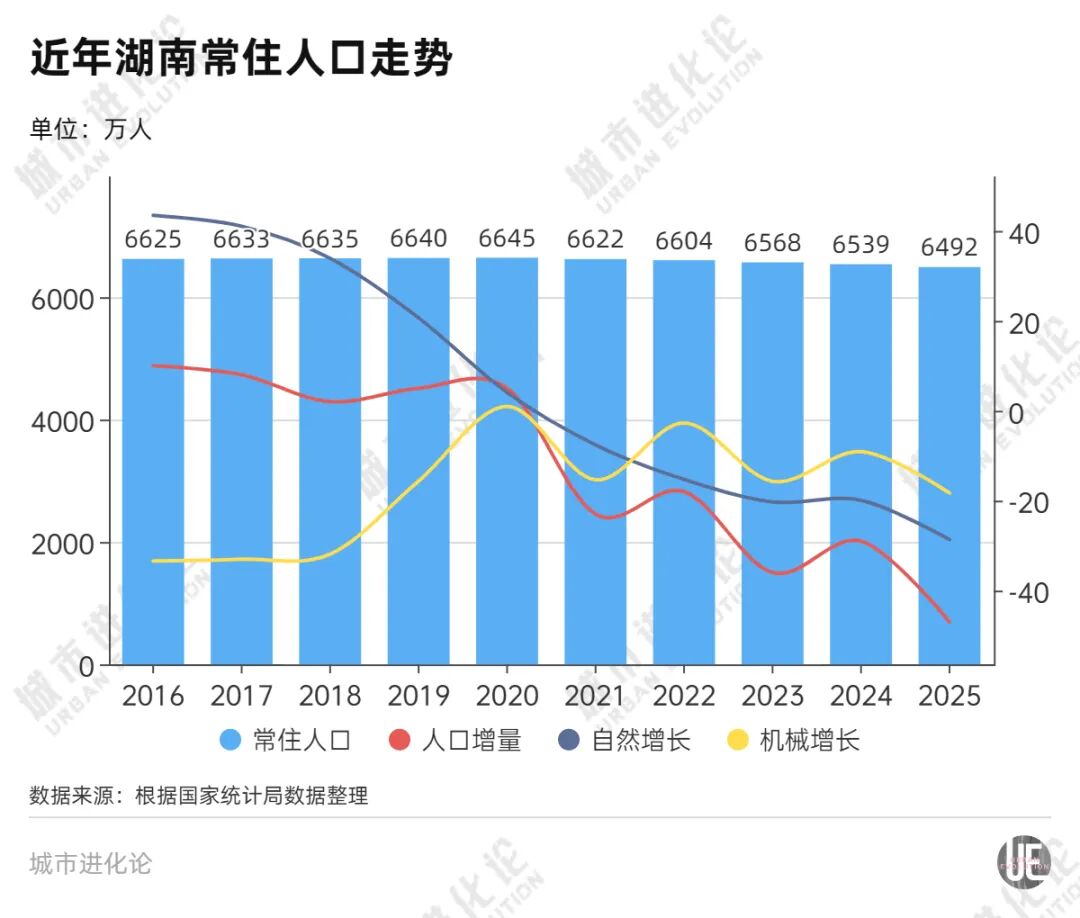
By the end of 2025, Hunan's permanent resident population stood at 64.92 million, a decrease of 470,000 from the previous year, the largest reduction among all 31 provincial-level administrative regions, marking the fifth consecutive year of negative population growth.
Recently, five departments including Hunan Provincial Department of Housing and Urban-Rural Development jointly issued the "Interim Implementation Opinions on Further Improving the 'One Room' Housing Security Work for College Students and Young Talents Who Choose to Stay in or Come to Hunan for Entrepreneurship", proposing that by the end of 2026, Changsha, Zhuzhou, Xiangtan, Yueyang and Hengyang will provide two years of rent-free accommodation for eligible college students and young talents who stay in or come to Hunan to start businesses; by the end of 2027, all other prefecture-level cities and prefectures will fully launch this policy.
What is unusual is that this time it is not Changsha playing a solo role, but five cities "team up" to take the lead, and the policy will soon be rolled out across the whole province. The effort to retain talents starts with the free "one room" benefit.
01 Population Outflow
Hunan and Guangdong are neighbors. Over the past decades, the Beijing-Hong Kong-Macao Expressway, Beijing-Guangzhou Railway and Wuhan-Guangzhou High-speed Railway run through the north and south, drastically shortening the spatiotemporal distance between the two regions. For this reason, the most mainstream choice for Hunan's inter-provincial migrant population is to "go south", and Shenzhen is even playfully called Hunan's "second provincial capital".
How large is this "southbound army"? Not long ago, the Guangdong Office of Hunan Provincial Government released a set of data ——
"According to our research and statistics, there are about more than 13 million Hunan natives and second-generation Hunan residents permanently living in the Guangdong-Hong Kong-Macao Greater Bay Area, accounting for one-tenth of Guangdong's permanent resident population and one-fifth of Hunan's total permanent resident population, with a scale second only to the native population in Hunan. In addition, more than 5 million floating population from Hunan work in Guangdong, accounting for more than half of the total number of Hunan's inter-provincial migrant workers."
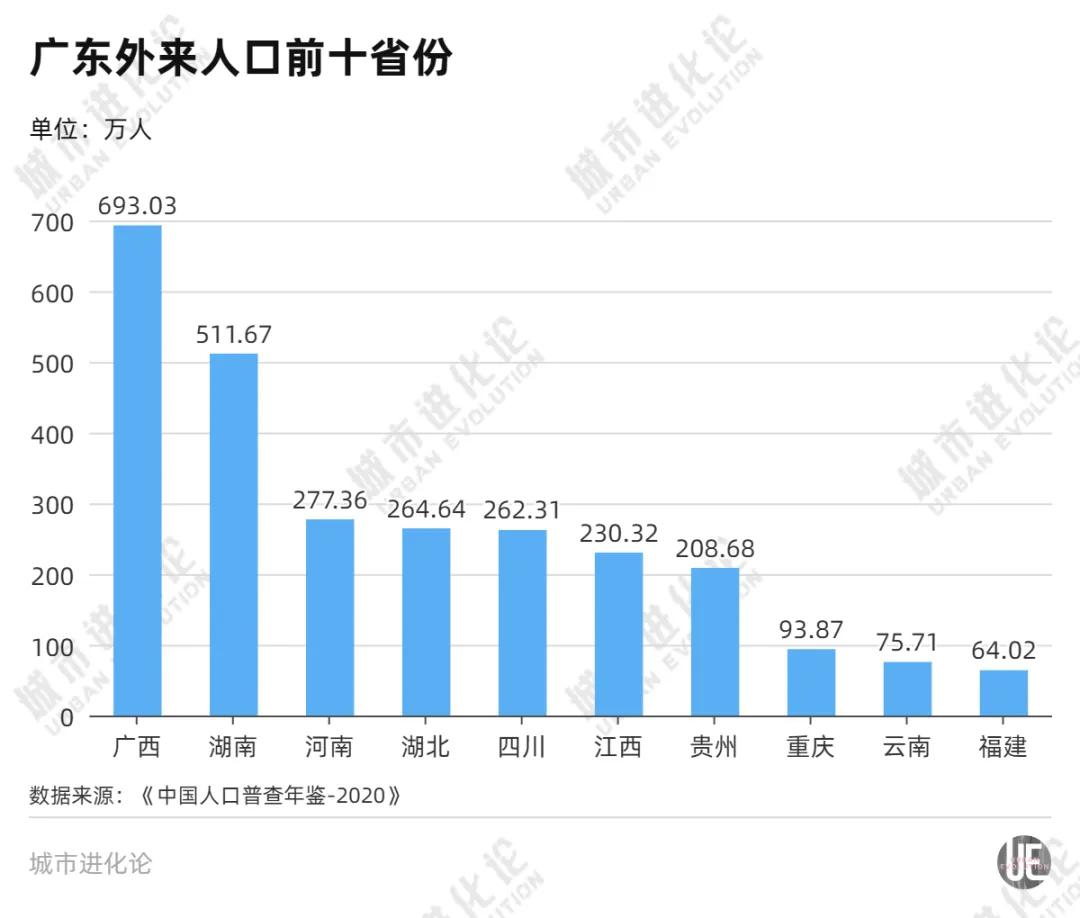
According to the data of the 7th National Population Census, Hunan's inter-provincial outflow population reached 8.0411 million, of which 5.1167 million flowed into Guangdong, accounting for more than 60%; on the other hand, among the 29.6221 million inter-provincial inflow population in Guangdong, people with Hunan household registration account for 17.3%, making Hunan the second largest source of inflow population after Guangxi (6.9303 million).
While the population flows out, the natural population growth of Hunan has also turned negative in recent years. Under the dual pressure, Hunan's total population dropped from 66.45 million at the peak in 2020 to 64.92 million in 2025, with a cumulative decrease of about 1.53 million in five years.
The talent-related signals are also not optimistic. Hunan has 147 regular higher education institutions, including 3 985 universities, with more than 2 million enrolled college students, ranking among the top across the country.
Data released by Hunan Provincial Department of Education shows that the retention rate of Hunan's 2023 college graduates in the province is 57.29%, and nearly 20% of them flow to Guangdong. In comparison, Anhui, which is also located in central China, had a local retention rate of 71% for its 2023 college graduates.
Reflected in the population structure, by the end of 2025, the proportion of permanent residents aged 0-15 and 16-59 in Hunan was 17.17% and 58.10% respectively, down 0.89 and 0.35 percentage points from the previous year; the proportion of population aged 60 and above increased by 1.2 percentage points to 24.72%, marking that Hunan has entered a moderately aging society.
Against this backdrop, Hunan is elevating the "retaining young people" initiative to a provincial-level strategy.
"Whoever has young people will have the future." During this year's National Two Sessions, Hunan's local government stated that it will build a youth-friendly province, vigorously implement the four "friendliness" actions covering friendly employment, friendly entrepreneurship, friendly life and friendly growth, and strive to attract young people from all over the country and even the whole world to start businesses and find jobs in Hunan.
As an important supporting policy, Hunan's "Implementation Opinions on Building a Youth-Friendly Province" (hereinafter referred to as the Opinions) proposes to provide diversified housing options, including "one bed", "one room" and "one apartment".
Now that Hunan has arranged for Changsha, Zhuzhou, Xiangtan, Yueyang and Hengyang to provide two years of rent-free accommodation for eligible college students and young talents who stay in or come to Hunan for entrepreneurship, it means that the strategy has entered the implementation phase. The latest policy also clarifies that "units with lagging work and poor implementation will be interviewed, held accountable and ordered to rectify within a time limit", which fully demonstrates the high priority Hunan attaches to this work.
02 Five Cities Team Up
It is worth noting that in addition to the provincial capital Changsha, Zhuzhou, Xiangtan, Yueyang and Hengyang are also explicitly named in the policy.
It is not hard to find that Zhuzhou and Xiangtan are both part of the Changsha-Zhuzhou-Xiangtan Metropolitan Area, while Yueyang and Hengyang are the two provincial sub-central cities. Why do these five cities take the lead in implementing the policy?
This is largely related to Hunan's population distribution pattern. Like many other central and western provinces, against the backdrop of overall negative population growth across the province, the provincial capital city still maintains remarkable growth relying on its advantages in resources and industries.
Statistics show that over the past five years, while Hunan's total permanent resident population continued to decline, Changsha's permanent resident population increased from 10.0608 million at the end of 2020 to 10.7214 million at the end of 2025, with a cumulative increase of 660,600. In 2025, Hunan's total permanent resident population decreased by 470,000, while Changsha achieved a counter-trend growth of 104,900 in the same period.
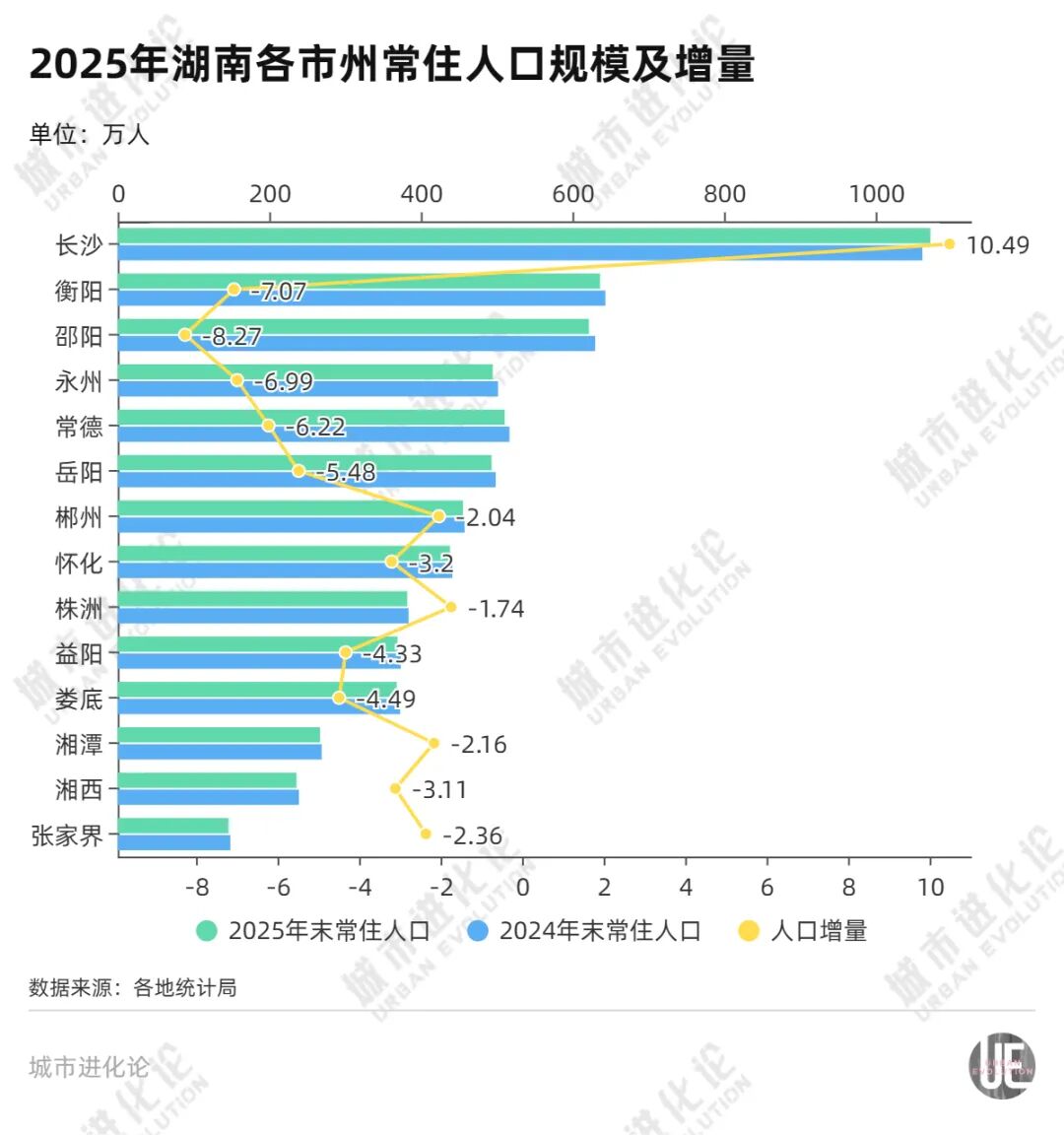
In sharp contrast, other prefecture-level cities including Zhuzhou and Xiangtan have all fallen into negative population growth. In 2025, the permanent resident population of Hengyang, Yueyang, Zhuzhou and Xiangtan was 6.3636 million, 4.9327 million, 3.8204 million and 2.6702 million respectively, decreasing by 70,700, 54,800, 17,400 and 21,600 respectively compared with the previous year.
In other words, Hunan's population has formed a pattern of "single-pole growth in the provincial capital". The population inflow from other prefecture-level cities in the province has always been an important source of Changsha's population growth, which also puts surrounding cities under continuous pressure of population outflow.
This trend emerged as early as the 13th Five-Year Plan period. Huang Liu from the Party School of Xiangtan Municipal Committee of the Communist Party of China previously pointed out in the paper "Analysis on 'Shrinking' or 'Expanding' of Hunan's Cities Based on Permanent Resident Population Data" that among the 14 prefecture-level cities in Hunan, only Changsha is a net population inflow area, and all other prefecture-level cities are net population outflow areas; in particular, the objective existence of Changsha's population agglomeration effect and Hunan's overall high aging rate further increase the shrinking risk of small and medium-sized cities.
Now, Hunan arranges for the five cities to team up to "compete for talents" collectively, aiming to change the pattern of the ebb and flow within the province. These five cities have the highest population and economic density in Hunan. If the five cities can take the lead in stabilizing their development, the downward trend of Hunan's total population, especially the outflow trend of working-age population, is expected to be reversed.
Since the beginning of this year, the five cities have spared no effort in the campaign to "attract young people" ——
In April, Xiangtan High-tech Zone held a press conference for the action plan of building a youth-friendly park, to "support employment with industries"; in May, Hengyang held a high-profile talent strengthening conference, proposing to make every effort to recruit college graduates, with a plan to introduce more than 10,000 people every year; in August, Yueyang issued the "Three-Year Action Plan for Promoting High-quality and Full Employment and Building Yueyang as a Major Employment Growth Pole (2026-2028)", targeting that by the end of 2028, the retention rate of Yueyang-native graduates in Yueyang will be no less than 40%, and more than 8,000 young talents of various types will be attracted to come to or return to Yueyang for employment every year.
Multiple cities have taken successive actions, with the core goal of enabling more young people to settle down and find jobs.
03 How to Retain Talents
Whether it is population flow or talent introduction and cultivation, it is highly correlated with economic development and industrial development.
The newly released Hunan's economic "Q3 report" shows that the province's gross domestic product in the first three quarters reached 4.160666 trillion yuan, a year-on-year increase of 2.8%, 0.1 percentage points higher than that in the first half of the year, but still significantly lower than the national average (4.6%), which is unlikely to close the gap with Anhui.
In the first half of this year, Anhui, which has been catching up with Hunan for years, recorded a GDP of 2.737 trillion yuan, surpassing Hunan for the first time and ranking among the top 10 provincial-level regions in China.
Previously, Tang Zhijun, a professor at Hunan University of Science and Technology and economic scholar, became widely known across the internet for his article "What Should Hunan Do". He pointed out directly in the article that Hunan is not experiencing a "normal cyclical adjustment", but is being gradually left behind by its competitors in the structural regional competition, which has drawn widespread attention.
Hunan has been accelerating its transformation. The outline of Hunan's 15th Five-Year Plan mentions that it is necessary to accelerate revolutionary technological breakthroughs, innovative allocation of factors and in-depth industrial transformation and upgrading, so as to open the "second curve" of industrial economic growth.
Image source: 58pic_501311192
It specifically emphasizes that Hunan will seize new industrial tracks such as solid-state batteries, green hydrogen energy, advanced nuclear energy, bio-manufacturing and embodied intelligence, establish a mechanism for steady growth of investment in future industries and risk sharing, and strive to build a pilot zone for future industries.
With the direction set, the implementation is launched immediately. Just a few days ago, Hunan held a symposium on promoting the development of the province's hydrogen energy industry, making it clear that based on its advantages in geographical conditions, policy support, industrial foundation, technical base and application scenarios, hydrogen energy will be taken as the key field and main direction of future industrial development.
At present, Hunan has been included in the comprehensive hydrogen energy application pilot of the Guangdong-Hong Kong-Macao Greater Bay Area urban agglomeration, initially building a whole industrial chain covering "production - storage - transportation - refueling - application". The three leading equipment manufacturing enterprises CRRC, Sany and Zoomlion have also extended their business layout in the hydrogen energy sector.
This is a direct manifestation of Hunan accelerating industrial transformation, and the "team-up" of provincial cities to attract young people is a re-matching of industrial structure and talent structure.
The above Opinions have clear arrangements for this: support employment with industries, build a number of advantageous industrial clusters, and develop and integrate about 200,000 jobs for young people every year; promote the employment of college graduates oriented by the matching of supply and demand, and actively add majors that are urgently needed for industrial development.
Various signs show that Hunan is trying to build a full-cycle closed loop covering the whole process of talent "introduction, cultivation, utilization, retention and service", and carry out talent work in the same way as building industrial chains.
The housing security from "one bed" to "one room" solves the problem of whether young people are willing to come or not; but whether they can be retained in the long run ultimately depends on the thickness of local industries.
This article is from WeChat Official Account "Urban Evolution Theory", written by DAN Zhongkui, published with authorization from 36Kr.