ChatGPT has cracked a 26-year-old conjecture, thousands of mathematicians declare war on AI, and the mathematics community is completely torn apart.
The entire mathematical community has been thrown into total chaos!
Mathematicians who have reigned over the high ground of human logic for thousands of years are feeling the chill of an existential threat for the very first time.
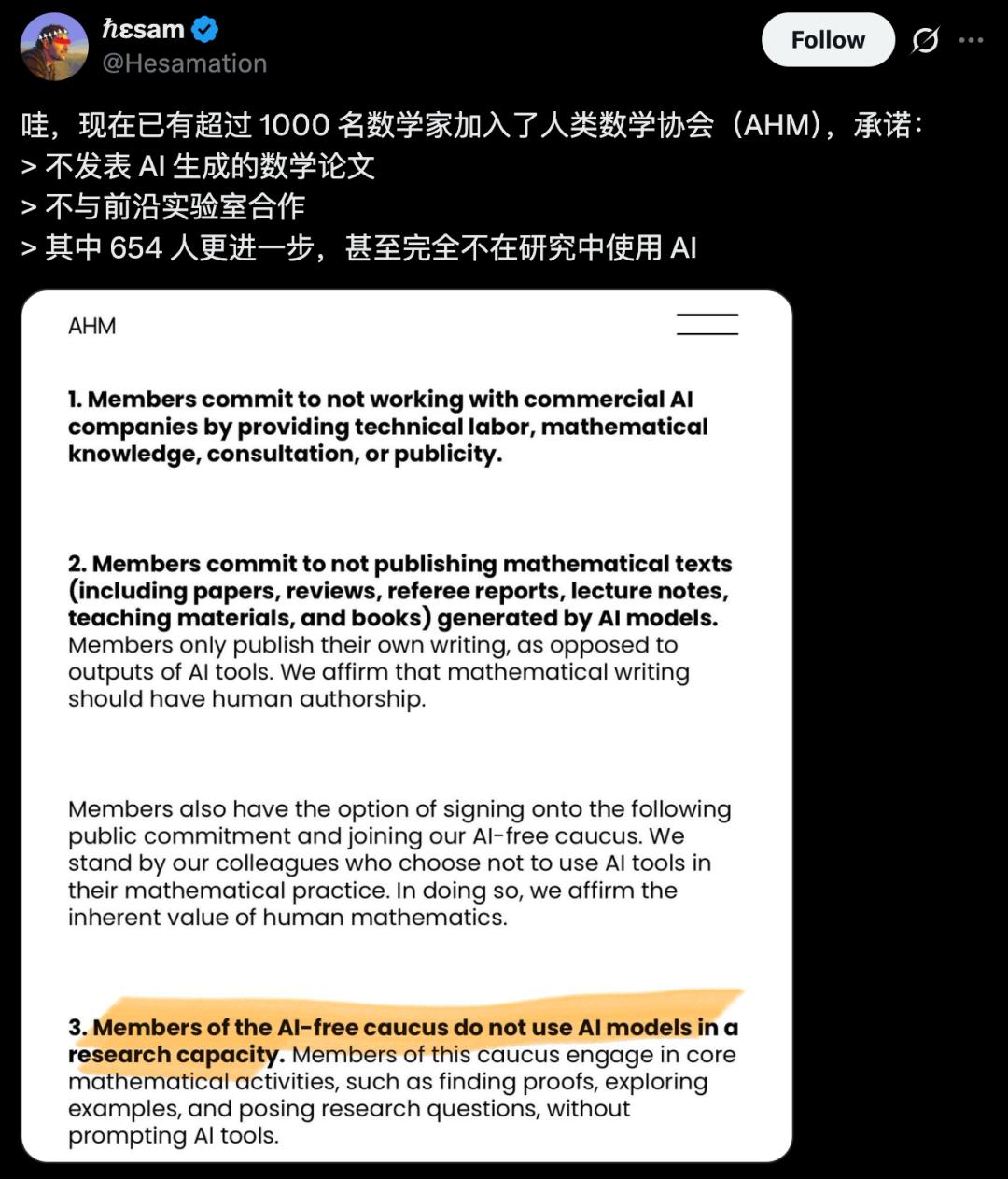
Just in the past couple of days, mathematics departments at top universities across the globe have launched a massive, collective rebellion.
Up to this moment, a full 1008 mathematicians worldwide have signed a joint open letter to join a newly established organization — the Alliance of Human Mathematicians (AHM).
The signature list alone stretches so long that you cannot scroll to the end at a single glance.
They have made a solemn pledge here: from this day forward, they will not contribute any effort to commercial AI, nor will they ever publish any mathematical paper written by AI!
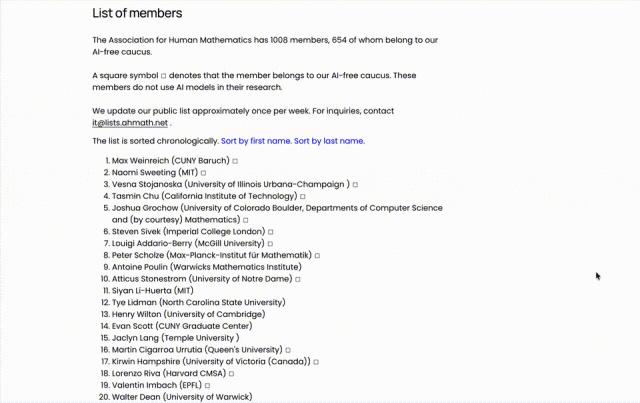
What is even more staggering is that 654 top scholars have joined the internal "AI-Free Core Group", and have publicly vowed to the whole world —
In their future daily scientific research, whether they are searching for proof ideas, identifying counterexamples, or proposing new research topics, they will not use any AI at all, 100% of the time.
Even Terence Tao, a Fields Medal laureate, personally shared the statement.
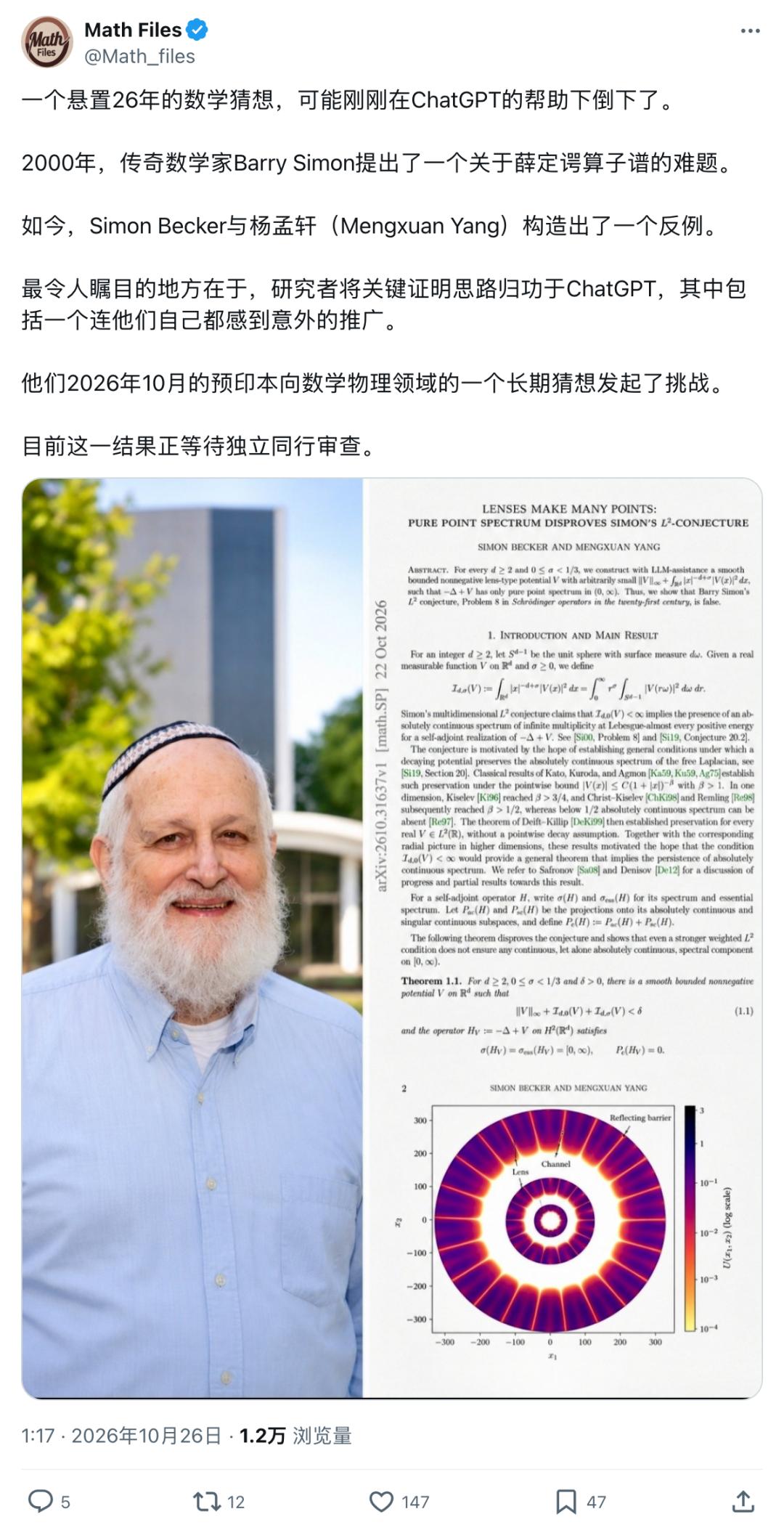
On arXiv in the same week, the 26-year-old Barry Simon conjecture was completely disproven. ChatGPT, which pushed the counterexample parameters to the extreme, even surprised the two human authors of the related paper.
Terence Tao Used Claude to Revise OpenAI Manuscripts, Sparking Fierce Debate in the Comment Section
Earlier this month, OpenAI released more than 700 manuscripts overnight, which became the trigger for all these events.
At that time, OpenAI tested roughly 4000 unsolved problems, spent 3 hours of ChatGPT Pro's reasoning computing power on each result, and released 719 manuscripts in one go.
These manuscripts are classified into 372 problem families, and around 42% of them come with Lean formal verification. While they are logically valid, the accompanying natural language proofs are obscure and fragmented, with a large number of previous scholarly references missing.
Facing these semi-finished works, four scholars including Abhinav Nellore and Johannes Schmitt set up an open-source GitHub repository named oai-math-revised.
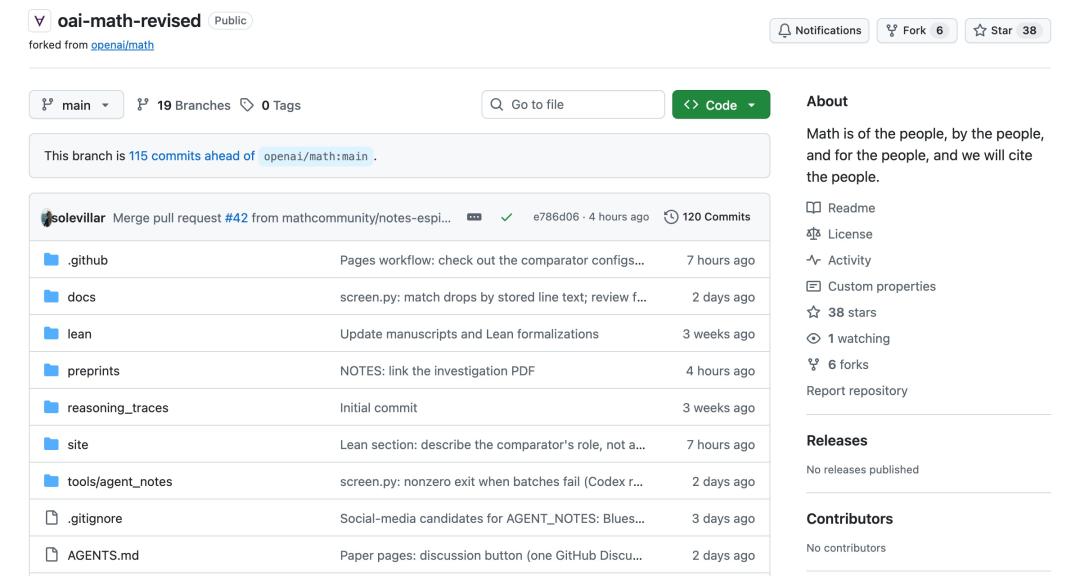
On October 24, Terence Tao published the joint article of the four scholars on his blog. The article invited peers from all over the world to submit pull requests, to complete the missing references and rewrite the derivation processes for these AI-generated manuscripts.
A very dramatic detail is hidden in the repository's commit history. As early as a few days before the repository was made public, Terence Tao, whose account name is teorth, had already started working on it quietly.
He submitted the 2nd and 3rd pull requests in succession for the No. 003 "Landau-Siegel Zero Uniform Exclusion Problem", a number theory challenge related to the uniformity of prime number distribution.
What no one expected was that Terence Tao used Claude Code (Opus 5.5) to draft both of these revisions.
After verifying the content for accuracy, he changed the author field of the manuscript to "OpenAI (with community contributions)", and supplemented the complete reference context of Banks, Green, and his own previous work in one go.
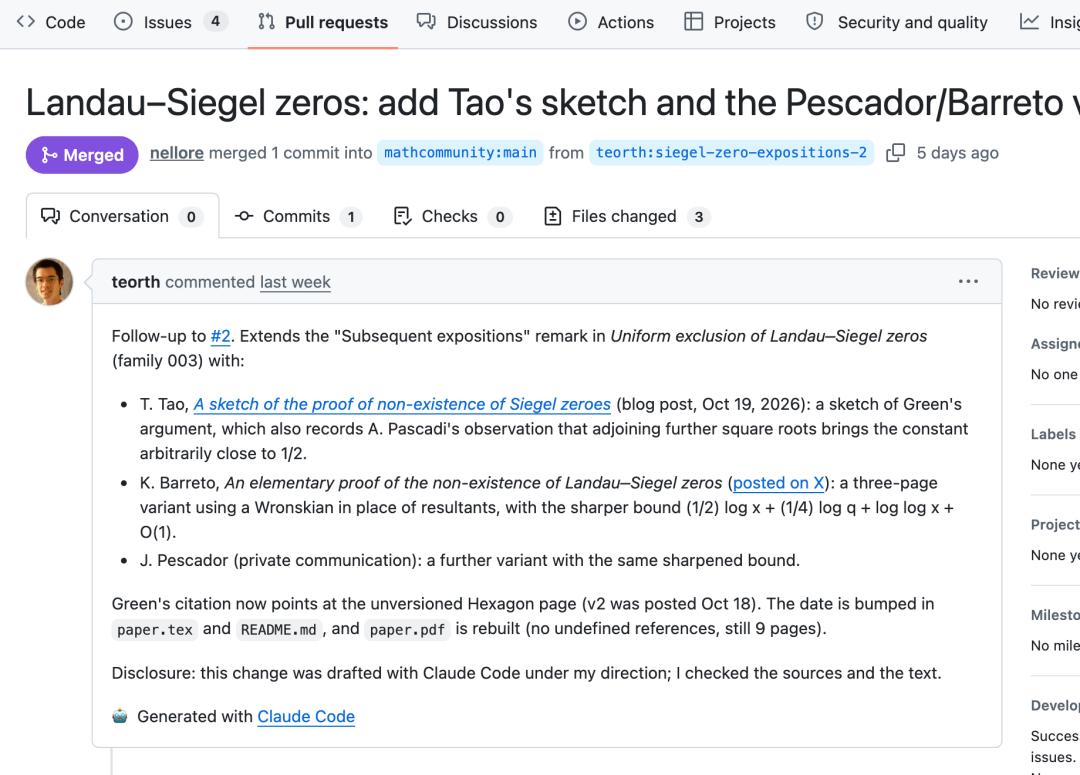
As of October 25, 8 out of the 13 revision records in this repository are marked as being drafted with the assistance of Claude Code.
A human mathematician used the AI coding tool of one company to patch the AI-generated mathematical papers of another commercial giant. This has become one of the most absurd scenes in the mathematical community this autumn.
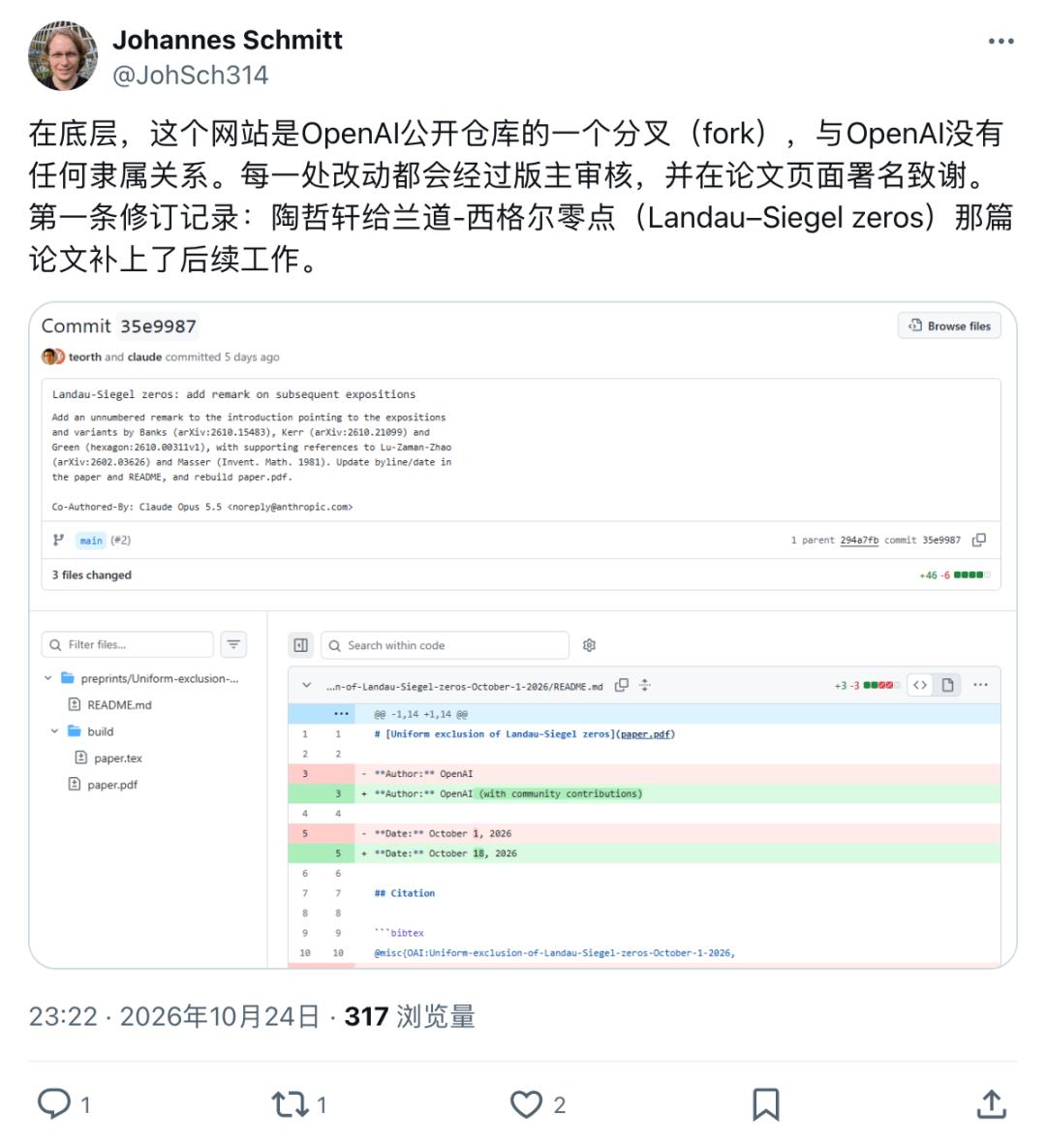
This recruitment post sparked direct confrontations in the comment section of Terence Tao's blog, and 21 long comments quickly split into two opposing camps.
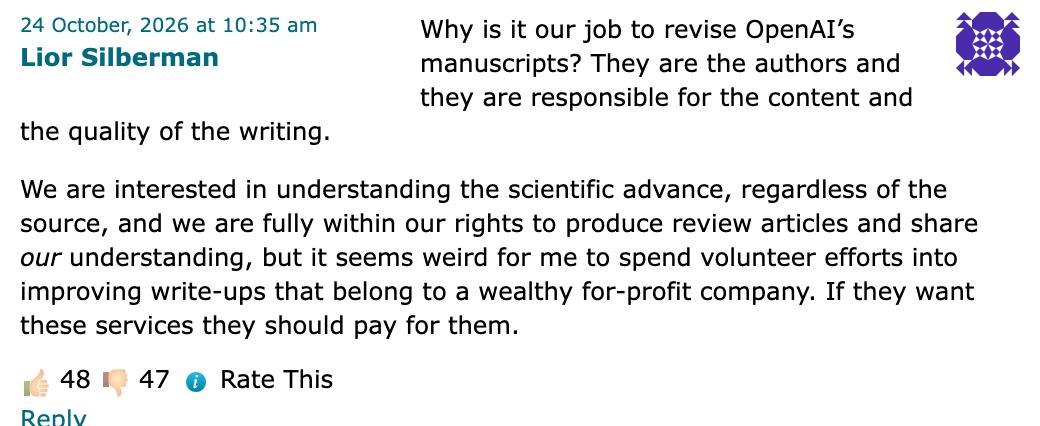
Lior Silberman, a mathematics professor at the University of British Columbia, holds a clear stance. He stated bluntly that since OpenAI is listed as the author of these manuscripts, organizing references and writing clear proofs should be the authors' own inherent responsibility.
In his view, if commercial companies want the academic community to provide peer review and polishing services, they should pay the market rate for such work. There is no reason for scholars to work as free volunteers.
Commenter Skip Tich pointed out the underlying calculation about training data. He noted that the high-quality proofs revised for free by peers will immediately be absorbed into the next-generation model training set.
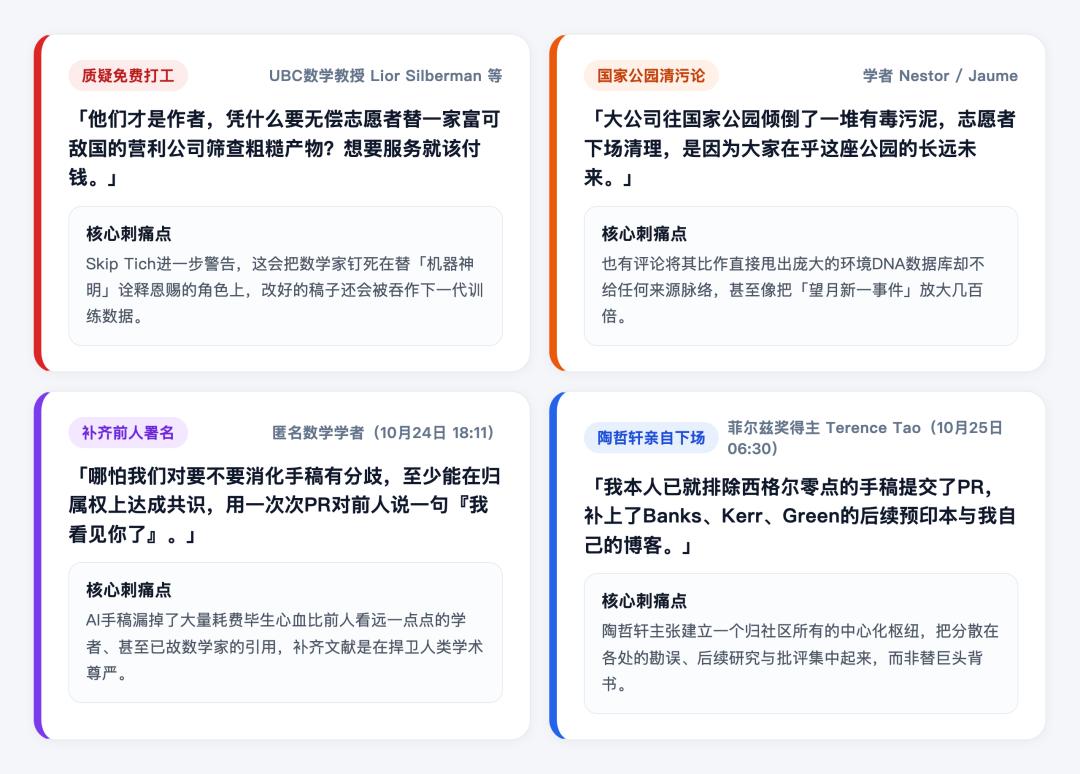
Scholars who supported the revision work also put forward their heavy, justifiable reasons.
Commenter Nestor drew an analogy: a multinational giant dumped toxic sludge in a national park. Even though the pollution is not the fault of volunteers, if no one steps in to clean it up, the entire academic ecosystem will be damaged.
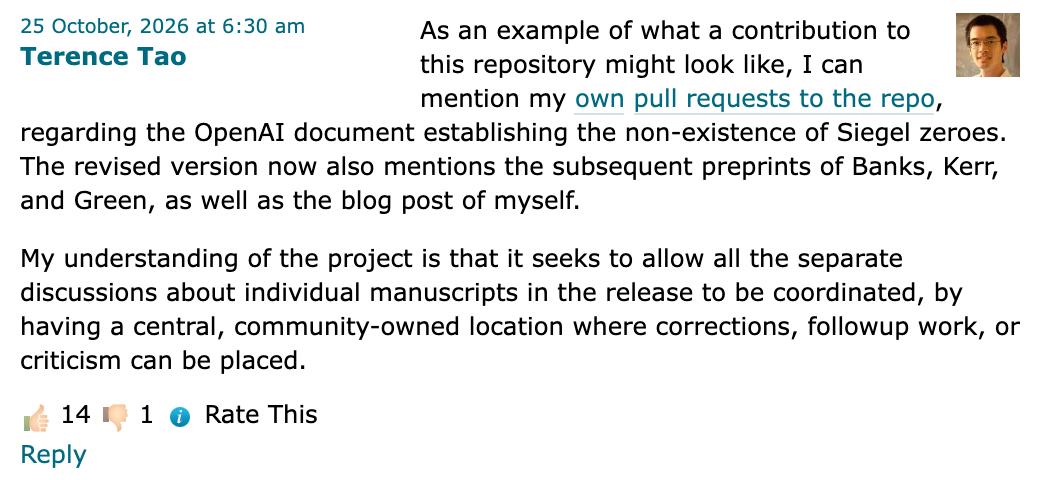
Facing the doubts, Terence Tao personally wrote a reply on the morning of October 25, taking his own commit that supplemented the Siegel zero reference context as an example.
He stated that this repository is built to create a public, community-controlled hub for the academic community, so that scattered error corrections, follow-up research and critical voices can be gathered in one centralized place.
Even with the Fields Medal laureate stepping in personally to calm the debate, the rift over whether humans should clean up the mess for commercial models is growing wider and wider.
1008 Mathematicians Publicly Cut Ties, 654 Commit to Full AI Abstinence
It is precisely because they refuse to become free labor cleaning up the mess for commercial giants that thousands of mathematicians have chosen to build a clear barrier directly.
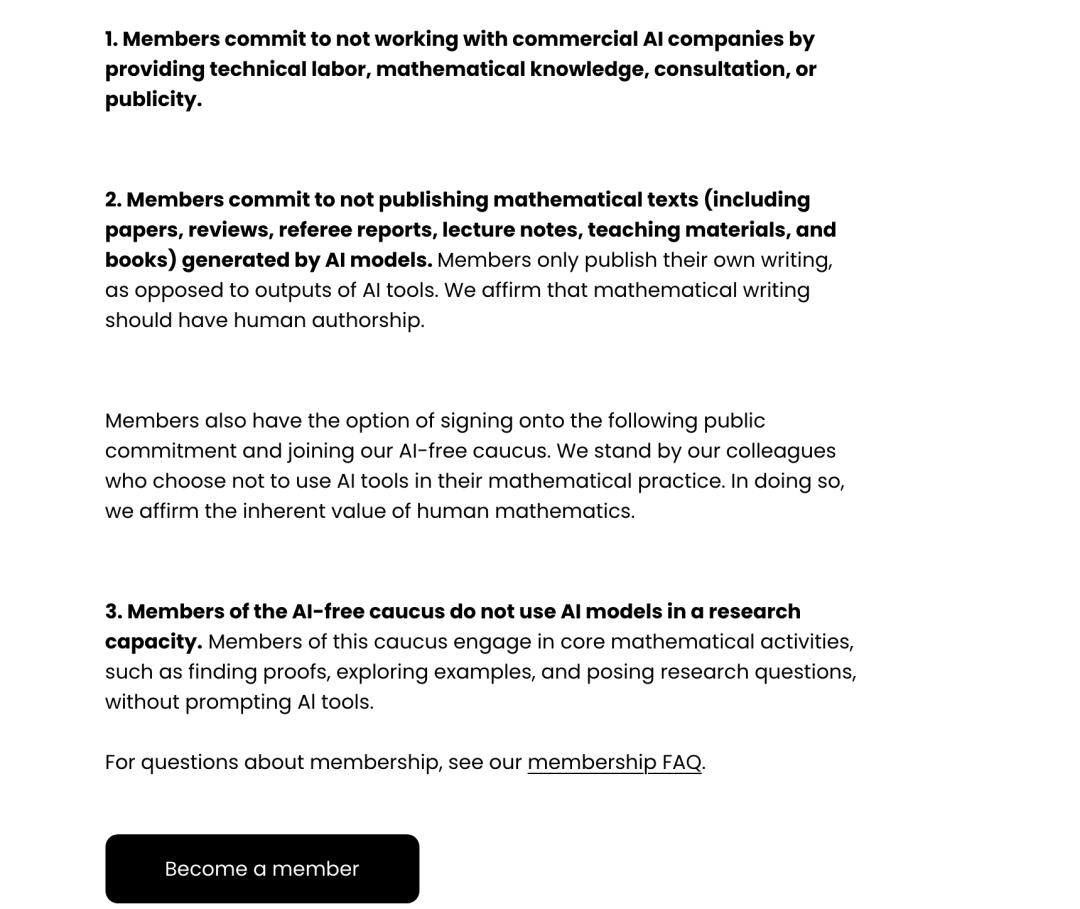
As of October 25, the newly established Alliance of Human Mathematicians (abbreviated as AHM) has over 1008 real-name members, all of whom have signed two core commitments.
The first is to not provide labor, consulting or promotion services for any automated mathematical commercial entity. The second is to never include any AI-generated text in their signed academic works.
654 of them have further joined the internal "AI-Free Faction" of the association. They promise to completely avoid using AI in the entire research process, including searching for proofs, exploring calculation examples, and even proposing new problems.
OpenAI Pushed Global Mathematicians to Rebel
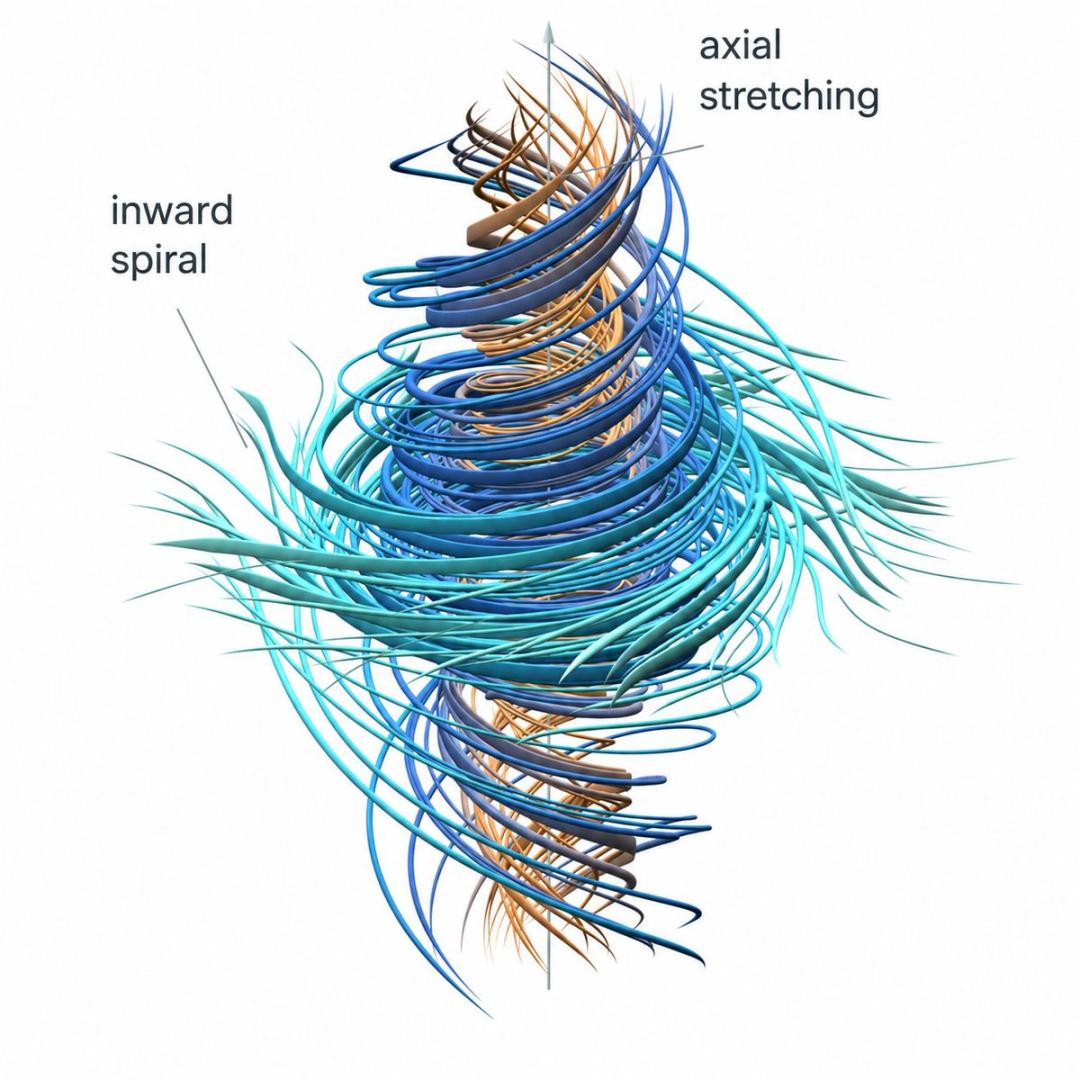
The trigger that pushed these thousands of mathematicians to publicly cut ties was the previous high-profile controversy where OpenAI claimed to have solved the Navier-Stokes equations, one of the seven Millennium Prize Problems.
At that time, a mathematician input an unpublished manuscript into ChatGPT for polishing. OpenAI then mobilized about 10,000 Agents to run concurrently for 88 hours, generating a massive proof that even experts found extremely difficult to verify.
This computing power spectacle was later packaged as a landmark event where AI broke through a million-dollar prize problem, which ignited the anger of the academic community.
The association made its stance clear in its first statement, pointing directly at the recent intensive publicity campaigns of commercial giants, saying they "only demonstrate computing power hegemony, and have nothing to do with rigorous academic research".
The statement criticized that the giants are trying to replace human understanding with an opaque statistical black box, turning mathematicians into "verification technicians" who only put their stamps on outputs generated by machines.
Three days later, the association's journal working group issued a call to all major mathematics journals: if AI is used in the peer review process, authors must be notified first, and no one can feed unpublished manuscripts to commercial models behind the authors' backs.
This open letter signed by thousands of people was soon mocked by the AI industry.
Tech blogger Hesamation used chess grandmaster Magnus Carlsen as an example, claiming that mathematicians refusing to use AI is as absurd as chess players refusing to use chess engines for game review.
26-Year-Old Conjecture Disproven, ChatGPT Deserves Full Credit
However, to completely abstain from using AI today, mathematicians have to pay a far heavier price than just giving up a polishing tool.
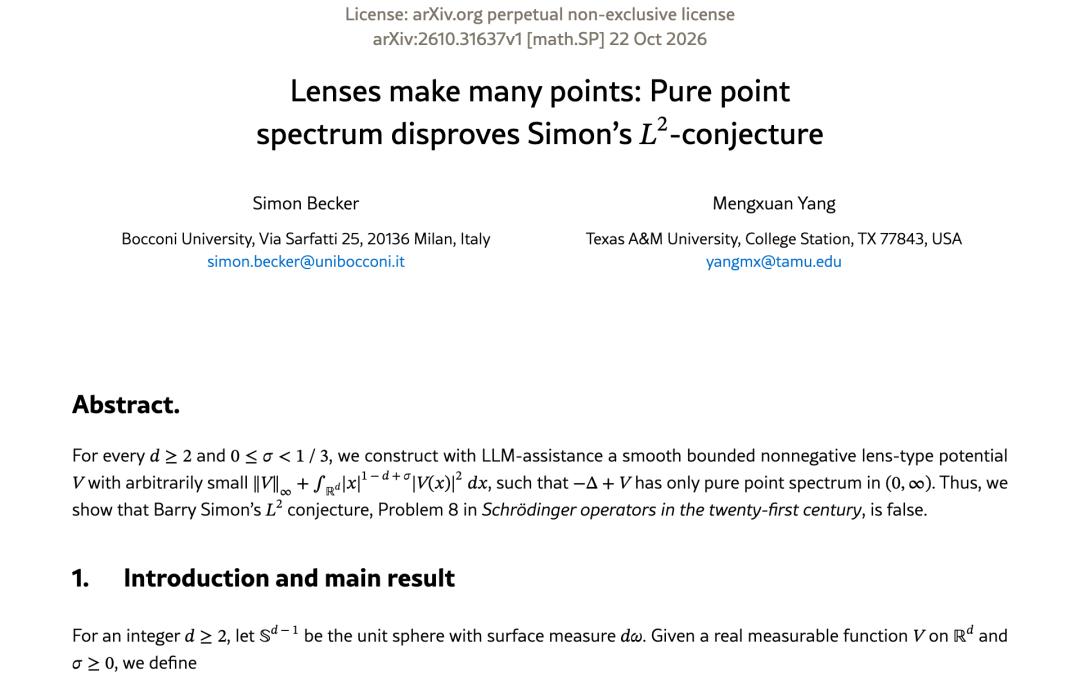
On October 22, Simon Becker from Bocconi University and Yang Mengxuan from Texas A&M University uploaded a paper on arXiv.
This paper disproved the "multi-dimensional L2 conjecture" put forward by Barry Simon, a giant in mathematical physics, in 2000.
This 26-year-old unsolved problem originates from the Schrödinger operator in quantum mechanics. The "spectrum" of the operator determines whether particles can scatter freely to infinity (absolutely continuous spectrum) or are trapped in a local area (pure point spectrum).
In three-dimensional and higher-dimensional spaces, the particle scattering channels are far wider than a one-dimensional straight line.
Barry Simon conjectured back then that as long as the square-integrable integral of the spherical surface in high-dimensional space remains finite, the absolutely continuous spectrum will definitely be preserved on the positive half-axis. In other words, particles will not be completely trapped.
For 26 years, countless mathematical physicists have been stuck at the geometric obstacle that it is impossible to block all escape angles in high-dimensional space.
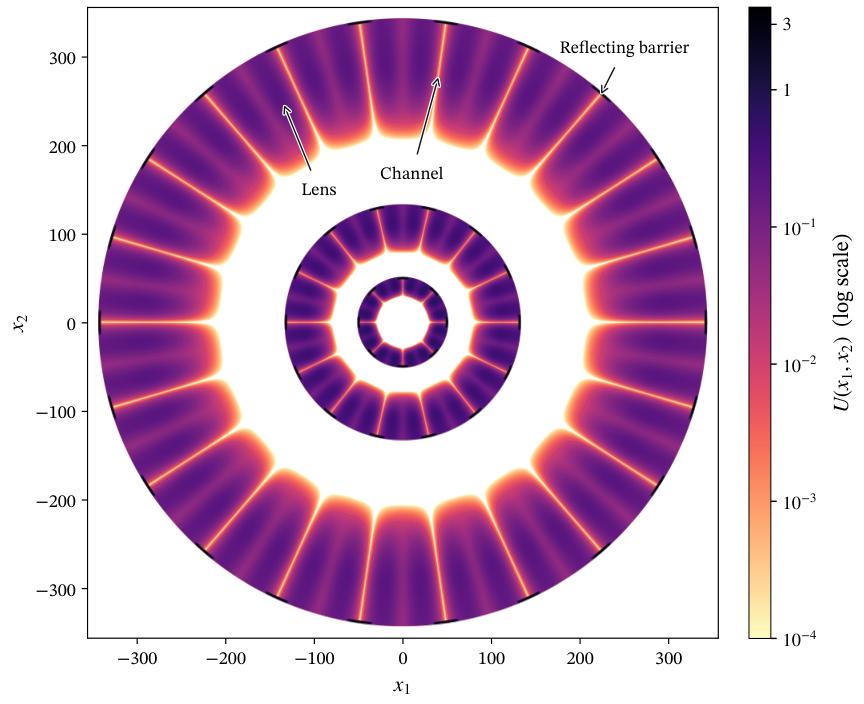
The construction of the 3D spherical shell counterexample: each spherical shell contains a lens area that focuses wave packets, a narrow-angle channel, and a periodic reflecting barrier
The two authors specifically reserved a section in the paper to explain the whole process of how they and ChatGPT broke through the conjecture in three steps.
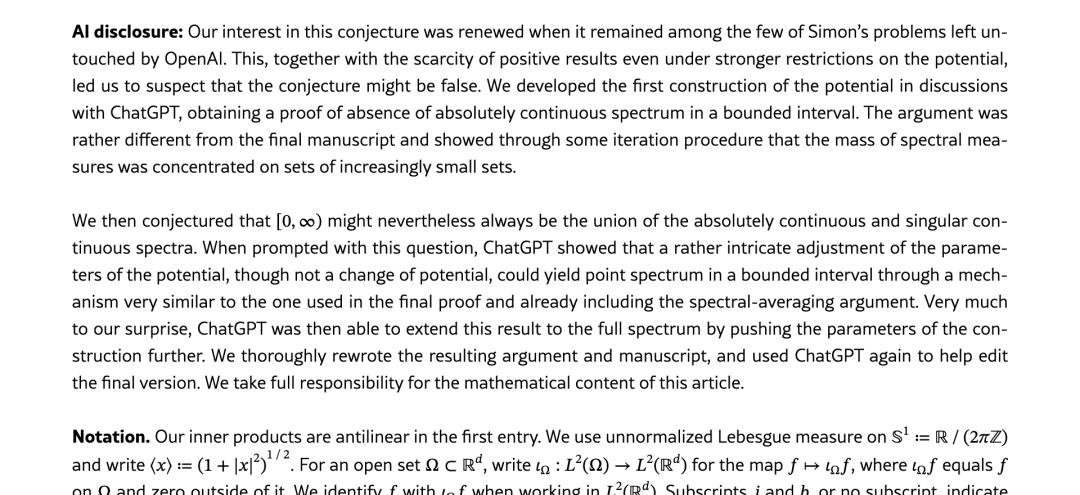
In the first step, the two authors checked the 719 manuscripts released by OpenAI and found that this problem had not been claimed, so they cooperated with ChatGPT to design the concentric spherical shell potential function.
This construction uses weak angular