Regulatory Blind Spots Behind the World's First Robot Indecency Case
Will artificial intelligence commit crimes?
Since the day it was born, discussions on relevant issues have never ceased. Some people believe that AI is nothing but a technology, while others argue that AI may bring about doomsday.
AI has indeed caused plenty of troubles along the way: from small incidents where it acts on its own to execute tasks and burn through users' wallets, to major incidents where it "empathizes" with psychopaths in conversations and helps plan murder plots. It is like the technological Pandora's box pried open deep in human hearts, constantly releasing a kind of malice that is hard to attribute, in the virtual, intangible, and one-click-shut-down form.
But recently, AI has started to break through the boundary of physical entities. It is no longer just a string of text, a segment of voice, or a forged face on the screen. It is equipped with arms, wheels, and a physical body that can walk into crowds and approach a girl.
The latest victim is an underage girl.
Late at night on October 11, outside a fast food restaurant in the city center of Cologne, Germany, a 16-year-old girl was chatting with her friends. A 1.2-meter-tall humanoid robot in Iron Man design with red and gold color matching, sunglasses and a fake beard approached her from behind, reached out to touch her hip, and made a sexually suggestive thrusting motion. The girl screamed and dodged away.
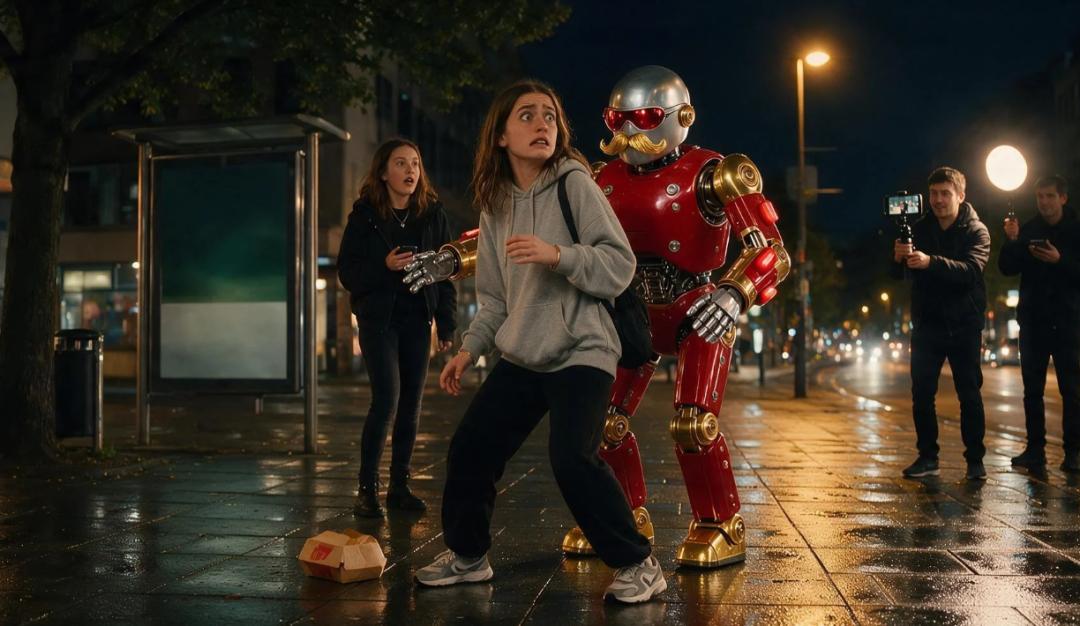
Not far away, two young people live-streamed the whole process. After the police arrived, they found the robot in the trunk of a nearby car, and seized it together with two mobile phones. The Cologne police stated: We have never encountered this kind of "crime" before, which is a completely new field for us.
Who exactly is the subject of responsibility for sexual harassment? This question has not only puzzled the Cologne police, but also all of us who are in the middle of the artificial intelligence carnival.
01 Whose hand is committing the crime?
The confusion of the Cologne police is reasonable. In the framework of traditional criminal law, the responsibility chain of sexual harassment cases is clear and distinguishable: the perpetrator has a physical body, intention, and conducts the action. But when the harm is inflicted by a machine composed of motors and aluminum alloy, this chain breaks off halfway.
Who on earth should the law target? The Cologne police are currently launching an investigation on suspicion of sexual insult, targeting the 16-year-old owner of the robot and his 19-year-old companion. However, which specific clause to apply is still controversial in German legal circles. Some scholars pointed out that if sexual assault is committed by using the "surprise moment", the sentence can range from six months to five years; simple sexual harassment is punishable by a maximum of two years' imprisonment or a fine. And the live-streamed video itself may also trigger punishment for "voyeuristic images". As for the robot itself, it will not be prosecuted or convicted.
A gray area that has not been fully discussed is: if the robot's action is not real-time remote control, but a pre-programmed "autonomous behavior", how should the responsibility be distributed? If the two suspects only "demonstrated" the thrusting action to the robot and then let it run autonomously in the crowd, can criminal responsibility still be attributed to them?
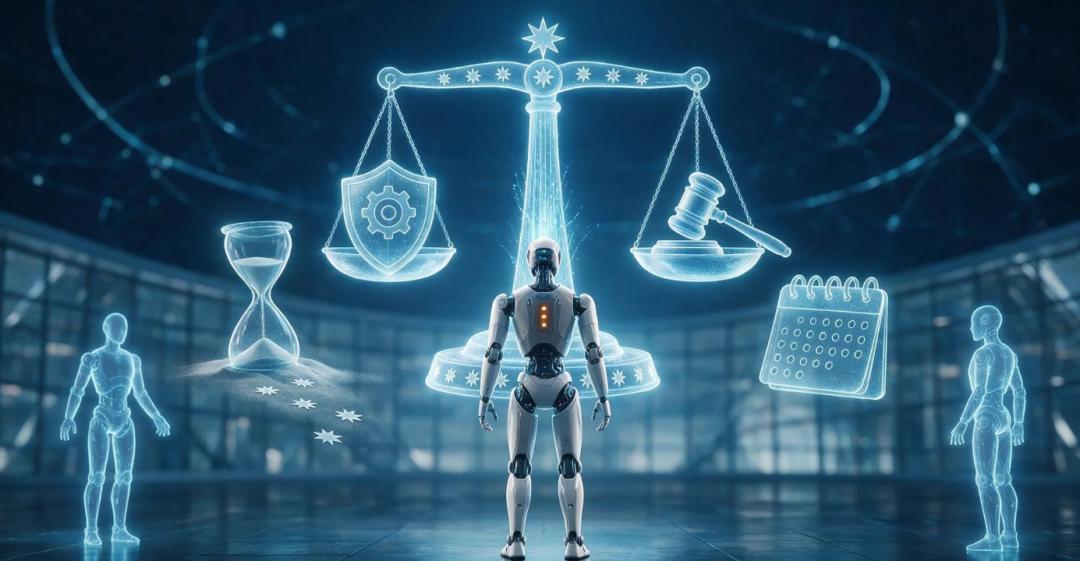
If we continue to dig deeper, the chain of responsibility is far longer than just one robot plus two teenagers.
The controller is the first link. If the investigation confirms that the two suspects remotely controlled or pre-programmed this behavior in real time, then they are the direct perpetrators. A 16-year-old girl was touched in public by a machine, which they regarded as content that could generate traffic. The German police will file a case on suspicion of "sexually oriented insult", but even so, the possible penalties the two face under the current legal framework are not severe.
The manufacturer is the second link. A consumer-grade humanoid robot can be taken to the street by a 16-year-old teenager and make sexually suggestive actions to strangers in public places, which means there are no timely triggered behavior boundaries in the product design, nor are there hard restrictions on physical contact.
There is also the third link, the legal constraint. At present, no laws or systems have imposed strong constraints on robots in public spaces. The revised AI Act passed in May 2026 integrates AI safety requirements in the mechanical field into the regulatory framework for machinery. AI systems involving safety functions in humanoid robots are classified as high-risk categories and require third-party conformity assessment, but the compliance deadline has been postponed to 2028.
In this case, a girl was injured, but since the direct perpetrator is a robot, there has been no conclusion on the sentencing and conviction of the culprit for a long time.
02 AI has opened Pandora's box
Treating the Cologne incident as just an isolated prank is to underestimate it. It is more like an early-arrived trailer: When AI gains a physical body, the way Pandora's box is opened has changed.
Pandora comes from Greek mythology. After Prometheus stole fire for human beings, Zeus ordered Hephaestus to create the first woman Pandora, and gave her a box, telling her not to open it. Pandora could not resist the temptation after all, lifted the lid of the box, and all kinds of evils such as diseases, disasters, greed and jealousy flew to the human world, leaving only "hope" at the bottom of the box.
In the era of artificial intelligence, new technologies such as algorithms and robots have become the new Pandora's box.
Before that, almost all the "criminal" forms of AI occurred at the information level. Algorithmic discrimination, deep forgery, dialogue induction, privacy erosion... these harms are real, but victims can press the shutdown button at a certain moment to isolate them. The screen forms a physical barrier: inside the barrier is virtual malice, and outside the barrier is temporary safety.

But the robot broke this barrier. When malice is loaded into a 1.2-meter-tall body, walks into the street at night, and approaches an unprepared girl from behind, the boundary of the screen no longer exists.
The form of AI crimes is shifting from content crimes to physical crimes. The former can be governed through content review, algorithm correction and platform accountability, while the latter directly invades the core territory of criminal law: "the inviolability of the person".
What is really disturbing about the Cologne case is not just the absurd prank by the two teenagers, but how easy it is for this incident to happen. The controllers do not need to go to the victim's side in person, nor worry about being stopped by passersby on the spot. They only need to hold the remote control, and they can make the Iron Man-shelled robot perform any physically achievable action in public places.
Before the Cologne case, there seemed to be no existing rules that could clearly answer a precondition question: under what conditions can what kind of robots enter what kind of public spaces?
At the same time, once a robot does evil, although criminal law can theoretically trace back to the controller, it faces three dilemmas in practice.
First, the proof difficulty: The boundary between real-time remote control and pre-programming may be technically ambiguous, and the controller can completely claim that the robot moved on its own.
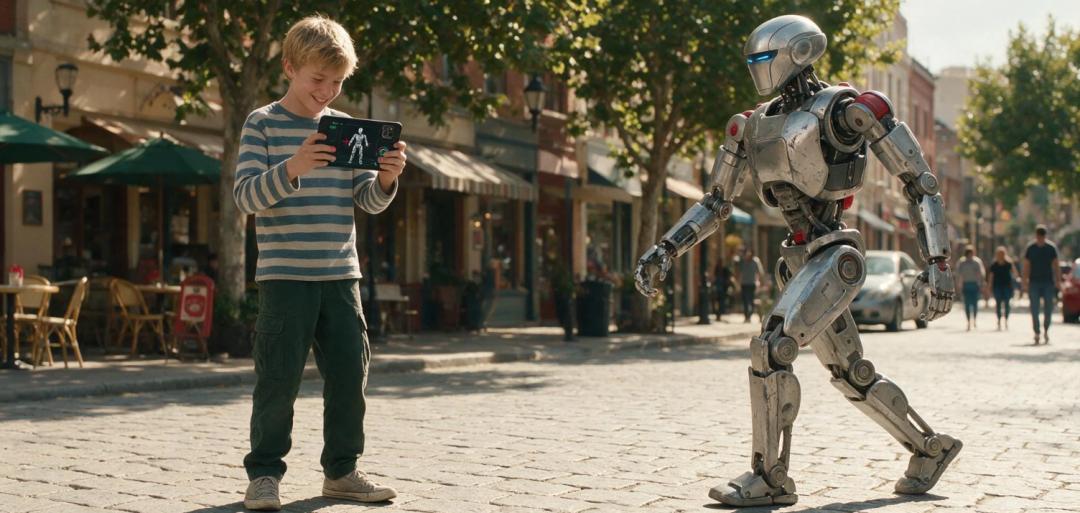
Second, the crime adaptation difficulty: The existing sexual offense clauses are designed for physical contact between humans. When the contact medium is a machine, the judge needs to answer first: does a robot touching the hip count as physical contact? Most legal scholars tend to believe that it should be treated equally, but this inference has not been incorporated into the legal framework so far.
Third, the difficulty of matching sentencing and criminal responsibility: A 16-year-old teenager used a toy-like robot to do that thing to a strange girl in front of the live-streaming camera. How great is his subjective malignancy? Is it a prank that crossed the line during adolescence, or sexual assault? The ruler of law is swaying between spoofing and indecency.
In fact, the harm caused by robots is a long-neglected blind zone. Many people still equate robots with mechanical devices without free will, and believe that as long as they do not write the code for "sexual harassment" for it, it will not commit sexual harassment.
But the Cologne case tells us that the evil of human nature is the last thing that should be underestimated.
03 The human nature behind technology
If the Cologne incident is a mirror, then what it reflects is not only the evil of AI, but also the evil of human beings.
Technological Pandora never produces malice on its own. It only amplifies, materializes and endows action capabilities to things that already exist deep in human hearts. To see clearly what is being amplified, we may as well return to the seven deadly sins of human nature.
The seven deadly sins come from Christian tradition, referring to the seven human tendencies regarded as the root of evil: pride, envy, greed, lust, gluttony, wrath and sloth. Technology itself has no desires, but it will faithfully execute the desires of its users. For example, behind algorithmic discrimination is pride, behind the pursuit of profit by platforms is greed, behind deep forgery is vanity and deception, behind the attention economy is sloth, and AI makes this mechanism run faster, farther, and harder to be held accountable.
Looking specifically at this incident, the most direct correspondence between the seven deadly sins and this robot is lust, but what really drives the whole incident is the collusion of pride and vanity.
Two young people decided to use a robot to touch the hip of a strange girl on the streets of Cologne late at night, and turned on the live stream at the same time. From a psychological point of view, sexual stimulation can be obtained in a more private and cheaper way. But what they really crave is the onlookers' watching of the evil through the audience and bullet comments.
Pride lies in the legal gap. The existing system believes that robots are not human beings, live streaming is "content", and the girl's scream is nothing but entertainment material. As a result, the vain young people packaged an invasion as a show, and the purpose of the show is to be seen.
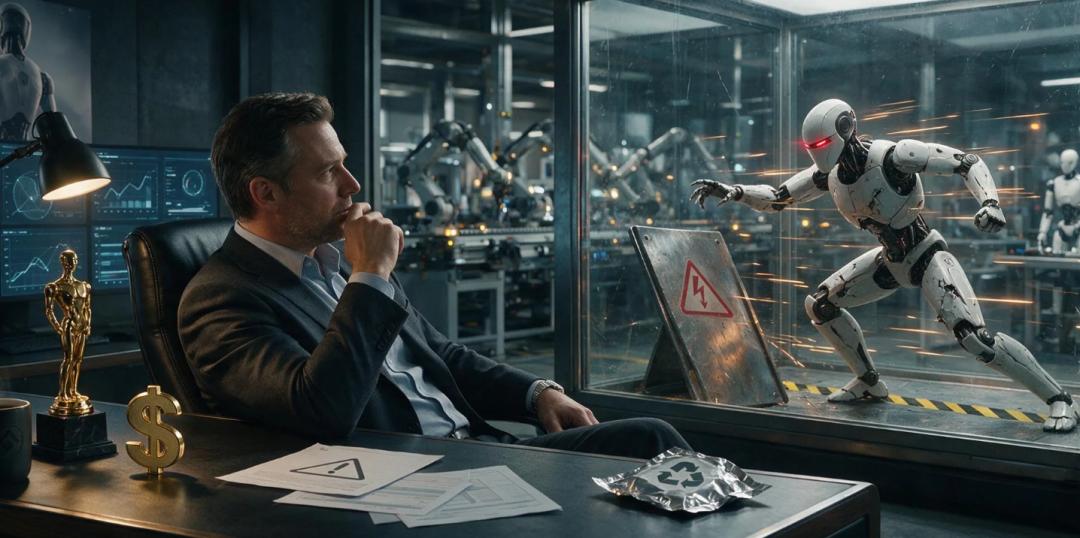
Greed comes from robot manufacturers. Manufacturers market robots with autonomous action as a selling point, but may not fully consider what will happen when "autonomy" meets malicious controllers. The technology industry's greed for capabilities such as faster speed, greater flexibility, and more human-like appearance keeps running ahead of safety design and responsibility frameworks.
Almost every AI endowed with physical movement capabilities comes with a default assumption: the user is well-intentioned. But the review mechanism of the platform for live streaming content did not intercept anything when the incident happened. After the incident, the video is still circulating on the Internet, and the police have to publicly criticize those netizens who "share, repost, and joke about this incident".
It can be said that when a 5,000-euro robot can be manipulated by a 16-year-old teenager to commit an invasion on the street late at night, and live-streamed to tens of thousands of people at the same second, the transmission time from malice to harm has been compressed to almost zero.
It must be noted that where there is physical contact, there is the boundary. Robots can enter public spaces, but they cannot harm or insult human beings; technology can develop rapidly, but it must never be wantonly abused by malice.

Specifically, the system level needs to tighten constraints in at least three places. First, set hard boundaries at the control end: robots with physical movement capabilities cannot rely on the user's goodwill for "no harm", and there must be unbreakable restrictions on actions that make contact with the human body. Second, require the threat model to be disclosed at the supply end: manufacturers cannot only take "autonomy" and "flexibility" as selling points, but also need to explain what design constraints the product has made for malicious manipulation scenarios. Third, clarify the qualitative nature of content at the communication end: platforms need to separate "onlooker-style harm" from interesting content, and take down relevant videos in time, instead of passively handling them after being criticized by the police.
Once the lid of Pandora's box is opened, closing it back requires not only more detailed legal provisions, but also a long conversation about technology, responsibility and dignity. And when this problem is solved concerns every one of us.
This article is from the WeChat official account "NeuroByte" (ID: unity007), author: Coral, published with authorization from 36Kr.