Weiyi Intelligent Manufacturing suspended its IPO three days before the planned listing, and industry investors said that "there are other hidden circumstances behind this matter".
Five days after the issuance of the share offering prospectus, Changzhou Weiyi Intelligent Manufacturing Co., Ltd. (hereinafter referred to as "Weiyi Intelligent Manufacturing") chose to voluntarily suspend its IPO.
The company, which planned to sprint for the title of "the first stock of industrial embodied intelligence", stated in its announcement on October 25 that after considering multiple factors including the market environment, it has decided to delay the global offering and listing on the Main Board of The Stock Exchange of Hong Kong Limited, and will complete the global offering and listing at an appropriate opportunity later.
In accordance with the previously disclosed arrangements, Weiyi Intelligent Manufacturing launched its share offering on October 20, planning to offer approximately 37.2758 million H shares with an offering price range of HK$16.63 to HK$21.46 per share, raising a maximum total of approximately HK$800 million. The company planned to close public subscription at 12:00 noon on October 23; it was originally scheduled to set the pricing on October 26 and be listed on October 28.
01 Revenue is growing, but profits fail to keep up?
Founded in 2018 and headquartered in Changzhou, Weiyi Intelligent Manufacturing's products are applied in industries such as automobile manufacturing, new energy and 3C.
While more embodied intelligence companies are competing for commercial service or home scenarios, Weiyi Intelligent Manufacturing has set its sights on industrial scenarios and positioned itself as a provider of Industrial Embodied Intelligent Robot (EIIR) products.
Different from humanoid robot enterprises that develop biped or wheeled robots, its EIIR has no fixed form. Zhang Zhiqi, the company's chairman and CEO, said in an interview with the media that the form is determined by the scenario, whether it is a single-arm, dual-arm or three-arm robot, all depends on the task capabilities required in industrial scenarios.
In the company's prospectus, EIIR has already shown a dominant position. From 2023 to 2025, its EIIR revenue increased from 114 million yuan to 453 million yuan, with the overall proportion rising from 26.3% to 57.0%. In the first 5 months of 2026, this proportion further rose to 61.4%.
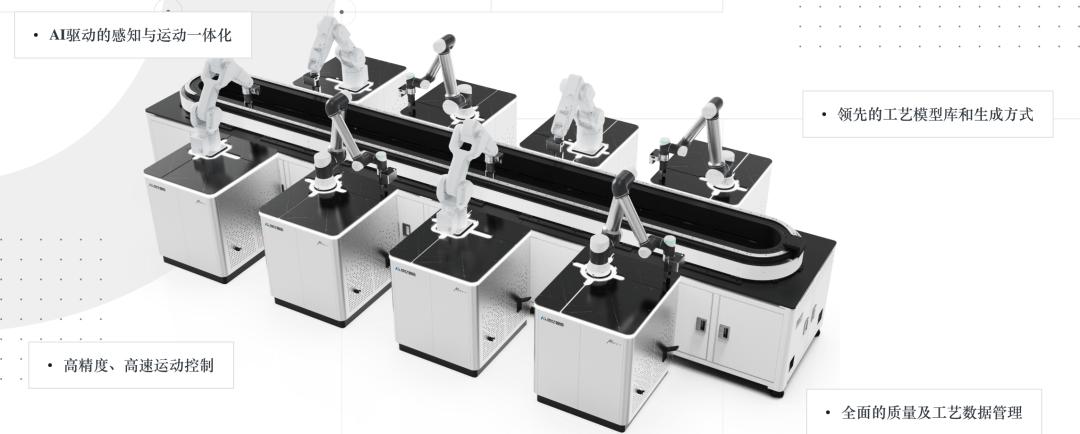
In Zhang Zhiqi's view, no matter what form the equipment takes, after entering the industrial site, it must solve specific problems and calculate the "economic account" of replacing manual labor. The more complex the robot form is, the higher the cost of the body and deployment will be.
Judging from revenue alone, Weiyi Intelligent Manufacturing is one of the few enterprises that have achieved large-scale profitability. From 2023 to 2025, its revenue was 434 million yuan, 600 million yuan and 796 million yuan respectively, with a three-year compound annual growth rate of 35.4%, and its gross profit was 184 million yuan, 287 million yuan and 385 million yuan respectively.
However, during the statistical period, the profit of Weiyi Intelligent Manufacturing did not form a growth curve corresponding to its revenue. After losing 114 million yuan in 2023, the company achieved a net profit of 15.74 million yuan in 2024, but in 2025, while its revenue increased, its net profit dropped to 5.07 million yuan. At the same time, in 2025, its net cash outflow from investment activities was 831 million yuan, and its cash fell from 240 million yuan at the end of the year to 94.67 million yuan at the end of May 2026.
In the first 5 months of 2026, its net profit was 22.53 million yuan, a year-on-year increase of 220%, and the adjusted net profit was 33.84 million yuan. In the announcement of suspending the IPO, Weiyi Intelligent Manufacturing stated that the industrial embodied intelligence industry is still in a stage of rapid growth with broad long-term development space, and the company is full of confidence in the industry prospects and its own long-term development. The company will pay close attention to changes in the capital market environment later, and prudently evaluate the updated timetable for the global offering and listing together with the overall coordinator.
Although Weiyi Intelligent Manufacturing stated when mentioning this IPO suspension move to The 4th Wave that it was affected by recent market environmental factors to slow down the process, in the view of Yang Shengjun, partner of Jisheng Capital, a company suddenly suspending its listing right before going public may also be related to the lack of enthusiasm from its cornerstone investors, or the market feedback failing to meet expectations during the issuance process.
In the view of an industry insider, Weiyi Intelligent Manufacturing has formed an energy efficiency ratio closed loop in industrial scenarios, but from a longer-term cycle, as more and more wheeled, biped robots, dexterous hands and other products enter the industrial track, "it is hard to say that any enterprise can form a unique moat", and for Weiyi Intelligent Manufacturing, which has not yet opened the gap with profit advantages, whether it has a first-mover advantage is "hard to judge".
02 The overall IPO progress of the industry is slowing down
It is worth mentioning that Weiyi Intelligent Manufacturing's move to delay its listing is at a delicate industry node. During this period, news about the tightening of IPOs for embodied intelligence has been frequently circulated in the industry.
China Finance and Corporation previously learned from investment bankers that some investment bankers have received reminders from their companies, which involve IPOs of hard technology including the robot industry. If the industry status is not prominent enough, the listing process may be affected.
Yang Shengjun told The 4th Wave that in recent months, considering the "slump" of the industry, the listing performance of Unitree and regulatory trends, the team has become cautious about embodied intelligence projects and has not made any new investments.
Many industry insiders mentioned the impact of Unitree's listing during discussions. After being listed on the Sci-Tech Innovation Board on August 19, Unitree Technology closed at 845 yuan per share on its first trading day, up 460.34% from the issue price, but then it fell for many consecutive days. At that time, some institutions said that the decline in Unitree Technology's stock price was the inevitable result of the burst of the early valuation bubble and the ebb of short-term sentiment.
Shen Meng, executive director of Chanson Capital, believes that on the whole, investors' enthusiasm for the embodied intelligence concept is decreasing, and embodied intelligence cannot establish the application value of commercial scenarios in the short term. He mentioned to The 4th Wave that Unitree Technology's performance in the secondary market also makes investors see clearly that the space for taking over high valuations is shrinking. "With the cooling of market sentiment, investors have established a new evaluation system for embodied intelligence projects."
In addition, many investors who have long paid attention to embodied intelligence respectively told The 4th Wave in mid-September that they have recently reduced their attention to or investment selection of embodied projects, and turned their attention to AI4S. Some investors mentioned during the communication that after two months of intensive research, they found that the current embodied intelligence track has serious homogenization and demo-oriented phenomena, and the technology itself is not competitive enough.
Some other investors told us that even when looking at embodied projects now, they will consider more dimensions than during the "hot" period in the first half of the year. For example, they will pay attention to the commercialization capabilities of enterprises, shipment volume, landing scenarios, stable customer groups and so on.
Yang Shengjun also mentioned that since last year, the valuations of many embodied intelligence companies have soared 10 times or even more, but in contrast, the commercialization progress of these enterprises is far behind the growth rate of valuations. This is very likely to trigger market doubts about "whether the industry has not reached the inflection point".
In Yang Shengjun's view, the embodied intelligence industry, which was in full swing for three years, has entered a cooling-off period, and this cycle will last for about 1 to 3 years. "Next, enterprises will start to compete for their real practical capabilities in real scenarios."
This article is from the WeChat official account "The 4th Wave", written by Qiu Hui, and published with authorization from 36Kr.