56-year-old Zhou Hongyi makes a rare "concession": he steers clear of the edge of major tech giants and engages in the tough, unglamorous AI business.
On October 14, in an interview, Zhou Hongyi admitted that 360 has not yet completed the enterprise-wide AI transformation.
He divided the enterprise adoption of AI into three stages: first, let employees learn to use AI, then improve personal efficiency with the help of Agents, and finally let intelligent agents enter business systems to independently complete a whole segment of work. 360 has tested a large number of Agents internally, but Zhou Hongyi said: "However, we have only explored to the second intermediate step so far, and we have not finished exploring it yet."
It has been less than three months since he officially released Nano Work. On July 28, at the Beijing National Convention Center, Zhou Hongyi invited Abulajiang Aisikaier, a breakfast shop owner from Kashgar, Xinjiang. The latter runs a breakfast shop named "Fragrant Hands", and demonstrated on site his experience of using Nano Work to handle marketing, design, contract and other affairs.
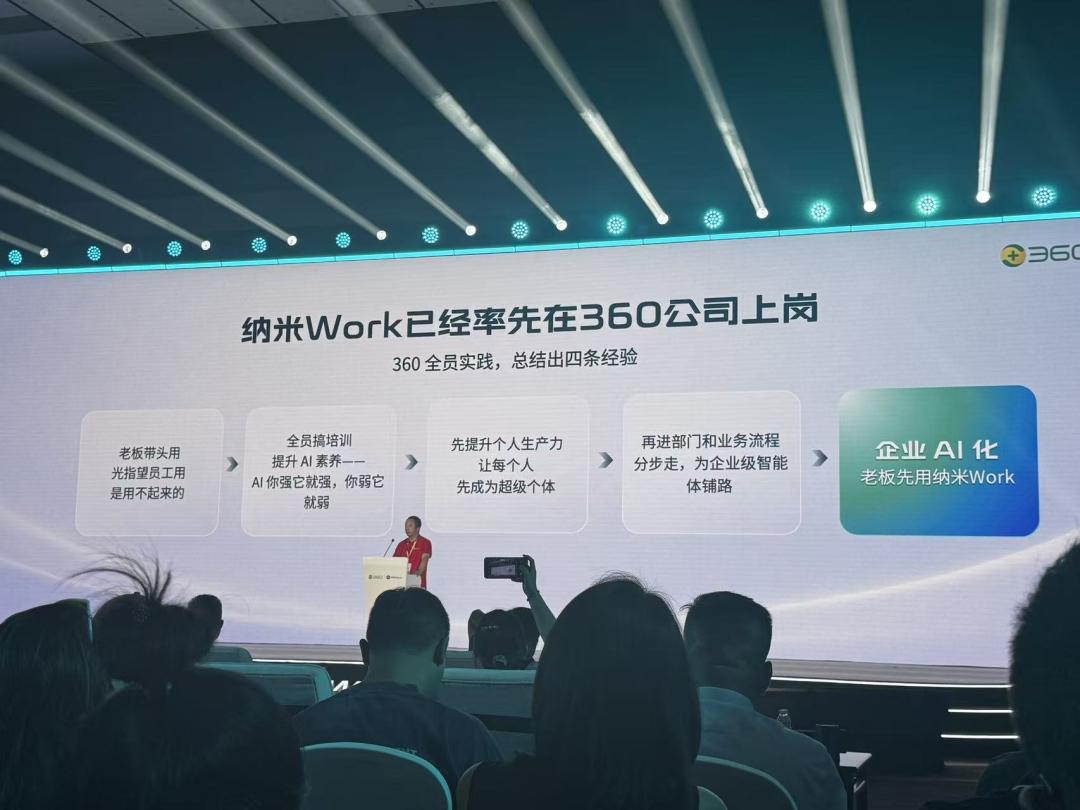
Zhou Hongyi put forward a proposition on this occasion: When enterprises adopt AI, business owners should be the first to use it. He wants to turn the Agent capabilities accumulated within 360 into an enterprise work platform, so that small companies without professional teams can also use AI.
However, in the office Agent market, 360 is facing a different landscape. On October 20, Analysys released the domestic desktop AI office agent traffic statistics for September. Tencent WorkBuddy reached 85.34 million visits, Qianwen Office 46.55 million, Doubao Work 30.39 million, while Nano Work recorded 2.27 million visits, ranking 18th.
After entering the market, it has been supplementing daily office capabilities such as WeChat message processing and Office editing on the one hand, and separating membership and cloud PC for separate billing on the other hand. It also began to send engineers to physical stores to configure intelligent agents for merchants. Zhou Hongyi has accepted that 360 cannot compete for the first place in all technical routes, and he hopes to focus more energy on enterprise intelligent agents and security. However, this path also has its own difficulties.
From PC Giant to 18th Place in Office Agent Ranking
Before releasing Nano Work, 360 had already conducted a round of experiments within its own company.
According to the data released at the launch event, the company deployed intelligent agents such as OpenClaw in more than 1000 internal business scenarios, collected 56000 pieces of feedback, and iterated 166 versions in 5 months. Nano Work can call different models, and let multiple Agents divide the work to complete data research, data analysis, document production and application development. 360 hopes to integrate these capabilities into one platform to lower the threshold for enterprises to use AI.
But no matter how many capabilities it has, it must first give users a reason to use it repeatedly before it can become a sustainable business. The desktop office agent ranking released by Analysys on October 20 makes the position of Nano Work intuitive. The total visits of the top three exceeded 160 million times. The 2.27 million visits of Nano Work only accounts for about 2.7% of WorkBuddy's traffic.
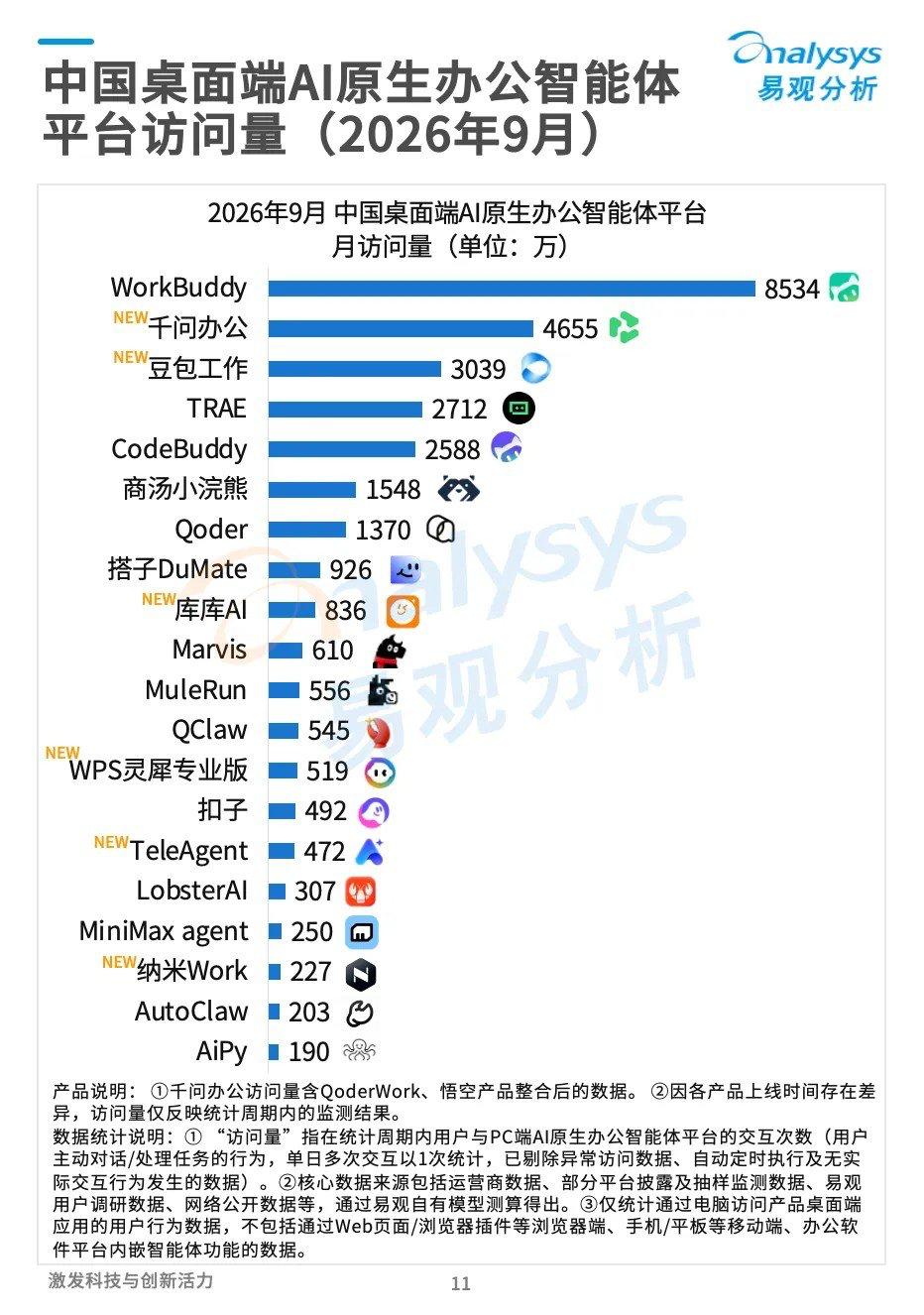
It is not only several large internet companies that rank ahead of Nano Work. SenseTime Little Raccoon recorded 15.48 million visits, and Baidu's DuMate reached 9.26 million visits. In addition, Baidu launched its independent office product Kuku AI only in August, and it had 8.36 million visits in September, nearly 3.7 times that of Nano Work. MuleRun, incubated internally by Alibaba Cloud, also had 5.56 million visits.
Further down the ranking, there are even some products that are not known for mass consumer traffic. TeleAgent, launched by China Telecom in July, had 4.72 million visits, and NetEase Youdao LobsterAI also had 3.07 million visits. It is not until the 18th place that Nano Work appears.
360's original PC user base has not shown corresponding advantages in this traffic ranking. The users accumulated by 360 Security Guard and 360 Secure Browser mainly use these products for computer security, system tools and internet access needs. Installing 360 does not mean that users will use 360 to process meetings, documents and work group messages every day.
Tencent has WeCom, Tencent Docs and Tencent Meeting, Alibaba has DingTalk, and ByteDance has Feishu. These products have already been involved in employees' daily work. The files, group chats, meeting minutes and enterprise knowledge that users need are originally stored in these products. For them, adding an office Agent allows them to continue to expand their business based on existing work relationships.
Nano Work, on the other hand, needs to convince users to bring the work that originally happened in other software back to 360's ecosystem.
On September 2, 360 also adjusted the billing method of Nano Work, separating membership subscription from cloud PC service. At the time of release, cloud office was one of its key selling points: users can turn off their local computers, and the Agent can continue to execute tasks. But in actual use, many individual users are still used to completing work locally, and cloud PCs are more suitable for on-demand configuration.
In this adjustment, what Nano Work needs to verify is not only how many things the Agent can do, but also which capabilities users are willing to pay for continuously. For people who are used to traditional office software, an extra cloud workspace may not be more attractive than reducing the times of switching between different software.
On October 15, Nano Work launched two functions that are closer to daily office scenarios. Nano Work released the WeChat work information access function. Users can transfer chat messages, work files and favorites from WeChat to the Agent on their mobile phones or computers, and then ask it to organize materials, make plans or PPTs.
On the same day, 360 also launched a built-in Office editor. Word, Excel and PPT generated by Nano Work can be opened and modified directly, so users do not need to regenerate the entire file just to adjust an image or a piece of data.
These functions reduce the trouble of users switching back and forth between different software, but WeChat message processing and Office editing are not unique capabilities of Nano Work. 360 has improved part of the daily office experience, but it still needs to convince users to switch from their original tools.
Security is its core competence, but not necessarily a killer advantage
Zhou Hongyi admitted that 360 does not have sufficient strength and talent density to compete for the general large base model, and it is not an expert in this field. He believes that 360 still has the opportunity to combine intelligent agents with enterprise business, and what he devotes most of his energy to now is AI security.
"After you have an objective understanding of your position, you need to find your own battlefield."
This is a clear trade-off made by Zhou Hongyi in the AI competition. In the past few years, 360 has also released its own large models and AI applications. But for Nano Work, it does not insist on developing all capabilities independently, but uses multi-model scheduling to complete work by leveraging existing models and intelligent agent technologies.
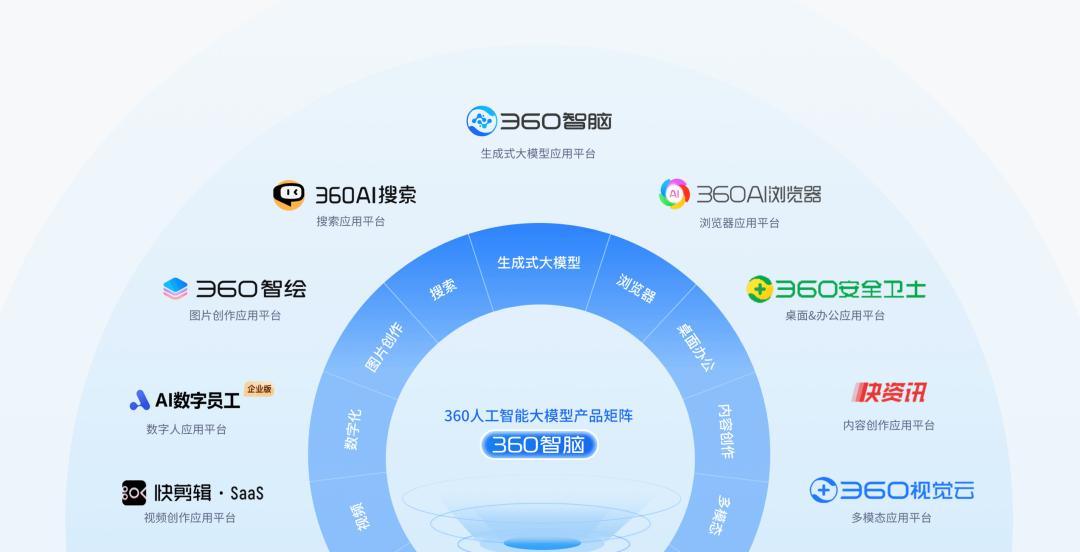
However, other Agents can also call these models. If Nano Work wants to stand out from them, it has to show capabilities beyond the models.
Zhou Hongyi puts the answer on security. In his judgment, the biggest difference between an Agent and a chatbot is that the former not only answers questions, but also can operate computers, call programs and modify files. Once it makes a mistake, it may affect the real business of the enterprise.
360 also encountered security problems when testing Agents internally before. Zhou Hongyi revealed that the team tried the OpenClaw architecture in the early stage, but found risks in permission and execution during internal use, and later adjusted to an architecture that draws on products such as Codex and Claude Code.
Nano Work has also designed a controlled execution environment for this purpose. Which files the Agent can use, which tools it can call, and which operations it can perform are restricted by permissions. 360 also tries to monitor the execution process through a security Agent, and send alerts or stop tasks when anomalies occur.
However, how many customers technical advantages can bring to Nano Work still needs to be verified in specific procurement scenarios. If a bank wants an Agent to read internal materials and process business processes, permission control, operation audit and data isolation are requirements that must be met before procurement. Government, energy and large manufacturing enterprises also have similar needs.
The situation is different for a breakfast shop. The owner wants AI to analyze turnover, create marketing content and sort out customer reviews, and will first care about whether the task can be completed and how much it will cost per month. For individual users who write code and make PPTs every day, execution speed, generation quality and usage habits are equally important. Security is not necessarily the main reason for these people to switch software.
In fact, even 360 itself has not completed enterprise-wide AI transformation. Zhou Hongyi mentioned in the interview that 360 has done a lot of Agent tests. Employees use AI to write code and process documents, and personal efficiency has improved rapidly, but the efficiency of the entire company has not seen a similarly significant improvement.
Zhou Hongyi once wanted the Agent to automatically collect information from various departments, eliminating the hassle of employees using AI to write weekly reports and managers using AI to read them. After further consideration, he found that to let the Agent directly read these work information, the original systems and data need to be reconstructed. 360 then tried AI development in some R&D teams, and found that everyone using AI does not mean that AI can independently complete a whole segment of work. Positions, processes and even organizational structures need to be adjusted. He did not roll out the program to all employees, but promoted it on a weekly basis.
In July, Zhou Hongyi had turned the Agent capabilities accumulated by 360 into an enterprise work platform. Less than three months later, he admitted that 360 itself has not completed the process from improving individual efficiency to automating enterprise business. Security can constrain how Agents operate, but it cannot replace enterprises to decide which work should be handed over to AI and how the original systems should be modified. The problems that Zhou Hongyi hopes Nano Work can solve are still being tried by 360 itself.
To build a scalable business, you have to do customized work first
The competition in the general office market is still ongoing, and 360 chooses to go offline to develop a business that is not quite like an internet software product.
On September 17, at the 798 Art District in Beijing, Zhou Hongyi announced the launch of the Nano Work "Dual City Thousand Stores Onboarding Plan", hoping to start from physical stores in Beijing and Shanghai, and gradually introduce AI into the daily operations of thousands of merchants.
This plan not only provides software to merchants, but also arranges engineers to visit the stores. Before the project was launched, FDE engineers had already visited some merchants in the 798 park to understand their business situation, sort out business processes, and then determine which work can be handed over to AI. 360 calls this method "in-depth implementation for a small number of merchants, batch support for more". On October 19, Nano Work also appeared at the Lujiazui International Coffee Culture Festival in Shanghai, demonstrating store operation scenarios such as passenger flow analysis and revenue calculation.
Compared with general office products, this is a more labor-intensive approach.

A coffee shop, restaurant or retail store usually does not have a dedicated IT team. The owner wants AI to help analyze operations and create marketing content, but may not know how to connect existing business systems. Take a catering store as an example: its sales data may be stored in the cash register system, procurement records are saved in spreadsheets, employee scheduling is communicated via WeChat, and customer reviews are scattered on several online platforms.
If you only want AI to make posters, the task is relatively simple. But if the owner wants to automatically generate business reports every day, someone needs to confirm the data sources, statistical rules and update methods. To let the Agent remind procurement, it is also necessary to clarify raw material inventory, restocking cycle, and which procurement needs approval from the owner.
All these tasks need to be sorted out for the merchants first. FDEs not only need to understand the customer's business, split the requirements into tasks that AI can execute, but sometimes also need to develop tools, connect systems, and then teach customers how to use them.
Zhou Hongyi hopes to train a group of FDEs from 360's existing security talent network. These people used to help enterprises find security vulnerabilities, and now they need to learn to configure intelligent agents for customers, connect business systems, and even develop new tools.
On October 23, 360 Digital Security Group launched a three-day special training, with courses including API development, workflow orchestration and enterprise knowledge base construction. But when introducing this training, 360 also mentioned that an FDE who can independently undertake project delivery usually needs two to three years of practical project experience.
Three days of training can let engineers get familiar with the tools, but it can hardly replace two to three years of project experience. When they arrive at the customer site, engineers still need to understand the business. Even for catering stores, the cash register and membership systems may be different; if the business scenario changes from a coffee shop to an auto repair shop, a lot of work needs to be re-sorted out.
360 hopes to use industry templates to reduce these repetitive tasks. Let engineers run through the process in a small number of stores first, and then organize the reusable parts into templates. In the future, when encountering similar customers, they do not need to design from scratch every time.
But how much work templates can save for engineers determines whether this business can be scaled up. Standardized software allows customers to register, subscribe and use it by themselves, without arranging staff to visit the site for every sale. FDEs, however, may need to communicate requirements separately for each enterprise, connect systems, and be responsible for training and subsequent maintenance. If it takes several days to deploy the first store, and it still takes the same amount of time to deploy the 100th store, then as the number of customers increases, the workload of engineers will also increase accordingly.
FDE is not a unique approach of 360. On September 10, Kimi announced that it would build an FDE team together with IT service providers and system integrators. The first batch of partners include China Software International, Kingsoft Cloud, Teamsun and other enterprises. Kimi hopes to enter enterprise business with the help of large integrators; in addition to developing the enterprise service network, 360 also devotes part of its energy to small and micro stores that lack IT personnel.
These small stores lack IT personnel and may rely more on on-site engineers, but they may not be willing to pay a high fee for a customized solution. What 360 needs to find is a service method that is affordable for customers and does not require engineers to implement from scratch repeatedly.