The "slow brand" Blue Bottle Coffee has its fast-forward button pressed by Chinese financial backers.
After the "Little Blue Cup", can the "Little Blue Bottle" shake up China's coffee industry?
As a specialty coffee lover, Li Yang (a pseudonym) who lives in Nanjing found that Blue Bottle Coffee, which he often drank when studying abroad, has put up its familiar blue logo hoarding on the B1 floor of Deji Plaza.
Not only has it opened its first store in Jiangsu in Nanjing, but after Centurium Capital, its controlling shareholder, acquired its global store business from Nestlé, Blue Bottle Coffee is expanding rapidly in China.
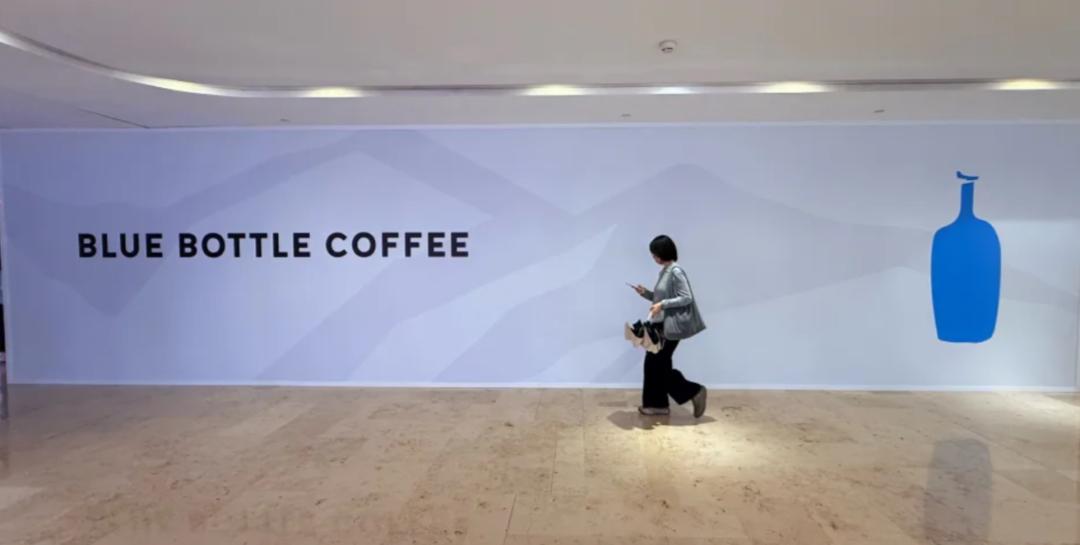
Image source: Screenshot from Xiaohongshu
In cities including Beijing, Nanjing and Wuhan, Blue Bottle Coffee has begun to accelerate its store opening pace; according to incomplete statistics from "Qujie Business", there are nearly 20 planned or operating stores of Blue Bottle Coffee in Chinese mainland, covering six cities: Beijing, Shanghai, Shenzhen, Hangzhou, Wuhan and Nanjing. At the same time, it has held its global barista competition finals in Wuhan for the first time, while the event was held in Tokyo the year before last and Seoul last year.
It remains uncertain whether Blue Bottle Coffee can achieve synergy with its "peer senior" Luckin Coffee in China, and fulfill Centurium Capital's ambition of "mass consumption + high-end specialty" in the coffee track.
01. Shift of Expansion Strategy
Blue Bottle Coffee was founded in San Francisco, the United States. It is known as the "Apple in the coffee industry" for its high-end positioning, minimalist style and distinct brand tonality.
As a representative of niche high-end specialty coffee, the price of a cup of Blue Bottle Coffee is usually between 30 and 50 yuan, more than three times that of Luckin Coffee, and also significantly higher than Starbucks.
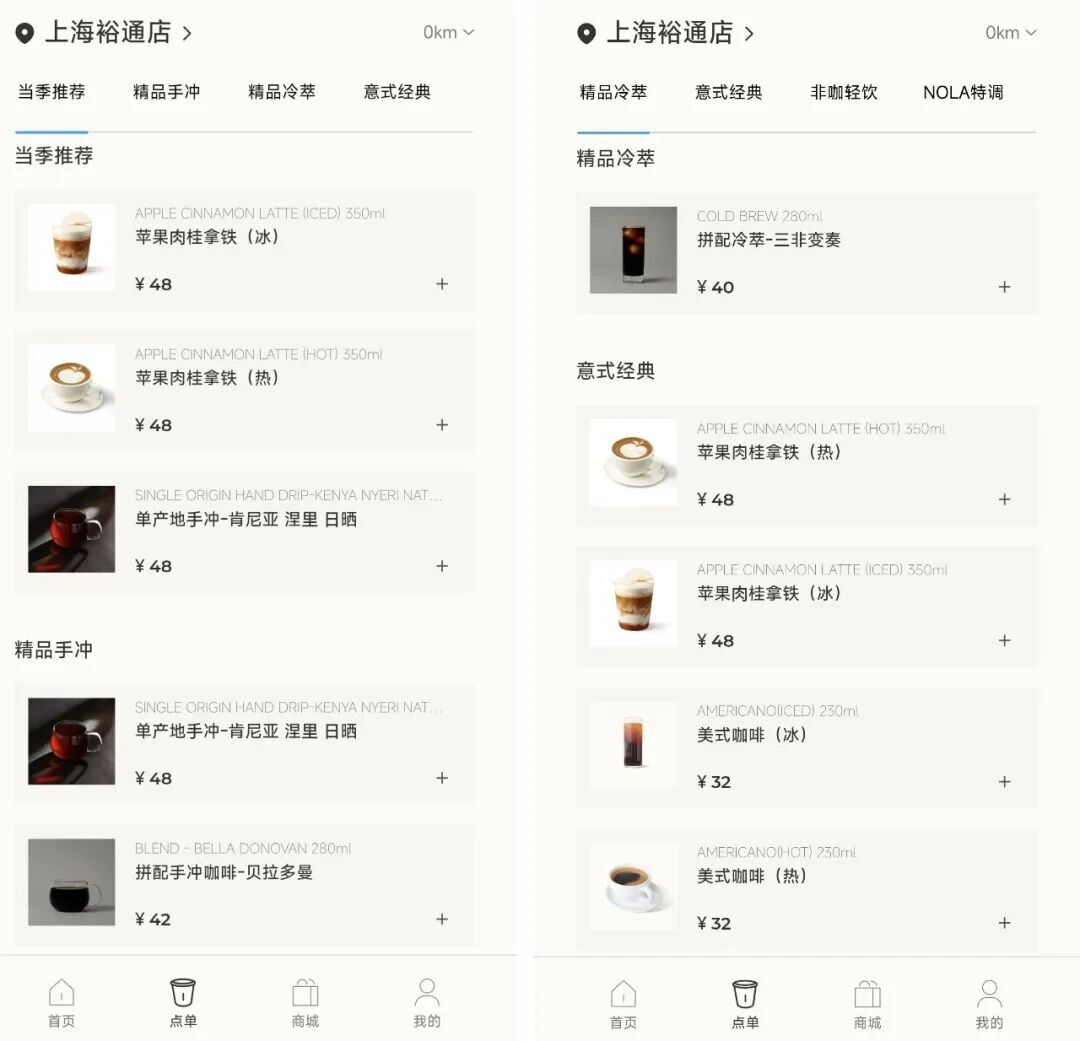
Image source: Screenshot from Mini Program
Since Nestlé acquired the majority stake in 2017, Blue Bottle Coffee has maintained a relatively independent structure and restrained growth, and its store expansion in China has always been slow. Since it entered the Chinese market in 2022, Blue Bottle Coffee has only opened 15 stores in Chinese mainland by the end of 2025, with an average of less than 4 new stores per year. But after being taken over by Centurium Capital, Blue Bottle Coffee has begun to change.
First, in terms of store opening, besides accelerating the speed, its site selection strategy has also transformed.
In the past, Blue Bottle Coffee pursued the "one store, one design" principle, and its store space design focused on connection with the local city. Therefore, it would prioritize cities with mature coffee consumption culture in site selection, and polish every detail of stores, striving to make each store a local landmark of coffee consumption.
However, judging from the stores launched in Beijing, Nanjing and Wuhan, Blue Bottle has begun to attach importance to mature commercial complexes and shopping centers: its first Beijing store is located on the 1st floor of the North Zone of China World Mall, its first Nanjing store is settled in Nanjing Deji Plaza known as the "nation's top-performing mall", and its Wuhan store is located in Wushang MALL, the "No.1 business district in Central China", trying to attract more passenger flow and exposure by leveraging mature commercial projects and brand agglomeration effect.
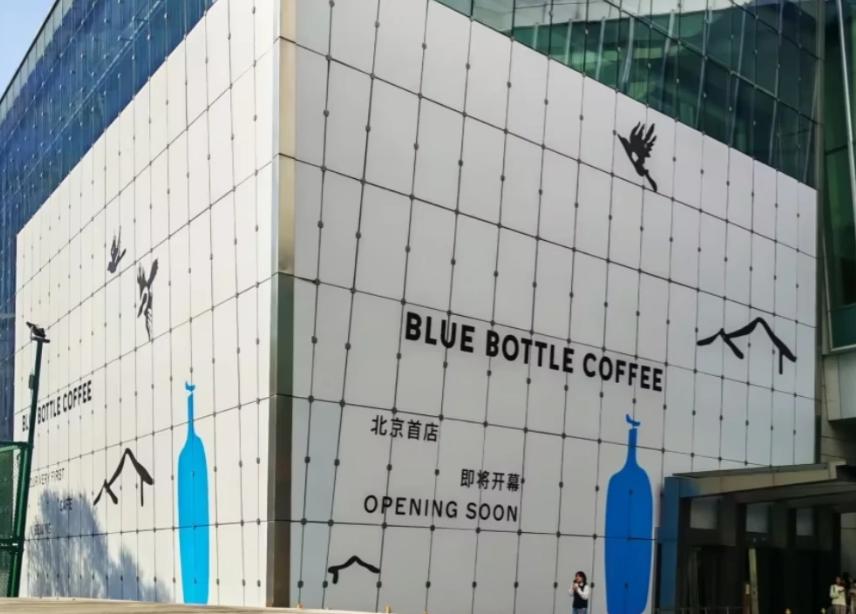
Image source: Screenshot from Xiaohongshu
Second, in terms of products, it is accelerating the trend of making coffee more like milk tea and expanding non-coffee product lines.
Blue Bottle Coffee has always taken specialty pour-over coffee and specialty cold brew coffee as its core products, focusing on the quality, taste and flavor of every cup of coffee.
Following the example of Luckin Coffee, the "new product launch maniac", Blue Bottle has also begun to expand its menu of non-coffee light drinks and custom special drinks, adding elements such as fresh fruits and milk brick to coffee, and launching new products including "coffee cherry sparkling water" and "white peach soft-serve iced coffee".
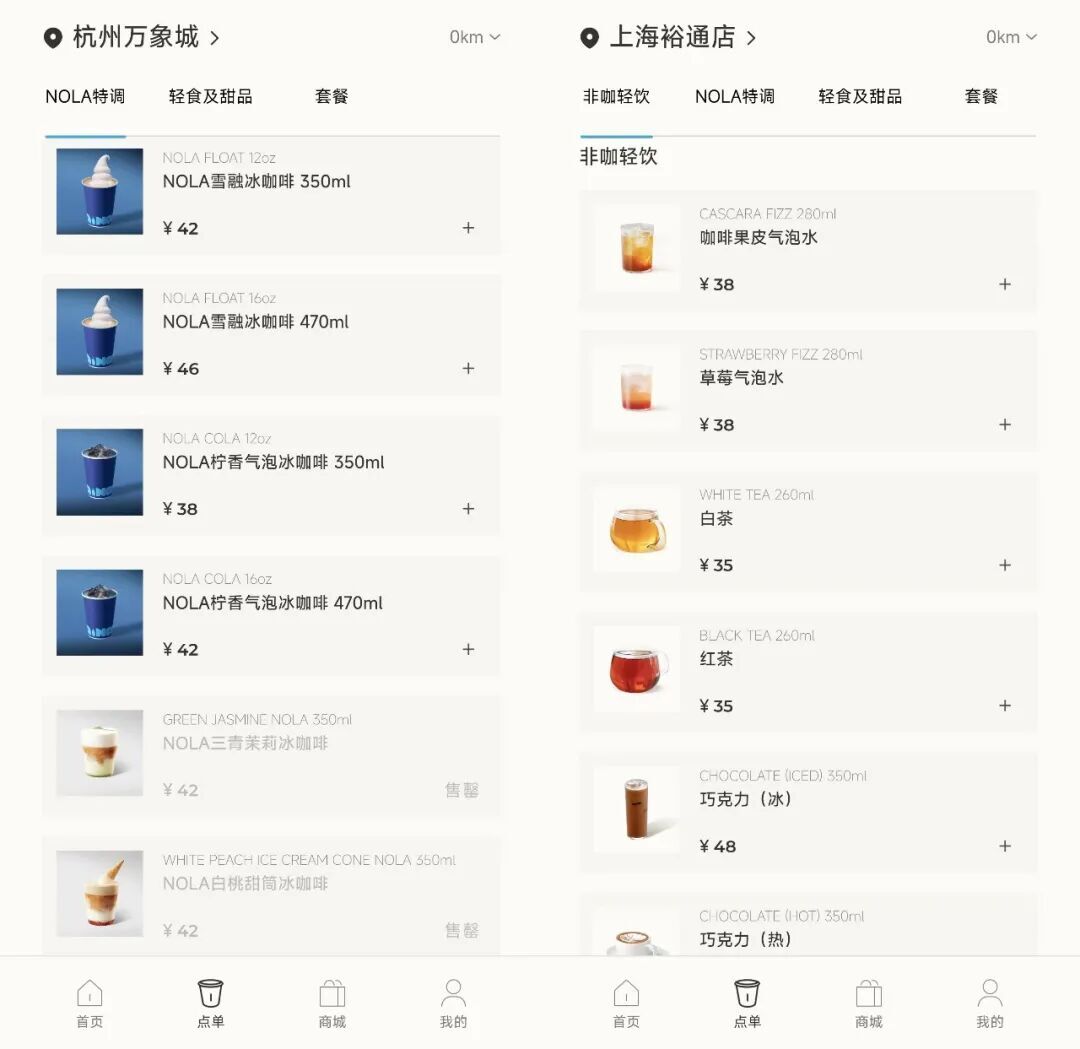
Image source: Screenshot from Mini Program
Third, it has introduced senior executives with backgrounds from Centurium Capital and Luckin Coffee at the organizational level.
In June this year, the legal representative and general manager of Blue Bottle Coffee (China) Co., Ltd., the Chinese operating entity of Blue Bottle, was changed from Chen Yixiang to Li Mo, who is responsible for the daily operation and management of the China region.
Public information shows that Li Mo previously served as the general manager of Luckin Coffee Beijing Branch, his mature market expansion capabilities accumulated in Luckin are very likely to drive Blue Bottle to accelerate its expansion.
The other new chairman Chen Weihao comes from Centurium Capital. He has served as the partner and managing director of Centurium Capital since July 2019, and is also a director of Luckin Coffee.
When joining Centurium Capital, Chen Weihao once stated his investment style, such as "holding-type investment", and being "more focused, small and refined" in consumer investment.
It is worth mentioning that in the past two years, Centurium Capital was once rumored to participate in the bidding for Starbucks China, and then evaluated specialty coffee brands including Costa, %Arabica and M Stand, so its core intention of betting heavily on the coffee track is not difficult to understand.
On the one hand, Centurium Capital focuses on sectors including consumption, commercial services, healthcare and technology. Compared with the long cycle and uncertainty of other tracks, the coffee track has stable cash flow, and China's coffee penetration rate is far lower than that of developed countries. It not only has strong consumption certainty and huge market space, but also allows in-depth layout in upstream and downstream industrial chains to bring long-term returns from industrial investment.
On the other hand, Centurium Capital has realized the importance of reforming and transforming enterprises from the successful turnaround of its "holding-type investment" in Luckin Coffee, and this aggressive investment style is also applicable to the tea drink industry that emphasizes strong operation and high efficiency.
02. Deep Coordination with Luckin Coffee
Behind Centurium Capital's push for Blue Bottle Coffee's rapid expansion in China, there may be a more critical driving factor: sharing resources, capabilities and experience with Luckin Coffee to achieve "1+1>2" synergy in the coffee track.
A person from the coffee industry told "Qujie Business": "Nestlé delegated power to Blue Bottle, while Centurium Centralizes power. Under the holding-type investment style, Blue Bottle's transformation will definitely speed up".
With the transformation of Centurium Capital, Luckin Coffee has become the "top coffee brand in China" by virtue of frequent new product launches, supply chain construction and digital store operation. However, under the increasingly fierce competition in China's coffee market, it has become more difficult for a single brand to achieve growth by fighting alone.
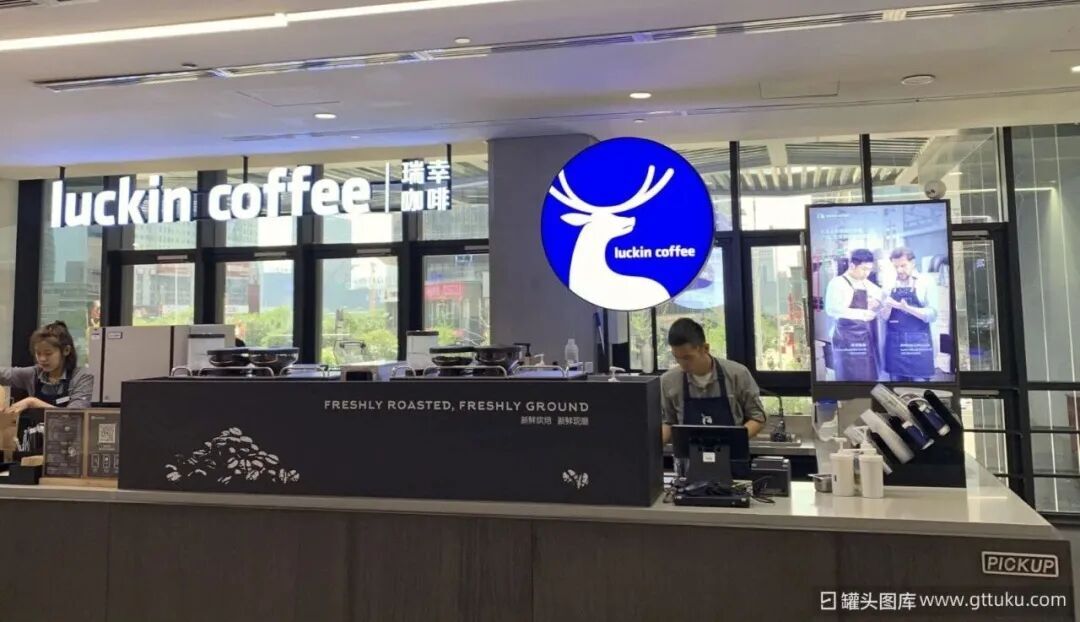
Image source: Canned Gallery
The joint operation of two brands can bring multiple benefits.
First, it can fully cover diversified demands in the coffee track. The affordable Luckin Coffee occupies the mass coffee consumption mind, while Blue Bottle Coffee positions itself as a high-end specialty coffee brand.
Secondly, it can promote Luckin Coffee to return to the capital market. In November 2025, Guo Jinyi, co-founder and CEO of Luckin Coffee, publicly stated that Luckin is actively promoting its relisting on the US main board.
However, affected by the "price war" and "takeaway war", Luckin's net profit and same-store sales of self-operated stores are both declining. With the expansion of Blue Bottle Coffee, this high-end brand, Luckin may be able to tell a new growth story beyond scale.
More critically, Blue Bottle Coffee can also help Centurium Capital and Luckin Coffee tap overseas incremental markets.
Luckin has been exploring overseas markets for three years, but the number of its overseas stores is less than 200 at present, and most of its stores are concentrated in Southeast Asia which shares similar geopolitical relations and consumption habits with China. The number of stores in Singapore, which has exceeded 100, accounts for half of its total overseas stores.
For Chinese coffee brands, the larger global market is the mature coffee consumption market represented by the United States, which features high customer unit price, no need to compete at low prices, and clearer logic for brand globalization, but it is also more difficult to enter this mature specialty coffee consumption market.
Blue Bottle Coffee's headquarters is located in the United States, and its high-end customer groups, local operation teams and supply chain accumulated over more than 20 years are expected to become a springboard for Luckin to enter the US market.
03. The "High-end Competition" of China's Coffee Industry
With the inherent high-end genes of the brand, and the experience and resource support from its controlling shareholder, Blue Bottle Coffee still cannot win easily without efforts.
After China's coffee market went through fierce competition in price and scale, its growth space is gradually narrowing. According to data from industry institution NCBD, the scale of China's ready-to-drink coffee market reached 217.79 billion yuan in 2025, with a year-on-year increase of 13.4%. Although the growth rate is higher than the overall catering industry, it has declined for two consecutive years.
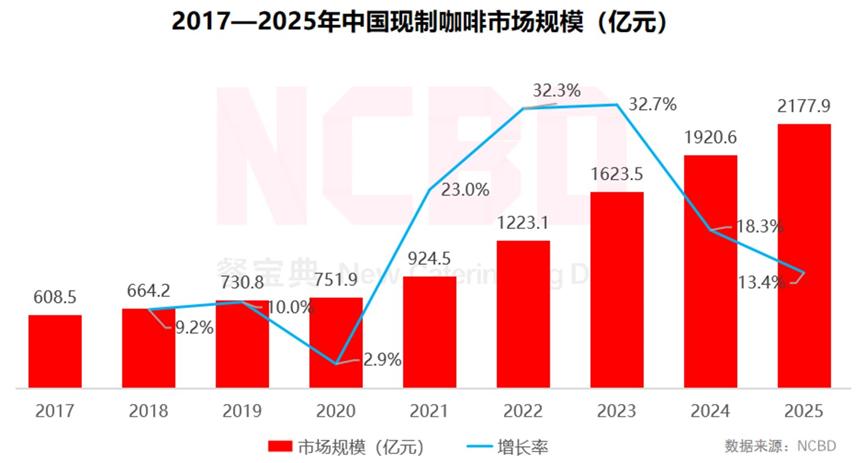
Image source: NCBD Catering Report
After saying goodbye to the "scale is king" development logic, the industry has entered a new stage of competing in consumption experience and brand value.
On the one hand, leading coffee brands have begun to compete in the high-end track, and expand business boundaries around products, stores and channels.
On the product side, they launch innovative high-end product lines. For example, Starbucks China launched the "Champion Set" this year, bringing the award-winning drinks from past coffee competitions to front-line stores; on the store side, they enter the market with large high-end stores such as high-end flagship stores and urban intangible cultural heritage themed stores to improve spatial consumption experience; on the channel side, they extend offline store business to retail business, for example, Luckin Coffee has increased investment in ready-to-drink coffee business to cover more channels.
On the other hand, Blue Bottle Coffee's most direct competitors are also accelerating to seize the high-end coffee consumption mind. For example, Peet's Coffee achieved double-digit growth in the Chinese market in fiscal year 2025, and Starbucks also accelerated its localization process after introducing Chinese partner Boyu Capital.
Under the general trend that the whole coffee industry regards "high-end transformation" as a strategic goal, whether Blue Bottle can shake up China's high-end coffee market still needs to answer two core questions.
First of all, can it strike a balance between accelerated expansion and maintaining its own uniqueness? With the synergy with Luckin Coffee, can Blue Bottle retain its unique brand characteristics in China? After all, "slowness and restraint" have always been Blue Bottle's distinct brand tonality in the past.
Secondly, can revenue growth and brand polishing advance simultaneously? Under the pressure of expansion, do Centurium Capital and Luckin Coffee have sufficient patience to polish the brand, considering that Blue Bottle Coffee is still in loss at present.
On social media, some consumers have raised similar concerns : "If Blue Bottle only ends up with drinks piled up with various ingredients, what is the core competitiveness that supports its high price?"
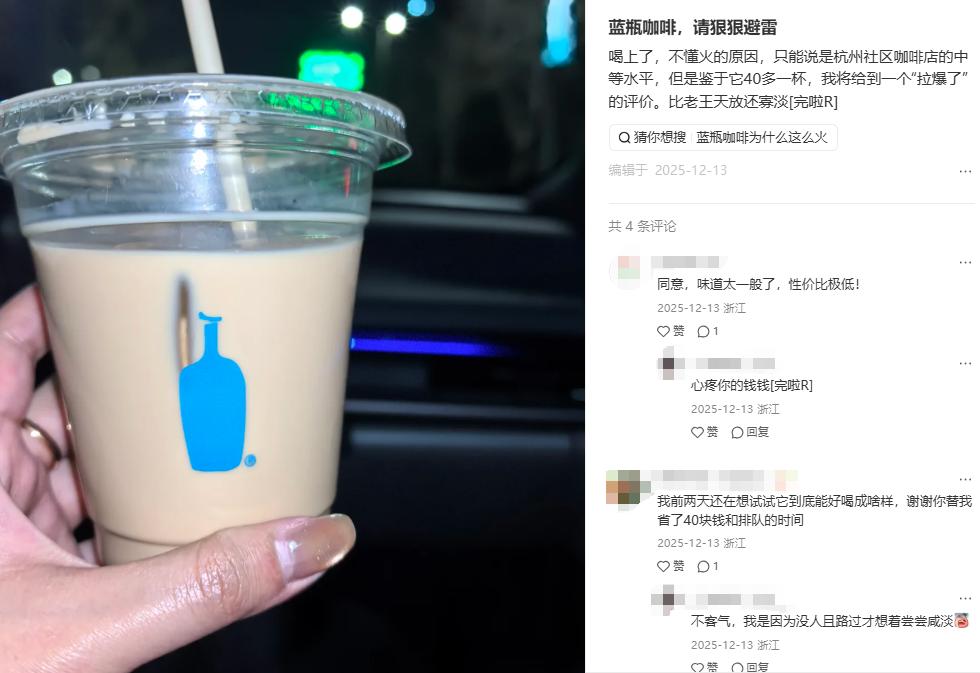
Image source: Screenshot from Xiaohongshu
In the final analysis, the demands of China's coffee market are complex and diversified, with both opportunities and challenges coexisting. In the past, the "Little Blue Cup" Luckin Coffee taught Chinese people to develop the habit of drinking coffee with 9.9-yuan affordable products, but today the "Little Blue Bottle" needs to prove whether Chinese consumers are willing to continuously pay for a 40-yuan cup of specialty coffee.
So far, neither Chinese coffee brands including Luckin Coffee, nor foreign players such as Starbucks China have given a perfect answer to this difficult question. Can Blue Bottle Coffee make it?