How can Sspai Stardust Intelligence justify its 700x price-to-sales ratio?
Against the backdrop of the cooling down of embodied intelligence IPOs, manufacturers are facing vastly different market conditions.
Recently, Yinghe Robotics announced bankruptcy, sending a chill through the robotics industry. On the other hand, Stardust Intelligence announced the completion of a new round of 1 billion yuan financing, which forms a sharp contrast with the former.
How popular is Stardust Intelligence?
Founded less than four years ago, it has completed four rounds of financing within half a year, with its valuation rising by 5 billion yuan in three months to reach 15 billion yuan. Estimated based on its revenue of about 20.9 million yuan in 2025, its static price-to-sales ratio exceeds 700 times.
This timing is also very delicate. Less than two months after Unitree went public, its stock price has dropped significantly from 1100 yuan per share, and the primary market has also tightened its investment significantly. The fact that Stardust can still obtain financing means it has the traits that appeal to capital.
In general, these traits are mainly reflected in two aspects: first, it claims to be "the world's first to achieve mass production of cable-driven AI robots", and has blazed a niche path outside the mainstream rigid joint route; second, it has deployed its robots in real scenarios such as retail, industry, cultural tourism and scientific research.
This contrast between prosperity and decline is not limited to one or two robotics enterprises.
Data from third-party institutions shows that the total financing amount of China's embodied intelligence track in the first half of 2026 is about 935 billion yuan, a year-on-year increase of about 5 times, but the capital is obviously concentrated in leading enterprises, and the top 20 enterprises have taken nearly 60% of the total share.
The current market's assessment focus on robotics enterprises has been concentrated on orders, delivery and production capacity. Only companies that can deliver mass-produced products and real customers at the same time can gain more favor.
As for Stardust Intelligence, its scarcity is real, and its commercial gap with leading enterprises is also real.
The Niche Player in the Robotics Industry
Among a large number of robotics enterprises, Stardust Intelligence appears rather maverick.
Zhu Xiaohu from GSR Ventures once complained: "There are more than 200 robotics enterprises in China now. Which one can't make robots dance? Which one can't make robots punch? This market is too small. The vast majority of them will not survive for ten years."
Stardust Intelligence is one of the enterprises that did not follow this trend.
"I really didn't expect that robots could make money by dancing in the past two years. I think robots must be able to do practical work." In the cognition of Lai Jie, founder and CEO of Stardust Intelligence, the core value of robots should be reflected in actual operations.
This may be related to the product gene of Stardust Intelligence: Lai Jie used to be the first employee and architect of Tencent Robotics X Lab, and the team leader of Baidu "Xiaodu Robot". All 6 core members of the company come from Tencent Robotics X, with quite rich experience.
The most distinctive part is the technical route selected by Stardust Intelligence.
Current mainstream humanoid robots, including Unitree and Agibot, mostly adopt the rigid joint scheme of motor plus harmonic or planetary reducer, with the motor and reducer arranged close to the joints.
Stardust Intelligence chooses the cable-driven route, which uses high-strength tendons to simulate human tendons to drive joints to flex and extend, forming "rigid-flexible coupling". This is a relatively niche route with relatively less mature technology. For this reason, Stardust Intelligence was once called the "Chinese version of Figure", but Figure has clearly abandoned the cable-driven route, making Stardust Intelligence look like a "lone hero" on this track.
According to Lai Jie's philosophy, choosing cable-driven technology essentially returns to the first principle of "robots work like humans": the cable-driven system imitates the transmission logic of human tendons, which can achieve more flexible motion control than rigid robotic arms, and has essential breakthroughs especially in force transparency and safety.
The so-called force transparency can be illustrated by a R&D example. When Stardust Intelligence trained robots to open doors, it tried to train them "with the idea of blind people", that is, not relying on vision for judgment, but relying on the force feedback generated after the robot's hand touches the doorknob, and then continuously fine-tuning the movement.
"Just like when two people shake hands, you know how much force you use and how much force the other party gives you." Lai Jie described it in this way.
The theoretical advantages of this route are very clear: it not only retains the stiffness required for operation, but also has the capabilities of flexible buffering and impact absorption, which is suitable for tasks such as grabbing fragile items, sorting clothes, and close-range collaboration.
Therefore, the outside world can see that Stardust Intelligence's products are mainly wheeled dual-arm robots, pursuing universality in diverse scenarios.
Its product line includes the flagship robot Astribot S1, with an arm span of nearly 194 cm and a rated load of 10 kg for a single arm, targeting complex operation scenarios such as industry, scientific research and home services. It started mass production and shipment in June 2025, making Stardust Intelligence the world's first enterprise to achieve mass production of cable-driven AI robots.
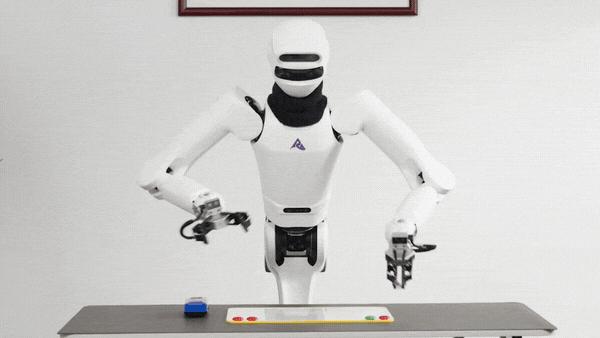
The new generation of lightweight wheeled humanoid robot T1 released this year has a total height of 1.55 meters, a weight of about 66 kg, and a single-arm load of 5 kg. With a starting price of 89,900 yuan, it focuses on "one robot for multiple uses", targeting five scenarios: home, business, scientific research, cultural entertainment and industry.
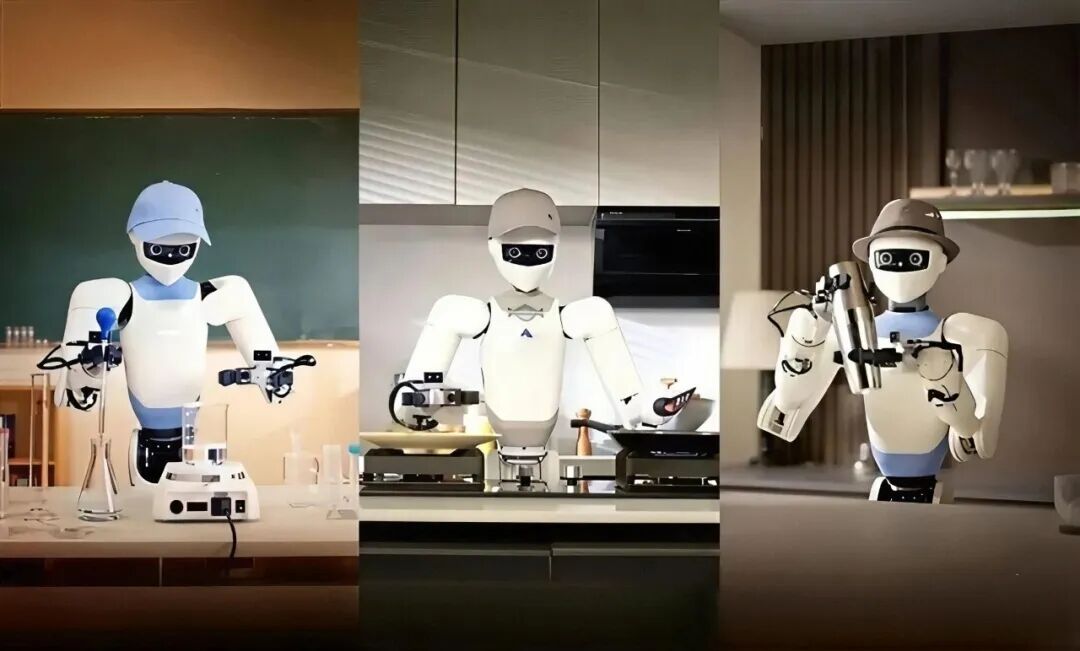
From the demonstration scenarios, it covers a variety of scenarios such as frying steaks, laundry and storage, business bartending, chemical experiments, auto parts sorting, and car charging. According to Stardust Intelligence's disclosure, the T series has won several thousand-unit orders in the fields of retail, cultural tourism and scientific research, with a cumulative total of thousands of units.
Stardust Intelligence missed the "performance hotspots" such as dancing and punching, and finally caught up with the boom in retail and cultural tourism. The next promising large-scale scenario will be the home, and the ultimate test for Stardust Intelligence's cable-driven route is coming.
Zhang Xinyuan, head of Kefangde Consulting, believes that it is difficult to enter the home scenario at present. He analyzed to AI Blue Media: "The home environment is highly unstructured, and the placement of items varies greatly, so the requirements for perception and decision-making are much higher than fixed stations in factories and retail front desks. In addition, families are more price-sensitive, and the pricing must be carefully considered to match consumers' willingness."
Lai Jie revealed that Stardust Intelligence plans to launch a home-oriented robot next year, and this product will break the industry's cognition in terms of selling price and capability.
There Is Still a Gap in Commercialization
"There will definitely be more than 200 listed embodied intelligence companies in the future, but the overlap rate with the current batch of companies may be less than 10%." Lai Jie made this judgment.
The core criterion for survival lies in the commercialization process.
In Lai Jie's view, "Embodied intelligence is an industry that can make money easily."
The two leading enterprises are indeed thriving: Unitree achieved a revenue of 1.699 billion yuan in 2025, shipped more than 5,500 humanoid robots, and recorded a non-net profit of 590 million yuan, making it one of the few profitable complete robot companies; its revenue in the first half of 2026 was 1.152 billion yuan, up 48.54% year on year. Agibot achieved a revenue of 1.05 billion yuan in 2025, and exceeded 1 billion yuan in a single quarter in the first quarter of 2026; it shipped 8,400 units in the first half of the year, accounting for about 44% of the global market share.
However, Stardust Intelligence's cumulative shipment volume and revenue scale have not been officially disclosed. According to information from Qichacha, Stardust Intelligence's operating income in 2025 was about 20.9047 million yuan, with about 151 employees. This scale is difficult to match the statements of "15 billion yuan valuation, 10,000-unit production capacity, and thousand-unit orders", and there is a significant gap compared with leading enterprises.
But Lai Jie is not worried, he said: "The commercialization of Stardust Intelligence is very easy."
At present, the most well-connected scenario for Stardust Intelligence is retail. Since November 2025, its self-developed "Robot MART" has been deployed in six cities including Beijing, Shanghai and Guangzhou, selling blind boxes and popcorn, with more than 100 units in the whole market. At one site in Hopson One, the monthly sales volume is 4 times that of automatic vending machines.
It can be seen that Stardust Intelligence is mainly operating in light scenarios, and has not competed for industrial tasks such as automobile welding and 3C heavy-load handling. It is not that it does not want to, but that it cannot. For example, for S1, the load-to-dead weight ratio is 1:1, and the rated load of a single arm is 10 kg. If the load is heavier, the elasticity of the cable drive will cause shaking.
Another line is scientific research and developers. According to Lai Jie's disclosure to ChinaVenture, the company's current scientific research orders are basically "out of stock", and the production capacity is booked one month in advance.
But can this be confirmed as profitability? It is probably not advisable to be blindly optimistic.
A robotics industry observer told AI Blue Media that as a consumable part, the service life and maintenance cycle of the cable will affect the actual use cost, "The level of selling price cannot necessarily truly deduce the profitability of the company."
Few robotics enterprises choose this route, because its disadvantages are also very obvious, and the technical difficulty is relatively high.
Moreover, the inherent contradiction of cable drive is difficult to avoid. According to Lai Jie: "The elasticity of the cable makes it difficult to control the system accurately in the initial stage, and the cable presents a stable nonlinear state, which requires accurate identification and real-time compensation."
These uncertainties obviously do not match the high valuation.
However, Stardust Intelligence has greater ambitions. In addition to polishing the robot's body, it is also improving the intelligence of the "brain".
As early as before the official release of S1, Stardust had set up a model R&D team. Later, it launched the Lumo series base model (VLA route), and continued to deploy the world model and reinforcement learning.
At the beginning of September, Sun Peng, a former reinforcement learning expert from ByteDance, joined Stardust Intelligence to be responsible for the R&D and application exploration of robot reinforcement learning. In the same month, it also released the online reinforcement learning framework SmoothRL.
Traditionally, the training of the robot "brain" model, whether VLA or WMA, relies entirely on expensive imitation learning. If reinforcement learning can be introduced, the evolution speed of the robot's "brain" may achieve a qualitative leap.
The experimental data disclosed by Stardust confirms this: the success rate of experimental links that require accuracy, such as dynamic throwing, putting on pen caps, and opening boxes, has been greatly improved.
Zhang Xinyu highly recognizes Stardust Intelligence's two-pronged strategy: "The bottleneck of embodied intelligence lies precisely in the coupling of software and hardware. Perception, decision-making and execution must be optimized in a closed loop. Otherwise, focusing only on the robot body will easily reduce to OEM, and focusing only on the model will lack real data feedback and hardware adaptation."
At present, the VLA, world model and reinforcement learning routes all have their own advantages and disadvantages. Stardust Intelligence's choice to deploy and promote them at the same time is not a simple extensive investment, but a complete link: robots imitate actions through VLA, predict actions through the world model, and reinforcement learning can gradually improve after trial and error. The three routes can collaboratively optimize the motion training of robots.
For Stardust Intelligence, a major test is whether the "killer" product next year can really subvert the industry, which is directly related to its performance and IPO process.
After Unitree went public, the window period left for the embodied intelligence track to prove itself is shortening, and Stardust Intelligence needs to speed up its pace in both robot ontology and AI capabilities.
This article is from the WeChat official account "AI Blue Media", author: Feng Hua, editor: Wei Xiao, published with authorization from 36Kr.