The halo of Ivy League top schools is fading, Wall Street is losing its allure, and straight-A high achievers are flocking to Silicon Valley to go all in on AI.
Wall Street, big tech firms or the garage: this generation of American college students has made their own choice.
To get a stable, decent six-figure annual salary internship offer at SpaceX or Google, or to plunge into the crowded "Hacker House" in San Francisco, squeeze into bunk beds with a group of equally crazy young people, with an uncertain future?
If you were them, what choice would you make?
Charles Muehlberger, a top student at Princeton University, did not hesitate to tear up the first admission ticket and jumped on the canoe.
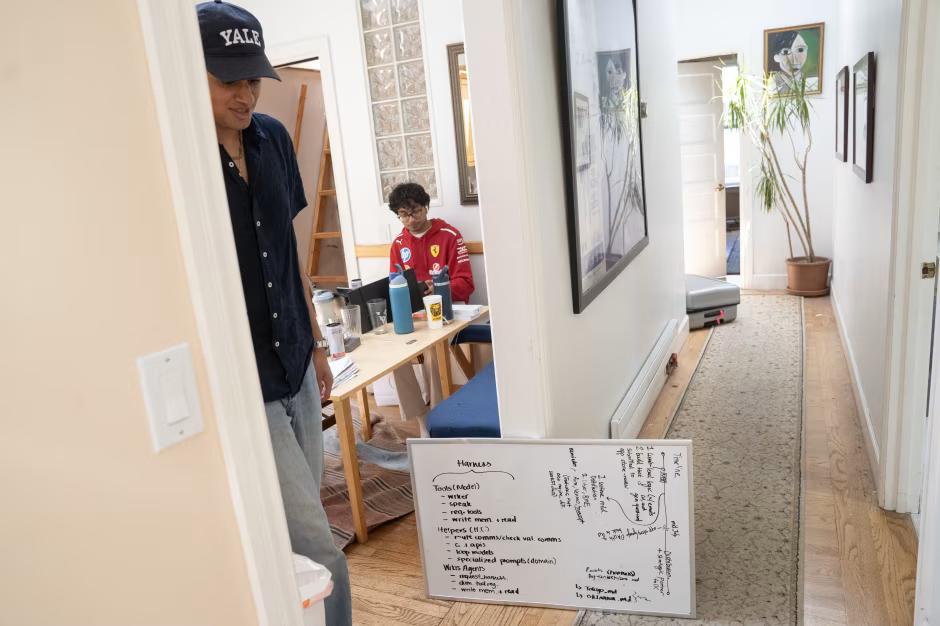
Just four weeks later, not only did he found his own AI startup, but he also traveled all the way to Barcelona to pitch his ambitious idea to potential clients — deploying open-source AI models offline to local devices.
This sense of urgency of being frantically chased by the times even made him make a decision that goes against traditional elite doctrines: take a one-year leave of absence from school.
"Only those who start building right now can have a say in the future landscape," said Charles.
This is by no means a cliché story about "college students rebelling to start a business".
Muehlberger is not an isolated case.
This summer, an abnormal scene emerged in San Francisco: batches of students from the Ivy League, Stanford, and MIT turned down internship offers from large tech companies and Wall Street investment banks, and poured into places called "Hacker Houses".
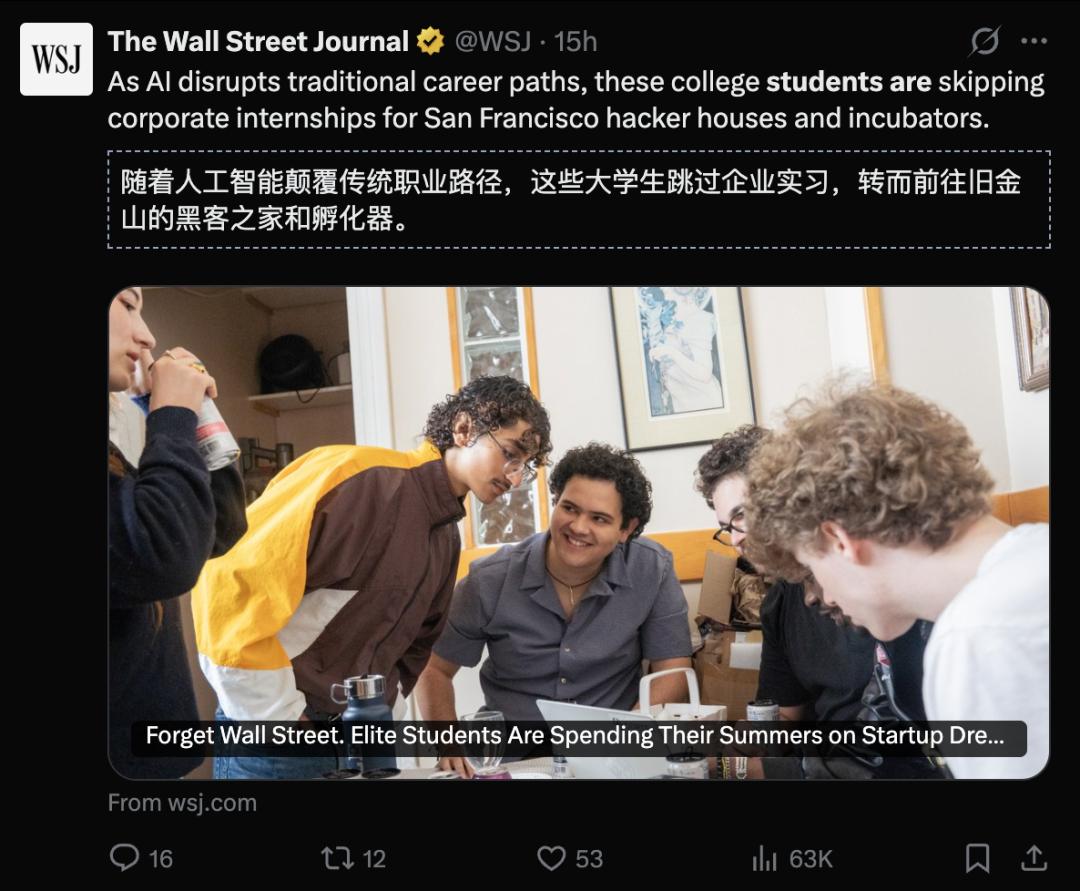
Many of these students are not even sure whether they will return to school after the summer ends.
The foundation of the traditional path has been dug through
For decades, the path for elite college students has been as clear as a highway.
Get an internship at a top company, become a full-time employee after graduation, and climb up the career ladder step by step. Finance, consulting, big tech firms: all three tracks lead to Rome.
This path has even become an identity label.

"I interned at Goldman Sachs" and "I interned at Google" — these sentences hold more weight in the social circles of top universities than GPA sometimes. At alumni dinners at Harvard and Wharton, the first sentence of self-introduction is always about which institution you work for.
The combination of top university and top company has worked flawlessly for decades.
But AI is turning this once rock-solid highway into a road with no destination.
The most direct impact comes from software engineering.
Once, the CS major was a safe haven for STEM students. Master it, get into a big tech firm, and start with a six-figure annual salary in US dollars — it could not be more stable.
The coder culture in Silicon Valley even spawned a whole set of lifestyles: apartments in the Bay Area, Tesla, drinking wine in Napa Valley on weekends. The entry to this lifestyle was an offer from a big tech company.
Everything has changed now. With Cursor, Copilot, and Claude Code iterating round after round, one person working with AI can do the work that used to require three junior engineers.
Therefore, people like Muehlberger made a seemingly crazy choice: instead of being a screw that could be replaced at any time in a big tech firm, it is better to build the machine by yourself.
Bunk beds crowded with smart people
These Hacker Houses and incubators in San Francisco are spread all over the Mission District and SoMa district.

The threshold is surprisingly low, and the facilities are surprisingly complete: free accommodation, mentor guidance, entrepreneur social networks, all fully equipped.
Some incubators even provide small seed funds and legal support, wishing to clear all logistical obstacles for starting a business with one click.
The only cost: to devote yourself fully to an AI startup project.
No salary. No big tech job title. No impressive brand endorsement to put on LinkedIn.
All you get is a bed, a computer, and a group of peers who are as anxious and excited as you are.
The biggest difference from a university dormitory is that no one is assigned here. Everyone voluntarily gives up more comfortable choices and comes to squeeze into bunk beds.
At two o'clock in the morning, the person in the next bed is still adjusting the model parameters. At seven o'clock in the morning, someone is already drawing architecture diagrams in front of the whiteboard in the common area. Half-eaten takeout boxes are piled up in the kitchen, and no one has time to cook.
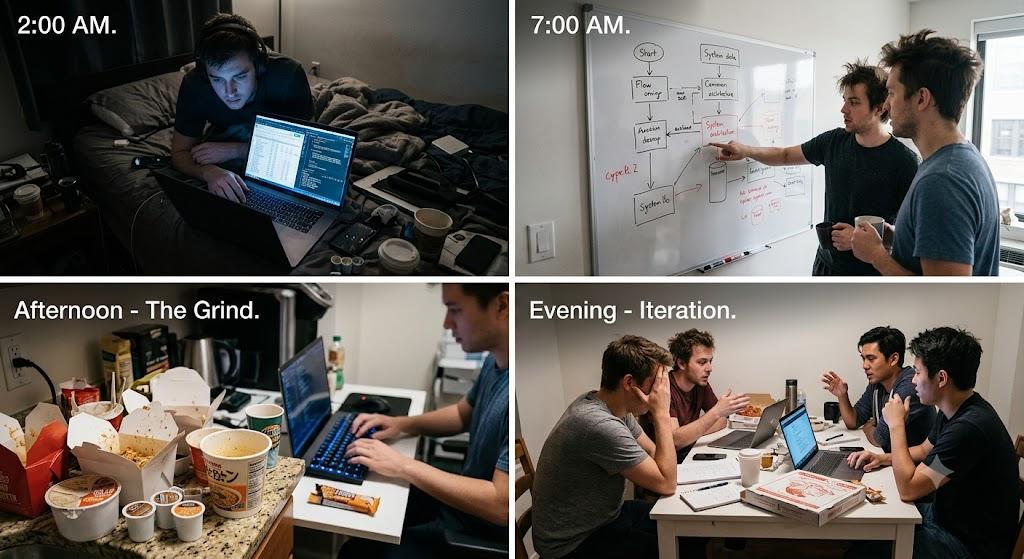
The pace here is completely different from that of big tech firms. Discuss product direction at 9 a.m., conduct tests with real users at noon, write codes and adjust models in the afternoon, review and iterate at night, and revise the plan overnight.
Seven days a week, no weekends. Deliver the demo in one month, meet investors in two months. The pace is so fast that you have no time to doubt yourself.
"What you learn in one month here is more than what you learn in a whole semester of lectures in the lecture hall." This has become a consensus in the Hacker Houses.
One entrepreneur said that universities teach you a knowledge system, while Hacker Houses teach you survival instinct. The gap between the two is the gap between a simulator and live ammunition.
Some projects even receive official support from top universities.
Princeton AI Lab has held entrepreneur roadshows to connect students with investors. Stanford's Startup Term program allows students to start a business full-time for one semester without dropping out.
Universities have also realized an awkward truth: if they do not actively embrace this trend, students will vote with their feet and drop out directly.
There have been precedents last year. Two 21-year-old Ivy League dropouts founded an AI company in the Bay Area and raised millions of dollars in financing within a few months.
Such stories spread extremely fast on campus, more convincing than any enrollment presentation. Every success case is weakening the core narrative of universities: "You need to finish your studies first before you can go out to explore the world."
3% success rate
Having said that, the risks are equally real.
The vast majority of AI startups will die within 12 months.
With a resume that has no big tech internship experience, once your startup fails, it will be harder to get back to the traditional track. The opportunity cost of taking a one-year leave of absence cannot be offset by just saying "I learned a lot".
It is even harder to explain to your parents — when you tell them you are going to give up the Google internship to live in a bunk bed, what you get in return is mostly silence, followed by a video call.
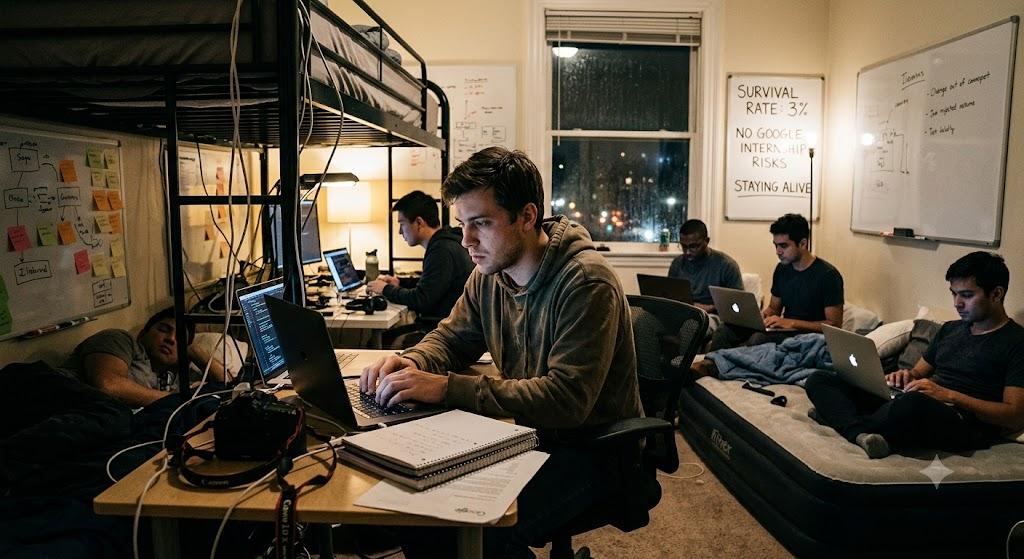
The crueler part is that the Hacker Houses are crowded with equally smart and equally hardworking people.
Do you think you are the one with the best ideas? The Stanford PhD in the next bunk may have already made a better prototype than yours.
The intensity of competition is no lower than any big tech job interview, even higher. Because here, there is no HR to screen your opponents for you, and no structured interview to protect you.
The market is the interviewer, and the product is the answer sheet.
A mentor at an incubator privately told a hard truth: "Out of 100 people here, maybe only 3 can really make something out. But the achievements of those 3 people will make the other 97 people feel that they should have come too."
A 3% success rate. It is roughly the same as the hit rate of early-stage venture capital.
Everyone thinks they will be that 3%.
Fleeing from certainty
Back to Muehlberger.
He is betting on one thing: in the AI window period, speed is more valuable than academic qualifications.
The most thought-provoking part of this collective exodus of elite students is its direction.
It is not fleeing from competition — the intensity of competition in San Francisco is no lower than that on Wall Street. It is not fleeing from pressure — the work intensity in Hacker Houses is no lower than that in investment banks.
What they are fleeing from is certainty.
In the final analysis, the choice of people like Muehlberger is to use one kind of uncertainty to hedge against another. No one knows whether this deal is worthwhile.
But one thing is already clear: the flow of elite talents is undergoing a structural shift. From big tech firms to startups, from stable salaries to equity bets, from the career ladder to the entrepreneurial wilderness.
Anyone familiar with the history of technology will immediately think of 2007. After the release of the iPhone, a group of the smartest young people poured into mobile internet startups. That time, the winners defined the next decade. The losers added a "co-founder" line to their resumes.
This time, the AI window may be shorter and the stakes are higher.
This article is from the WeChat official account AI Era, author: ASI Revelation, published with authorization from 36Kr.