The unsolved problem that Zhang Yitang had been working on has been cracked by OpenAI. Humans joined forces with GPT-6 for two weeks of collaborative research, and the final completed proof is only 5 pages long.
The Siegel zero problem that Zhang Yitang has dedicated decades to cracking has finally been conquered!
A long-standing puzzle that has plagued the number theory community for nearly a century has now been condensed into a proof of only 5 pages.
In 2007 and 2022, Zhang Yitang published two papers to challenge this problem, the last one was 111 pages long, but only a weakened version of the result was achieved.
Just in the past two days, Oxford mathematician Ben Green released a proof that rules out the Siegel zero, which caused a huge stir in the mathematics community.


And these 5 pages came unexpectedly from a "vibemathing" session between Green and ChatGPT 6 Astra, which means he completed the proof while chatting with the AI, and he only rewrote the argument by hand afterwards.
On the first page of the paper, he wrote a sentence: "This paper makes no claim of any human originality."
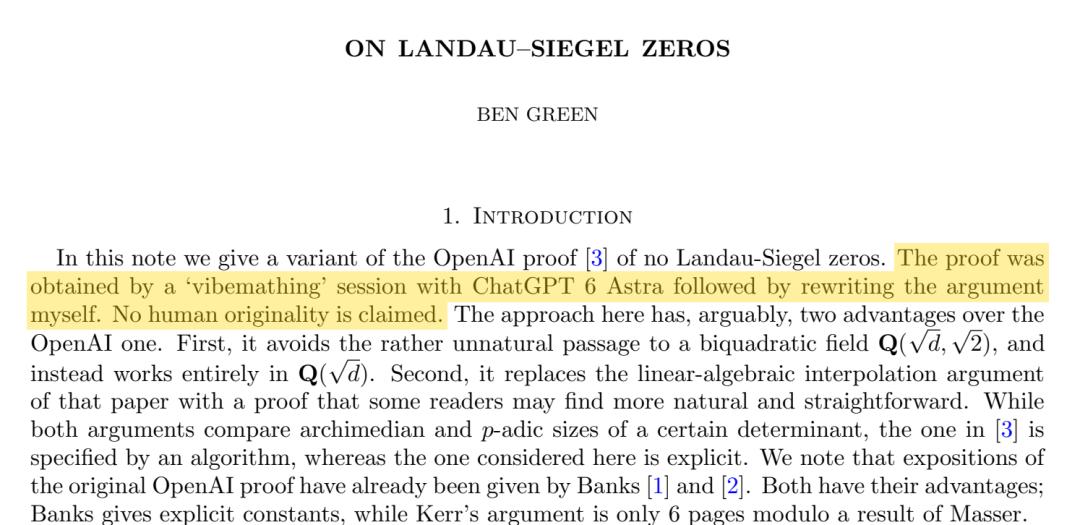
Paper link: https://hexagonmath.org/pdf/2610.00311v1
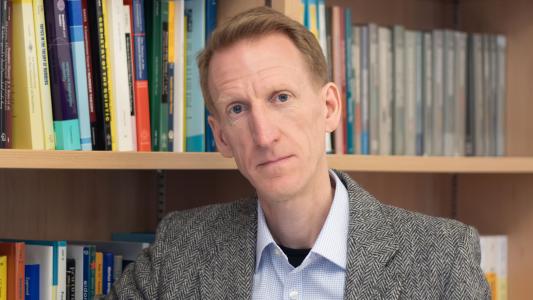
You know, this Green is no ordinary person.
He is the one who teamed up with Terence Tao to prove that arbitrarily long arithmetic progressions are hidden in prime numbers back then.
Just on October 6, an unnamed internal model from OpenAI took the lead in cracking this problem.
After that, mathematicians took over the relay with the help of AI, and it only took 12 days to shorten the proof to 5 pages.

For nearly a hundred years, from Siegel to Zhang Yitang, generations of mathematicians have got stuck on this problem. This time, AI was the first to break through the door, and human mathematicians rushed in right after.
From now on, mathematics is no longer a peak that humans climb alone.
OpenAI kicks off the relay, leading mathematicians race to "reduce the page count"
On October 6, OpenAI released more than 700 mathematical manuscripts at once. Among these lengthy works, there is a very thin paper titled Uniformly Excluding Landau–Siegel Zeros, with a main text of only 8 pages.
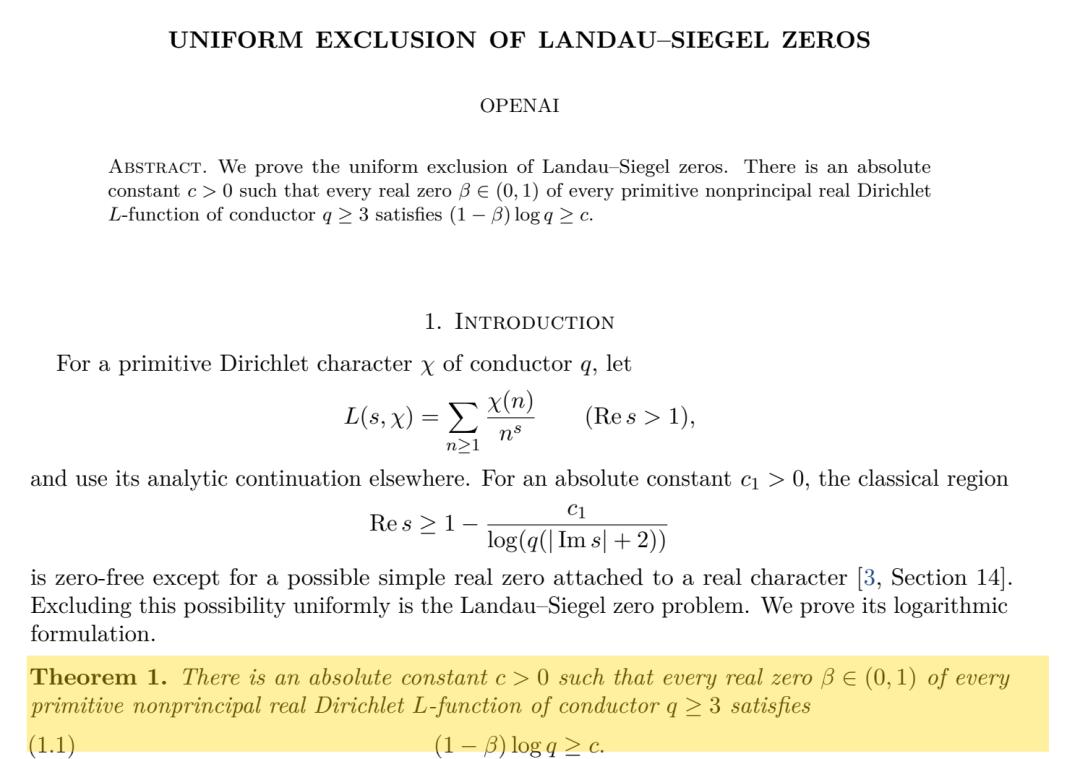
Paper link: https://github.com/openai/math
Only 5 days later, mathematician William Banks from the University of Missouri took the first baton.
He expanded the full argument into a 19-page detailed version, and he also calculated the constant that was only known to "exist" in the original proof as a specific number: 0.003.
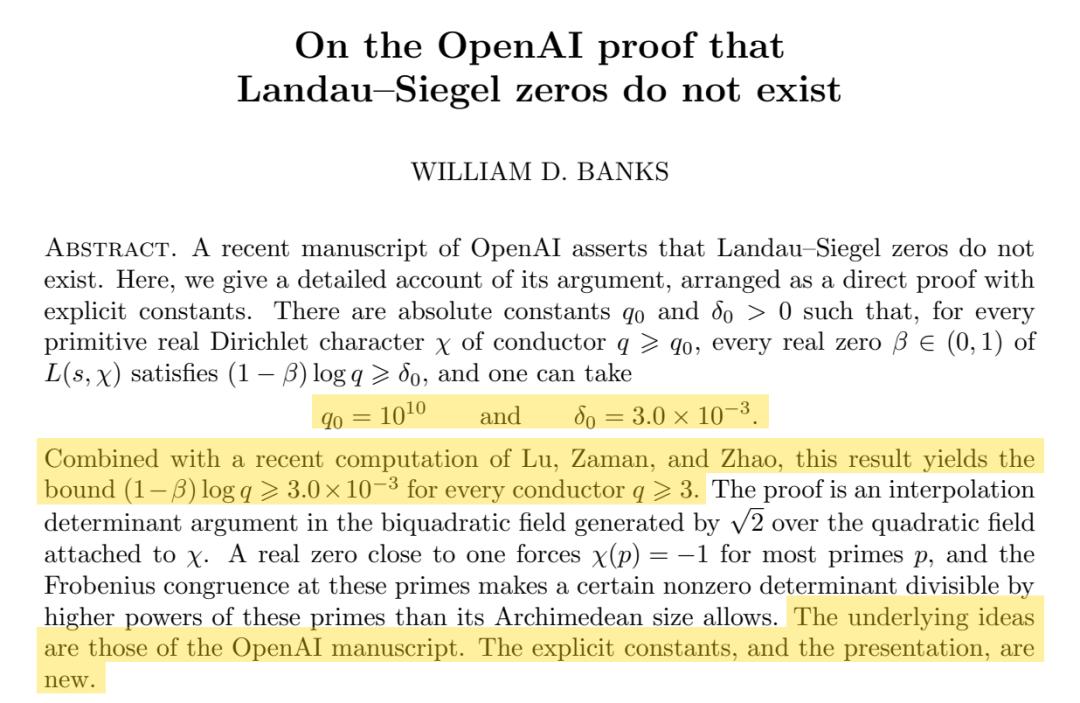
Paper link: https://arxiv.org/abs/2610.15483
4 more days later, Bryce Kerr from the University of New South Wales Canberra cut the proof down to 6 pages with a single stroke.
He replaced the most tedious interpolation and determinant derivation in the original proof entirely with the "pigeonhole principle", which means if you put 10 apples into 9 drawers, there must be at least one drawer with more than one apple.
Kerr explicitly stated in the acknowledgements that ChatGPT participated in the derivation and writing.
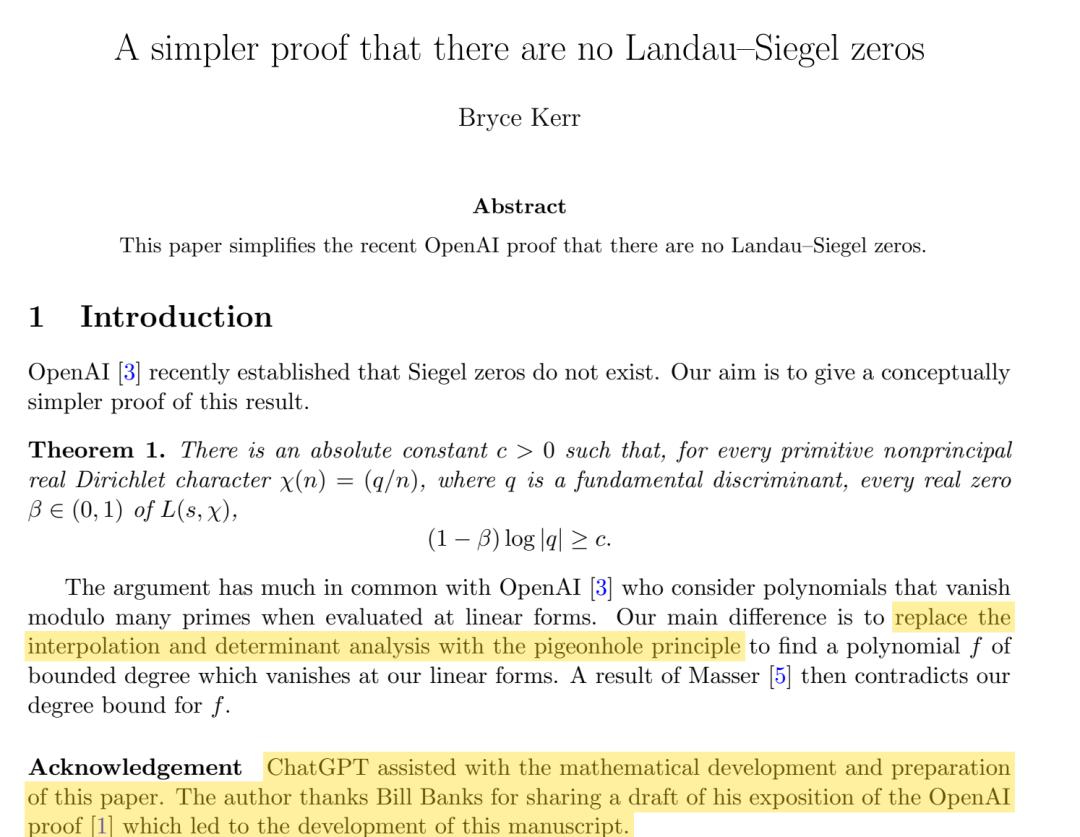
Paper link: https://arxiv.org/abs/2610.21099
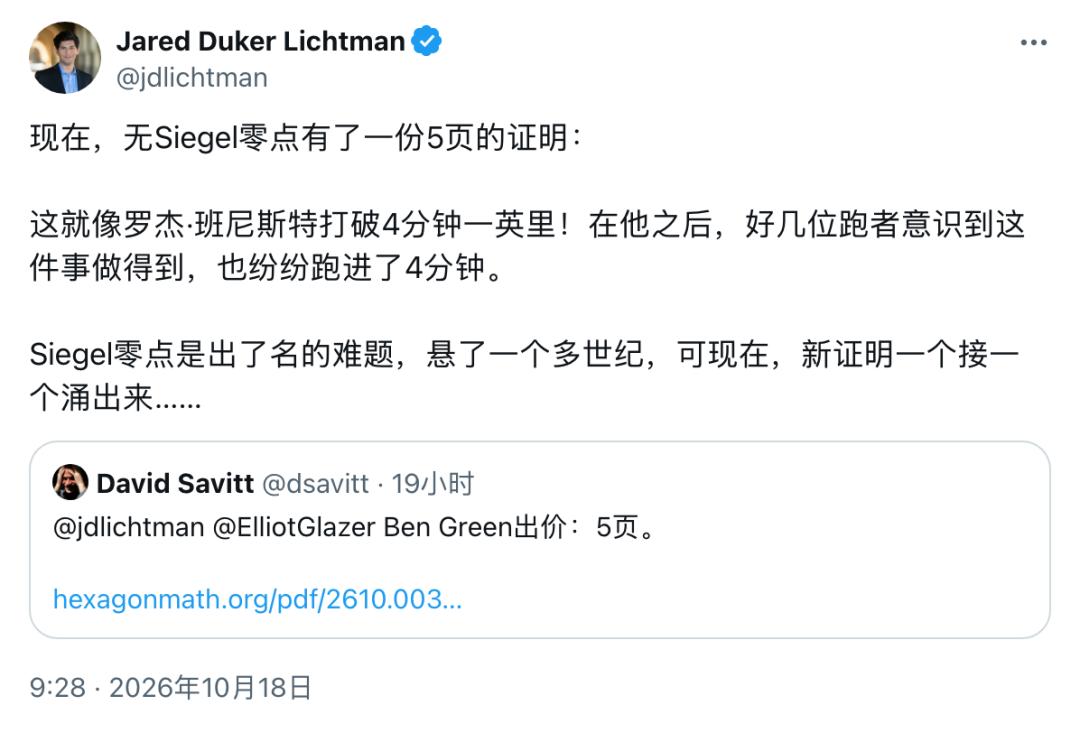
On October 18, Stanford University mathematician Jared Lichtman excitedly reposted Kerr's paper, calling it "perhaps the proof from that book".
The legendary mathematician Erdős often said that God has a book that records the most elegant proof for every theorem.
Lichtman then posted a note, comparing this scene to Bannister being the first to run a mile in under 4 minutes in 1954.
5 pages, banishing the century-old ghost
When mathematicians study the distribution of prime numbers, they rely on a type of tool called the L-function. The farther its zeros are from 1, the more evenly the prime numbers are distributed, yet some L-functions may hide a real zero that is extremely close to 1.
This is the Siegel zero. It is like a ghost: no one has ever seen it, and no one could prove that it does not exist.
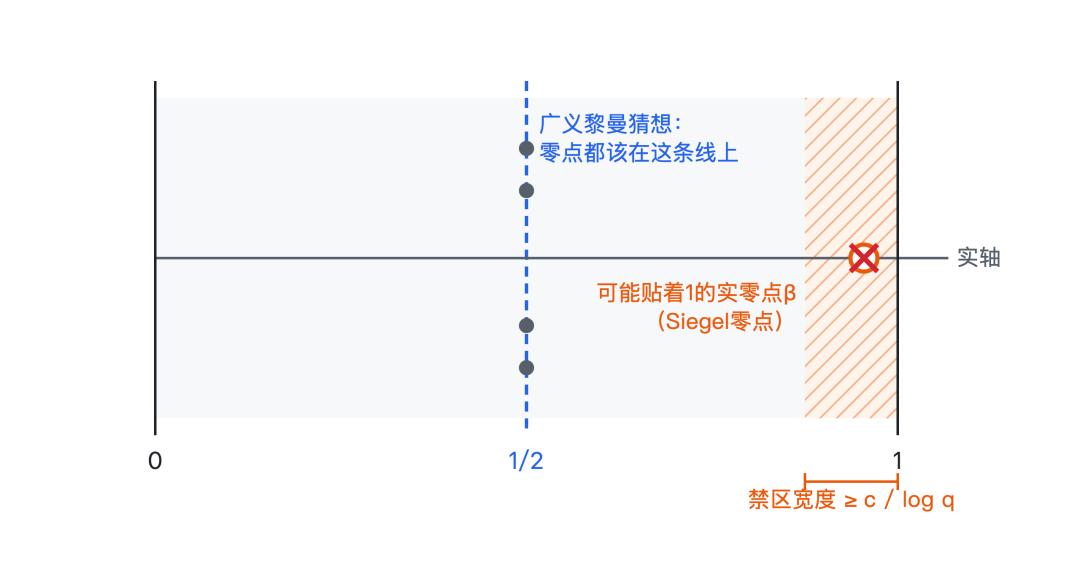
For nearly a hundred years, a large number of theorems about the distribution of prime numbers have had to carry a tail note: "Unless the Siegel zero exists".
In 2022, the bound given by Zhang Yitang's paper was still far from completely banishing this ghost.
And this time, OpenAI proved that this kind of zero that is extremely close to 1 does not exist at all.
In other words, there is at least a certain distance between all zeros and 1, and the ghost has nowhere to hide from now on.
This is not yet the Riemann Hypothesis, but for researchers of classical analytic number theory, this ghost has stuck for generations.
Green's 5-page proof uses the method of contradiction. Assuming the ghost exists, we can deduce an impossible integer.
If the ghost exists, most small primes will be forced to stand on the same side. Green uses these primes to construct a huge positive integer det G, which has an upper bound on its size.
The key step is like looking in a mirror. Raise these primes to the p-th power, √d becomes -√d, and det G is divisible by them layer by layer, so it has to get larger and larger.

On one side is the upper bound, on the other side the lower bound is getting higher and higher. The lower bound exceeds the upper bound, a contradiction arises, and the ghost disappears.
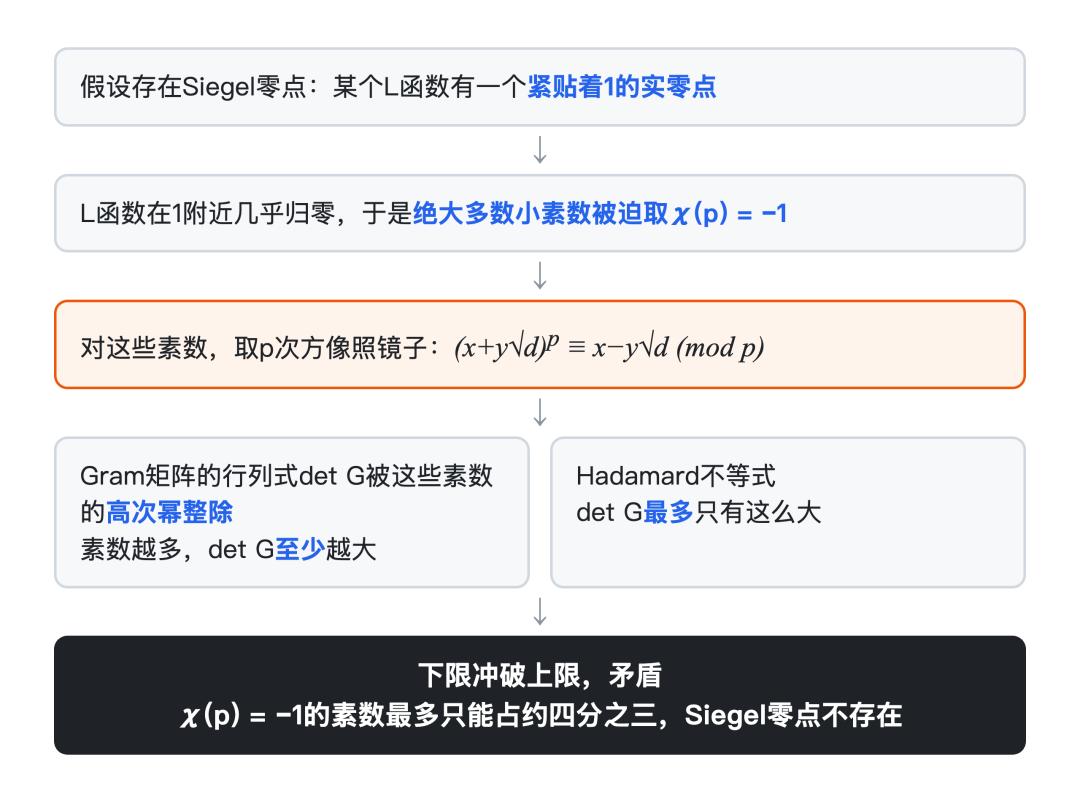
Compared with the original OpenAI version, Green only works in a smaller number field throughout the whole process, and the determinant is directly written as an explicit expression.
His research project was preempted by AI, and he personally wrote these 5 pages
This breakthrough directly hit Green himself. In June, he just received a senior grant from the European Research Council. 4 months later, approximately three quarters of the research goals were conquered by AI.
He wrote in the collective call for papers from the mathematics community Proofs and Prompts:
I didn't expect some of these achievements to be of such a huge scale, which shocked me a lot.
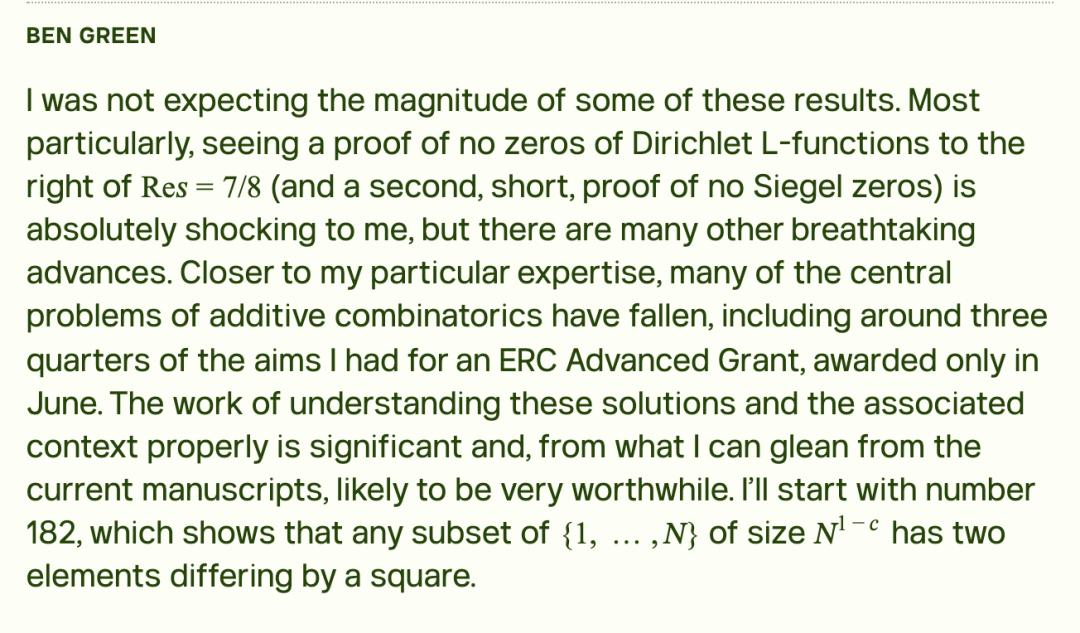
Most of the project was taken over by AI, but Green's reaction was unexpected:
There is no shortage of ideas at all. In a sense, precisely because the scale of the achievement is so huge, the pressure is gone instead.
Terence Tao was not so relaxed. What he feels distressed is that no one behind these AI proofs can answer questions, give lectures, supervise students, or participate in subsequent development.
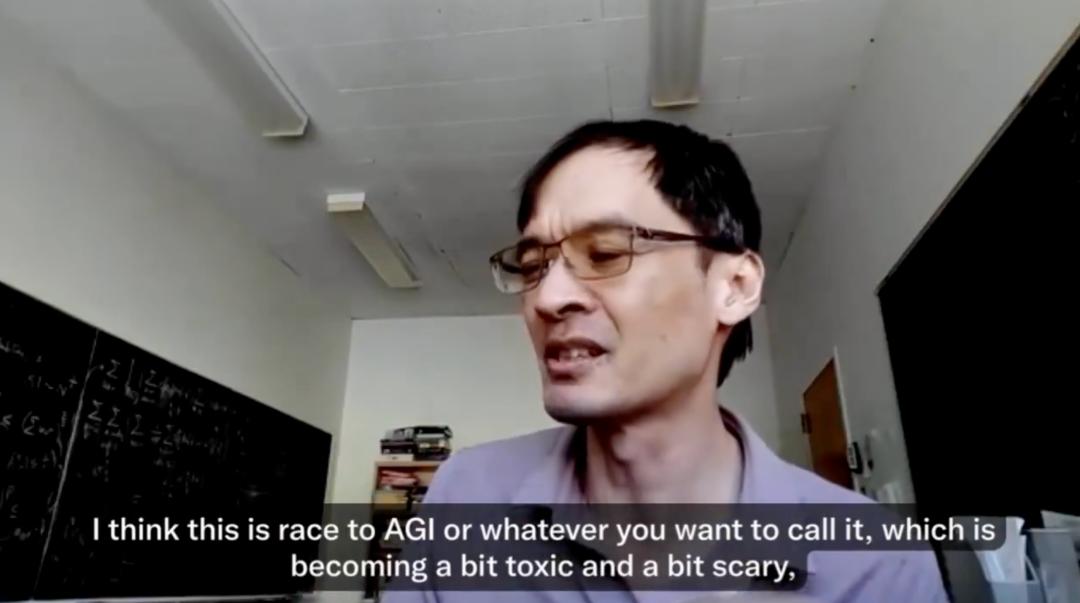
In less than two weeks, the subsequent development really came, and AI is still involved all the time. Kerr's acknowledgements mention ChatGPT, and Green even stated on the first page that he makes no claim of any human originality.
The human mathematicians who took over this proof now do the work of understanding, rewriting the AI's proof, and explaining it to more people.
A top mathematician who proved the Green-Tao theorem has become a rewriter of AI's proof. No one could have imagined this scene a year ago.
It only took 12 days to conquer the century-old problem
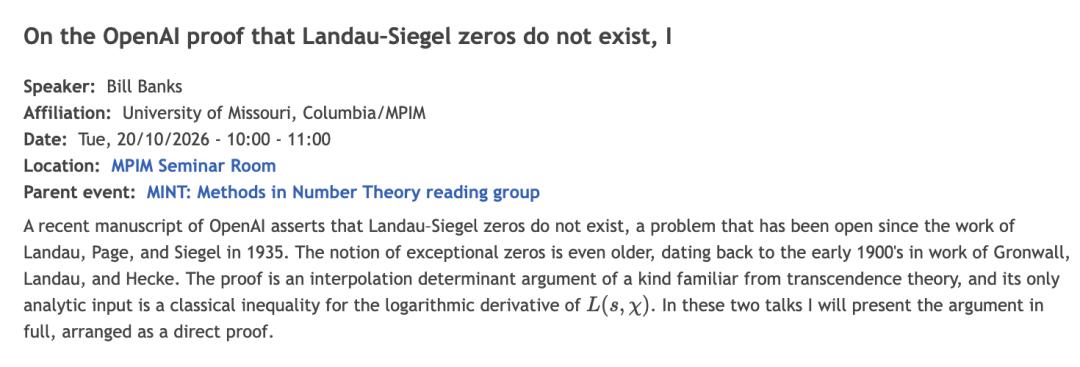
On October 20, Banks will give two lectures at the Max Planck Institute for Mathematics in Bonn, Germany, to explain this proof to his peers from beginning to end.
This problem that has been unsolved since 1935 has thus moved from AI's manuscript into the lectures of mathematicians.
Abhishek Saha, professor of mathematics at Queen Mary University of London, said after reading these versions of the proof that researchers of classical analytic number theory have been stuck on this problem for many years, and everyone thought it was incredibly difficult.