Are e-commerce women's clothing sellers and buyers conducting a cyber hedging with AI?
On the weekend, Ba Mei planned to buy several new autumn outfits. After browsing dozens of stores, she felt increasingly weird: the real-person seller shows in women's clothing stores had unexpectedly turned into AI-generated shows. Some AI models for women's clothing have no heads, while others have three arms. When she opened the comment section, the buyer shows also had a distinct AI-like vibe.
For a moment, she suspected that her shopping app had been attacked by AI. After searching on Xiaohongshu, she found that she was not the only one who encountered this situation. Recently, AI models have been flooding into the product detail pages of clothing on e-commerce platforms, and the use of AI models is particularly common in the women's clothing industry. Some netizens complained: Are the women's clothes nowadays made to sell to AI?
Collective "Mutation" of AI Women's Clothing Models
On e-commerce platforms, a large number of surreal women's clothing product images that break immersion are being launched in batches. When an AI women's clothing model turns around, the back of the figure still shows the front of a human body; one arm disappears, but grows out from the other side of the body; when the same style of clothes is changed to another color, the model's movements and expressions are exactly the same. Even more horrifying are the model images with "no head" or "three hands". In the display images of some stores, the portrait hanging in the gallery behind the model looks exactly like the model, even the radian of the raised corners of the mouth is almost identical. Some netizens complained that "you will have nightmares if you scroll through these images at night".
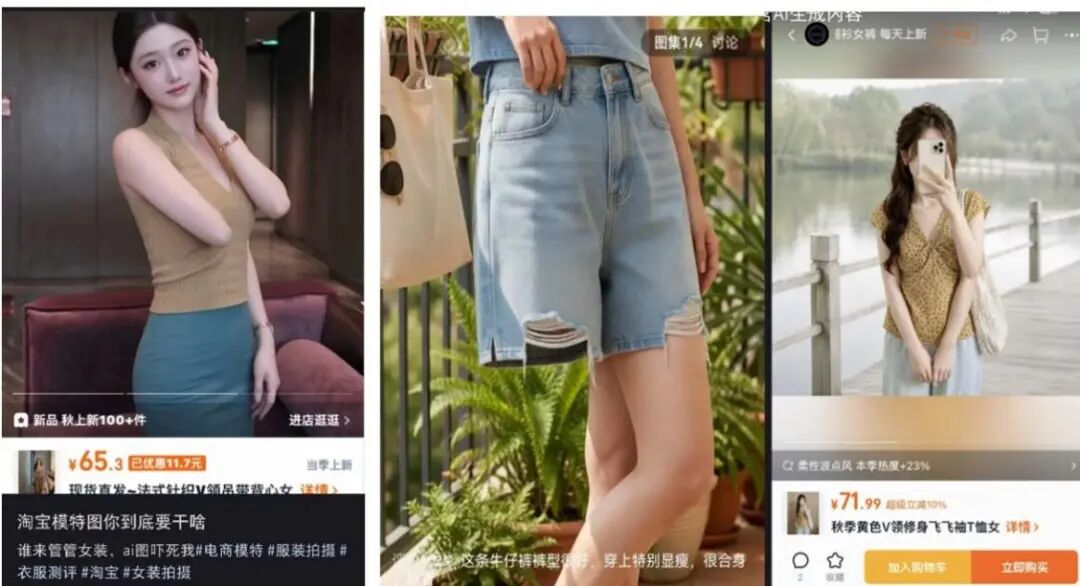
When asking customer service, most of them said the product images were shot in real life, and even reported the model's height and weight, but avoided talking about the parts that do not conform to the human body structure. Some customer service staff even asked buyers in reply: "What's wrong? The real product is like this." If the real product really looks like that, the clothes would have to be worn by characters from *Classic of Mountains and Seas*.
What is more fatal than the weird body structure of AI women's clothing models is that there may be no real product at all. The new style of women's clothing that buyers are looking at may just be a design drawing.
A women's clothing designer revealed that in the past, to launch new products, merchants had to make real patterns and sample clothes, then find five, six or even seven or eight models to shoot the upper body effects of different body sizes. A cheap pattern costs two to three hundred yuan, and for a complex pattern with imported fabric, making seven or eight patterns can cost tens of thousands of yuan. Now that "AI makes everything look good on", merchants can skip making sample clothes, directly generate product images to launch for pre-sale, and start production after collecting enough orders. The "perfect outfit" on the detail page may not even have a single loose thread made yet.
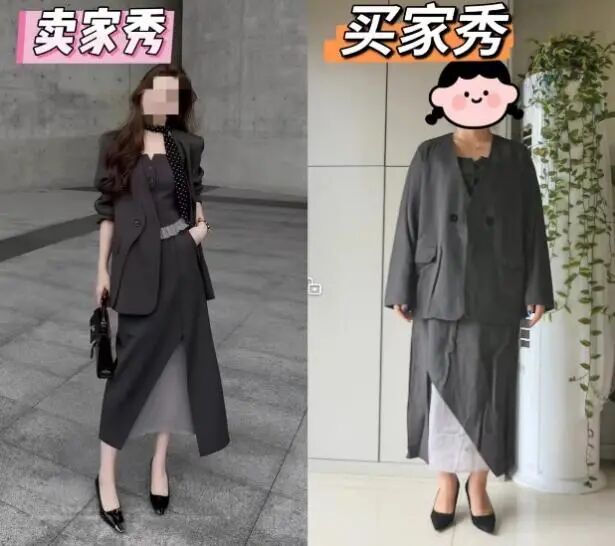
In addition, AI often "optimizes" clothing design composition, fabric, texture and pattern casually through algorithms, or even generates them out of thin air, so the final product often differs drastically from the real item. Many netizens complained: "As soon as I see an AI-generated image, I lose the desire to buy." Some curious netizens placed orders for the women's clothing shown by AI models, and after receiving the goods, they found that the buyer show and the seller show are completely different.
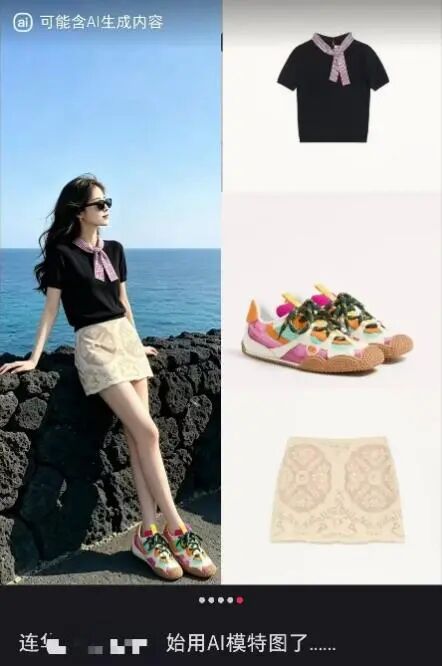
Do you think you can avoid AI model images by spending a lot of money? Some netizens naively thought that "there will be no AI images when buying luxury goods", but some consumers found that AI models have quietly appeared in the promotional images posted by luxury store sales associates on their WeChat Moments. From affordable women's clothing to luxury shop windows, AI women's clothing models are almost ubiquitous.
One-click "Hole" for Socks, Buyers Get Full Refunds Without Returning Products Easily
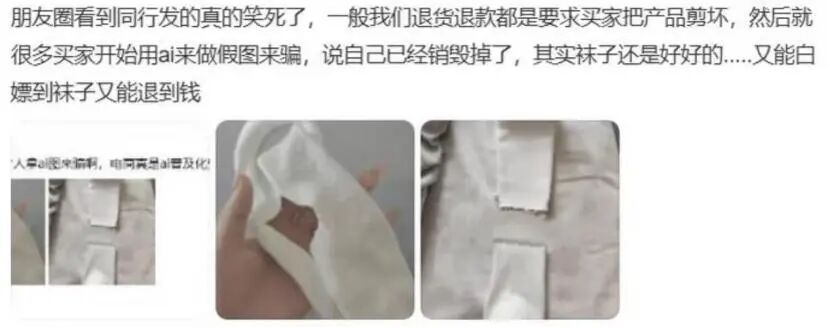
Merchants use AI image generation to cut costs, while buyers use it to apply for full refunds without returning goods. A fake image costs almost nothing, but one refund can offset the profits of several orders. AI has lowered the threshold of "counterfeiting" to the level of socks that cost only a few yuan a pair.
"Some images are obviously AI-generated, but the guests refuse to admit it. When I ask them to shoot a video from another angle, they are unwilling, and keep insisting on a full refund only. Some people even send the images over without cleaning up the watermarks." The complaint from Yaoyao, a customer service staff of a clothing store, is the daily experience of countless merchants. A customer claimed that the neckline of the dress was severely frayed, but in that image, the light angle of the frayed part was obviously inconsistent with the light and shadow of the whole dress, and the edges still had typical traces of AI generation.
Lin Wei, who runs an online sock store, has suffered huge losses from this practice this year. The number of full refund requests increased by 20 to 30 percent compared with last year, and the 2.8-yuan "welfare" plush home socks became the hardest hit area. Fraying, holes, stains were all images forged by AI. At first, her mother helped her handle after-sales issues, and suspected there was a problem with the goods after finding several orders with "similar problems", until she checked the backend and realized what was happening. "We only earn two or three yuan per sock order. If we have several full refund requests a day, we work for nothing the whole day."
Ms. Yu, who sells toys, feels even more aggrieved. For a 167-yuan plush doll, the buyer claimed it was "broken" and "peeling off", and in the photo, the doll's tail was cracked like peeling wall paint. She immediately fed the image to an AI tool for identification, and the AI returned the result: the image was modified by AI, and the material has obvious traces of digital generation. But the platform still refunded 50 yuan first. She repeatedly appealed, and with the intervention of the media, she finally got the money back.
The "full refund without return" rule has been tightened in the past two years. In April 2025, several major platforms successively canceled the platform-initiated "full refund without return" policy, and let merchants handle the disputes on their own. But in categories such as fresh food and small goods worth only a few yuan, where "returning goods costs more than the goods themselves", the loophole still exists, which has become a hotbed for buyers to use AI to generate fake images for full refunds.
After the AI Magic Collision Between Sellers and Buyers
Forced to a corner by the AI-modified image full refund fraud, merchants began to "use AI to verify AI". Some require that claims for high-value goods must provide multi-angle videos, some feed the original buyer images to AI tools for "checkups", and others simply cancel the "full refund without return" policy, and all quality disputes are subject to the return process.
At present, the most serious consequence for buyers who use AI to modify images for full refunds is facing court judgment.
From October 2025 to January 2026, Tan Moumou frequently placed orders for high-value fruits such as durians and cherries on the platform. After receiving the goods, he used AI to modify the images, turning the intact fruits into rotten and moldy ones, so as to apply for full refunds without returning the goods, and then resold the intact fruits. In four months, he made more than 100 malicious refund applications, involving a total value of 16,070 yuan. The court convicted him of fraud, sentenced him to one year of fixed-term imprisonment, and imposed a fine of 5,000 yuan.
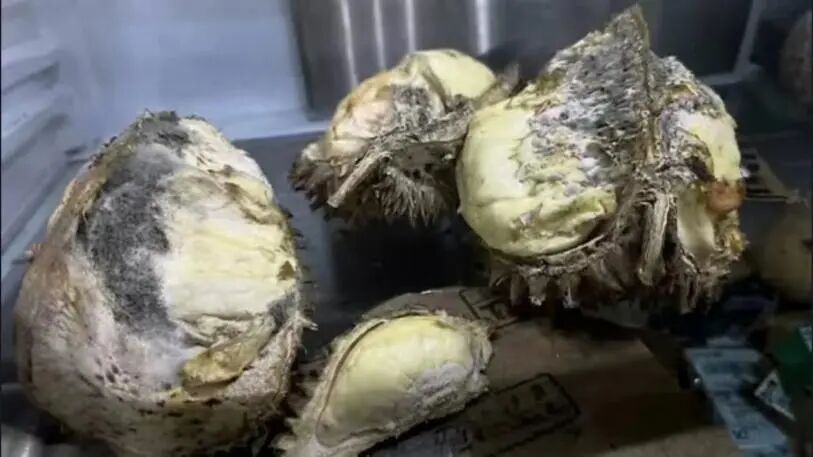
The legal red line for buyers is very clear. Using AI to forge damaged images to apply for refunds may at least constitute civil fraud and public security punishment. If the accumulated amount reaches 3,000 yuan, it may be suspected of the crime of fraud. If the "wool" you "scraped" through AI accumulates to 3,000 yuan, you might end up "scraping" yourself into a detention center.
On the other hand, regulators are not idle when it comes to the fake AI images used by merchants. In March 2025, a platform released the governance rules for fake AI images. After accessing the recognition model, it has blocked nearly 100,000 fake images in total, and added AI synthesis reminders on the product detail pages. On September 1, 2025, the *Measures for the Identification of Artificial Intelligence Generated Synthetic Content* came into effect, requiring that all AI-generated content must be marked. The Guangzhou Intermediate People's Court also heard a case: the difference between the AI promotional images and the real product in terms of pattern and version "far exceeds the boundary of 'reasonable beautification', 'moderate image editing' and 'minor difference'", which constitutes consumer fraud.
After fighting wits and courage with AI women's clothing models for a long time, Ba Mei finally went to physical stores and bought autumn clothes that she can see and touch. AI can help merchants save the cost of models, sample clothes and image editing, but it loses consumers' trust. When a piece of clothing only exists in AI images, what buyers see through the screen is just a picture, and their desire to buy has long been scared away. At the end of the day, what women's clothing sellers need to sell is not AI, but trust; and trust cannot be edited out by AI, it has to be sewn stitch by stitch slowly.
This article is from the WeChat official account "Financial Gossip Girl Channel" (ID: baguanvpindao), written by Zhi Zhi, and published with authorization from 36Kr.