The flying magic car show cannot save Tesla's core business fundamentals.
Pulling off such a grand stunt, does it mean that the upcoming Q3 financial report will be a total flop?
On October 15, 2026, at SpaceX's rocket test site in McGregor, Texas, Tesla's second-generation Roadster charged up an arc-shaped ramp, drove upside down against the slope by using negative pressure generated by fans under the chassis, then ten cold gas thrusters ignited, lifting the whole car off the ground to flip before it landed steadily back on the ground.
The show that day was undoubtedly spectacular, but when I talked with friends, the only thought that popped into my head was the line above.
There are three things worth noting about the second-generation Roadster. This car will not go into mass production until 2028, more than ten years after the prototype made its debut in 2017. Elon Musk himself admitted that this car will not have a significant impact from a revenue perspective. The person sitting in the driver's seat during the demonstration was not a human, but an Optimus robot.
A company that uses a flying stunt which cannot be mass-produced, cannot be driven on public roads and does not contribute to revenue to grab attention one week before its earnings release has practically shown its cards.
Product launches can be full of gimmicks and marketing can be all for show, but financial reports can hardly lie. As expected, at Tesla's 2026 Q3 earnings call six days later on October 21, the result was a flop — the revenue hit 28.046 billion US dollars, a slight year-on-year drop of 0.2%. While the GAAP net profit was only 787 million US dollars, down 43% year on year.
Looking through this quite important annual Q3 financial report disclosed later, I can even draw such a conclusion — this is undoubtedly the worst Q3 earnings report of Tesla in the past six years, and it may also be the best-looking Q3 financial report in the next few years...
Tesla is no longer just a "automaker"
If we put together Tesla's eight third-quarter financial reports from 2019 to 2026, the shape of the curve is very clear.
The revenue rose all the way from 6.303 billion US dollars in Q3 2019 to 28.095 billion US dollars in Q3 2025, marking a 3.45 times increase in eight years.
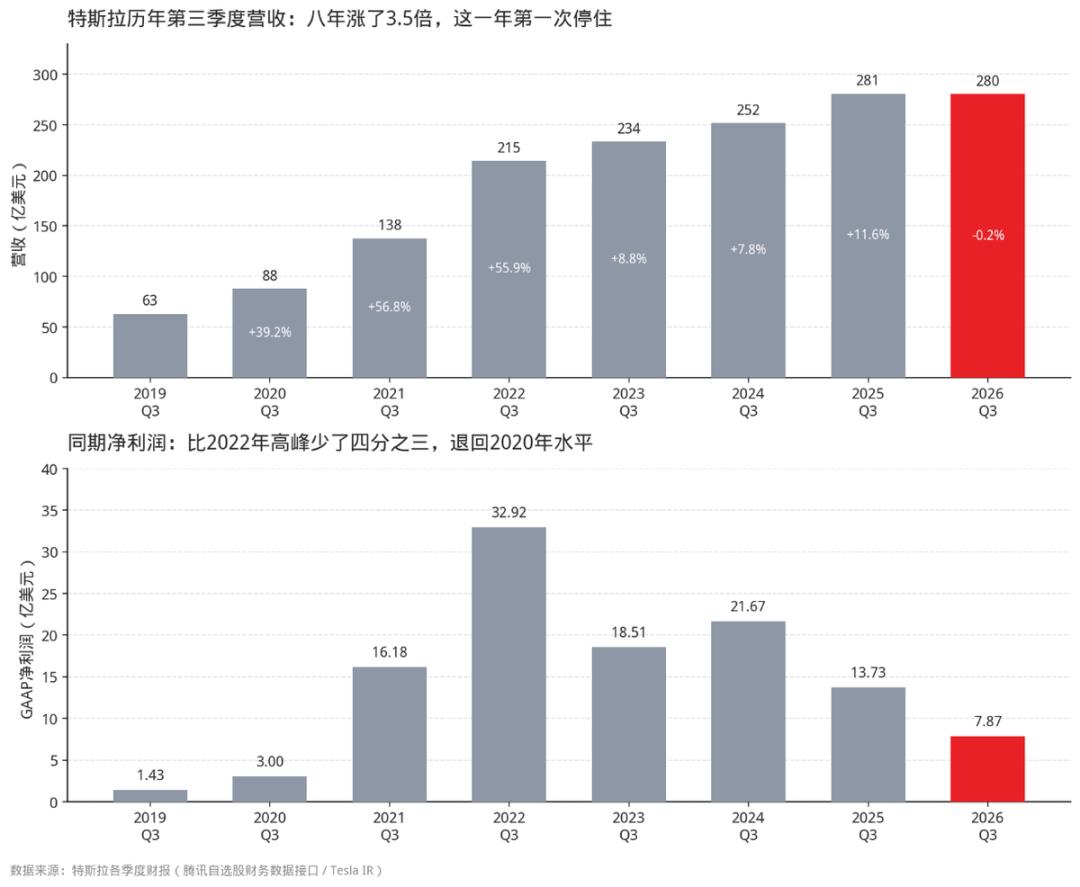
The three years with the fastest growth rate were from 2020 to 2022, at 39.2%, 56.8% and 55.9% respectively. The growth rate dropped sharply to 8.8% in 2023, 7.8% in 2024, 11.6% in 2025, and turned negative for the first time in 2026 with a 0.2% decline. As for the net profit curve, it looks even worse.
Q3 2022 saw the historical peak of 3.292 billion US dollars, the figure dropped to 1.851 billion in Q3 2023, rebounded to 2.167 billion in Q3 2024, stood at 1.373 billion in Q3 2025, and only 787 million US dollars remained in Q3 2026.
This figure has fallen back to the range between the 300 million US dollars recorded in Q3 2020 and the 1.618 billion US dollars in Q3 2021, three quarters lower than the peak four years ago.
The automotive business generated 20.560 billion US dollars in revenue this quarter, down 3% year on year, accounting for 73.3% of the total revenue. Undoubtedly, this is still Tesla's largest income source at present, and it is also the key business responsible for cash flow support for a long time in the future. But its growth has undoubtedly come to an end.
The problem with the product line is obvious: there has been no outstanding product since the Model Y, and the Cybertruck has been proven by time to be a total letdown — among all 486,532 new vehicles delivered this quarter, 478,237 units are Model 3 and Model Y, accounting for 98.3%. The sum of "all other models" is only 8,295 units.
Considering that the last Model S/Y rolled off the production line at the Fremont Factory on May 10, this "all other models" is probably only the Cybertruck. The failure of this product does not need further debate.
In Tesla's original future plan, the Cybertruck held a lofty position. Musk once set an annual sales target of 250,000 units, and the market frenzy at the beginning of the product launch seemed to prove the potential of this product. However, the protracted development and mass production process, as well as the performance far reduced from what was promised at release, completely exhausted users' patience and enthusiasm — 38,965 units were sold across the United States in 2024, and the delivery volume in 2025 was directly cut in half to 20,237 units.
As for 2026, those who do not follow relevant news may find it hard to believe that under such circumstances, the price of this car was raised in the second half of this year! The dual-motor version rose from 59,990 US dollars to 74,990 US dollars in August. This is of course not a business adjustment driven by strong demand, but a last resort to maintain gross margin amid severe nationwide inflation.
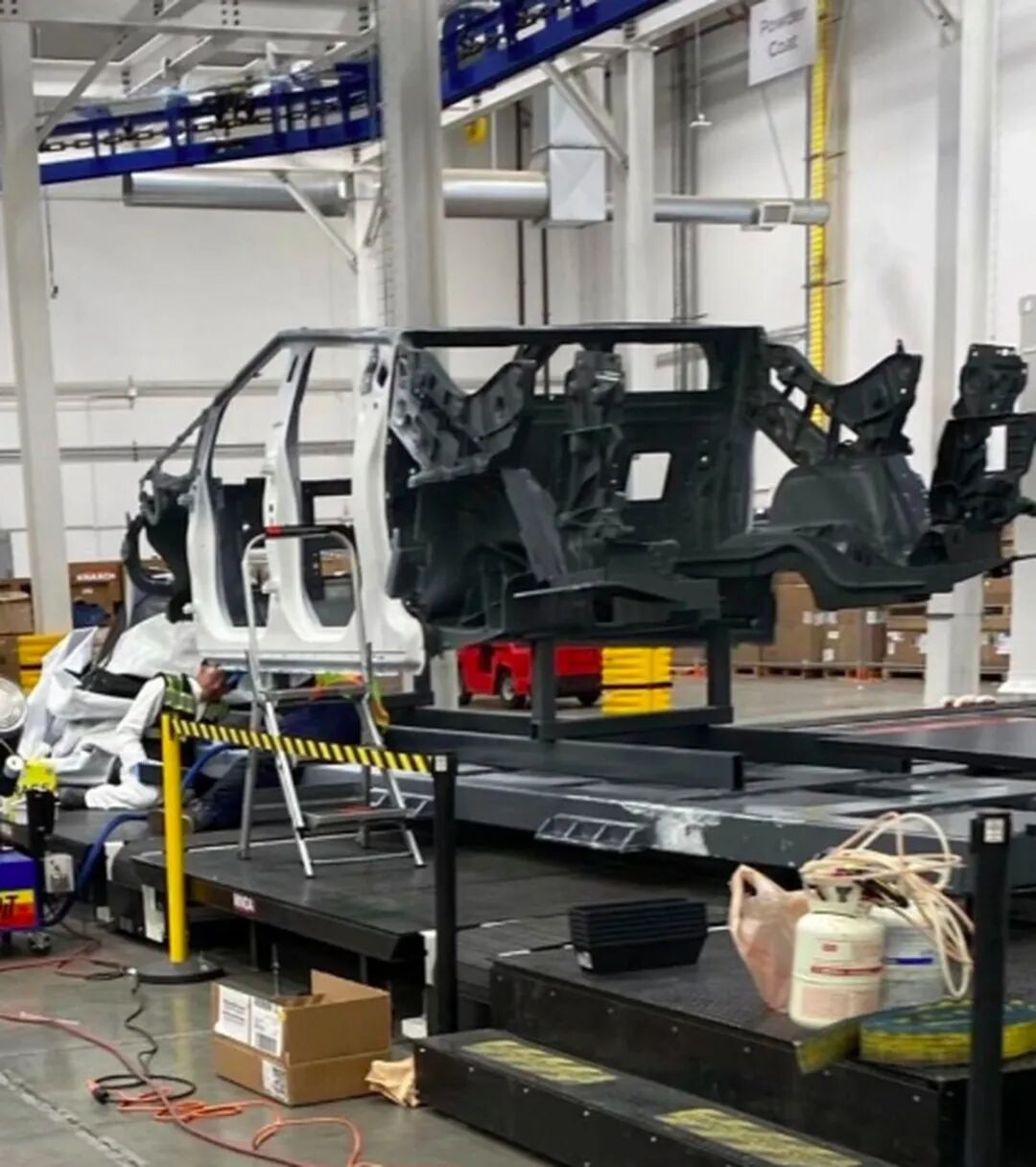
Figure丨The process of changing from the initially claimed "exoskeleton" mode to a conventional structure with large-scale die-casting process is the fundamental reason why Cybertruck took so long to go from concept to mass production
The highly anticipated affordable Model 2, the 25,000 USD vehicle revealed at the Battery Day on September 23, 2020 with the internal project code Redwood, was reported by Reuters in April 2024 that the project had been axed. Although Tesla rarely publicly denied it on the same day, the total silence for six years since 2020 has fully proved the authenticity of the report.
But car manufacturing is still critical for today's Tesla. Because this business contributes more than 70% of the company's revenue, generates billions of US dollars in operating cash flow, and supports the 2.761 billion US dollar quarterly R&D expenditure. However, with the discontinuation of flagship products and the termination of new model projects, this business only exists to maintain the status quo.
The target of 5 million units by 2030, compared with the delivery volume of 1.3247 million units in the first three quarters of 2026, requires the production capacity to nearly triple, which is more like a perfunctory statement to the capital market rather than a production scheduling plan. Car manufacturing is now Tesla's cash cow, but it is clearly not the future of the enterprise.
FSD's entry into China in the third quarter is completely hopeless
Since the test was launched in China at the end of last year, the progress of FSD entering the Chinese market cannot be said to be zero. After all, on May 21, 2026, Tesla's official website listed China as an FSD-available region. Although the customer service of the China region immediately clarified that being listed as an available region does not mean immediate opening, and the actual gray-scale test in China only covers about 5,000 vehicles.
Up to now, large-scale push has not happened, the subscription model has not been launched, and the one-time purchase price of 64,000 yuan remains unchanged.
Although the rapid entry of FSD into the Chinese market is almost an insurance that can stably maintain Tesla's cash flow and revenue for the company that has made up its mind to "shift focus away from car manufacturing". Unfortunately, the collection of related updates has directly become a compilation of delay excuses.
In November 2025, Musk said that full approval in China would probably come in February or March 2026. In January 2026, he changed his words and said "as soon as next month". But in April 2026, CFO Vaibhav Taneja moved the target to the third quarter at the Q1 2026 earnings call. Now the third quarter has passed, at the October 21 earnings call, the statements of the two people were only vague remarks such as "working hard to strive for it" and "maintaining cooperation with regulatory authorities".
No new timeline was given. What is more noteworthy is Musk's self-evaluation this time. He admitted frankly that local Chinese automakers have fierce competition in the field of autonomous driving, and Tesla has not yet truly established a leading advantage. This statement, coming from a CEO who just claimed that FSD has no real competitors among the models on sale, is a clear contrast.
There are three implications: first, admitting that Tesla is no longer a technical benchmark in the Chinese market; second, creating a buffer for the delay of FSD's entry into China; third, quietly shifting the moat from technical leadership to license access. It is worth affirming that in the face of such a difficult situation, Elon Musk did not try to force a face-saving excuse like many of his fans.
The first obstacle leading to the current situation is hardware. All new cars sold in China are now equipped with 720TOPS HW4.0, but a large number of old cars are equipped with 144TOPS HW3.0, which cannot run the latest end-side model. The cumulative global FSD mileage has exceeded 16.1 billion kilometers, while the local data stored in China is only about 3 billion kilometers, five times less than the global total, and cannot be merged into the global training pool due to the regulation that data cannot leave the country.
The primary problem that has stalled the current progress is related to security, and it is national security. At the same time, Tesla has a firm attitude of acting purely on business terms. Therefore, in order to provide physical and practical guarantees for well-known issues similar to "pagers can not only receive information but also explode", Tesla has independently built a data center and AI training center in Lingang, Shanghai. This effort has been proven effective, and the official security certification for "four types of data" has been passed. But the cost is that the Chinese version of the model is isolated from the main North American model.
But the bigger problem lies in the principle level of the entire system.
From the perspective of national standards, the new mandatory national standard GB 47955—2026 will be implemented on January 1, 2027, which is China's first mandatory national standard for L2 level autonomous driving. As for GB 44721—202 for L3 and L4 levels, it will be implemented on July 1, 2027. The new regulatory audit has shifted from clause compliance to full-chain safety demonstration, requiring every steering and braking decision to be traceable and auditable. The problem with FSD is that it does not have a modular split of perception, planning and control, which makes it inherently difficult to meet the official compliance requirements. Local Chinese competitors, such as Huawei and XPeng, adopt a hybrid architecture of end-to-end plus rule-based fallback, which retains white-box logic and makes compliance much easier.
In addition, on the issue of public safety, since the serious fatal car crash accident involving Xiaomi last year, the authorities have strictly stipulated that all major version updates related to driving assistance must be reported in advance and complete a full set of safety assessments. The high-frequency OTA that happens once a week in North America has no room in China. This also leads to the fact that even though the gray-scale test has been launched in China, the version gap between the domestic version and the foreign version has widened. The domestic version is still the V13 basic version, while the North American version has risen to V14.3.3, with a huge difference in the number of parameters.
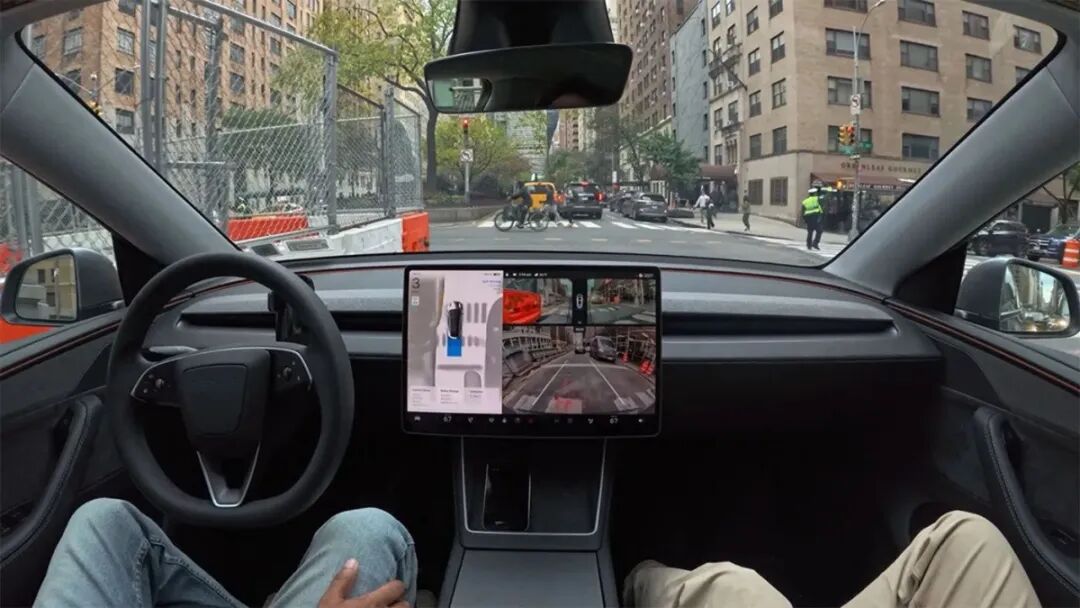
Figure丨When the v14 version was launched, Musk once bragged that the so-called AI had "gained consciousness"...
If Tesla does not find a way to solve this problem, even if FSD can land in China in the future, it will definitely not be able to compete with local competitors.
Of course, FSD has achieved substantial growth in other markets at present. It currently has about 1.74 million paying users worldwide, a year-on-year increase of 67%. More than 75% of new cars delivered in North America are equipped with paid FSD, and subscriptions account for more than half for the first time. In addition, 9 countries in Europe have approved its launch. This part of revenue has been included in the gross profit of new car sales, and the gross profit margin rose from 16.3% in the previous quarter to 18.1%.
There is no doubt that FSD is Tesla's only AI business that generates large-scale cash flow at present, and it is also the only story with specific figures to tell during the transition period when Cybercab and Optimus are not ready. However, it cannot support the full weight of the 1.52 trillion US dollar market value. Being locked out of the world's largest electric vehicle market itself is lowering the ceiling. If the most important section of a bridge is not built, what it connects is not the future, but a dead end.
Cybercab and Optimus cannot take on major responsibilities for the time being
After the market closed on October 22, Tesla's share price stood at 385.80 US dollars, with a total market value of 1.52 trillion US dollars and a price-earnings ratio of 425 times. A company with zero revenue growth and a 43% net profit decline can get this valuation, which obviously is not recognized by the market for how many cars it can sell.
For Tesla, both the Cybercab and Optimus projects have made progress this quarter, but it is clear that they are still far from being able to take on major responsibilities.
For the Robotaxi business, the data released by Tesla shows that by the end of the third quarter, the total unsupervised mileage of Cybercab is close to 2 million miles, an 8-fold increase over the quarter. The fleet size in Austin expanded tenfold within one month, and the operating hours were extended from the original 09:00-21:00 to 06:00-24:00. Tesla has announced that the pilot program will be expanded to Dallas next month, and will cover more cities across the United States by the end of the year.
The financial timeline given by Musk is that starting from the second quarter of 2027, operating revenue will increase and scale up, and it will "become significant" in the third or fourth quarter of next year. Its operating cost target is 0.3 US dollars per mile.
Admittedly, even if the numbers are rising, we must look at the base. The so-called 8-fold growth corresponds to a total of less than 2 million miles at the end of the quarter. For comparison, Waymo is already operating in 15 cities in the United States, with a fleet of about 4,000 vehicles and 500,000 paid orders per week. Tesla's Robotaxi is still a pilot in only one city, Austin, with hundreds of vehicles, and the order volume and revenue have not yet been disclosed.
At present, the biggest risk for Tesla's Robotaxi business is regulation. The National Highway Traffic Safety Administration has an open safety review for Cybercab's certification process, and Tesla's response deadline after applying for a 30-day extension is October 30. Musk also made it clear that most Cybercab vehicles will be operated and owned by Tesla itself, which is essentially Transportation as a Service, and the