From "the First Year of Mass Production" to "the First Year of Practical Implementation": Angsheng Technology (Jiangsu) Explores the Industrialization Path of Embodied Intelligence
In 2026, the competition logic of the embodied intelligence industry is undergoing changes.
With the continuous development of technologies such as robot ontology, motion control, multimodal perception and world models, robot manufacturing capabilities have been continuously improved. However, moving from the laboratory to the real production environment still needs to cross an important threshold: technical feasibility does not mean that the application is viable. Facing complex on-site environments, robots must not only complete tasks, but also maintain operational stability, and strike a balance between deployment cost, operation and maintenance efficiency and business revenue.
This has also gradually shifted the competition in the embodied intelligence industry from "what can be manufactured" to "what can be done in real scenarios, whether it can be done sustainably, and whether it can be replicated and promoted".
Against this backdrop, Angsheng Technology (Jiangsu) Co., Ltd., founded in June 2026, is exploring an industrialization path different from pure robot ontology manufacturing. The company, jointly invested and established by Whale Cloud Technology, Nanjing Xinguang Investment Group and Agibot, tries to integrate artificial intelligence and industrial digital capabilities, industrial resources, as well as robot technology and supply chain capabilities, to promote robots from product delivery to industrial applications.
On October 21, at the "Capital Empowering Innovative Enterprises" sub-forum of the 2026 Physical AI and World Model Conference, Lin Zhongren, CEO of Angsheng Technology (Jiangsu), delivered a speech, putting forward the "3+3+2" theoretical framework for embodied intelligence industrialization, analyzing the key problems to be solved for robots to move to large-scale applications from three dimensions: task capability, application scenarios and industrialization constraints.
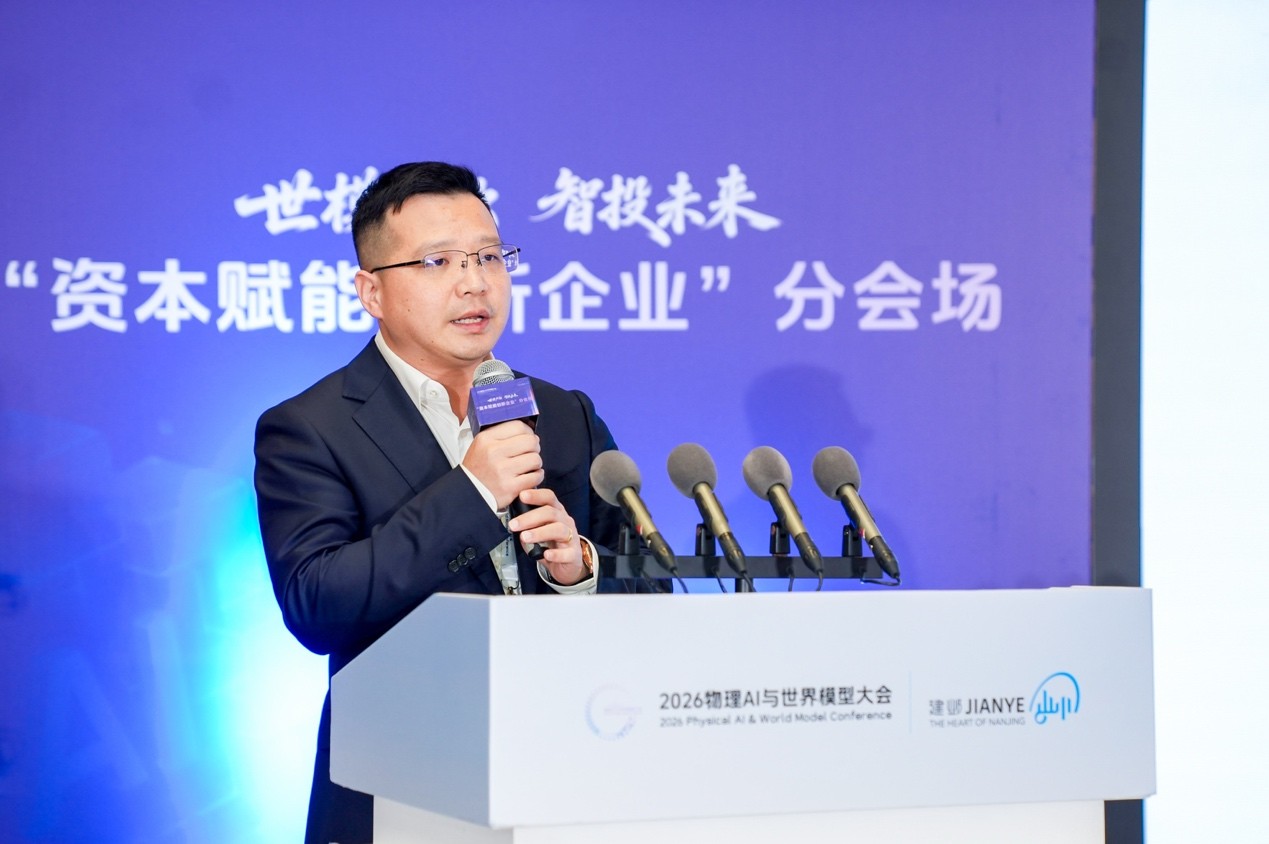
Lin Zhongren, CEO of Angsheng Technology (Jiangsu), delivered a speech at the "Capital Empowering Innovative Enterprises" sub-forum of the 2026 Physical AI and World Model Conference
For a newly established embodied intelligence industrialization company, this framework is not only a judgment on the development stage of the industry, but also reflects its thinking on its own business path: how to build a connection between technical capabilities and real demands, and transform the experience of single-point projects into reusable solutions?
The difficulty of industrialization is not only whether the robot can complete the task
For embodied intelligence to enter industrial sites, a basic question needs to be answered first: What are robots actually suitable for?
At present, different robot forms, motion control methods and perception capabilities have their own applicable boundaries. Handling, inspection, fine grasping and complex assembly put forward different requirements for the robot's motion capability, environment perception and task execution. Even the same type of robot entering different sites may need to be re-adapted due to differences in spatial layout, equipment conditions and operation processes.
Without a clear judgment on task boundaries, enterprises are prone to fall into two dilemmas: one is to pursue full coverage of technical capabilities, but it is difficult to find applications that can form a closed business loop; the other is to meet the needs of individual customers through customized development, but it is difficult to reduce the delivery cost of subsequent projects.
The "3+3+2" framework proposed by Lin Zhongren is precisely trying to incorporate these issues into a unified analysis system.
Among them, "three types of tasks" refer to force-oriented tasks, spatial movement and navigation-oriented tasks and dexterous tasks; "three types of scenarios" include flexible industry, commerce and public services, education and scientific research; "dual constraints" refer to technical availability and economic feasibility.
The three types of tasks answer what basic execution capabilities robots need to have. Force-oriented tasks involve handling, load bearing and rigid pushing and pulling; spatial movement and navigation-oriented tasks involve positioning, path planning and autonomous movement in dynamic environments; dexterous tasks focus on complex operations such as fine grasping, plugging and unplugging, and disassembly and assembly.
The technical difficulty and maturity rhythm of the three types of tasks are not consistent. For some scenarios with clear operation boundaries, force and movement capabilities are easier to carry out engineering verification; dexterous operation still needs continuous breakthroughs in fine perception, motion control and complex environment adaptation. Breaking down tasks helps enterprises select application entry points according to technical maturity, instead of requiring robots to have comprehensive capabilities in all scenarios at the same time.
Scenario selection determines where the technology enters the market. Flexible industrial scenarios can carry out verification around clear operation objectives and efficiency indicators; commercial and public service scenarios involve continuous tasks such as distribution, cleaning and inspection, which test the robot's adaptability to open environments; education and scientific research scenarios can provide conditions for technical verification, talent cultivation and data accumulation.
But finding an application scenario is only the beginning of industrialization. Whether the robot can complete tasks stably, operate continuously, and have reasonable input-output ratio, ultimately needs to be tested by real business.
This is exactly the dual constraint in the "3+3+2" framework: technical availability determines whether the robot can complete the operation, while economic feasibility determines whether the operation is worthy of continuous investment. For industrial users, equipment purchase, deployment and integration, operation and maintenance management and actual business revenue should all be included in the application evaluation.
From this perspective, "3+3+2" is not a simple technical classification, but an attempt to establish a set of industrialization analysis methods from task definition, scenario selection to business verification.
Starting from property inspection to verify the robot's operation capability in real environments
Whether the theoretical framework can generate practical value ultimately needs to be tested by specific applications.
In the business exploration of Angsheng Technology (Jiangsu), property inspection is a breakthrough point. Compared with complex industrial operations, the tasks of park inspection are relatively clear, but to achieve stable operation, robots still need to face a series of problems such as outdoor environment changes, route planning, anomaly identification and alarm handling.
The Qiyue K1 quadruped inspection robot dog of Angsheng Technology (Jiangsu) has completed the property inspection POC verification in Danru Yuan, a high-end community in Nanjing, carrying out verification of autonomous inspection, anomaly identification, alarm push and inspection record around areas such as park roads, fire passages and perimeter walls.
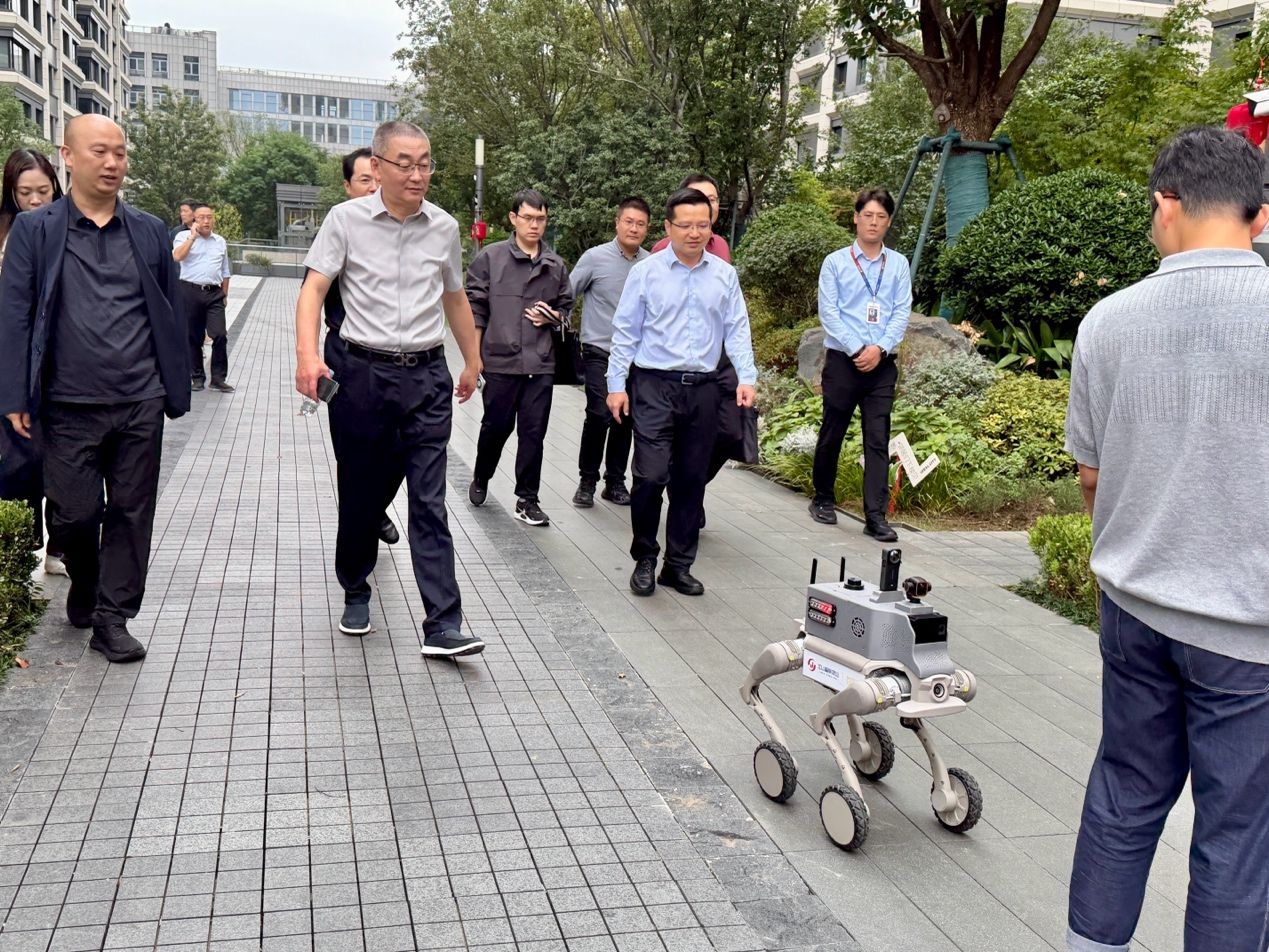
Qiyue K1 quadruped inspection robot dog of Angsheng Technology (Jiangsu) is conducting inspection in Danru Yuan, Nanjing
The significance of this practice lies in testing the robot's capabilities in specific business processes. Inspection robots not only need to move according to the route, but also identify on-site situations, form records, and connect with existing management processes. Only when these links can cooperate effectively, can robots change from display equipment to tools with practical operation value.
However, there is still a gap between POC verification and large-scale application. Whether stable and continuous operation can be realized subsequently, whether it can adapt to the environmental conditions of different parks, and whether it can form advantages in deployment and operation and maintenance costs still need to be verified through further project practices.
This is also a practical challenge for the industrialization of embodied intelligence: the technical verification of a single scenario is not difficult to understand, and the real problem is how to migrate the capabilities formed in one verification to other projects, avoiding re-development from scratch every time when landing.
Around this problem, Angsheng Technology (Jiangsu) is promoting the construction of robot products and platform capabilities. The Qiyue series is oriented to inspection applications, integrating capabilities such as quadruped robots, multi-channel visual perception, infrared thermal imaging, 3D navigation perception and edge AI; Sense Studio is oriented to robot interaction and agent applications, and Task Studio has built a basic framework for data collection, training, evaluation, reasoning and operation orchestration.
These layouts point to the same direction: combining robot ontology, perception capabilities, software platforms and industrial operation processes to provide support for adaptation and reuse of different projects.
If the robot ontology determines which actions the device can perform, then the platform capabilities and industry solutions are related to how these actions are organized into complete tasks, and whether the same set of capabilities can be reused in different projects. For enterprises aiming at industrialization, this system integration and reuse capability is a link that needs continuous construction from single-point delivery to large-scale promotion.
Not only deliver products, but also build the capability of continuous iteration
An important difference between embodied intelligence and traditional automation equipment is that its capabilities still need to be continuously verified and improved in real environments.
Laboratory tests can verify some technical indicators, but cannot cover all on-site conditions. After the robot enters the real scenario, anomalies in task execution, environmental changes and user feedback may expose the shortcomings of the original solution. Therefore, deployment should not only be the end of project delivery, but also the starting point for the next round of capability optimization.
For inspection applications, task routes, on-site images, abnormal events and handling records can help the team evaluate the performance of robots in actual operation; for factory operation tasks, links such as data collection through teaching or teleoperation, model training, real machine evaluation and on-site review can gradually improve task execution capabilities and station adaptation efficiency.
This involves not only model training, but also multiple links such as data collection, task evaluation, on-site deployment and system operation and maintenance. Only by forming a relatively complete feedback mechanism can the problems found in the project be transformed into experience that can be reused in subsequent projects.
The shareholder combination of Angsheng Technology (Jiangsu) also provides it with resource bases of different dimensions to explore this path. Whale Cloud Technology has artificial intelligence and industrial digital capabilities, Agibot provides support in robot technology and supply chain, and Nanjing Xinguang Investment Group has industrial resources and scenario coordination conditions.
The combination of the three parties' resources creates conditions for enterprises to simultaneously promote the application of robot technology, the development of industry solutions and the expansion of industrial scenarios. But resource integration is only the starting point. Whether it can further form stable product capabilities, standardized delivery processes and sustainable business models still needs to be continuously tested through actual projects.
In terms of scenario and talent construction, Angsheng Technology (Jiangsu) also participates in the construction of the embodied intelligence industrial talent ecosystem in Jianye District, undertakes the organization and daily operation of the relevant training center, and promotes the connection between practical training and application demands in combination with the scenario verification base. This layout responds to another practical demand in industrial development: the implementation of embodied intelligence not only requires algorithm and hardware talents, but also needs compound talents who understand robot technology, on-site processes and industry demands.
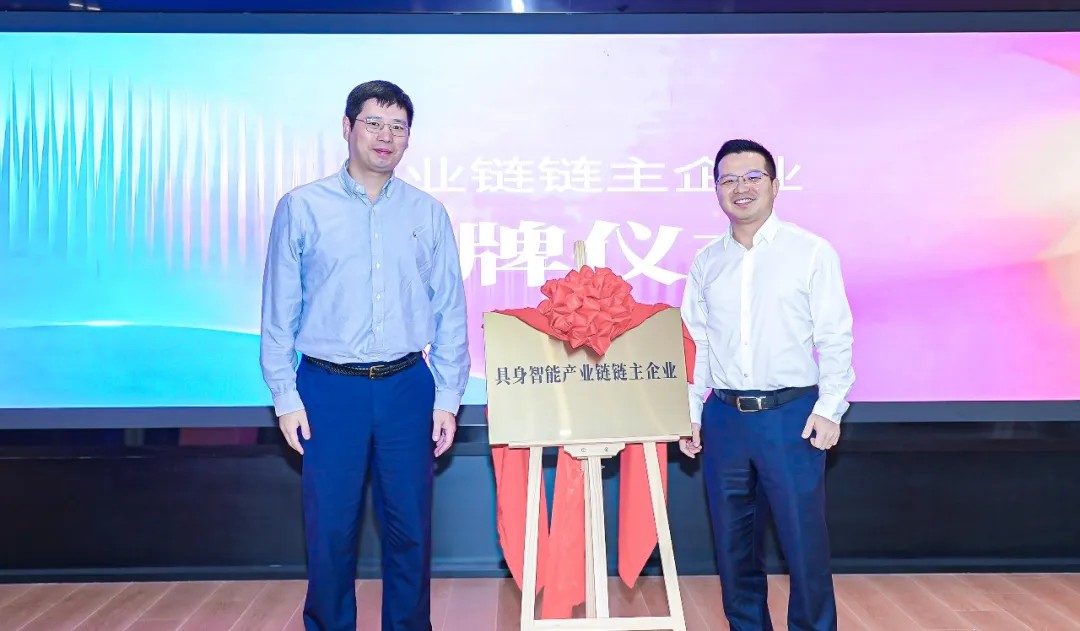
Chen Yuming (left in the picture), Member of the Party Leadership Group and Vice District Mayor of the People's Government of Jianye District, Nanjing, and Secretary of the Party Working Committee of Jianye High-tech Zone, Lin Zhongren (right in the picture), CEO of Angsheng Technology (Jiangsu)
From technology R&D to on-site application, and then to talent cultivation and industrial collaboration, the industrialization of embodied intelligence has gradually shown the characteristics of multi-link collaboration. What enterprises need to solve is no longer just whether robots can perform a certain task, but how to build a system that can continuously deliver, operate, improve and replicate.
From vertical scenarios to large-scale replication, it is still necessary to cross the commercialization threshold
In the speech, Lin Zhongren also put forward a three-stage evolution judgment on the development of the embodied intelligence industry.
In the short term (from now to 2028), the industry will be in the period of supplementing the three types of tasks. Force and spatial movement navigation tasks are expected to take the lead in carrying out economic model verification in some industrial scenarios, while dexterous operation will continue to tackle key problems. Real machine deployment, scenario data accumulation and delivery closed-loop capabilities will become important competitive foundations for enterprises.
In the medium term (2028-2032), with the further development of dexterous operation, dynamic navigation and software and hardware decoupling capabilities, embodied intelligence is expected to move from single task verification to cross-scenario application. In the long term (after 2032), with the continuous progress of models in cross-scenario adaptation, autonomous decision-making and continuous learning, robots are expected to undertake more complex and diverse tasks.
These time nodes are judgments on the direction of industrial evolution, and do not mean that different technical routes and application scenarios will mature at the same rhythm. For specific enterprises, what is really important is to determine the application priority according to technical capabilities and customer demands, and continuously verify the cost, reliability and replication conditions in project practice.
For Angsheng Technology (Jiangsu), the practical problems that need to be faced recently are how to transform the existing scenario verification into standardized solutions, how to reduce the deployment and adaptation cost of new projects, and how to prove the continuous use value of robots in the actual business processes of customers.
These problems also constitute a common exam for the embodied intelligence industry to move from technological breakthroughs to large-scale applications.
Moving from the "first year of mass production" to the "first year of implementation", the competition in the robot industry is extending from the manufacturing end to the application end. For industrialization companies like Angsheng Technology (Jiangsu), the opportunity lies not only in the growth of the robot market, but also in connecting ontology, models, data, industry demands and operation services, and organizing scattered technical capabilities into solutions that can solve real problems.
What the "3+3+2" framework presents is exactly the response to this transformation: clarify the capability boundary with tasks, find application entry points with scenarios, and test the implementation value with technical availability and economic feasibility.
Whether robots can truly go deep into the industry ultimately depends on real operations. For Angsheng Technology (Jiangsu), the process from single-point verification to large-scale replication will also become the key to testing whether its industrialization path is feasible.