Going all-in with hundreds of billions of capital, the investment in AI yields zero returns.
DeepSeek has secured another 100 billion yuan in financing. This fundraising round, which set a new domestic record for single-round AI financing in China, was led by Tencent and CATL — one represents the core entry point of China's mobile internet, and the other holds the unrivaled leading position in the new energy vehicle battery sector. As soon as the news broke, the narrative of "industrial capital going all in on AI" went viral across all platforms.
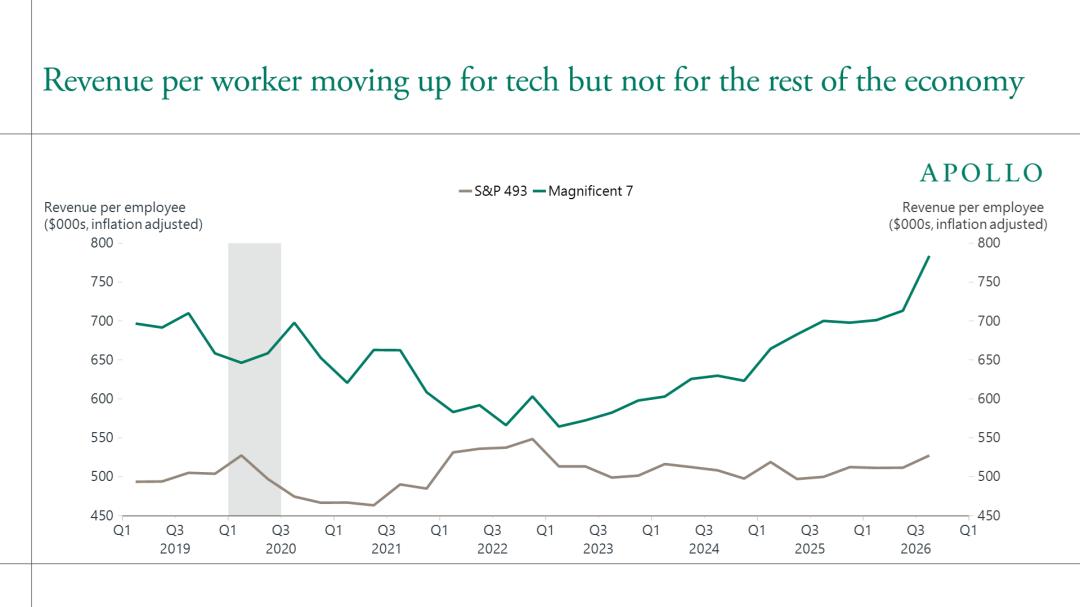
But almost on the same day, Torsten Slok, chief economist of Apollo, released another set of figures: excluding tech giants, AI has delivered zero financial returns to U.S. enterprises. The per capita revenue, profit margin, and total factor productivity of 493 non-tech companies on the S&P 500 have all stayed flat, with the money spent failing to generate tangible results.
On one side is a hundred-billion-yuan-level computing power arms race, on the other side is the ruling that "AI delivers zero economic returns". The coexistence of these two scenarios forms the most awkward moment for capital and technology in 2026.
100 Billion Yuan: Where Is the Money Invested
For this financing round of DeepSeek, the fundraising target was raised from 500 billion yuan all the way to nearly 1 trillion yuan via over-subscription, with a pre-money valuation of around 5 trillion yuan. In just half a year, the company has raised a total of over 1.5 trillion yuan across two financing rounds.
Tencent has made heavy bets in two consecutive rounds (10 billion yuan in Series A, and additional capital in this round), aiming to get priority access to the ecological entry point — when WeChat, gaming and cloud businesses need to connect to model capabilities, it can take the front seat first. CATL raised its contribution to about 10 billion yuan for another consideration: data center electricity bills, energy storage peak-valley arbitrage, and direct supply of green power — to incorporate "electricity", the largest cost item of computing power, into its own business territory.
One controls traffic, the other controls electricity. What they bet on is not necessarily the large model itself, but the occupancy of the "computing power infrastructure" position — SMIC PES (backed by SMIC), Stony Creek Capital (backed by GigaDevice), and Geely have also joined in. The demand for computing power from the chip manufacturing and automotive industries is forming a positive cycle.
The flow of this sum of money has laid out its ambition clearly: DeepSeek plans to build a data center in Ulanqab, Inner Mongolia, deploying at least 160,000 Huawei Ascend chips, and using domestic computing power for frontier model pre-training for the first time. Liang Wenfeng himself called it "the biggest high-stakes gamble".
The statement "we have never been short of money" no longer holds true. Back then he said the company's problem was the embargo on high-end chips; now the financing logic has changed — since the most advanced chips cannot be purchased, we will use massive capital to build up the domestic computing power ecosystem first. Money has become a weapon against the embargo.
The Economy Failed to Absorb This Sum of Money
Apollo's report calculated the accounts of this round of AI investment very coldly. Four charts all point to the same conclusion: AI has not brought any output growth.
The per capita revenue of S&P 493 (companies excluding the Mag 7) has long stayed flat in the 450-550 range, while that of the Mag 7 has been approaching 800 all the way; the profit margin of the former stays flat while the latter keeps rising; productivity growth — whether TFP or output per hour — shows no sign of being boosted by AI.
What is more striking is the distribution of expenditure. The top 10% of enterprises account for 99.5% of the expenditure on model services and inference; among the customers of OpenAI and Anthropic, the top 10% account for 95.6%; among the companies with the top 1% AI expenditure, 80.4% have venture capital background, while VC only accounts for 13.1% of customers at the median expenditure level.
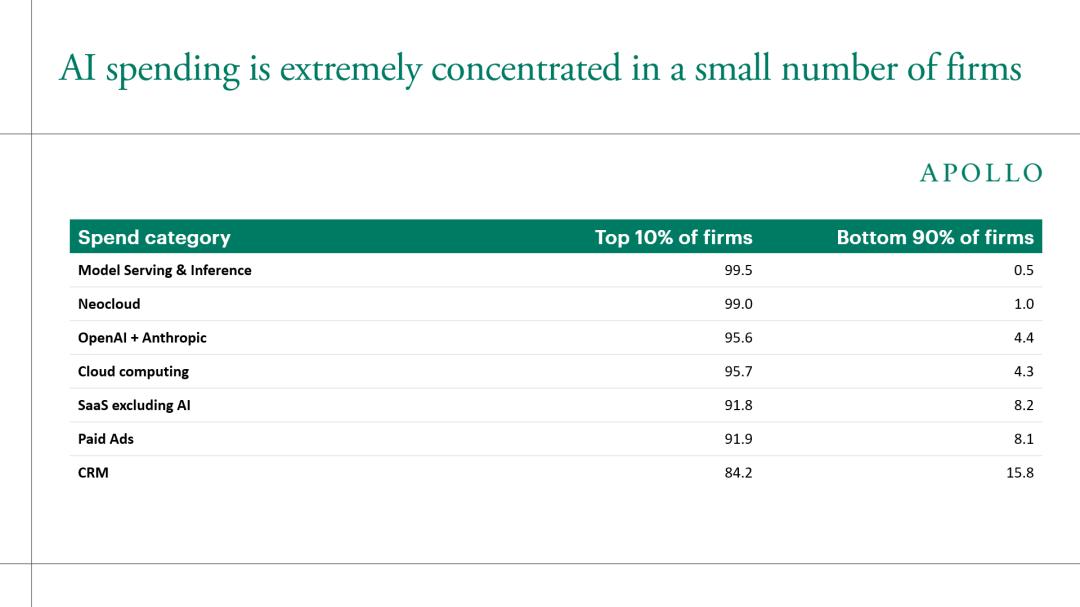
A considerable part of AI consumption is the self-circulation of VC money — just like the shared bikes that burned subsidies in the past, it looks bustling on the App, but there is no real profit on the books.
Torsten Slok pointed out in one sentence: mainstream enterprises have begun to redefine token expenditure from "growth source" to "profit-eroding cost center". They do not need the latest model, nor are they willing to pay for it.
The AI Graveyard Is Getting More and More Crowded
Foreign media set up a monument for this round of fanaticism, calling it the AI Graveyard. According to S&P Global Market Intelligence, about 42% of corporate AI projects were eventually abandoned by their parent companies, for reasons ranging from insufficient financing, technical difficulties, fierce competition, difficulty in large-scale implementation, to weak market demand.
Even tech giants are cutting related projects. OpenAI shut down its video platform Sora — high operating costs plus low user retention made it unsustainable; the browser Atlas was merged back into ChatGPT less than a year after its launch; Operator and DALL-E were also folded into the main application, and even the "Super App" redesign was rolled back due to user complaints.
Going down the list, there is a long list of names: Relay, a Zapier alternative, was crushed by platforms; Phind, a wrapper model, shut down one month after financing; Tome, a PPT making tool, had more than 20 million users but only an annual revenue of 3 million US dollars; Humane AI Pin, a hardware pioneer, raised 230 million US dollars and was finally acquired by HP for 116 million US dollars; Yupp which burned 33 million US dollars, Figgs AI which was too expensive to operate for free, and top-tier companion app Character.ai went bankrupt — the "graves" in the AI graveyard are still increasing.
The domestic market is also clearing out: in 2025 alone, at least 25 domestic AI applications were shut down, removed from shelves, or stopped updating for a long time; according to the statistics of the overseas AI Graveyard, 392 AI tools around the world stopped services that year. Tencent Yuanqi, QClaw, the self-built agents of Doubao and Qianwen were shut down one after another. The unified and enterprise service sectors were merged into the "office" agent.
When giants integrate their capabilities into their own products, startups have no moat at all. The death list of this round of AI is almost the same as that of shared bikes and community group buying in the past.
Autonomous Driving Has "Died Once"
This list of exit enterprises in the autonomous driving sector from 2019 to 2026 is actually the autopsy report of the first complete cycle of the AI industrial chain. Drive.ai, Starsky Robotics, Uber ATG, Argo AI (divested by Ford and Volkswagen with broken capital chain), Velodyne, the top lidar manufacturer (trapped in product involution), TuSimple (difficult commercialization of technology + geopolitical pressure + internal management problems, delisted), Luminar, Zongmu Technology (failed 3 times in IPO), Hedou Technology, Qiangu Technology, Qiangtian Zhika... The causes of death are highly consistent: broken financing, difficulties in commercial implementation, slow technology iteration, and tight capital chain.
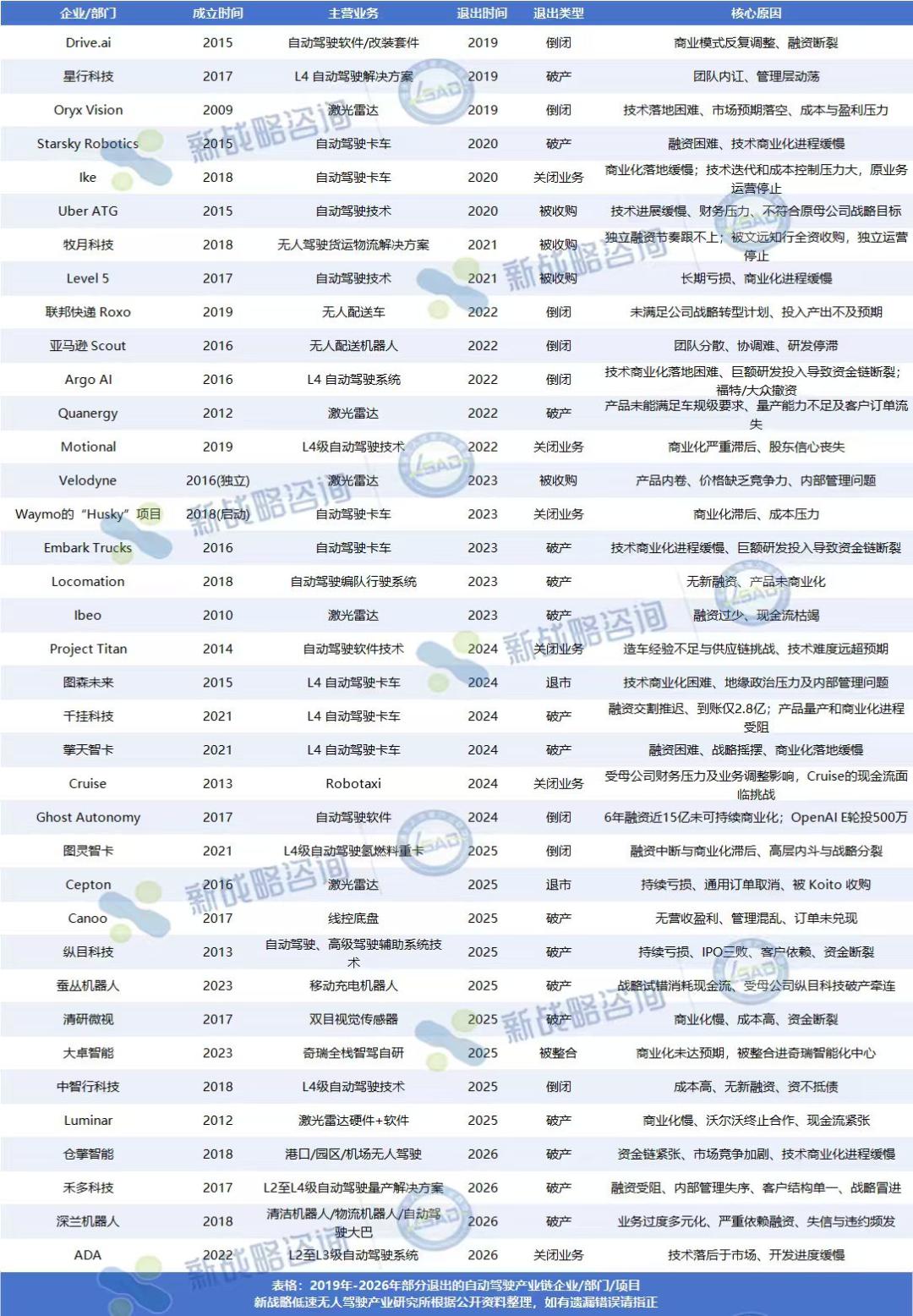
These are not small workshops. Argo AI was backed by Ford and Volkswagen, Velodyne used to be the industry leader, and TuSimple was the "first stock of autonomous driving trucks". But their commercialization process never landed, and once the capital market tightened, their capital chains broke. In eight years, the autonomous driving industry proved one thing with a list of more than 40 exit enterprises: the technology being feasible does not mean the business model being feasible.
Today's general large models are repeating the fanaticism of the autonomous driving industry from 2019 to 2021, and the ebb tide that started in 2022 — only with a larger stage, faster capital burning, and more staggering scale.
Embodied Intelligence: The Next Bubble?
The same script has already been staged by some players. DeepSeek invested in Unitree Robotics with 141 million yuan in August, and Liang Wenfeng is going to lead the investment in humanoid robot company Winverse AI. Embodied intelligence is now standing at the position where autonomous driving used to be: hot financing, rising valuations, and commercial implementation is nowhere in sight.
Robots burn more money than autonomous driving — hardware, supply chain, mass production, and scenarios, every link is a capital burning black hole, and no company has run through a sustainable business model so far. What's more troublesome is that it shares the same lifeline with large models: capital. Once this round of computing power arms race cools down first, embodied intelligence will be the first track to feel the chill of capital supply cut. It does not even need to become the second autonomous driving bubble — as long as it follows the same path again, that is enough.
Go All in on AI, or Go All in on the "Infrastructure"?
Back to the question at the beginning: does the heavy bet from Tencent and CATL mean that the mobile internet and new energy vehicle industries are going all in on AI?
My judgment is no. They are the players who have hit the ceiling of their respective dividends — the growth of mobile internet has peaked, and the new energy vehicle sector has been trapped in overcapacity due to fierce involution — both are looking for the next certain growth engine. AI, especially computing power, happens to be the most certain asset closest to "infrastructure" in the eyes of capital at present. Therefore, what they go all in on is not AI applications, but the AI infrastructure: one wants the traffic entry point, the other wants electricity, and essentially both are occupying core positions.
"Risks and opportunities coexist" is a correct but empty statement, but in practice it has two sides: the opportunity is that if DeepSeek really uses hundreds of billions of capital to get through the domestic computing power ecosystem, the integration of chips, energy, models and applications will be a more fundamental infrastructure transformation than the mobile internet; the risk is that if this round of investment still only blossoms but does not bear fruit like autonomous driving, the impact of the burst of the hundred-billion-yuan-level bubble will far exceed the sum of the shocks from the autonomous driving sector in those years.
The final outcome of the AI story is not written in the financial reports of the Mag 7, nor in the financing news, but in the profit margin table of S&P 493. It only counts when the real economy truly absorbs the value created by AI. Before that, this round of hundred-billion-yuan-level all-in investment is more of a high-stakes gamble for the future — if you win the bet, you get the infrastructure; if you lose, you get a tombstone. The name list of the AI graveyard is still getting longer.