Shanghai's second-hand housing prices have "stopped falling"
When the national 70-city housing price data for September was released, Shanghai once again stood in the spotlight.
After 32 months, Shanghai became the first among 70 large and medium-sized cities across the country to record a positive year-on-year growth in second-hand residential prices, which is a rare signal of market recovery.
Based on the second-hand residential transaction data monitored by Puru Smart Digital, Shanghai's second-hand housing market in the third quarter of this year showed distinct stabilization characteristics: the average transaction price basically stopped falling year on year, the price expectations of buyers and sellers gradually converged, and the properties with the lowest total price and smallest floor area were the first to see their prices stabilize.
01
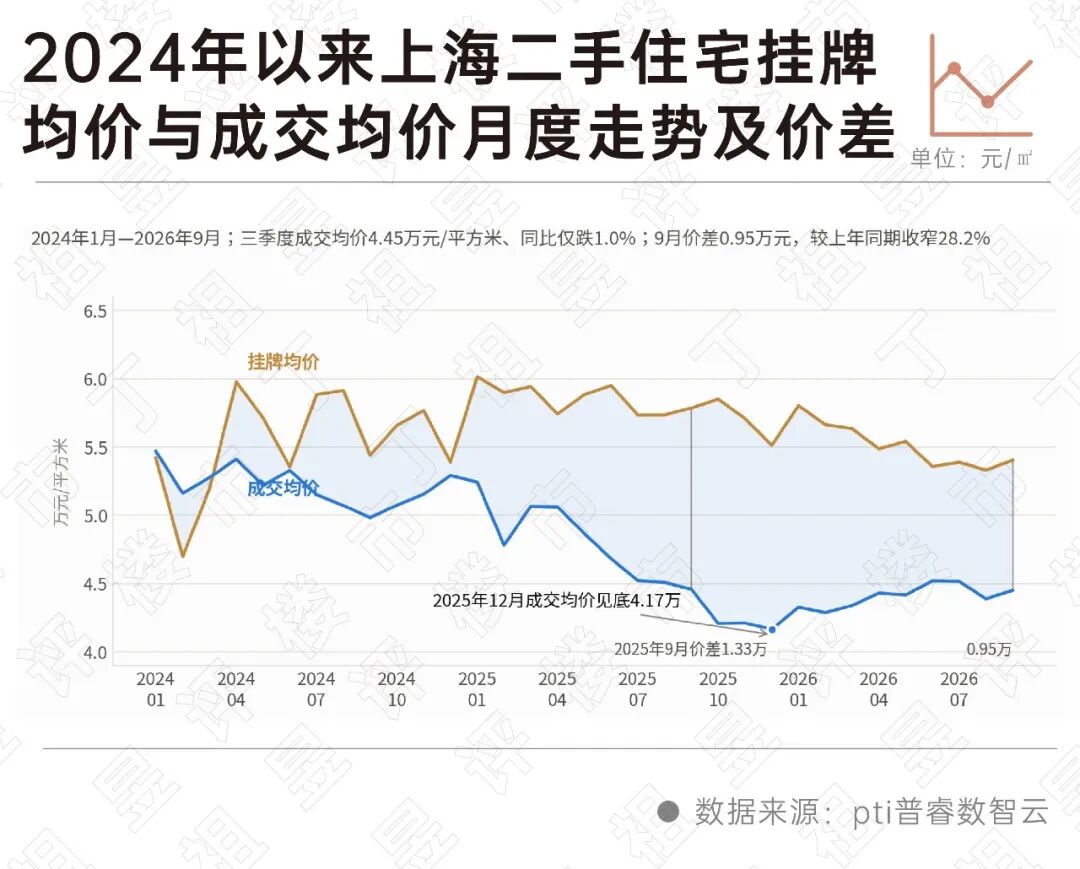
In the third quarter of this year, the average transaction price of second-hand residential properties in Shanghai was 44,527 yuan per square meter, down 1% year on year and 0.1% quarter on quarter, which was basically flat.
Compared with last year, the price recovery trend is more obvious. The year-on-year decline in the third quarter of 2025 was 11.3%. In one year, the decline narrowed from double digits to around 1%, which means the downward trend has been curbed.
In terms of the monthly average transaction price, it has been slowly rising for three consecutive quarters: the average transaction price of second-hand housing in December 2025 fell to a phased low of 41,670 yuan/㎡, and reached 44,518 yuan/㎡ in September alone, which was 6.8% higher than the low point in December last year.
In contrast to the rising average transaction price, the average listing price is still declining unilaterally. In the third quarter, the average listing price of second-hand residential properties was 53,751 yuan per square meter, down 6.6% year on year and 1.6% quarter on quarter.
While the average listing price continues to decline, the average transaction price has stopped falling. The price gap between the two has narrowed rapidly from 12,552 yuan per square meter in the third quarter of 2025 to 9,224 yuan per square meter in this third quarter, with a narrowing range of 26.5%.
According to the average transaction price of different total price segments, the overall second-hand transaction price stabilized in the third quarter: properties priced below 3 million yuan remained flat; those priced between 3 million yuan and 5 million yuan fell by 0.3% quarter on quarter; those priced between 5 million yuan and 7 million yuan rose by 2.2% quarter on quarter; those priced between 7 million yuan and 10 million yuan fell by 0.4% quarter on quarter.
By floor area segment, small-area properties rose slightly while large-area properties fell slightly, with overall narrow fluctuations: the average transaction price of properties under 70 square meters increased by 1.9% quarter on quarter; that of properties between 90 and 110 square meters increased by 1.6% quarter on quarter; that of properties between 110 and 144 square meters decreased by 2.7% quarter on quarter; that of properties over 200 square meters decreased by 2.1% quarter on quarter.
Looking back at the overall decline in housing prices in 2025, the lower the total price, the larger the decline. From the first quarter to the fourth quarter, properties priced below 3 million yuan fell by 9.4% cumulatively, and those priced between 3 million yuan and 5 million yuan fell by 4.5%. Low-total-price properties achieved rapid transactions with larger price cuts, which was the fundamental reason why the transaction proportion of low-total-price properties rose rapidly in the same period. This year, the properties with the lowest total price and smallest floor area are the first to see their prices stabilize.
02
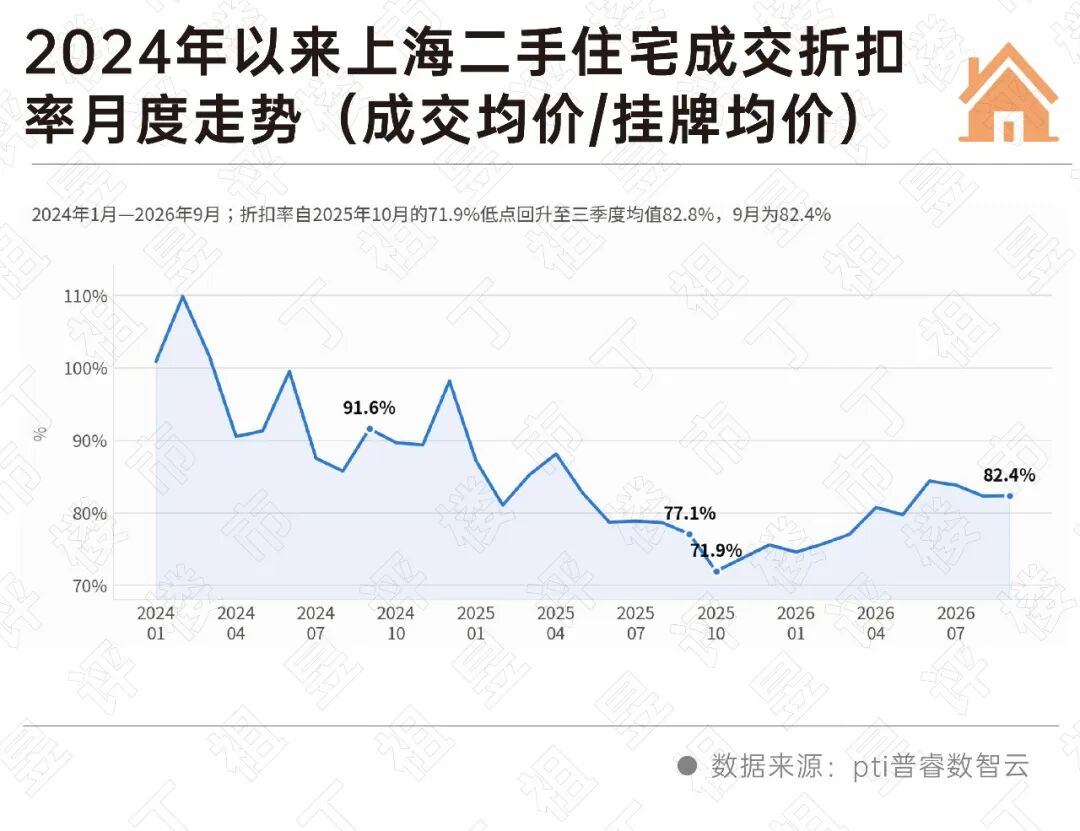
To judge whether the price expectation of second-hand housing has stabilized, the discount rate (average transaction price / average listing price) is more sensitive than the average transaction price.
The discount rate of second-hand residential properties in Shanghai once dropped to a minimum of 71.9% in October 2025, which means that houses could only be sold at a 28% discount. By September this year, this figure has returned to 82.4%, rising by nearly 11 percentage points in less than a year. The average discount rate in the third quarter increased by 4.7 percentage points year on year to 83% from 78% in the third quarter of last year.
The more intuitive changes are hidden in three transaction details.
First, landlords no longer repeatedly cut prices. In the third quarter, the average monthly price adjustment of listed properties was 4,537 times, down 63% year on year, hitting the lowest level since 2024.
Second, the efficiency of house viewing has improved. In the third quarter, the average monthly number of house viewings was 114,000, down 41% year on year, while the number of second-hand residential transactions recorded a positive year-on-year growth in the same period, which means that the conversion efficiency of transactions per house viewing has increased significantly, and buyers no longer need to compare prices repeatedly.
Third, the transaction speed has accelerated. In the third quarter, the average transaction cycle of second-hand residential properties was 106.3 days, down 4% year on year and 14% quarter on quarter. The monthly transaction cycle in September was 100 days, the shortest monthly transaction cycle record since January 2024. It shows that the game time required to complete a transaction is shrinking.
These three changes are leading signals of market stabilization ahead of transaction volume.
03
From the perspective of transaction structure, the core feature of Shanghai's second-hand residential market in the third quarter can be summed up in one word: stability.
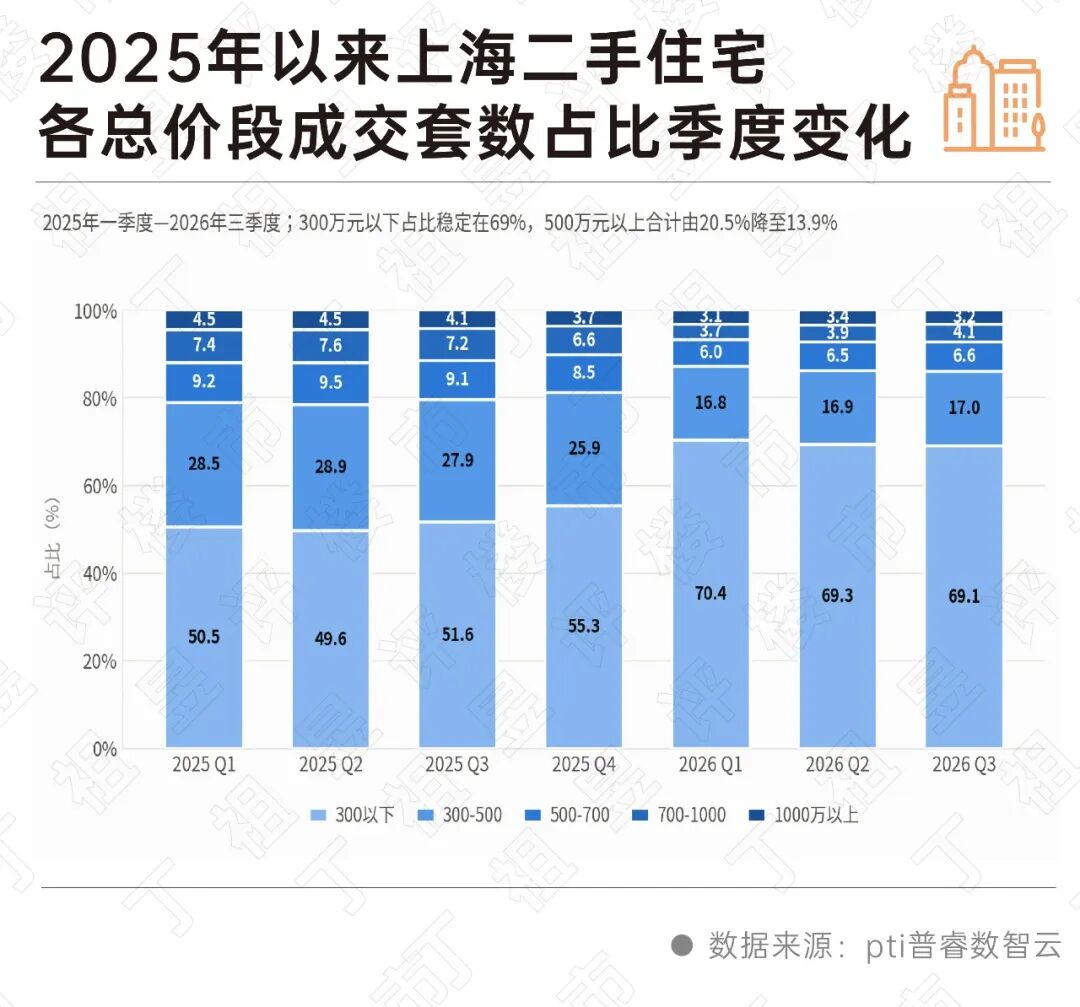
In terms of data, the transaction proportion of rigid-demand properties priced below 3 million yuan fell slightly for two consecutive quarters, from 70.4% in the first quarter to 69.3% in the second quarter, and then to 69.1% in the third quarter, basically stabilizing at around 70%.
What is really noteworthy is the marginal return of improvement demand.
The total proportion of properties over 110 square meters rose to 17.5%, hitting a new high since the fourth quarter of 2024. Among them, the proportion of properties over 200 square meters was 1.9%, and that of properties between 160 and 180 square meters was 1.2%, both reaching the high level in the past two years.
The total volume of second-hand transactions in Shanghai in the third quarter fell by 14.9% quarter on quarter, but the decline range of each floor area segment decreases with the increase of floor area: properties under 70 square meters fell by 16.9%, while those between 160 and 180 square meters only fell by 9.4%. In the correction after the concentrated release in the second quarter, large-area properties are obviously more resilient to price decline than small-area ones, which is a signal of the substantive return of improvement demand.
Behind the stabilization of the transaction side, structural changes are taking place on the listing side. The second-hand houses currently listed in Shanghai are getting smaller in floor area and higher in unit price.
In terms of data, in the third quarter, the average floor area of each listed second-hand house in Shanghai was 96.9 square meters, and the average total price per unit was 5.209 million yuan, down 12.5% and 18.2% year on year respectively. The figures in September alone were 94.6 square meters and 5.111 million yuan, both hitting the lowest level since 2024.
Breaking down the listed properties of different total price segments in September, almost all show the feature of "rising listing unit price and shrinking average floor area per unit". Among them, the year-on-year increase of listing unit price for properties priced below 3 million yuan was the highest, reaching 11.8%, and the average floor area per unit shrank from 70.2 square meters to 66.4 square meters. For listed properties priced between 3 million yuan and 5 million yuan, the average floor area per unit shrank most significantly by 7.7%, while the average listing price increased by 6.5%.
In other words, for the same budget, the floor area of the house you can buy now may be smaller. Those "bargain properties" with lower unit price and larger floor area are gradually withdrawing from the listing pool. For home buyers, the window of "spending less money to buy larger floor area" is narrowing little by little.
Overall, the keyword of Shanghai's second-hand market in the third quarter is stabilization at a low level, rather than a trend reversal. As the first city across the country to record a positive year-on-year growth in second-hand housing prices, the stabilization of Shanghai's second-hand housing market is a bottom formed through gradual market adjustment.
What trend will Shanghai's second-hand housing market show in the last quarter of 2026? There are three key points:
First, the price is likely to continue fluctuating in a narrow range, and the average transaction price is expected to turn positive year on year, with the price gap with the average listing price continuing to narrow.
Second, the transaction scale of second-hand housing will face quarter-on-quarter pressure: it has fallen by 14.9% quarter on quarter in the third quarter, and the number of price adjustments and house viewings have decreased sharply at the same time, which means that the active supply on the listing side is shrinking, and there is no new source of volume expansion in the fourth quarter.
Third, the marginal recovery of improvement demand will continue, but the range is limited, and the proportion of low-total-price rigid-demand properties will still remain at around 70%.
This article is from the WeChat Official Account "Ding Zuyu Comments on the Real Estate Market", written by the Editorial Department and Puru Research, and published with authorization from 36Kr.