I found that there is a hidden question in Accenture's quotation.
Speaking of Accenture, how many people still remember it?
Many people still see it as a consulting firm, but it is an unavoidable player in the global IT service market.
In recent days, according to FT reports, Accenture is evaluating the sale of its Greater China business, with a valuation of up to 1.5 billion U.S. dollars. The company has declined to comment, and it remains uncertain whether the transaction will be completed.
However, compared with whether to sell the Greater China business, I care more about another thing: After going through its annual report and meeting minutes, I found a hidden problem in Accenture's quotations. The business is still growing, but why have the prices loosened first?
.......
If your company has purchased consulting services or deployed systems, the following figures are related to your quotation sheet.
Let's first talk about what Accenture does.
When a client needs to deploy a system or optimize a process, Accenture sends its staff to combine software, processes, and local regulatory requirements into a workable solution. The consulting business is mainly project-based, with delivery completed after the project is finished. The managed service business operates the client's systems on a long-term basis.
In the final analysis, what clients pay for is having a responsible party to get things done. As for how many people to assign and how many days to spend, those are factors Accenture needs to consider when calculating quotations.
This business is still growing this year.
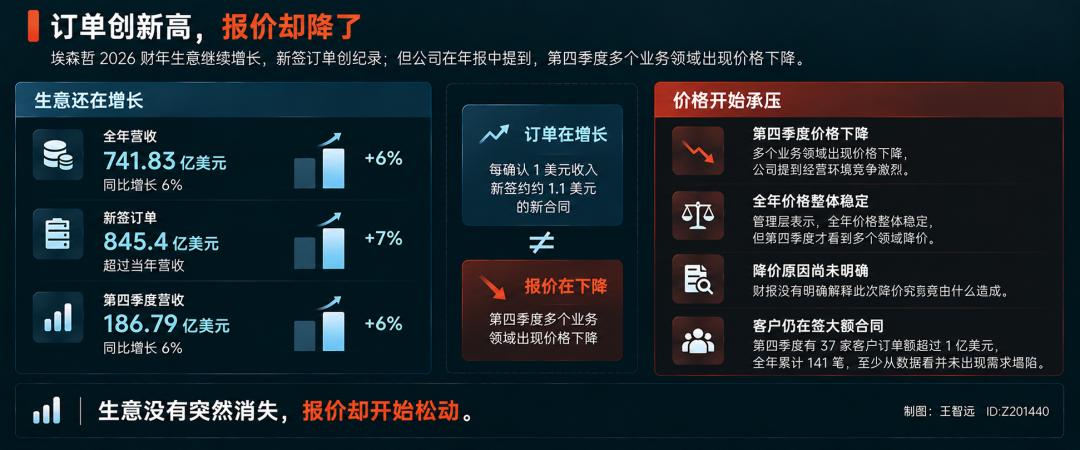
In fiscal year 2026, Accenture posted revenue of 74.183 billion U.S. dollars, a year-on-year increase of 6%. For a company with a revenue base of more than 70 billion U.S. dollars, this growth rate is not slow. On average, its daily revenue exceeds 200 million U.S. dollars.
The total value of new contracts signed for the whole year reached 84.54 billion U.S. dollars, which is even higher than its revenue. For every 1 U.S. dollar of recognized revenue, it signed about 1.1 U.S. dollars of new contracts. In the fourth quarter, its revenue hit 18.679 billion U.S. dollars, also rising by 6% year on year.
But strangely, the prices have loosened. Accenture wrote in its annual report that in the fourth quarter of fiscal year 2026, price drops occurred in many business segments, and the company also mentioned the fierce competition in the operating environment.
At the earnings call, the management added that the overall price level remained stable for the whole year, and price cuts in multiple segments were not seen until the fourth quarter.
Note this time point: stable annual prices do not mean no price cuts in the fourth quarter, and price drops in the fourth quarter do not indicate that prices have been falling throughout the year.
More importantly, the financial report does not clearly explain what exactly caused this round of price cuts.
Why did a company with record-high new order value see price drops in the fourth quarter? Did the demand disappear suddenly?
It does not seem to be the case. Revenue in the fourth quarter is still growing, and the total value of new signed contracts for the whole year also hit a record high. In the fourth quarter, 37 clients placed quarterly orders worth more than 100 million U.S. dollars, and the total number of such orders for the whole year reached 141.
At least from the data, large clients are still signing contracts, and Accenture has not encountered a comprehensive demand collapse.
Then where might the problem lie?
One possible reason is competition. Peers are willing to take the same work at a lower price, so Accenture also has to adjust its quotations accordingly.
Another possible reason lies in delivery costs. A project that used to require 10 people to complete may now only need 7 people. When clients know this, they will naturally ask: since you can finish the work faster, why do you still charge as much as before?
Both scenarios will lead to price drops, but they mean different things to Accenture.
Peer pressure on prices tests how much profit Accenture can retain. When clients negotiate prices based on lower delivery costs, it will change the way Accenture calculates quotations.
Of course, there is another possibility. When the quotation is lowered, the number of assigned staff is also reduced, and even the seniority of the assigned personnel is lower. The money clients save at present may need to be made up in subsequent delivery processes.
We also need to distinguish between orders and revenue here.
The 84.54 billion U.S. dollars refers to the total value of newly signed contracts, not the money actually received in that year. Orders represent businesses that may be delivered in the future, while revenue is recognized gradually as the performance obligations are fulfilled.
Therefore, the current growth of orders cannot directly prove that the demand for every type of business is growing, let alone prove that there is only one reason for the price drop.
But there is an unavoidable problem.
If Accenture really no longer needs to invest so many people to complete the same work, can its previous business model of estimating quotations based on manpower still make money in the original way?
......
The calculation of the case that the number of required staff drops from 10 to 7 needs to be scaled up to hundreds of thousands of people when it comes to Accenture.
I checked and found that as of the end of August 2026, Accenture had 814,000 employees distributed in more than 200 cities across 52 countries, most of whom are based in India, the Philippines and the United States.
Clients may discuss requirements in New York, write codes in Bengaluru, and carry out operation and maintenance in Manila. A global delivery network connects these three links together. This network was not built in a day, and the quotation system cannot be changed overnight either.
In the past, the more employees it had, the more projects it could take on. Now with the advent of AI, this equation has started to loosen.
Accenture is also investing heavily in AI, and it already has about 110,000 AI and data professionals. The management said that AI has enabled each employee to handle more work, and the revenue generated by each employee is also rising. The number of new hires planned for the next fiscal year is expected to be lower than that of this year, which is partly related to AI.
But the management added another sentence: The time saved from efficiency improvement has been filled with more new projects.
What does that mean?
As long as new projects keep coming in, the company can generate more revenue with the same number of employees. If it cannot get enough new projects, the staff will be idle. However, after the efficiency is improved, who will take the saved cost? It depends on how Accenture charges for its services.
Generally speaking, there are three pricing models.
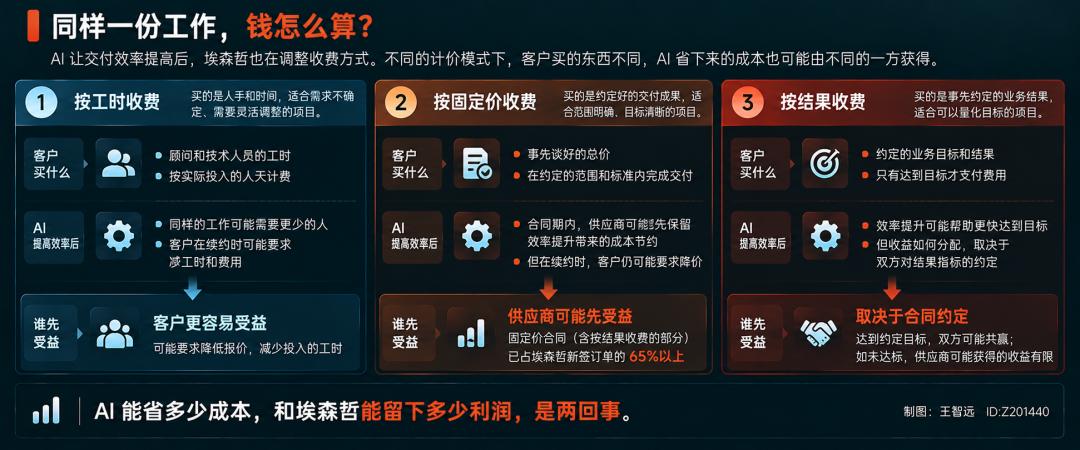
Time and material based pricing: what you buy is the manpower and working hours. For work that used to be done by 10 people, now only 7 people are needed to complete it. When you negotiate the contract next time, you will naturally ask to pay less.
After the efficiency is improved, the supplier may even earn less money. But for projects with changing scopes and unclear requirements, this pricing model is still the only feasible choice. What you buy here is flexibility.
Fixed-price pricing: you pay for a pre-agreed total price. As long as the delivery standards remain unchanged, you do not need to care about how many people Accenture assigns internally to complete the project.
The cost saved during the contract period will first stay with Accenture. Suppliers usually factor in the overspending risk into the quotation, but when the contract is renewed, you may still ask for a price cut.
Outcome-based pricing: you only care about whether the pre-agreed target is finally achieved. You pay only when the target is met, and you may pay less if the target is not achieved. The most troublesome part here is that both parties need to clarify in advance what counts as a successful outcome.
Well, three models for the same calculation. Who will take the cost saved by AI, and who will bear the corresponding risks?
Accenture is also adjusting its charging models.
The management said at the earnings call that fixed-price contracts, including the outcome-based part, have accounted for more than 65% of new signed orders, and the proportion is still rising.
Note that this 65% refers to fixed-price orders, which does not mean all these orders are charged based on outcomes. The company did not disclose the specific proportion of real outcome-based contracts separately. This figure only proves that the charging model is changing, rather than that clients have fully accepted it.
There is another point: fixed-price contracts are not equal to managed services.
In fiscal year 2026, the revenue of managed services reached 37.3 billion U.S. dollars, accounting for 50.3% of total revenue, with a year-on-year increase of 8%. The consulting revenue hit 36.883 billion U.S. dollars, rising by 5% year on year.
But in terms of new signed orders, the total value of managed service orders is 43.7 billion U.S. dollars, with only a 2% year-on-year growth, while the total value of consulting orders is 40.9 billion U.S. dollars, rising by 9% year on year.
The revenue growth of managed services is faster, while the order growth of consulting services is faster. If clients are really shifting to long-term managed services, the order growth should reflect this trend first.
Based on these figures alone, we cannot conclude that all clients are shifting to long-term managed services, let alone say that the growth of managed service revenue means the growth of outcome-based charging.
By the way, Accenture also develops customized software, but there is no separate revenue item for this business in its annual report, so we cannot calculate the exact size of this segment.
The fixed-price model only sets the price in advance. Whether Accenture can retain more of the cost saved by AI still depends on whether clients recognize this arrangement.
By the way, there is a risk warning in the annual report: if clients do not accept the new pricing that reflects the value of AI, the company's performance may be adversely affected.
What is more troublesome is that clients may choose to complete the work by themselves. The annual report mentions that clients and ecological partners may build their own AI capabilities, and AI-native companies are also competing for this type of business.
For work that could only be done by Accenture in the past, now you may be able to complete part of it by yourself.
In the final analysis, AI has reduced Accenture's operating costs. But whether the saved cost can be converted into profit is not yet clearly specified in the contracts.
......
When clients can not only negotiate prices but also have the ability to complete the work by themselves, what else can Accenture do to retain its clients?
Accenture itself is also worried about this problem. It has listed clients' internal IT departments and global capability centers as competitors in its annual report.
In the past, clients raised requirements and Accenture sent staff to complete the work. Now, internal teams of clients may have used AI to build a preliminary solution.
For work that can be completed on their own, why should companies pay for external service providers?
Of course, enterprises cannot complete everything by themselves.
The launch of a system involves business processes, data security, and regulatory requirements of different countries, and someone needs to take responsibility when problems occur. These issues cannot be solved simply by several employees using AI to write codes, and that is exactly where Accenture's value lies.
But the trouble does not end there. Accenture achieved its current large business scale by splitting the same work to different countries, so that one team can serve different markets.
Now, this model is also facing new problems.
Accenture mentioned in its annual report that sovereign regulatory requirements in some countries may make the technology and delivery architecture more fragmented.
To put it simply, data may need to be stored locally, and some systems have to be built on the local site. Work that could be completed across borders in the past may now have to be split into separate parts.
This means that the cost advantage brought by global division of labor is not as strong as before.
The recent rumor about the sale of its Greater China business becomes quite interesting when we take all these factors into consideration. The FT report also includes several details: Accenture has received unsolicited acquisition offers in the past year.
The transaction scope covers mainland China, Hong Kong and Taiwan, with a maximum valuation of 1.5 billion U.S. dollars; the potential buyer may be a private equity firm. Accenture has hired JPMorgan Chase to conduct a strategic assessment, and it may retain a minority stake after the transaction is completed.
This transaction is still in the evaluation stage, and no official announcement has been released yet.
Accenture entered the Chinese mainland market in 1993, and it has been 33 years by now. According to the company's Chinese materials, its Greater China region has about 20,000 employees distributed in 9 cities.
This is not a business segment that can be easily discarded, and it is also very difficult to calculate its exact scale.
Accenture does not separately disclose the revenue and profit of its Greater China business. In fiscal year 2026, the total revenue of the entire Asia-Pacific region reached 10.678 billion U.S. dollars, accounting for 14.4% of the total revenue, and the Greater China business is only a part of it.
Therefore, the 1.5 billion U.S. dollars upper limit of valuation mentioned in the report cannot be directly regarded as the confirmed value of this business segment. Compared with its annual revenue of more than 70 billion U.S. dollars, this figure is not large.
As for why Accenture is considering selling this business, the company has not given any explanation.
It may involve business portfolio adjustment, or considerations related to local market and regulatory requirements. There is not enough evidence to attribute this move to AI, let alone conclude that Accenture is preparing to withdraw from the Greater China market.
Besides, this type of company's business has another feature: extremely long-term client relationships.
Accenture disclosed that among its top 200 commercial clients, 85% have cooperated with the company for more than 20 years. Even if the main business entity changes in the future, how the original client relationships and delivery arrangements will be handled still depends on the specific transaction plan.
Therefore, what is really worth paying attention to in this rumor is how Accenture will rearrange its own business.
In the past, it relied on a global delivery network with hundreds of thousands of employees to take over the work that clients could not complete. Now, AI has reduced the cost of part of the work, and clients have begun to have the ability to complete the work by themselves. At the same time, regulatory requirements in different regions have made global delivery more complicated.
Which projects are still worth doing on its own, and which business segments are still worth retaining, all need to be recalculated.
The rumor about the sale of its Greater China business just lets the outside world see this problem clearly: AI is making work cheaper and cheaper, but the truly valuable businesses are still those that clients cannot complete on their own and must have a responsible party to deliver.
Data Sources:
[1]. The data in this article comes from Accenture's 2026 Fiscal Year 10-K (October 16, 2026), the 2026 Fiscal Year Fourth Quarter and Full Year Earnings Release (October 1, 2026), the minutes of