With its Shanghai factory nearing completion, Lexus embarks on its all-electric redemption journey.
It is revealed that the Lexus Shanghai plant will be completed in just two months, with recruitment for some workshops already finished, and the team is gearing up for full-scale operation.
When visiting the Lexus Shanghai Jinshan Plant for research in April, Auto Community learned from the announcement board that the painting-welding workshop section near the intersection of Tingwei Highway and Tiangong Road, as well as the final assembly workshop section at the intersection of Jiugong Road and Jinmao Road, are both scheduled to be completed on November 15.
Recently, sources said that the Jinshan Plant has been basically completed, and The Community went to the Jinshan Plant again for research at the end of October.
Lexus Shanghai dealers released a video in mid-October saying that the six main buildings including the die-casting workshop, stamping workshop, stamping and welding combined workshop, painting workshop, final assembly workshop, and battery assembly workshop have all been completed, and the rooftop photovoltaic power stations have also been basically laid.
Although it is difficult to directly enter the construction area and no drone is available, there is no iron enclosure, so we can catch a glimpse of the interior of the workshops through the gaps in the fence.
A large number of equipment have been moved into the final assembly workshop, and workers are carrying out installation and commissioning. However, judging from the installation progress, it will take some time to complete the work.
As for the personnel recruitment that readers are most concerned about, there is not much information available. According to the actual research situation, the current Lexus employees at the plant are mainly project supervisors and technical personnel, and it will take some time for production staff to move in.
Completion is roughly "two months away"
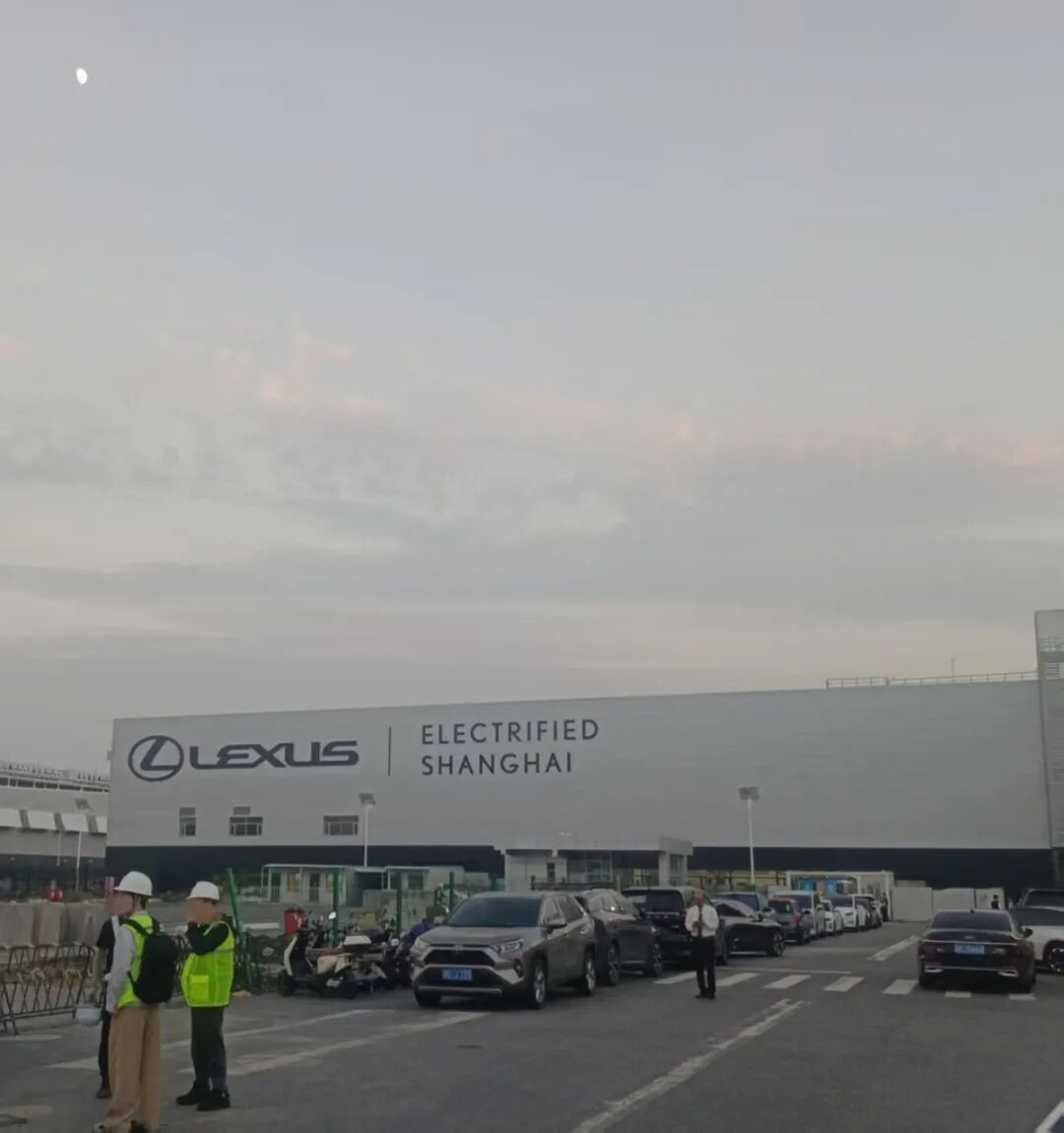
Due to the tight schedule, the author arrived at the plant at 5 p.m., near the off-duty time. Workers in orange-yellow vests and yellow hats, as well as supervisors in black jackets printed with the Lexus logo, white work badges and white hats, came out of the turnstiles at the gate of the final assembly workshop in groups.
About 100 meters in front of the workshop, there is a canteen and supermarket similar to a container, where construction workers are smoking and resting at the door. When asked about their main work and whether they know the construction progress of the plant, several simple, thin middle-aged men waved their hands slightly shyly, speaking Mandarin with a strong accent: "We are just workers and don't understand this. Go ask the people wearing white hats, they are the Party A side."
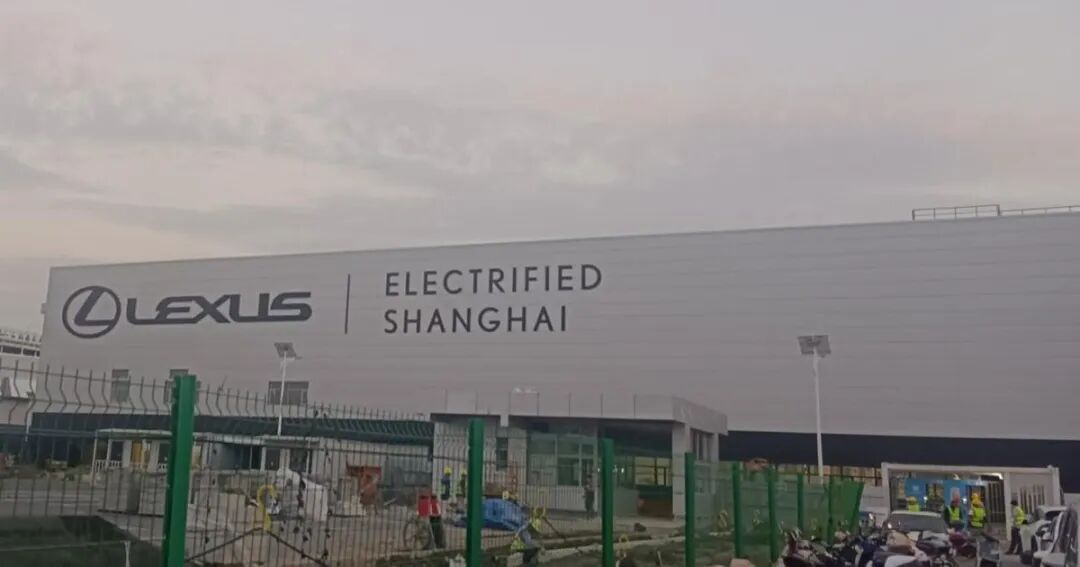
Photo: Workers off duty
Unlike the confused workers, Lexus employees were very cautious when responding to inquiries. After stating the purpose of the visit, the author tried to ask questions about recruitment, plant progress and current employee work, all of which were rejected. "We can't comment on this, you need to apply to the official side." The six or seven interviewees all responded in this way. Although their attitude was particularly kind, it is not difficult to see the hesitation of the employees from their refusal.
Only one Lexus employee who was having dinner in the canteen gave a referential reply. "Currently, the employees in the plant are doing construction work, and the production line workers have not yet entered the site." He revealed that production workers for workshops such as assembly and welding have all been recruited, but the specific start time of work is not yet known.
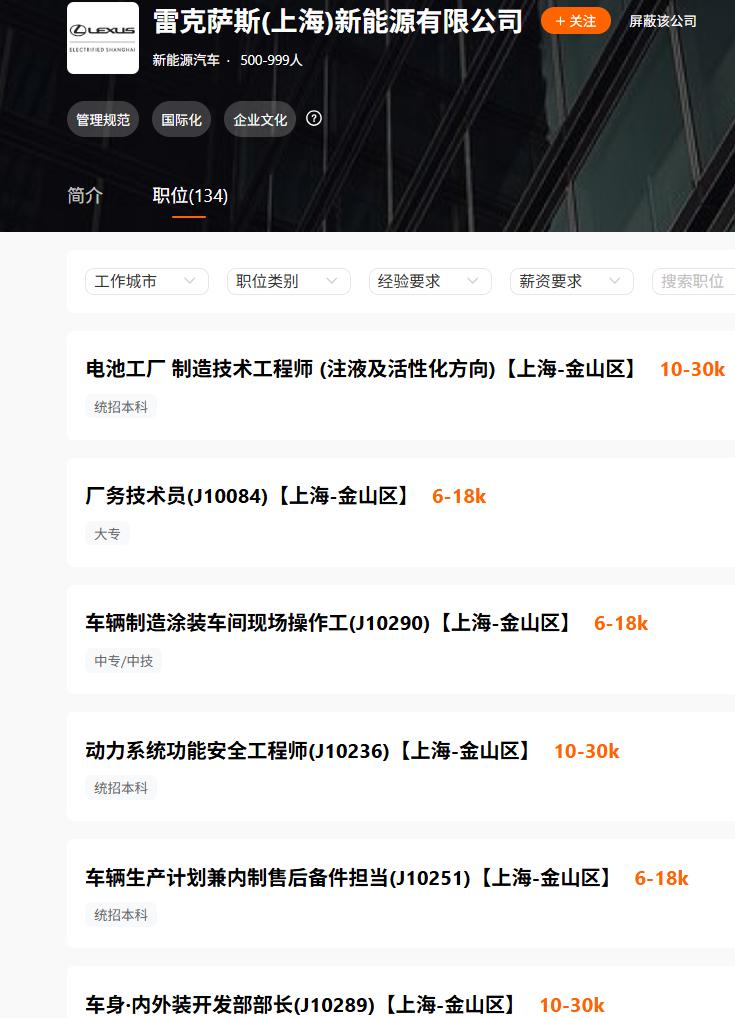
This statement has not been corroborated by other sources. Although a reader previously left a message under the article about the Lexus Shanghai plant saying that front-line workers have been recruited and several of his colleagues have already gone there, a large number of front-line production posts are still posted on well-known domestic recruitment websites for Lexus (Shanghai) New Energy Vehicle Co., Ltd., including painting, final assembly, die-casting, welding, stamping and other positions.
As for the time when construction workers will withdraw after the plant is completed, just like asking the canteen store manager to find out whether the school is on vacation, the response from the canteen staff can be used as a side reference.
"Two months left." The canteen auntie, holding the trash can she just emptied in her right hand, made a "two" gesture with her left hand.
It is learned that the canteen opened in March last year, and only provides services during the plant construction period, mainly to solve the catering problem of workers. After the Lexus Shanghai Jinshan Plant is completed, the container canteen will no longer be retained and will be evacuated together with the workers. The expiration date of the cooperation is two months later.
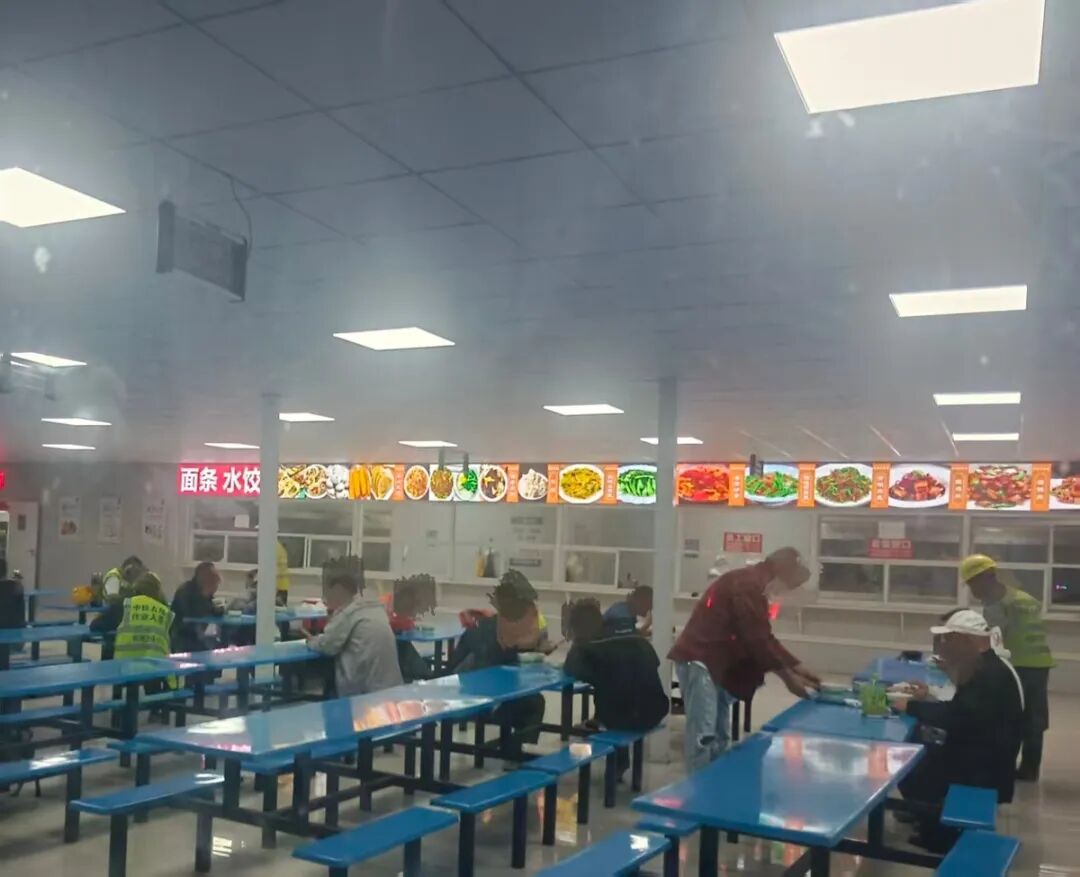
Photo: Only a few windows are open for the temporary canteen at night
Main buildings have equipment moved in, and independent office buildings have employees settled in
In terms of main buildings, during the last visit, The Community used a drone to list the distribution and production processes of the six main buildings: die-casting workshop, stamping workshop, stamping and welding combined workshop, painting workshop, final assembly workshop, and battery assembly workshop from an overhead perspective.
Although there was no time to use a drone during this research, according to a video released in October by the official account of a Lexus Shanghai sales and service company, all the main workshop buildings have been completed, and photovoltaic panels have been installed on the pre-reserved photovoltaic fixing seats on the plant roof.
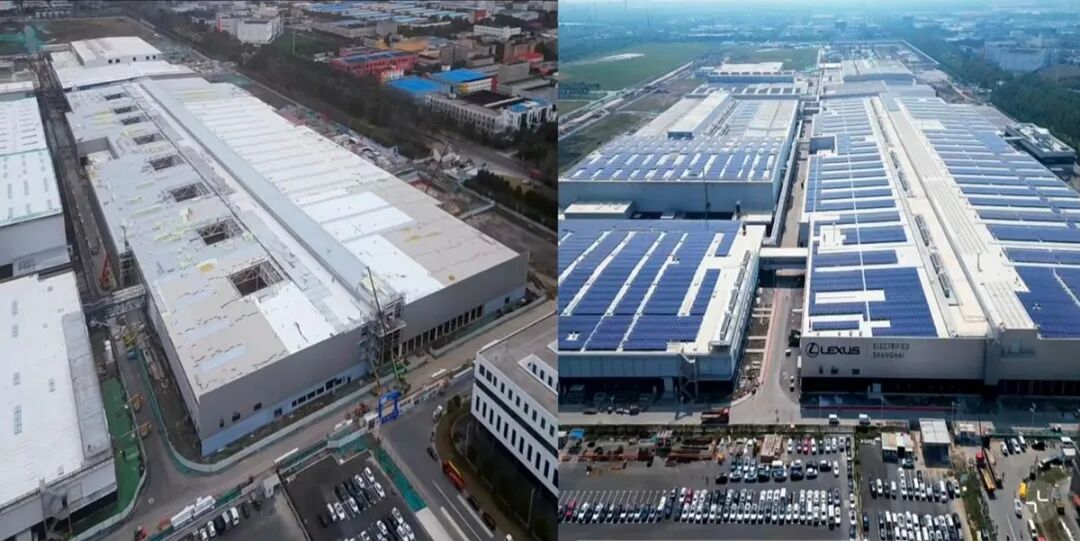
Looking through the gap in the railing in front of the final assembly workshop, a large number of equipment have been moved in, and workers are carrying out installation. But overall, the site is relatively messy, and workers leave one after another after 5:30 p.m. There is no multi-shift system to speed up the construction period. It can be inferred that the overall construction progress is orderly, and it will still take some time to complete.
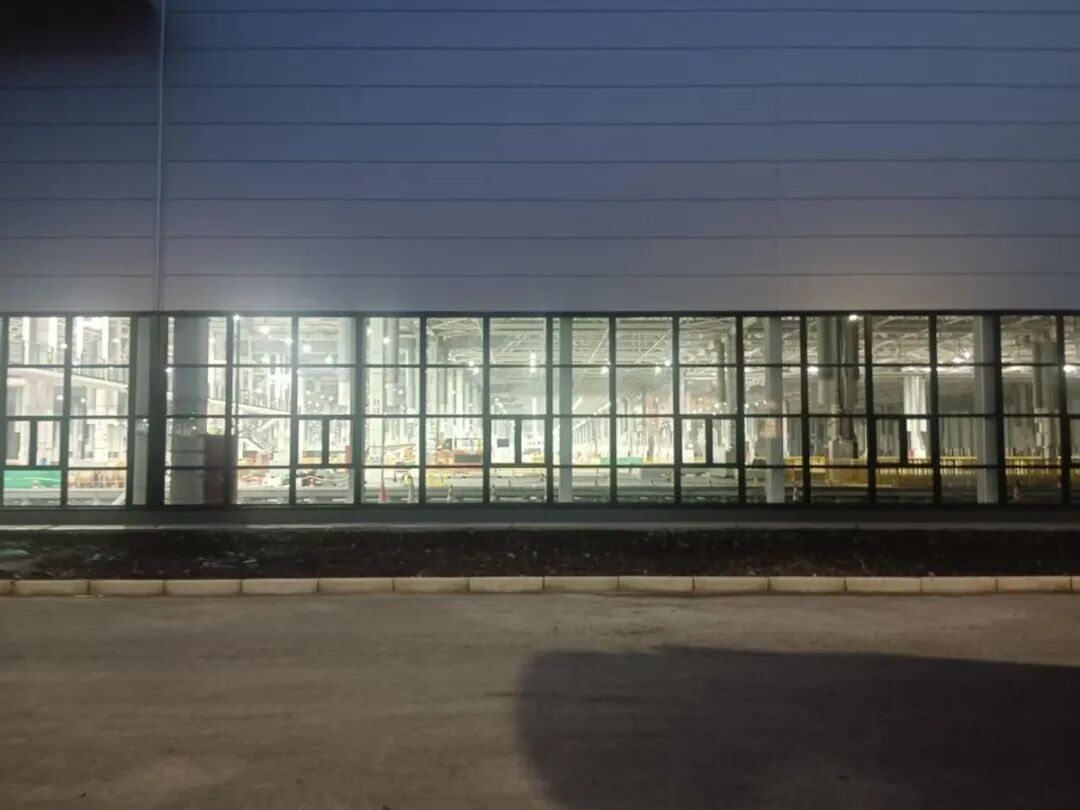
Photo: Equipment has entered the site, and workers are installing it
The main body of the painting workshop has been completed, but the side road has not been leveled, and there is a faint roar of machines nearby.
There are strict access control at the gate of the plant. People need to pass through the turnstile and there are security guards on duty, so it is difficult to enter. However, there are no restrictions on several independent office buildings in front of the final assembly workshop.
The visit found that Building 2 and Building 7 have been actually put into use, with people working inside, whose costumes are the same as those of the Lexus supervisors in the plant. There are also turnstiles inside the induction doors of the office buildings, which require identity verification to enter and exit, and there are security guards guarding the induction doors behind the turnstiles. Due to the employees' cautious awareness of information protection, we did not learn their specific job types.
In terms of employee benefits, some media broke the news that Lexus employees have commuting subsidies and meal subsidies, and the company is convenient for employees to take taxis for business trips. The employee dormitories have not yet been completed, and employees need to rent apartments, but the price is relatively cheap: 1200 yuan/month for a one-bedroom apartment, and 1450 yuan/month for a two-bedroom apartment.
Business trip subsidies and overtime pay are very considerable. The business trip subsidy is 160 yuan/day on working days and 240 yuan/day on weekends. Since the plant has not been completed, most blue-collar employees are currently on business trips at other Toyota bases, and can get relatively generous business trip salaries every month. The company provides free hotels for accommodation and also includes breakfast.
The overtime pay base is based on the current salary, but the blue-collar employees are strictly controlled to work no more than 36 hours of overtime per month. According to the actual investigation, after the workers left one after another at 5:30 p.m., many employees in Building 2 were still working overtime.
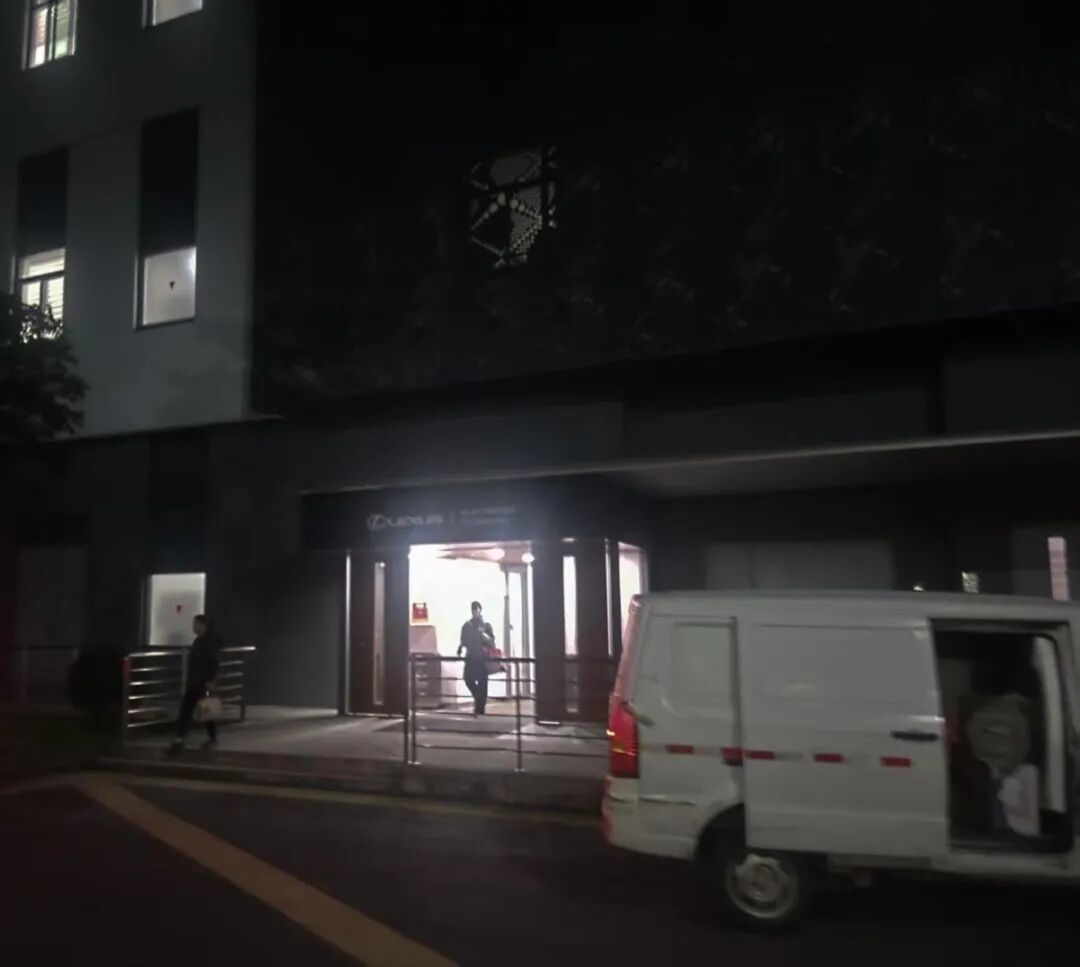
Photo: Employees walk out of Building 2 to get off work
It is worth noting that many exclusive Lexus parking spaces have been marked in front of Building 2, two of which are parked with Lexus RZ 450e, and there are two identical models in the charging area.
Lexus has never given specific information about which model will be produced specifically.
The market speculates that the first model to be put into production at the plant will be a three-row pure electric SUV of the TZ series or the electrified version of the ES, which supports the brand's sales — the ES-e pure electric sedan. The former is a large family SUV that is more suitable for Chinese consumers, while the latter is the most popular imported car in the Chinese market.
Can Lexus pure electric models turn the tide with the Shanghai plant?
Although the plant will produce pure electric models, judging from current sales, Lexus' pure electrification transformation is lonely and even bitter.
In the domestic market, the UX did not leave much impression on users, and the subsequent RZ series has long been hovering at single-digit sales in China. In May, Toyota suspended the development of the mass-produced model of "LF-ZC", giving the reason that "it is part of the adjustment of the company's overall vehicle development project in consideration of changes in market demand".
Although the TZ model and the pure electric ES are both ready to launch, domestic pure electric competitors have already carried out one or even two rounds of iterations, and even the large six-seat market is gradually shrinking.
From January to July this year, Lexus ES, RX, and NX are the best-selling imported models in China, but these models are still dominated by fuel and hybrid versions. Whether the new plant can make up for Lexus' shortcomings in pure electric vehicles is of great significance.
From the perspective of production capacity planning, the Jinshan Plant has a total investment of about 14.6 billion yuan, covers an area of 1.13 million square meters, and has a planned annual production capacity of 100,000 vehicles. This estimate is actually somewhat conservative. Even compared with half of the 450,000-500,000 annual production capacity of the Lingang Tesla Gigafactory, the production capacity after climbing will approach 250,000 vehicles.
Judging from Lexus' annual sales volume of about 850,000-900,000 vehicles and the current sales proportion of its pure electric models, these production capacities are obviously not only to serve domestic demand. The Shanghai plant has had the mission of feeding back overseas markets since its planning.
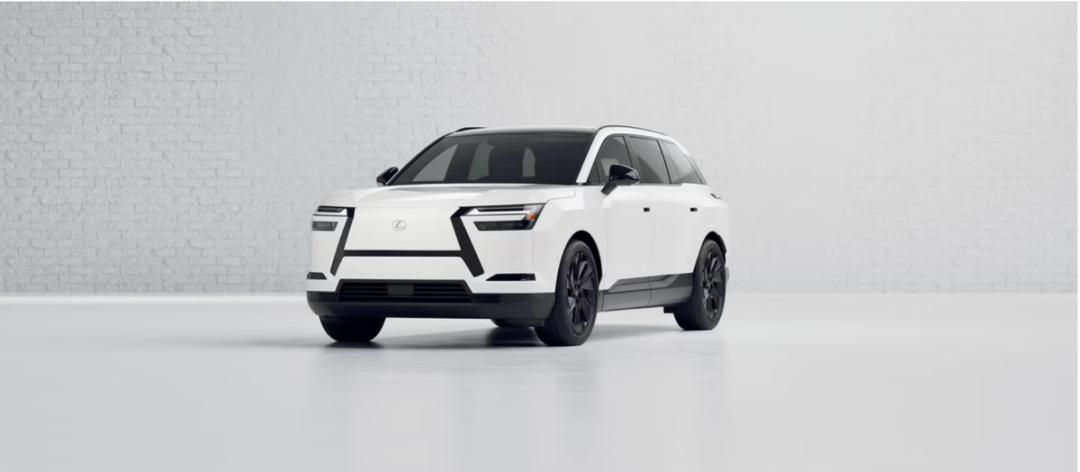
But the problem follows: can Lexus sell so many electric cars?
In fiscal year 2025, Toyota and Lexus sold about 5.04 million electrified vehicles, of which 4.62 million were hybrid vehicles and only 243,000 were pure electric vehicles.
Toyota's forecast for fiscal year 2026 is that HEV sales will exceed 5 million for the first time, the overall sales of electrified vehicles are expected to reach about 6 million, and pure electric vehicle sales will be below 1 million. The pure electric sales target allocated to the Lexus brand is even less.
Pure electric products are yet to gain momentum, but production capacity has been implemented in advance. How will Lexus digest it?
At present, there are two solutions.
The first is to expand demand, relying on China's developed and dense supply chain and complete technical system to enhance the pure electric competitiveness of the Lexus brand. In 2025, the global market share of Chinese auto parts enterprises reached 14%, a threefold increase in 10 years. This industrial potential is exactly what Lexus can leverage.
According to the plan, the local parts utilization rate of Toyota's new base will be the same as that of the Tesla Shanghai Gigafactory, exceeding 95%, and it will be deeply integrated into the Yangtze River Delta parts supporting system. At present, this plan is being implemented.
Nikkei Chinese Network recently reported that the new generation Lexus pure electric SUV that Toyota is scheduled to put into production in China in the autumn of 2027 is shifting its parts supply chain to local Chinese enterprises on a large scale. During the bidding process for core components such as body, battery, and control wiring harness, traditional Japanese Toyota-affiliated parts manufacturers have lost bids on a large scale, their orders have been greatly reduced, and relevant orders have mainly flowed to Chinese suppliers.
An executive of a Toyota partner company admitted: "We have never heard that this China-made SUV will use Japanese equipment and technology."
Deeply integrating into the Yangtze River Delta supporting system means shorter product iteration cycles, faster cost optimization space, and faster response speed closer to the Chinese market. For Lexus, this is not just a simple move to take China as a production base, but also an important transformation springboard, which is expected to open up its pure electric sales space in China and around the world.
The second solution lies in the production capacity margin. At present, the main sales force of Lexus is still fuel and hybrid models, and the market expansion of new energy vehicles is bound to take a certain amount of time. Then when the increment on the production side exceeds the demand on the sales side, will the Shanghai plant produce other models?
Nihon Keizai Shimbun