People Who Left Huawei: 23 AI Entrepreneurs, 18 Companies, A Commercial Journey Beyond the Gates
On April 17, the Shanghai Zhangjiang Science Hall was packed with people. Nearly a quarter of the seats in the main venue were reserved for foreign guests, and large screens on both sides provided real-time translation in English, Japanese, Korean and Thai. The three-day conference hosted by Agibot Robotics attracted more than 2,500 customers and partners from over 30 countries and regions.
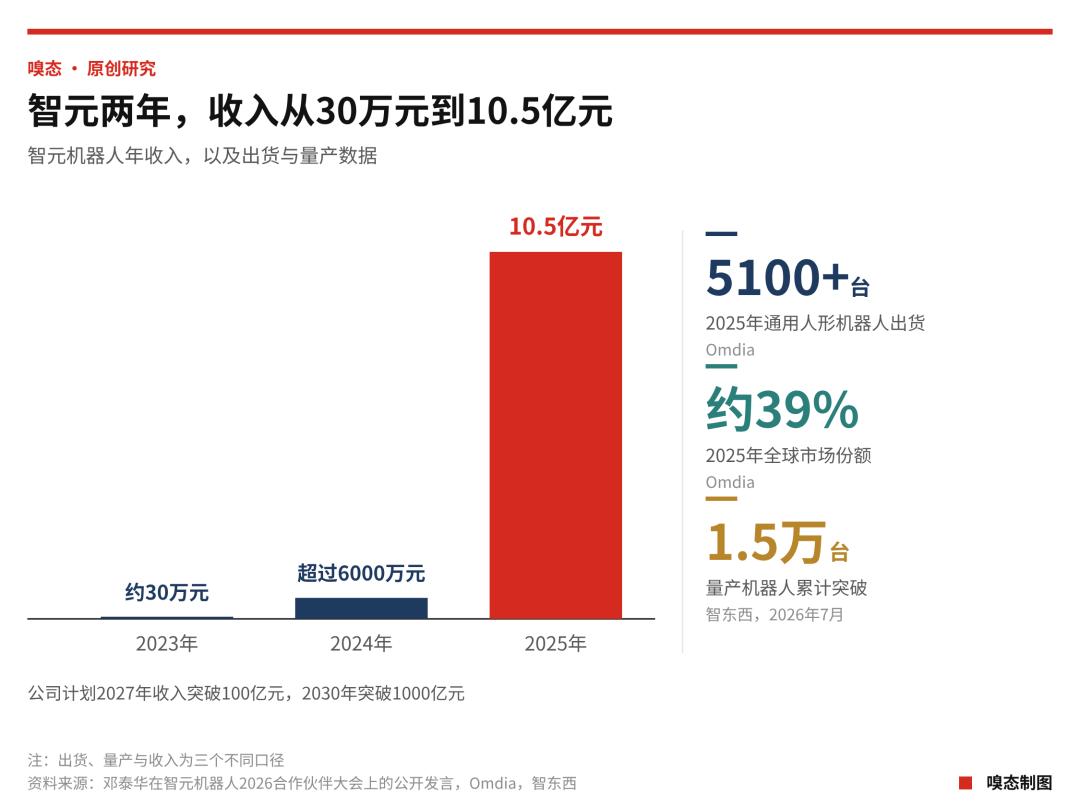
Deng Taihua, Chairman of Agibot, took the stage and announced a set of figures. The company's revenue was about 300,000 yuan in 2023, exceeded 60 million yuan in 2024, and reached 1.05 billion yuan in 2025. According to statistics from market research firm Omdia, Agibot shipped more than 5,100 general-purpose humanoid robots in 2025, accounting for about 39% of the global market. Three months later, Agibot launched the process for listing on the Hong Kong Stock Exchange.
In August, at the World Robot Conference in Beijing, another Huawei-backed company Moqi Intelligence brought its MORPHI KINO robot. The robot on the booth could wipe tables, restock drinks in refrigerators, and fold clothes. The company was just one year old, had raised more than 1 billion yuan in financing, and had not yet made its customer list public.
One company has sold thousands of robots and is preparing for an IPO; the other has just brought its robots to the exhibition booth and raised more than 1 billion yuan in financing. Between Agibot and Moqi, there are a number of AI startups founded by former Huawei employees.
Based on industrial and commercial registrations, company announcements, media reports and public speeches by the parties concerned, Xiutai has verified 23 AI entrepreneurs with Huawei work experience, involving 18 companies, with data as of October 23, 2026.
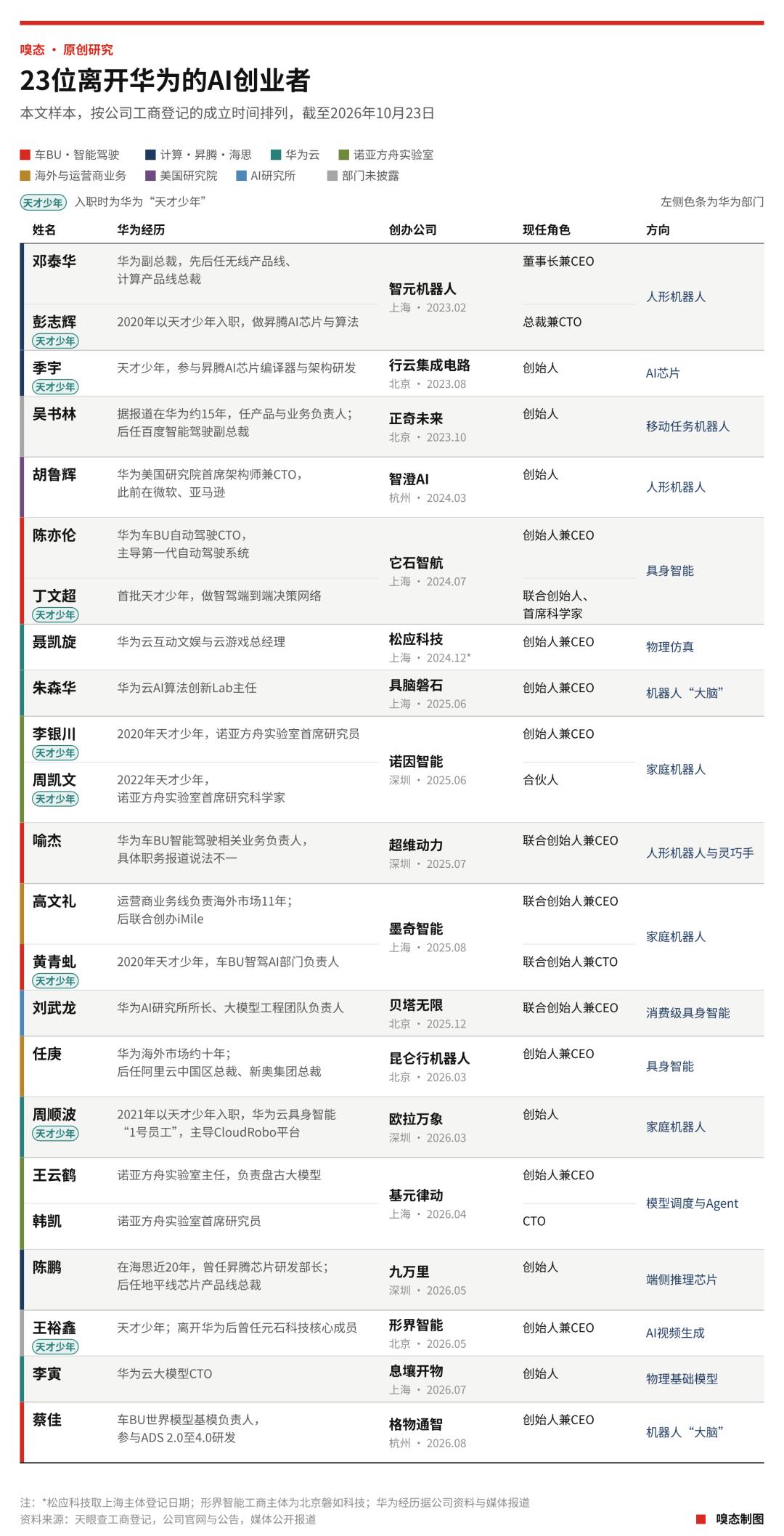
Among the 18 companies, only Agibot can be confirmed to have large-scale operating revenue. Some enterprises have delivered their products to households or factories, some have announced orders, and six have not yet released their products. The progress of commercialization varies greatly, but the financing scale is not sorted according to product delivery and revenue scale. Among the companies that have raised funds of the 1-billion-yuan level, there are not only Agibot, but also Moqi Intelligence whose product has just been released, and Nuoyin Intelligence which plans to launch its first product next year.
Huawei itself does not make robots. In July this year, Wu Xiaodong, director of the Embodied Intelligence Lab of Huawei Cloud, said in an interview with Yicai that Huawei Cloud does not produce robot bodies, and mainly provides development platforms, computing power and models. On July 3, Huawei Cloud signed a memorandum of cooperation with Yijiahe, planning to jointly develop robot products for industry scenarios.
Huawei keeps its platforms, computing power and industry customers inside the company. People who walk out of this door take with them the skills they have practiced on the business lines, and they have to find partners, funds and customers again outside. The 23 entrepreneurs left from different business lines and embarked on 18 entrepreneurial paths. What they did inside the company roughly determined their first direction after leaving; what they found outside is now widening the gap between each other.
Where Does 1 Billion Yuan Come From
There are two Huawei alumni in the story of Agibot: one came out with technical capabilities, and the other came in with commercial capabilities.
Peng Zhihui was the first to appear. In 2018, he graduated from the University of Electronic Science and Technology of China with a master's degree and joined the AI Laboratory of OPPO Research Institute. In 2020, he was selected into Huawei's "Genius Youth" program to work on Ascend AI chips and algorithms. This program was initiated by Ren Zhengfei in 2019, with a plan to recruit 20 to 30 people from all over the world that year. A widely circulated email from the president's office showed that the annual salary of the first batch ranged from 896,000 yuan to 2.01 million yuan. Among the 23 entrepreneurs in this article, 8 people have gone through this path, most of whom joined the company from 2020 to 2022 and stayed in Huawei for more than 2 years to more than 5 years. When the outside world talks about Huawei-related startups, these young people are the most frequently mentioned group.
Peng Zhihui stayed in Huawei for more than two years. In December 2022, he announced his resignation on Weibo. Two months later, Agibot was established in Shanghai.
In the following two years, what Agibot could show was mainly technology. At the end of 2024, it publicly released a robot dataset called AgiBot World, which contained more than 1 million motion trajectories covering 217 tasks; in March 2025, it released a general embodied foundational model. However, the revenue scale in these two years was very small, about 300,000 yuan in 2023 and just over 60 million yuan in 2024.
In March 2025, industrial and commercial information showed that Deng Taihua took over as the legal representative of Agibot. His resume later appeared in an announcement of Shanghai Sino New Material Co., Ltd., a company on the Sci-Tech Innovation Board. He used to be Vice President of Huawei, successively in charge of the Wireless Product Line and the Computing Product Line. The former sells base stations, and the latter sells servers, both of which are hardware businesses facing operators and government and enterprise customers with batch delivery. From Huawei's product line to a two-year-old robotics company, he did not start with technology, but took the position of operator, and later served as Chairman and CEO.
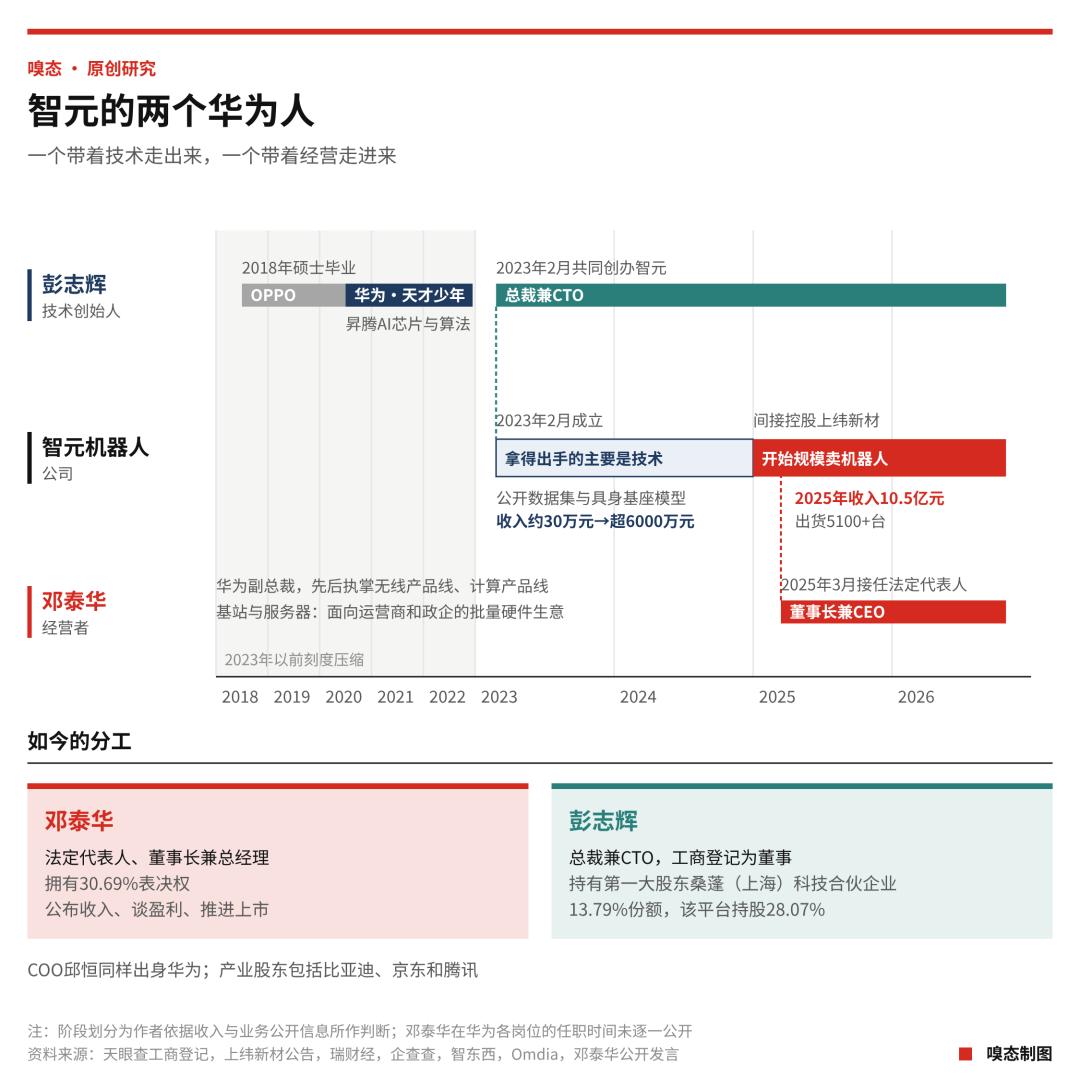
This year, Agibot has changed. Shanghai Sino New Material announced the transfer of control rights, and Agibot later indirectly held the controlling stake in this Sci-Tech Innovation Board company through a holding platform. Revenue rose from tens of millions of yuan to more than 1 billion yuan, and Omdia's statistics show that shipments exceeded 5,100 units. According to a report by Zhidx in July this year, Agibot's mass-produced robots have exceeded 15,000 units. Mass production, shipment volume and revenue are three different figures, which together show that Agibot has transformed from a company that demonstrates technology to a company that actually sells robots.
Nowadays, the roles of the two people in this company are very clear. Deng Taihua is the legal representative, chairman and general manager, and Ruicaijing reported that he holds 30.69% of the voting rights. It is also him who announces revenue, talks about profitability and promotes the listing. Peng Zhihui's title is President and CTO, and he is registered as a director in the industrial and commercial registration; the largest shareholder of the company is Sangpeng (Shanghai) Technology Partnership with 28.07% of the shares, and Qichacha shows that Peng Zhihui holds 13.79% of the partnership's shares. The report from Zhidx also mentioned that Qiu Heng, COO of Agibot, is also a Huawei veteran.
A young technical founder and a former Huawei executive who has managed large-scale hardware businesses, one in charge of technology and products, the other in charge of the company. This kind of partnership is not isolated in the sample of this article, and it will appear twice later.
Agibot has disclosed revenue and shipment volume, and also announced some customers and orders. However, gross profit, loss level and customer concentration will not be clear until the prospectus is made public. On April 17, Deng Taihua, Chairman of Agibot Robotics, said at the Partner Conference that the company is in no hurry to turn net profit positive and needs to continue to invest in R&D. Agibot's revenue reached 1.05 billion yuan in 2025, and it plans to exceed 10 billion yuan in 2027 and 100 billion yuan in 2030. Agibot's industrial shareholders include BYD, JD.com and Tencent.
Among the 18 companies counted, Agibot is the only one that publicly announced an annual revenue of more than 1 billion yuan. It has taken a lead of one to three years, and completed the puzzle of "technical geek + management veteran" earlier. The other 17 companies outside the door have not reached this point yet, and they are facing another level of challenge.
From Automobiles to Wiring Harnesses
Apart from Agibot, it is Chen Yilun and Ding Wenchao's Tushi Intelligent Navigation that delivers robots to customers' production lines.
They both come from Huawei's Intelligent Automotive Solutions BU. Chen Yilun completed his bachelor's and master's degrees at Tsinghua University, pursued his doctorate at the University of Michigan, worked at DJI, and later became CTO of Autonomous Driving at Huawei's Auto BU, leading Huawei's first-generation autonomous driving system. Ding Wenchao is one of Huawei's first "Genius Youths", working on the end-to-end decision-making network for intelligent driving. Intelligent driving requires a car to see the road by itself, make judgments by itself, turn the steering wheel by itself, and be installed in mass-produced cars for stable operation. What the two did at Huawei was to collect data, train models, verify on the car, and then collect data again.
After leaving Huawei, Ding Wenchao first went to Fudan University as a young researcher. In July 2024, Shanghai Tushi Intelligent Technology Co., Ltd. was established. Many reports wrote that the establishment time was February 2025, but the industrial and commercial registration date was seven months earlier.
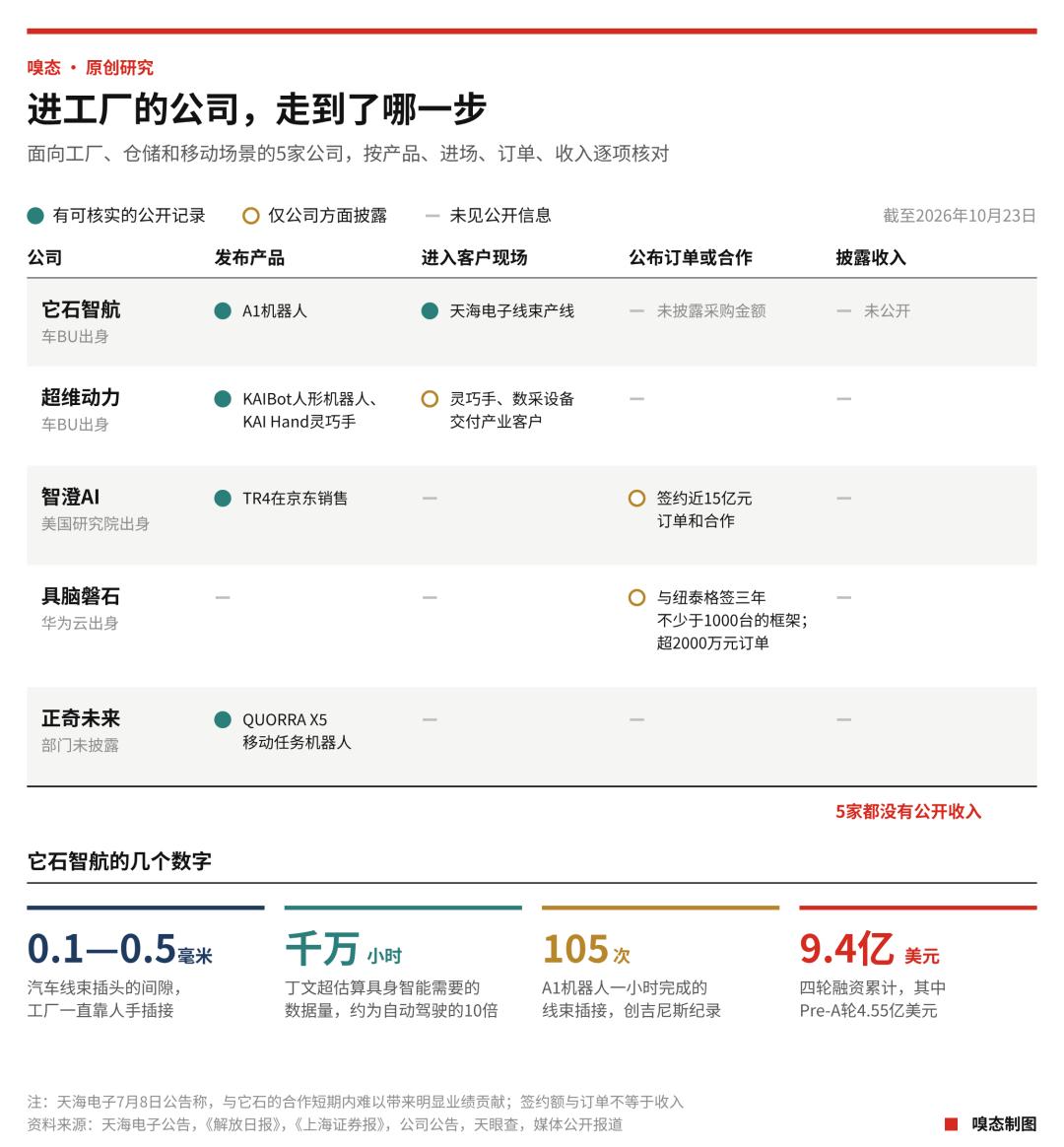
The first problem they chose to solve was automotive wiring harnesses. The gap between the wiring harness plugs is only 0.1 to 0.5 millimeters, and factories have long relied on workers to manually insert them. Ding Wenchao calculated an account in an exclusive interview with Jiefang Daily: when autonomous driving reaches a relatively mature stage, it requires data of the order of millions of hours. The difficulty of embodied intelligence is at least ten times higher, which requires about ten million hours. Their solution is to let workers wear wearable devices to record the movements, postures and operating forces of their hands while working, and then use the collected data to train the robot.
Ding Wenchao said: "I have always positioned myself as a problem solver."
After leaving Huawei, the problems he faced changed from roads to factory production lines. Collecting data, training models and repeated verification are still important links to solve problems.
At this year's AWE China Home Appliances & Consumer Electronics Expo, Tushi's A1 robot completed 105 wiring harness insertions in one hour, creating a Guinness World Record. On June 26, Tushi Intelligent Navigation signed a strategic cooperation agreement with Tianhai Electronics, an automotive wiring harness enterprise, planning to deploy robots on the automotive wiring harness production line to complete processes such as grasping, insertion and detection. The two sides had carried out nearly half a year of joint technical research before, but the cooperation agreement did not disclose the purchase amount, and Tushi did not disclose its operating revenue. On July 8, Tianhai Electronics announced that the cooperation between the two sides has not had a substantial impact on the company's main business, and it is difficult to bring obvious performance contributions in the short term.
However, among the Huawei-related startups counted in this article, Tushi is one of the few enterprises that have delivered robots to customers and put them into industrial field operations.
Capital has priced this company higher. Tushi has raised a total of about 940 million US dollars in four rounds of financing, of which the Pre-A round in April this year was 455 million US dollars. In the industrial and commercial registration, Chen Yilun is the actual controller, Ding Wenchao is a director, and the chairman is Li Zhenyu, the former head of Baidu's Autonomous Driving Business Group. Like Agibot, the name of "Genius Youth" appears more often in reports, and the control right in industrial and commercial affairs is in the hands of more senior managers.
Among the 23 Huawei-related entrepreneurs counted in this article, 5 are from the Auto BU, and all their entrepreneurial directions point to embodied intelligence.
Superpower Dynamics founded by Yu Jie has launched the humanoid robot KAIBot and the dexterous hand KAI Hand. In September, the company announced the completion of a series of angel+ round financing of more than 500 million yuan, and the dexterous hands and data collection equipment have been delivered to industrial customers. Cai Jia, who once participated in the R&D of intelligent driving systems at Huawei, founded Gewu Tongzhi in Hangzhou in August, to develop robot "brains" that integrate multi-modal information such as vision and touch. In October, it disclosed the completion of nearly 100 million yuan in angel round financing. Huang Qingqiu co-founded Moqi Intelligence with Gao Wenli, who also has Huawei work experience. They first collected data and tested robots in scenarios such as hotels and serviced apartments, with the long-term goal of letting robots enter ordinary households.
It is not only people from the Auto BU who are targeting factories and warehouses. Hu Luhui worked at the headquarters of Microsoft and Amazon in Seattle for more than ten years, participated in offline retail projects at Amazon, and then served as Chief Architect and CTO of Huawei US Research Institute. In 2024, he founded Zhicheng AI in Hangzhou, with its office located in the Cainiao Smart Valley Industrial Park, directly facing the Cainiao Global Headquarters.
Zhicheng AI's wheeled humanoid robot TR4 has been sold on JD.com, mainly for scenarios such as logistics warehousing and industrial manufacturing. The company also launched the biped humanoid robot TR5, and gradually iterated to TR6 and XR1 for industrial scenarios. In August this year, Hu Luhui revealed in an interview with Shanghai Securities News that the company has signed a total of nearly 1.5 billion yuan in orders and cooperation, involving intelligent manufacturing, security inspection, biochemical detection and other fields. However, Zhicheng AI has not fully disclosed the actual delivery quantity of orders and operating revenue, and the signed scale still needs to be distinguished from the final formed sales revenue.
Wu Shulin worked at Huawei for 15 years, from a front-line engineer to a product and business leader, and later went to Baidu as Vice President of the Intelligent Driving Business Group. His Zhengqi Future develops "door-to-door" mobile task robots, and the first product QUORRA X5 has been launched. The follow-up investors in the angel round include capitals related to SAIC, CATL and BYD. Zhu Senhua is the former director of Huawei Cloud AI Algorithm Innovation Lab. Ju Brain Panshi develops robot "brains" on the brain-like route. The company disclosed that it has signed a three-year procurement framework with no less than 1,000 units with the GEM listed company Newtech, and there is also an order of more than 20 million yuan.
These entrepreneurs have accumulated experience in technology R&D, engineering verification and enterprise business at Huawei, but making robots and selling robots are two different things. Industrial customers are willing to open up production sites, giving startups the opportunity to verify their technology. Whether the robot can work stably continuously and reduce production costs determines whether customers are willing to pay.
The skills accumulated during the Huawei period can help them find entry points, and the subsequent business has to be done step by step in the customer's factory.