From "Competing on Model Development" to "Seizing Entry Points": Domestic large AI models march into the consumer hardware sector
In 2026, domestic large models in China have started to "deviate from their supposed core business": on October 13th, StepVerse and Alibaba Qwen released AI-focused smartphones, glasses and earphone products on the very same day.
It is by no means a coincidence that the two large model vendors launched consumer electronics products on the same day, which marks the vane of domestic AI large model development in China — the competition between vendors will no longer be limited to the performance parameters of the latest version of AI large models, nor the price and cost of products, but will extend to consumer hardware terminals.
Why did large model vendors rush to cross-border to develop consumer-grade hardware products in 2026?
The reason is quite simple, the iteration speed of AI large models is getting faster and faster, which leads to a common problem faced by all major vendors: they cannot retain users and realize monetization. Therefore, seizing hardware entrances such as smartphones and smart glasses has become a mandatory task.
However, when a large number of software application companies swarm into developing consumer-grade AI hardware, can they really form a closed loop to retain the lost users?
【1】Anxiety under fierce competition
In China's technology industry, AI large model is the most popular sector, bar none. Data released by the Cyberspace Administration of China shows that:
As of July 2026, the total number of large models released in China has reached 1509, ranking first in the world; in the first half of 2026 alone, the total financing amount in the AI sector reached 4544.9 billion yuan, almost twice that of last year.
From the data perspective, the AI large model industry seems to be in a golden age of prosperity and booming development.
But just like the novel *Fortress Besieged*, outsiders only see the bright side, while insiders know all too well the hardships behind these figures — the industry is extremely involuted, so much so that even a slight lag will lead to the loss of users.
According to statistics from *New Wisdom*, from the beginning of this year to September 22, ten major vendors including Doubao, Alibaba Qwen and DEEPSEEK have released at least 28 flagship models in total, with a new domestic large model launched every 9.5 days on average.
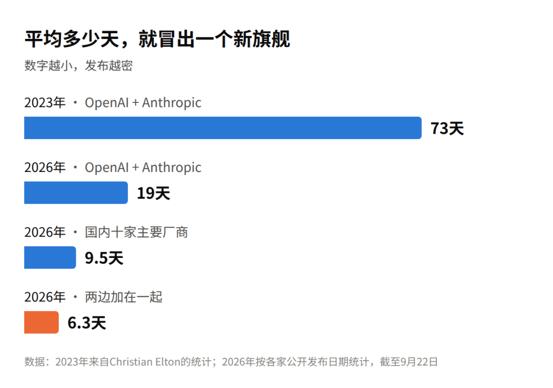
(Source: New Wisdom)
In terms of price, in the first half of 2026, there were six rounds of price cuts in the industry, with the cumulative decline exceeding the sum of all price cuts from the beginning of 2024 to the end of 2025.
It is not hard to see that the involution in performance and price is driving the continuous development of the entire large model industry, which is a good thing at the macro level, forcing all major domestic large model vendors to improve their competitiveness.
But it is not necessarily a good thing for large model vendors — this competition featuring extremely fast iteration speed makes it impossible for vendors to retain users, who will only flow to large model products with better intelligent experience and lower cost.
Data from QuestMobile shows that from January to February this year, the first-day retention rate of mainstream domestic AI applications was 65%, but when the time horizon is extended, the 15-day retention rate is only 18%, and the 30-day retention rate is only 12.8%.
It should be noted that to make profits, a product must first have a certain number of core user base. Only when the core user base reaches a certain scale can the enterprise have room for growth and realize commercial monetization through value-added services.
For example, providing services such as product recommendations or localized food, entertainment and leisure recommendations based on user environment, behavior and preference data; providing office assistants based on users' language habits and work styles.
All the above visions are based on the premise that users are deeply dependent on a certain large model. But obviously, in this booming wave of diverse products, what domestic large model vendors lack most is user loyalty and stickiness.
【2】Betting on consumer-grade hardware entrances
To fix the loopholes, we need to make up for the shortcomings. How to solve the problem of user loss? Domestic large model vendors have set their sights on consumer hardware.
The reason is very simple. First, the iteration speed of domestic large models is too fast, so users will naturally flow to the large model applications with the highest test rankings and best performance. Second, for software products, the cost for users to switch is almost zero.
Consumer-grade AI hardware can just solve these two problems. Whether it is AI glasses or smartphones equipped with intelligent agents, users will hold and use them for a long time. This means that once users start using their own AI hardware products, it will be very difficult for them to churn due to factors such as high switching costs.
"AI that stays at the App level will always be a 'tenant'. Only by developing hardware on its own can AI become a 'native resident'", the statement from Yin Qi, CEO of StepVerse, is the most straightforward. Only by securing consumer-grade AI hardware can large model vendors achieve long-term user retention.
In fact, Yin Qi's hardware philosophy has long become the industry consensus:
In December 2025, ByteDance teamed up with ZTE Nubia to launch the nubia M153 equipped with Doubao mobile assistant. In September this year, the Doubao smartphone hit the market, with more than 360,000 reservations on JD.com. ByteDance also jointly released the "Lingxi Xinghuo Smart Box" series with China Mobile, covering hardware forms such as AI office laptops, AI voice recorders and AIPC;
In July, StepVerse released "STEPX", a native large model AI terminal brand, and its first self-developed smartphone STEPX Neo, with a built-in personal intelligent agent Amoo. On October 13, the "Pioneer Version" of STEPX Neo was officially released, with a full-stack pricing of 3999 yuan. Amoo can independently plan and schedule corresponding services across applications, and complete a variety of tasks such as ticket booking, office work, video editing and local life services in one stop;
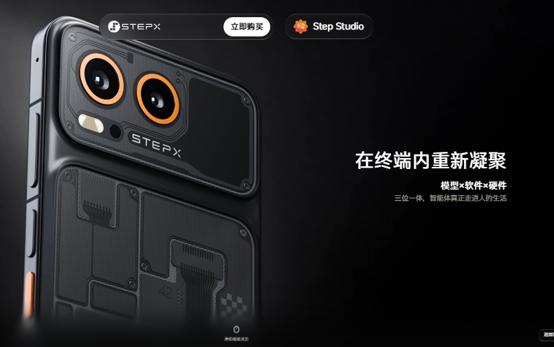
(Source: StepVerse official website)
In October, Alibaba released Qwen AI Glasses N1/N1 Pro with built-in daily "Personal Agent" and its first Qwen AI ear-clip headphone. According to a report by *LatePost*, following the AI glasses, the Wuying team under Alibaba Cloud is testing an AI tablet device named QwenBook, positioned as a native intelligent agent computer, whose full version is expected to be released at the end of 2026 or early 2027.
From ByteDance's Doubao to StepVerse and Alibaba Qwen, all of them launched consumer-grade AI hardware in the first half of 2026. It is obvious that self-developed consumer-grade hardware has become the major trend for domestic AI large model vendors.
【3】New challenges facing the ideal blueprint
In fact, many AI large model vendors attribute problems such as user churn and difficulty in commercial monetization to the lack of consumer-grade AI hardware, trying to retain users through terminal hardware products and build an ecosystem centered on their own large models.
The vision is very beautiful, but is it really easy to realize this grand blueprint where consumer hardware feeds back software applications? I don't think so.
First of all, there are constraints from limited resources. Consumer products such as AI smartphones and AI glasses involve many links including supply chain, R&D, spare parts stockpiling and so on, which will inevitably consume the manpower and capital of large model enterprises.
It should be noted that the current large model industry features an iteration speed of "overnight updates". If large model vendors disperse their energy to cross-border into hardware development, for example, in 2025, Zhipu AI's revenue was only 724 million yuan, while its net loss reached 4.718 billion yuan, with the loss 6.5 times its revenue; MiniMax's total revenue was 79.038 million US dollars, while its total loss within the year reached 1.872 billion US dollars...
Even for large manufacturers like ByteDance that have sufficient capital, the Doubao smartphone is not fully developed on its own, but cooperated with ZTE Nubia. For independent large model companies like StepVerse, facing continuous losses on one hand, and high investment and high failure rate of consumer hardware on the other, the pressure of independently developing consumer-grade AI hardware can be imagined.
Secondly, in addition to large model vendors developing AI hardware, hardware manufacturers are also launching their own AI large models and implanting them into their own products.
For example, Xiaomi's MiMo series. In this year's September Artificial Analysis Intelligence Index, Xiaomi MiMo-V2.6-Pro scored 46 points, surpassing Kimi K3 and GLM-5.3, ranking first among global open-source models and first among domestic models.

(Source: Xiaomi MiMo official website)
More importantly, the MiMo large model has been implanted into all of Xiaomi's hardware products. For example, Xiaomi 18 Fold and Xiaomi 18 Pro are equipped with the super Xiaoai 2.0 powered by MiMo on-device large model; its first AI native smartphone code-named "Lobster" has entered the closed beta testing stage...
Facing players like Xiaomi that have strong hardware capabilities and excellent software performance, how domestic large model vendors can attract users and gain competitive advantages through the strengths of AI software is the key focus of the industry in the future.
This terminal competition in 2026, on the surface, is a competition over the forms of smartphones, glasses and headphones, but in essence, it is competing for the same thing: who can make users truly inseparable from their products. Seizing the entrance is only the first step. Turning the entrance into user habits, and then turning the habits into a complete ecosystem, is the final destination.
This article is from the WeChat official account "Siku Finance", written by Qing Fu, edited by Jia Jia, and published by 36Kr with authorization.