Is Milkland Becoming More and More Like Mengniu?
Recently, Milkland released its performance express announcement for the first three quarters of 2026.
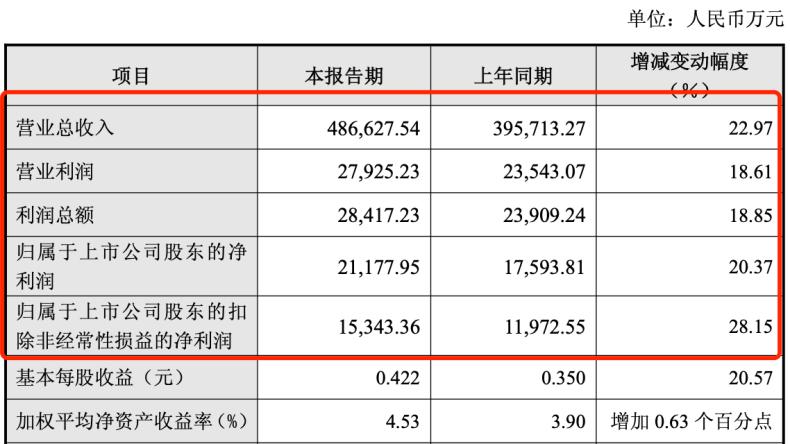
In the first three quarters of 2026, Milkland achieved revenue of 4.866 billion yuan, a year-on-year increase of 22.97%, and the net profit attributable to shareholders of listed companies was 212 million yuan, a year-on-year increase of 20.37%.
This is the last performance report in the era of Milkland's founder. In September this year, 61-year-old Chai Xiu, the founder of Milkland, resigned and no longer holds any positions in the company or its subsidiaries.
If you only look at the data, this performance is quite impressive.
Revenue and profits have increased significantly, and the non-recurring profit and loss net profit increased by 28.15% year-on-year, which is higher than the growth rate of revenue and net profit attributable to parent company, indicating that profit growth mainly comes from the endogenous improvement of main business.
At the same time, gross profit margin increased significantly compared with the same period of the previous year.
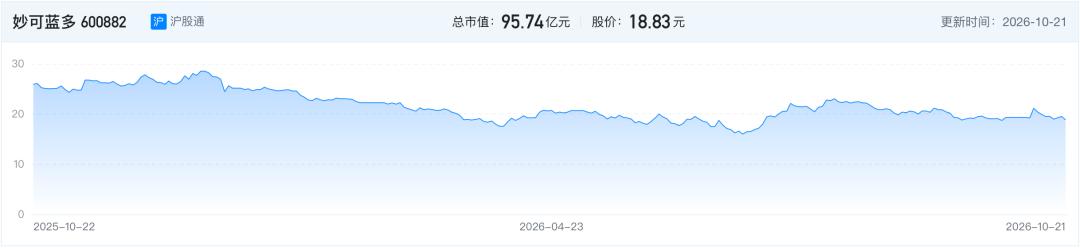
According to the Tianyancha APP, as of the close of trading on October 21, 2026, the total market value of Milkland was 9.574 billion yuan.
In the post-founder era, has Milkland found the code for growth? Is this growth sustainable in the long term?
Deep cultivation in vertical fields, will B-end business help take off?
As we all know, Milkland is the absolute leader in the domestic cheese industry, with a market share of about 38% in 2025.
The mainstream view in the past held that there may be two factors restricting the development of Milkland:
One is over-reliance on the single category of cheese.
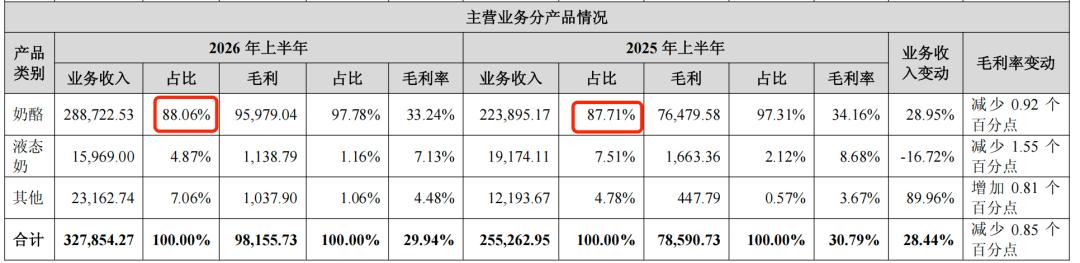
In the first half of 2026, Milkland's cheese business revenue accounted for 88.06% of total revenue, which did not decrease but increased compared with the same period last year.
The second is that growth is mainly driven by marketing.
In the first half of 2026, Milkland's sales expenses increased by 42.93% year-on-year, among which advertising and promotion expenses increased by as high as 58.54%, far exceeding the revenue growth rate.
Many professionals have given suggestions to Milkland, mostly focusing on these two aspects, such as how to carry out category innovation and how to get rid of dependence.
However, under the leadership of the Mengniu faction, Milkland does not seem to intend to change its course.
First of all, the dominant position of the cheese business may further rise.
The performance announcement for the first three quarters shows that the growth of profitability benefits from two points: 1. The proportion of core cheese business is further increased, and the business structure is continuously optimized. 2. The improvement of supply chain efficiency and the optimization of business strategies also promote cost reduction.
Secondly, marketing efforts seem to be continuously increasing.
In the first half of this year, Milkland obtained the identity of the global official cheese partner of the FIFA World Cup USA, Mexico and Canada, and signed three star players Messi, Mbappé and Yamal as brand ambassadors.
Financial reports show that the sales expense ratio in the first half of this year also rose to 19.3% from about 17% in the same period of last year, making it a minority that "rose against the trend" in the dairy sector.
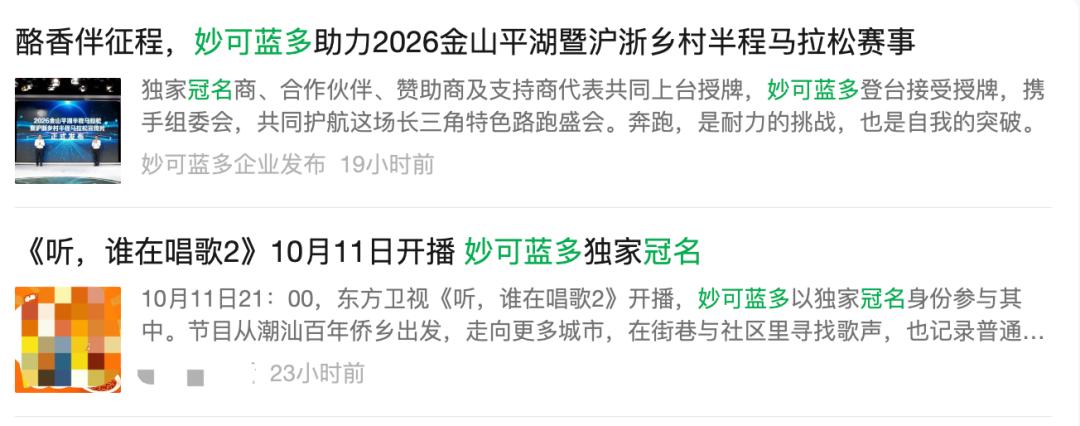
By October, Milkland successively announced the exclusive title sponsorship of marathon events and hit variety shows, with no sign of weakening marketing efforts.
These seemingly "unadvised" operations may be the result of the clarification of Milkland's positioning under the Mengniu system.
Milkland is Mengniu's most important business card in the cheese track. Concentrating resources on this category is in line with the strategic interests of the controlling shareholder.
The expression in the 2026 semi-annual report is very straightforward: "The company continues to focus on the high-margin core cheese business, the proportion of cheese business is steadily rising, and the core position of the main business is continuously consolidated."

From Mengniu's perspective, such a strategic choice is reasonable, but Milkland may face the challenge of the industry ceiling.
Cheese is an imported product, and like bread, it is difficult to truly become a staple food for Chinese people. Coupled with the decline in birth rate, the consumption scenarios of cheese sticks may also face pressure.
According to a report by *The Beijing News*, the compound annual growth rate of cheese category sales from 2020 to 2024 was -10% to -15%. It was not until June 2025 that the decline narrowed to 0.1%, showing signs of recovery.
Of course, Milkland under the leadership of the Mengniu faction did not go all the way to the dark, but focused its attention on the B-end.
In the first half of 2026, Milkland launched domestically produced original mozzarella cheese, intending to accelerate domestic substitution. At the same time, the Changchun Original Cheese Industrial Park was officially put into mass production, with an annual output of 30,000 tons in the first phase, and the second phase is expected to add another 25,000 to 30,000 tons of production capacity.
The announcement shows that in the first three quarters of 2026, Milkland's C-end and B-end businesses continued to maintain a high growth trend, both growing by more than 20% year-on-year.
In terms of product characteristics, cheese as a raw material for the food industry and a nutrient-enhancing ingredient does have very imaginative penetration space.
On the one hand, Western fast food and chain baking continue to expand, and the application of cheese in pizza, baked rice and baking has increased accordingly. The higher the degree of catering industrialization, the greater the amount of cheese used as a standardized ingredient.
On the other hand, in scenarios such as student meals, elderly nutrition, and sports supplements, cheese can be embedded as a concentrated carrier of calcium and high-quality protein, without requiring consumers to "fall in love with eating cheese", which reduces the acclimatization in eating habits.
Of course, this does not mean that Milkland has no challenges at all in the B-end business.
First of all, the domestic original cheese market has actually relied on imports for a long time.
According to a report by *Agriculture Daily*, the self-sufficiency rate of domestic original cheese is less than 20%. For every 5 pieces of cheese eaten by Chinese people, 4 pieces come from overseas.
The core driving force for the acceleration of domestic B-end substitution at present is the countervailing duty imposed on EU dairy products at the end of 2025, and the cost advantage brought by the domestic raw milk price being periodically lower than overseas.
This creates a price difference, allowing domestic cheese to cut into the B-end supply chain that was originally occupied by foreign brands.
But the problem is that the development of domestic substitution may be cyclical and reversible.
In 2025, China's imports of auto parts fell sharply, with the full-year import value reaching 21.12 billion US dollars, a year-on-year decrease of 21.7%.
This trend was interpreted as a landmark signal of the rise of local supply chains and the acceleration of import substitution. However, in the first quarter of 2026, the data reversed, and the import value of parts and components rebounded by 4.5% year-on-year.
Since 2019, Feihe has surpassed all foreign brands to become the best-selling brand in China's infant formula market, and the overall market share of domestic brands did show an upward trend at that time.
But in the first half of 2025, imported milk powder rebounded again. Customs data shows that from January to September 2025, the import volume of infant formula milk powder increased by 6.7% year-on-year.
Foreign brands such as Friso, Aptamil, and a2 have also resumed growth in the Chinese market, while some leading domestic brands are under pressure on revenue and profits.
Although these cases do not represent the failure of domestic substitution, they illustrate that domestic substitution may rebound. Once the policy dividend and price dividend change, Milkland's deep cultivation in the B-end may also encounter challenges.
Secondly, the competition intensity of the cheese B-end business is gradually increasing.
Yili officially put into operation a 10,000-ton annual production original mozzarella production line in March 2026, starting directly from raw milk, facing the B-end catering channel, and positioning itself to "fill the gap in large-scale domestic original cheese production".
This to a certain extent dispels Milkland's supply chain advantage of "backed by Mengniu".
In addition, the essence of B-end business is to serve large customers, who have bargaining power. Chain catering giants like Yum China, facing multiple suppliers such as Milkland and Yili, naturally have the ability to suppress prices.
This may keep the B-end business at a relatively low profit margin for a long time, affecting the overall profitability of Milkland's main cheese business.
In the final analysis, Milkland is the first domestic cheese brand, but its product power is not absolutely leading. Its market position relies more on first-mover advantage and brand power, and these advantages may contribute relatively little to the B-end business.
In the final analysis, cheese production does not have deep technical barriers, and the entry threshold is not high. If Milkland wants to maintain its leading position in the siege of giants such as Yili, Bright Dairy, and Junlebao, it may not only have supply chain and efficiency advantages.
The ship of the 1.0 era cannot support the waves of the 2.0 era?
Like many other consumer goods, the cheese industry is also going through a transition period.
In the past, a single super product of cheese sticks could support the overall market, but now it is necessary to maximize the intensity of product innovation to ensure that you do not fall behind.
According to data from Maiying Win, between Q3 2024 and Q2 2026, the number of new SKUs launched in each quarter of the cheese industry ranged from 47 to 61, making it a relatively active category.
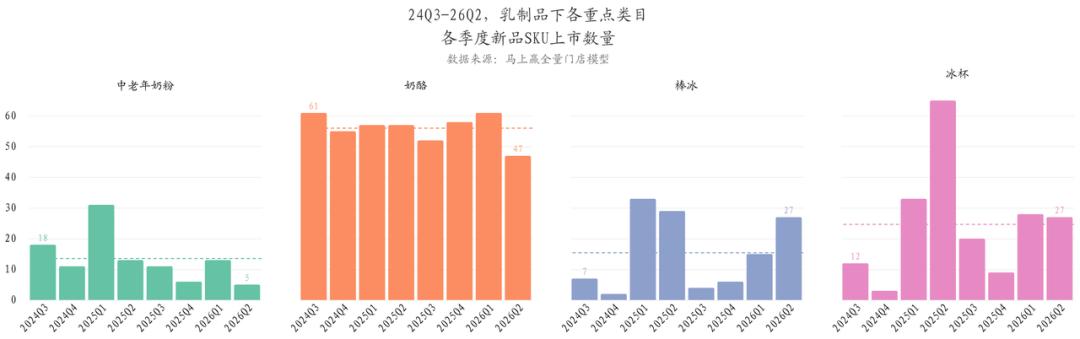
As industry competition intensifies, the importance of product innovation may become more and more obvious.
At the C-end, although the penetration rate of cheese sticks is high, the growth ceiling is clearly visible. To continue to expand the market, we can only rely on product innovation to expand the crowd and scenarios.
At the B-end, the window for domestic substitution has opened. Real innovation must be made in original cheese production technology, customized formulas, and supply stability.
In addition, another driving force for B-end innovation comes from customer demand itself.
The application of cheese in Western fast food, baking, tea and coffee, and even Chinese catering is expanding rapidly. Chain catering customers do not need standard products, but customized solutions that can be embedded in their menus.
Whoever can embed R&D into the customer's scenario can obtain higher customer stickiness and more stable orders.
Under such a general trend, Milkland's product innovation rhythm has also accelerated significantly.
In 2025, it launched small triangular cheese and cloud cheese cups for adult leisure, and further launched the original cheese "milk tofu" in 2026, clearly targeting fitness, breakfast, and family dining crowds, made with 100% raw cow milk.
At the B-end, in November 2025, Milkland released the first domestically produced original mozzarella cheese, claiming to break the situation of complete dependence on imports, and has entered B-end catering systems such as Yum China.
This is not only product innovation, but also a reinforcement of upstream supply chain capabilities.
However, the accelerated pace of innovation does not mean that innovation is effective. Milkland's new products have not yet had real hits, which is evidenced by the fact that the proportion of cheese business in revenue has not decreased but increased.
Financial reports show that in the first half of 2026, Milkland's R&D expenditure was 29 million yuan, and the R&D expense ratio was less than 0.9%. Even in the dairy industry where R&D expense ratio is generally low, this is a medium to low level.
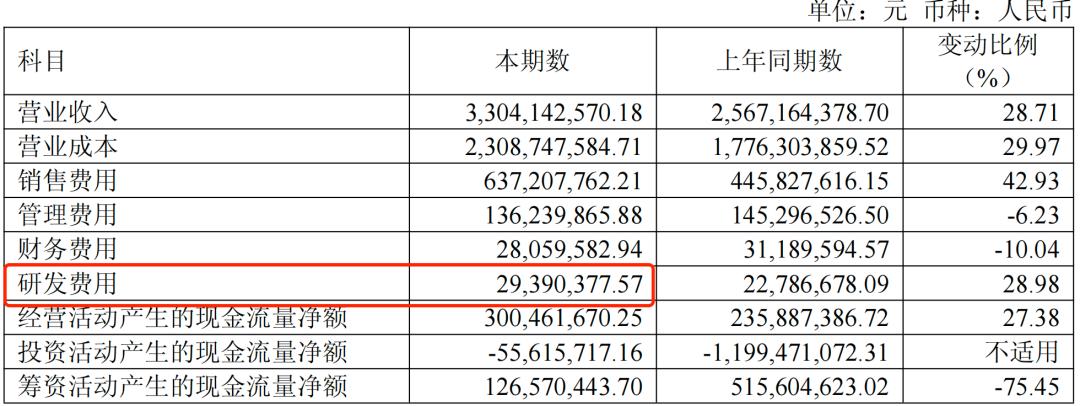
Such R&D investment may have considerable room for improvement compared with Milkland's positioning as the "first cheese stock" and category innovation leader.
Of course, backed by a big tree to enjoy the cool, Milkland may get Mengniu's assistance at the technical level.
Mengniu's own technical capabilities are also commendable,
For example, at the end of 2025, Mengniu announced that it had achieved important results in the field of deep processing of dairy raw materials. Its first batch of deep processed products including mascarpone, lactoferrin, pizza cheese, demineralized whey powder D90, micellar