Gold prices have dropped back to 4000, institutional investors are pulling out of the market, the central bank has made massive purchases, who do you trust?
Why Buy?
The chart below illustrates the relationship between the monthly gold purchases of the central bank and the international gold price since 2020:
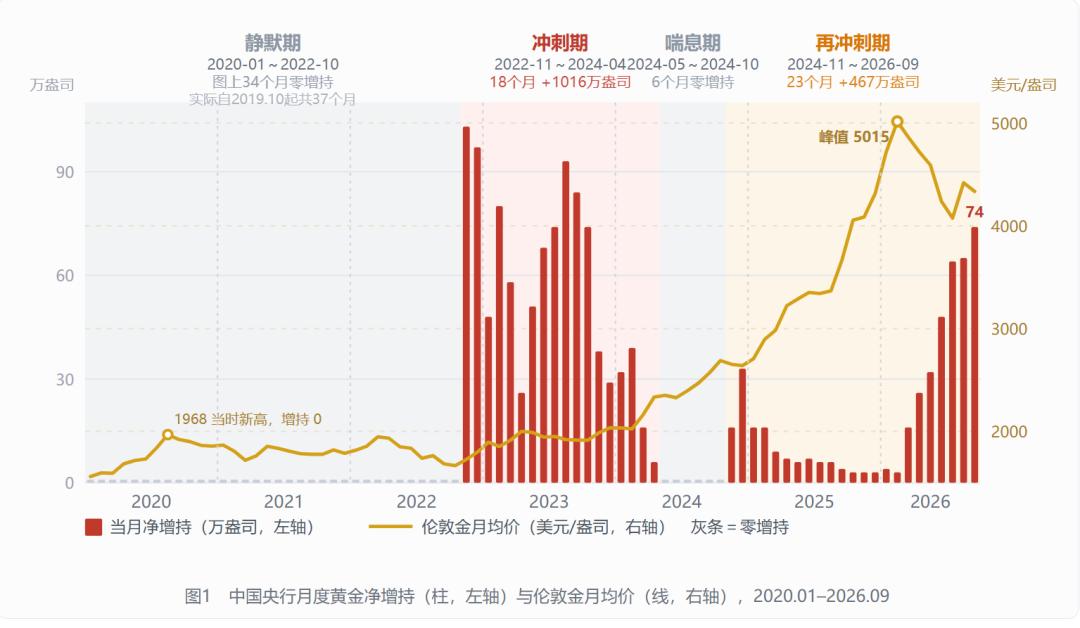
The clear conclusion is that although the gold price appears to be in a long-term peaking trend from the technical structure, considering the unique gold purchase model of China's central bank, this bearish structure is very unlikely to be established. It is only a correction in the long-term bull market of gold in the future.
This article sorts out the underlying logic behind this round of continuous gold purchases by the central bank, as well as the resulting changes in the purchase pattern.
November 2022 marks the starting point of this round of gold purchases by the central bank. Before that, when the gold price hit a record high of 1968 US dollars in 2020, it did not buy. When the gold price fell back to 1718 US dollars in 2021, it still did not buy. After that, when the price rose again, it still did not purchase, until November 2022.
What happened in 2022? After the Russia-Ukraine conflict, the West's freezing of Russia's foreign exchange reserves is a landmark event, that is, the first large-scale "weaponization" of the US dollar, which reminded the Chinese government of a huge potential risk:
Taking the end of October 2022, the last month before the restart of gold purchases, as the benchmark, US treasury bonds held by China accounted for about 28.8% of its foreign exchange reserves. Once a conflict breaks out between the two countries in the future, these 28.8% of reserve assets are very likely to be frozen by the United States.
Looking at the gold reserves at that time, they only accounted for 3.2% to 3.5% of China's officially announced international reserves, which was at a relatively low level among major gold holding countries around the world. Portugal, which had the highest proportion that year, was as high as 69%, Russia, which prepared two years in advance, was only 22%, and India, a fellow developing country, also had 8.4%. It is extremely urgent to increase gold reserves.
This is not only the choice of China's central bank. In 2022, global central banks purchased 1082 tons of gold, the fastest pace since 1967. However, in the following years, only China's central bank has persisted in doing so.
Therefore, increasing gold reserves is a national-level financial security strategy with huge room for growth. Only by understanding this qualitative positioning can we grasp the long-term logic behind the central bank's gold purchase behavior. The purchase pace can be fast or slow, but it will not stop before the target is reached.
Of course, strategy and tactics are separate. How exactly does the central bank increase its gold holdings?
I host a live stream every Wednesday to talk about market trends, industrial policies and industrial trends. You are welcome to make an appointment:
Why Pause?
In October 2022, the gold price fell to the lowest point of this round of decline at 1667 US dollars. Due to the US's aggressive interest rate hikes, gold became an asset that all major investment banks unanimously bearish on, and gold ETFs continued to see capital outflows.
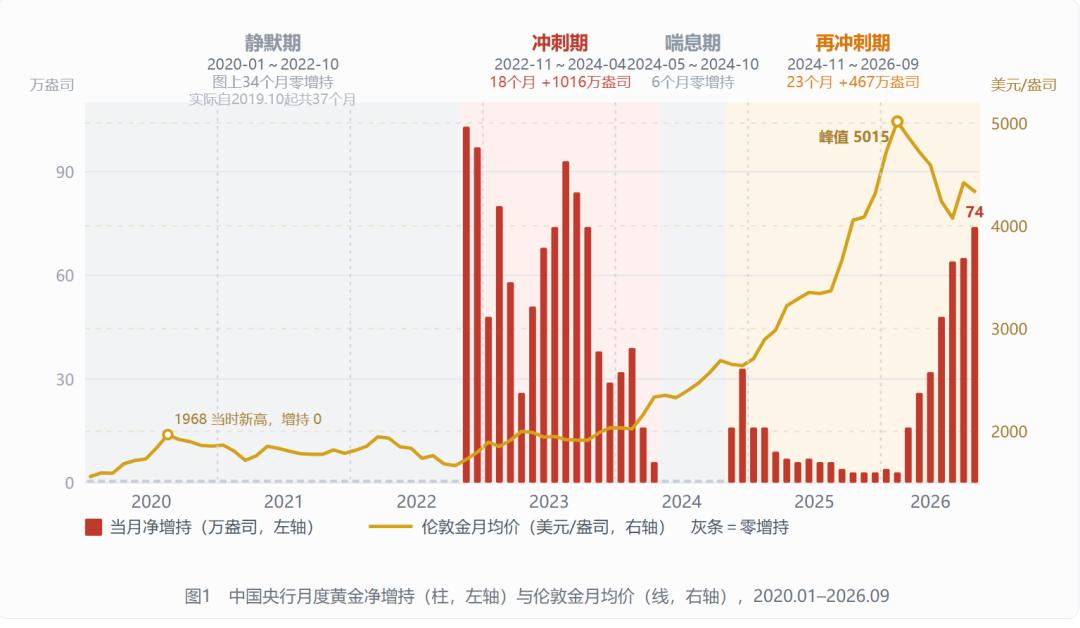
It was exactly from November that the central bank restarted its increase plan, buying 1.03 million ounces and 970,000 ounces respectively in the two months. So far, these are the two months with the highest purchase volume. In the following 18 months, it accumulated an additional 10.16 million ounces (about 316 tons), ranking second in the world after Turkey.
In addition, in October 2023, the Central Financial Work Conference proposed to "promote the RMB internationalization in a steady, prudent and solid manner". As the "ultimate means of payment widely accepted globally", the reserve function of gold was explicitly tied to the credit of sovereign currency.
It should be noted that a premise of US dollar hegemony is that the United States holds about one-fifth of the world's official gold reserves. Sufficient gold holdings are the guarantee of currency influence. And gold can only be bought slowly and continuously. If you buy too aggressively, the price will skyrocket and push up the purchase cost.
Sure enough, with the entry of China's central bank, gold started a major bull market. From the bottom of 1618 US dollars, it rose to 2448 US dollars in April 2024, with an increase of 51.3% in a year and a half.
Perhaps realizing the impact of its additional purchases on the gold price, or perhaps the previous purchases were more tentative, the central bank suddenly stopped increasing its gold holdings from May 2024, and this pause lasted for 6 months.
The market had a highly consistent explanation at that time: the gold price was at a historically high level, and the probability of short-term fluctuations and corrections rose. Suspending allocation helped to control costs.
Because the central bank's previous gold purchase model had always been buying on dips. It also suspended increasing holdings in October 2019, when the gold price rose sharply for several consecutive months, with a year-on-year increase of 26.1% in September 2019. Historically, whenever the gold price rises to a level that makes the central bank uncomfortable, it will stop buying; it will only come back when the price falls back to a comfortable range.
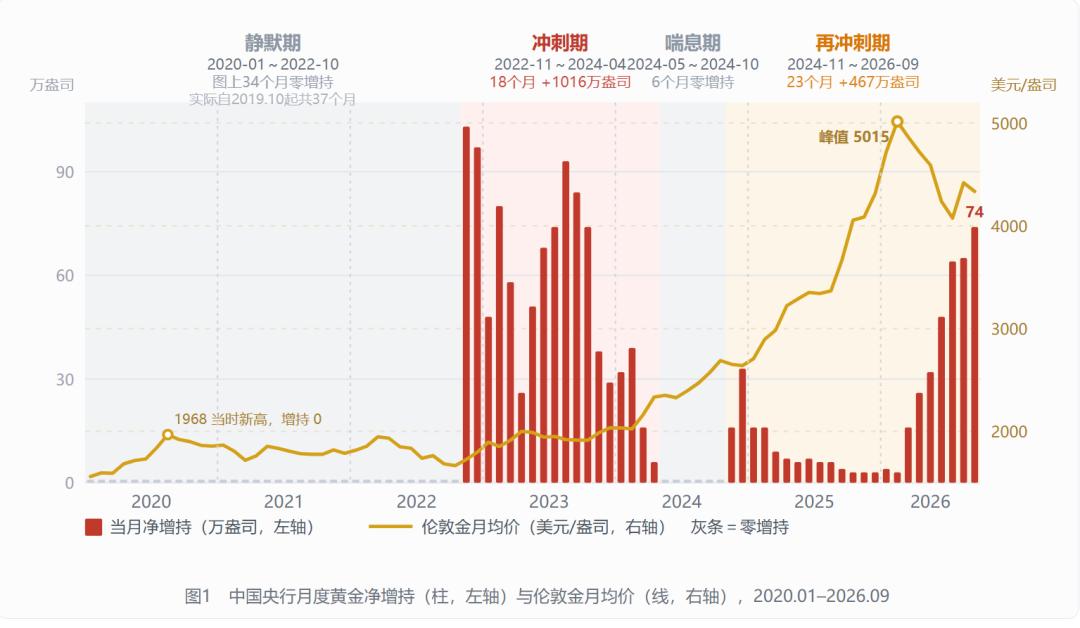
In the first few months, gold indeed stopped rising as expected, but it rose again in July and hit a new record high.
The central bank "missed the rally". What should it do next?
Why Resume Purchases?
At this point, the logic of gold's rise has shifted to the resonance cycle of global de-dollarization and interest rate cut expectations. The central bank's additional purchases have opened the floodgates for the rise, and the trend cannot stop just because it suspends additional purchases.
In addition, Trump won the general election, and the tariff war is inevitable. China's central bank realized that the previous strategy of buying and pausing may never be able to buy enough volume, so it restarted the additional purchases and made some revisions to the strategy. It only bought 160,000 ounces in the first month, and until February 2026, the purchase volume in most months was in single digits, more like a symbolic presence to show that "I am still buying".

The reason is very simple. Over the past year or so, gold has seen two waves of accelerated rise, with a cumulative increase of 120%, and 53 new historical records were set in 2025 alone.
In February 2026, the gold price peaked at 5626 US dollars, and then started a major correction, with a maximum decline of 29% within the year. The central bank finally waited for the opportunity, and the monthly additional purchase volume also expanded month by month, from 160,000 to 260,000, 320,000, 480,000, 640,000, and reached 740,000 ounces in September, which is the sixth highest level in nearly 4 years.
Quantitative analysis shows that for this round of additional purchases by the central bank since November 2024, after excluding the silent period, the correlation coefficient between the monthly additional purchase volume and the month-on-month change of gold price is -0.45, which is a very strong negative correlation, while the correlation coefficient between the additional purchase volume and the absolute level of gold price is +0.07, which is almost irrelevant.
This means that the central bank is a typical reverse buyer. The monthly additional purchase volume is very sensitive to price fluctuations, but not sensitive to the absolute level of gold price, and keeps buying continuously.
Conversely, how much impact does this gold purchase model of the central bank have on the gold price? Where is the impact reflected?
What Has Been Influenced?
The proportion of gold in China's foreign exchange reserves rose from about 3.2% in January 2022 to about 9.9% in September 2026. It seems that the proportion has more than doubled, but there is a counter-intuitive reason: among the attribution of the increase, only 17% comes from the growth of the reserve volume proportion, and the remaining 83% is contributed by the rise of the gold price itself.
This also verifies what was mentioned earlier: the proportion of gold in total reserves is still relatively low, far from reaching a safe level. The central bank controls the pace only to prevent gold from rising too fast, and to prevent its additional purchase behavior from being exploited by international speculators.
Many people believe that the daily trading volume of gold is 3000 tons, and the central bank buys less than 1000 tons a year, which is impossible to affect the trading price.
This idea confuses trading and demand. Gold demand refers to long-term holding, while gold trading involves both buying and selling. The latter only affects short-term fluctuations, while the former changes the long-term supply and demand structure. As a "gold devouring beast" that only buys and does not sell, the central bank accounts for more than 20% of global gold demand, exacerbating the long-term shortage of global gold supply.
More importantly, it adopts the mode of "the more the price falls, the more you buy, and buy more heavily".
At the current gold price, every additional 1 million ounces (about 31 tons) of gold only increases the proportion by about 0.1 percentage points. To raise the proportion to 22% (equivalent to the level before the Russia-Ukraine conflict), considering the annual growth of foreign exchange reserves, it will take 20 years at the current pace, which is too slow. Most of the factors for the proportion increase in the future will still be provided by the rise of gold price, so that it is possible to shorten this time to about 5 years, so that China's foreign exchange reserves can obtain sufficient safety margin before 2030 and support the RMB internationalization.
In contrast, at the end of August 2026, US treasury bonds accounted for about 17.2% of foreign exchange reserves, twice that of gold, which is still relatively high and not safe enough.
This determines that this gold purchase behavior of the central bank will continue for a long time in the future. Although it does not determine the short-term price fluctuation, it can continuously provide bottom support. In addition, there is huge room for additional purchases in the future, which is the biggest support for the long-term bull market of gold price in the next five years.
Therefore, the answer to the question "Will the gold price fall further?" depends on whether you stand on the side of the central bank.
This article is from the WeChat Official Account "lig0624" (ID: tongyipaocha), the author is Sixiang Gangyin, and 36Kr publishes it with authorization.