Who has been harmed by the "WeChat Business"-style media of 100EC?
"Wechat business-style" media has emerged.
In the early days of Wechat business, people would first package their identities on Moments: today they are some kind of mentor, tomorrow they attend some kind of summit, the day after tomorrow they are some kind of expert, all kinds of titles keep popping up. The more glamorous the identity is, the easier it is to sell products.
Not long ago, the exposed "NetEco" is exactly this kind of "Wechat business-style" media.
"Wechat business-style" Media: Gaining Huge Traffic With Fake Identities
Public information shows that the resume of Cao Lei, founder of "NetEco", is quite glamorous.
Founder of the "Thousand E-commerce and Ten Thousand Merchants" ecosystem;
Director of the NetEco E-commerce Research Center, a top 10 influential social think tank for the Belt and Road Initiative recognized by the National Development and Reform Commission;
Visiting professor at Tsinghua University, Peking University, Zhejiang University, and Shanghai Jiao Tong University;
Entrepreneurship mentor at the Oriental College of Zhejiang University of Finance & Economics.
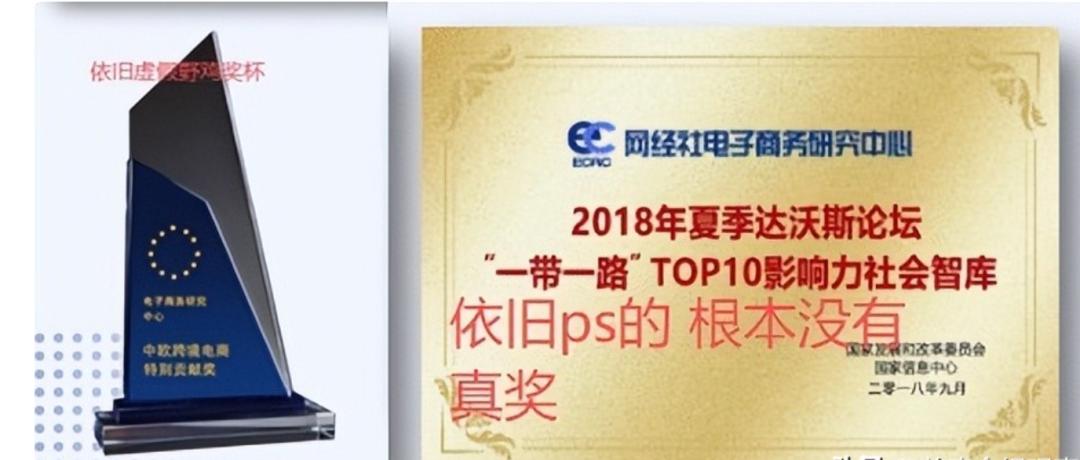
But in-depth investigation of these titles and experiences shows that their authenticity cannot be justified.
According to the Jiangnan Metropolis Daily, Yao Kefeng, a lawyer whose name is "listed" in the official expert database of NetEco, actually did not know that he had been included in the expert list by NetEco.
This is not an isolated case.
An associate professor of law at a university also stated that he did not know he was included in the expert database by NetEco.
As for Cao Lei himself, his identity as a visiting professor at Tsinghua University was also denied by the university's publicity department.
Even the trophy of the "Special Contribution Award for China-Europe Cross-border E-commerce" and the certificate of "Top 10 Influential Social Think Tanks for the Belt and Road Initiative under the National Development and Reform Commission of the State Council" are photoshopped. This think tank was also announced as an "illegal social organization" by the Ministry of Civil Affairs in 2018.
On Cao Lei, I see the exact same vibe of Wechat business Moments back in the days: no matter if it is real or not, you must put up photos of "luxury cars", "trophies" and "mentor titles".
With the blessing of the identity as an e-commerce expert, Double 11 is the best time to attract traffic.
At this time, e-commerce topics are prone to break out intensively at this node. Therefore, NetEco has also continuously published various industry topics such as annual e-commerce promotions, competition between platforms, and brand reputation.
The Public Relations Business of "Wechat business-style" Media
For a media that can continuously create industry content, hot spots are not only traffic, but also business opportunities.
However, if the media's own identity is problematic, hot spots may become another tool: using seemingly professional analysis, expert interviews and video distribution to add weight to a piece of negative information.
According to an informant, at the beginning of this year, a well-known enterprise with a market value of over 100 billion yuan encountered negative public opinion, and NetEco seized the relevant event to keep speaking out.
Cao Lei first released "E-commerce Quick Comment", then followed up with several "expert interviews", and then produced the interviews into videos for further dissemination.
The informant said that the enterprise, worried about the continuous fermentation of negative public opinion, finally signed a contract worth more than 100,000 yuan with NetEco.
The enterprise initially wanted to pay 60,000 yuan, but it was considered insufficient.
Another senior corporate public relations person also said that companies in industries such as e-commerce, education, new consumption and medical care have encountered Cao Lei, and described him as "taking advantage of enterprises of all sizes".
If these claims are true, NetEco's business model is not just ordinary media placement, but a dangerous cycle has emerged: first use the media identity to create public opinion pressure, and then convert enterprises' fear of negative information into commercial revenue.
This is also similar to the Wechat business in the early days.
Wechat business first tells you through carefully created Moments that ordinary people can make money easily, then uses success cases and identity packaging to create anxiety, and finally makes you pay to join.
The difference is that the anxiety created by Wechat business is "you will miss the wealth opportunity if you don't join now",
while this kind of public relations business creates the anxiety that "the negative news will not stop if you don't pay".
One sells the hope of getting rich, the other sells the hope of getting rid of negative public opinion.
According to the informant, JD has always been an important client of NetEco with long-term paid cooperation; while Douyin has hardly paid any fees.
Subsequently, a dispute arose between JD and Douyin, and NetEco released negative content related to Douyin E-commerce.
Victims of "Wechat business-style" Media Public Relations
Running a media business relies on credibility and influence. This credibility first comes from the content quality accumulated over a long period of time.
But anyone who creates content knows that this is a long and arduous process.
In the era of self-media, the shortcut to skip this process is to "build personal design".
As a long-term client of NetEco, JD is essentially choosing a voice channel that can reach the industry and influence the public when selecting media placements.
But from the perspective of commercial cooperation, since Party A values the "personal design" of Party B's media, it has to take the risk of this personal design collapsing.
This time, JD is in the same situation.
In the process of cooperating with this kind of "Wechat business-style" media, JD is actually "passively victimized" invisibly.
After all, JD cannot check the qualifications and identities of every cooperating media one by one.
However, when the cooperating channel has identity packaging, conflict of interest or improper public opinion operation, JD will be involved in it, and eventually suffer the backlash of credibility.
Compared with the "indirect victim" like JD who is "innocent",
the ones directly affected by the "Wechat business-style" media are all the objects "supervised" by the "Wechat business-style" media.
It is not a problem that media releases articles with positions and tendencies. Because the value and influence of the media come from its ability to provide credible information, independent judgment and effective supervision.
But "Wechat business-style" media is different.
It relies on the personal design of experts.
As readers, what you see first is often identities such as "XX lawyer", "XX investor" and "XX professor".
These titles bring natural trust to the media content, and also make an ordinary negative comment look more like an industry supervision with professional endorsement.
But when these expert identities themselves are in question, the credibility of NetEco's content also needs to be questioned.
Looking deeper into the expert content released by NetEco, you will also find a problem: these manuscripts are not only of doubtful credibility, but also highly convergent in views.
For example, in the series of manuscripts "7 Experts Comment on the Dispute between JD and Douyin" released by NetEco, it seems that the experts come from different industries, but the core positions of the 7 manuscripts are surprisingly consistent:
They believe that there is a conflict of interest between traffic distribution and e-commerce operation, and criticize that Douyin "may" and "has the motivation" to use the algorithm black box to transfer platform traffic to e-commerce operation. Among so many experts, not even one person said that Douyin really has the above problems, but between the lines of each article, there is the famous accusation made hundreds of years ago: "groundless accusation".
When expert identities are questioned and commercial relationships are controversial, can this kind of "collective voice of experts" still argue out the truth for the Double 11 dispute between JD and Douyin?
After all, real industry supervision should let facts and evidence speak, instead of creating a sense of "final conclusion" by relying on "personal design" and "titles".
When "experts" are actually "pseudo-experts" and "media" may be used for commercial pressure, it is difficult for the public to judge whether a negative news is normal supervision or interest-driven public opinion operation.
E-commerce brands, readers, and Double 11 consumers have not benefited from this public opinion war.
In the end, "Wechat business-style" media like NetEco brings a "three-loss" situation. Especially considering that the Central Political and Legal Affairs Commission has just included "public opinion extortion" and "online water army troublemaking" into the key governance scope of the anti-crime and evil campaign, it may also bring criminal risks.
This article is from the WeChat official account "Zhibei Focus", and is released by 36Kr with authorization.