If the rebound continues, can AI still play the leading role?
Since July, after this round of correction in the A-share market, the most tangled question among investors is: Is this just a mid-fall relay, or has the market already entered the bottom range?
The reason why this question is hard to answer is that there is abundant evidence supporting both sides of the argument.
Bearish investors argue that the US Treasury yield remains at a high level, US tech stocks are undergoing correction, domestic domestic demand is still weak, and corporate earnings have not truly rebounded, so there is no basis to claim that the bottom has arrived.
Bullish investors point out that valuations have been compressed to historical lows, ETFs are seeing large net inflows, policy signals to support the market are clear, and margin trading positions have been largely cleared out, so there is little room left for further market decline.
To answer this question, we may need to change our mindset: instead of debating "whether the bottom has arrived", we should look at "what position and stage the market is currently in, what conditions are already met, and what conditions are still one step short of being satisfied".
01
As of October 23, the P/E ratio of CSI 300 stood at 12.8 times, at the 51.8th percentile of the past 10 years, which is not extremely cheap. The ChiNext Index recorded a P/E ratio of 31.25 times, only at the 15.48th percentile of the past 10 years, which is already at a relatively low level.
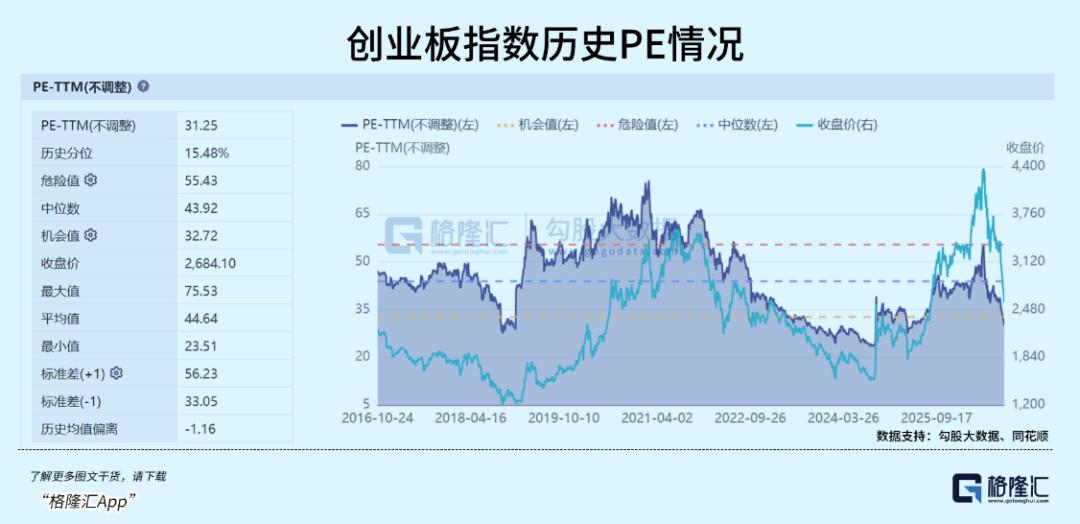
Calculated based on the market's earnings forecasts for 2026 and 2027, the dynamic P/E ratio of the ChiNext Index is only 23.1 times and 16.3 times respectively. At this level, its cost performance in the growth sector has become quite prominent.
In other words, from the perspective of valuation, the market has already priced in a considerable part of the pessimistic expectations.
However, cheap valuation has never been a sufficient reason to buy, because assets that are cheap can still become even cheaper.
What really supports the judgment of the "bottom range" is the change in capital conditions.
In recent weeks, equity ETFs have seen sustained large net inflows, with a single-week inflow of 1529 billion yuan, of which the net inflow of CSI 300 ETFs reached 637 billion yuan. Historically, this level of inflow corresponds to the bottom range of the market.
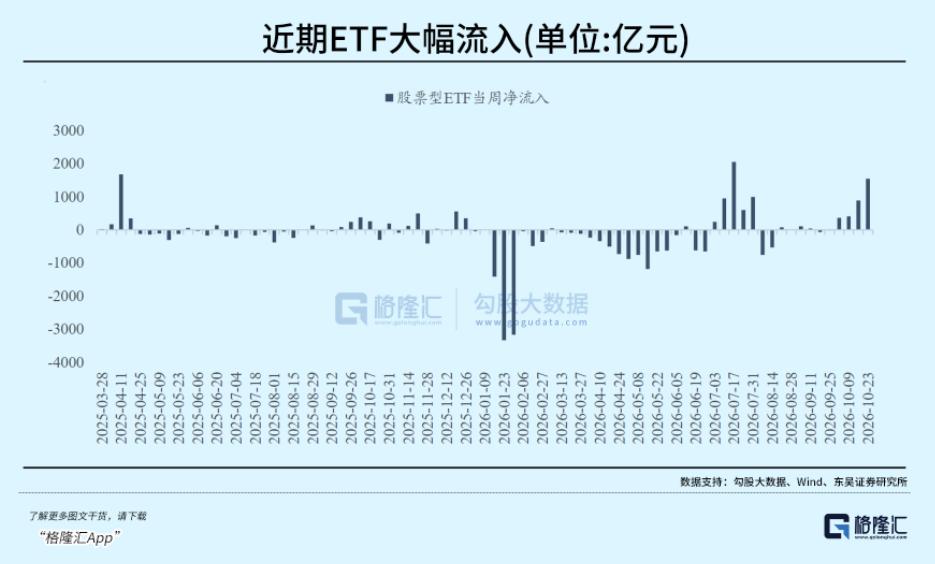
What is more noteworthy is that the way of market stabilization is changing: in the past, it was mostly volume-driven rise in late trading, but in recent days, it has turned to pulse-style net buying during trading hours, with multiple volume surges in the morning session.
This change shows that the capital supporting the market is not passively defending the market, but actively taking positions at key price levels.
The data of margin trading positions also tells the same story.
At present, the margin trading balance has dropped by 18.6% from the highest point of this year, returning to the level in late November last year; the proportion of margin trading purchases in total trading volume has dropped to 7.84%, the lowest level since September 2024. The position ratio of active private equity funds has also dropped to the lowest level since March 2024.
These data all indicate that leveraged capital and active capital have been largely withdrawn, and the momentum for a sharp further decline is weakening.
However, the "low level" of capital conditions does not mean that the deleveraging and clearing process is fully completed.
Historically, when the 8 major bottoms of the A-share market appeared, the average turnover rate was 1.56%, and the average shrinkage of trading volume was -50%. The lowest turnover rate in this round is 2.48%, the lowest total trading volume is 1.44 trillion yuan, and the trading volume has shrunk by about 40%.
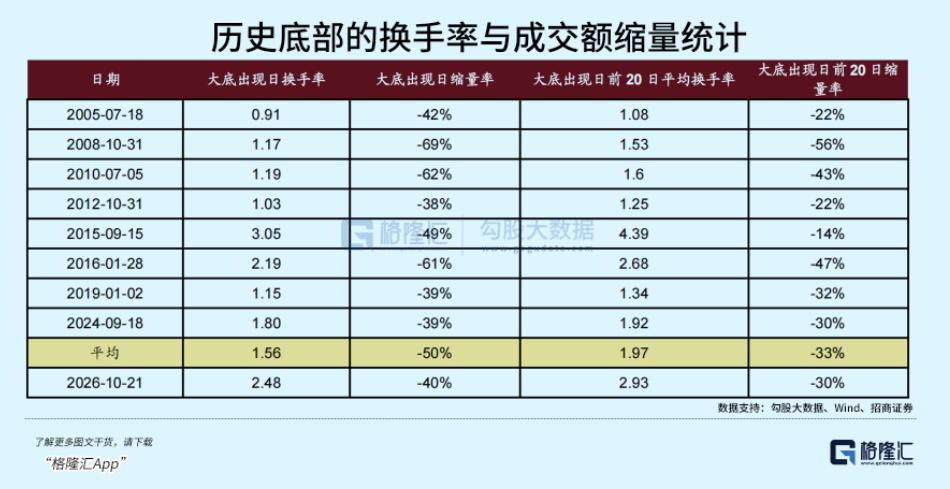
That is to say, the clearing at the trading level is close to the historical bottom range, but it has not reached the state where all indicators are at extreme levels.
This means that the market may have entered the bottom range, but the bottom is not a single point, but a range, and there will still be repeated fluctuations within this range.
From the perspective of policy, market stabilization policies have been continuously promoted since July, with China Guoxin Investment and China Chengtong Holdings increasing their holdings, the Financial Street Forum clearly stating that the market stabilization mechanism will be improved, and the policy framework has expanded from simple capital increase to institutional construction and the entry of medium and long-term capital.
The significance of policy support is that it provides a lower limit for the market and reduces the probability of systemic risks. However, policy support does not equal policy stimulus, it will not directly change the market's earnings expectations and risk appetite, so it determines that "the market will not fall too deep", rather than "how fast the market will rise".
Then what about earnings and the external environment? This is the most uncertain part at present.
Domestically, the economic data in September showed marginal improvement, but the structure is still "strong external demand, strong production, weak domestic demand". The growth rate gap between exports and total retail sales of consumer goods is widening, and the scissors gap between PPI and CPI is also widening, which indicates that price transmission is still not smooth, and the recovery of domestic demand still takes time.
Therefore, the direction of corporate earnings is improving, but the strength is not enough to support a comprehensive earnings-driven market rally.
02
Overseas, the US Treasury yield remains at a high level, and US tech stocks are in a correction phase.
More importantly, the pricing logic of US AI stocks is changing, shifting from "investment expansion" to "capital return constraint".
For example, Meta's free cash flow turned from positive 10.6 billion US dollars to negative 2.1 billion US dollars in the third quarter, which is a landmark event, indicating that AI investment has entered a stage where returns need to be verified. This will put valuation pressure on the AI-related sectors of the A-share market, as the pricing of global tech stocks is linked.
But there is a very interesting perspective that is worth discussing separately.
There is a popular worry in the market: If the AI industry trend cools down, does that mean the bull market is over?
This worry comes from historical experience, because past industry trends, such as industrial finance in 2006, real estate and infrastructure in 2009, mobile internet in 2013, and energy transition in 2019, all had a wide driving effect on other economic sectors, so the experience that "the end of the industry trend means the bull market turning to bear market" has been verified repeatedly.
However, this round of AI trend has a big difference: it has more "crowding out effect" on other sectors rather than "driving effect".
The price rise of electronic components and electricity has pushed up production costs; the huge debt financing of computing power infrastructure has pushed up the global risk-free rate; the crowding out effect of AI on employment, especially its impact on youth employment, has begun to appear.
This means that many non-AI sectors have already started to decline, and AI is the last sector to see supplementary decline.
Therefore, if the pace of AI investment slows down in the future, non-AI sectors may face a more favorable macro environment: the risk-free rate falls, cost pressure eases, and the employment crowding out effect weakens.
At the same time, the trend of 10-year US Treasury yield is highly correlated with the trend of North American AI hardware stocks. If the US Treasury yield sees a sustained decline, it will promote the demand of overseas non-AI sectors, and also form marginal support for the non-AI sectors of the A-share market.
From this perspective, the cooling of AI trend is not a sufficient condition for a full-scale bear market. The more likely outcome in this round is that "AI valuation contraction and non-AI expectation contraction" are completed successively, and then the market enters a K-type convergence process.
When the market stopped falling and stabilized this week, the first to rebound among new AI technologies was the robot sector, which had complete chip clearing and low institutional positions, rather than the computing power infrastructure sector, which in itself is a noteworthy signal.
On the other hand, the process of valuation contraction also supports this judgment.
Since July, the P/E ratio of the electronics and communication sectors has been compressed from 74 times to 42.4 times, a decline of 42.8%, which is quite comparable to the 45.7% decline in the first round of new energy correction in 2022.
From a global comparison, the A-share market is the only market where the valuation premium of AI relative to non-AI sectors is still higher than the historical average, while the P/E ratio of non-AI non-financial leading enterprises is only 15.6 times, at the 21st percentile of history, and the leading enterprises in consumer, manufacturing, and pharmaceutical sectors are at the 12th, 1st, and 3rd percentile of history respectively.
This valuation level reflects the full pricing of weak domestic demand and concerns about external demand.
In other words, the pessimistic expectations have been fully priced in, and any marginal change that exceeds expectations may lead to the repair of the valuation system.
03
Then, back to the original question: Is the current A-share market a mid-fall relay or a bottom range?
My judgment is: The valuation bottom, capital bottom, and policy bottom are already relatively clear, but the clearing at the trading level has not reached the historical extreme, earnings verification and the direction of external interest rates have not given decisive signals, and incremental capital still needs to wait for more signals before entering the market on a large scale.
This means that the downward space of the market is relatively limited, but the upward pace will not be achieved overnight, and repeated fluctuations within the range will still occur.
In this bottom-grinding stage, the cost performance of sticking to high-momentum track sectors has declined, and capital will prefer targets with stable earnings and matching valuations. The PB-ROE framework that focuses on quality is more likely to generate relative advantages.
Specifically, the next market rally may have two types of relatively advantageous directions:
One type is varieties with high dividend yield and stable earnings growth, such as white goods, textiles and garments, food flavoring, and thermal power;
The other type is varieties with potential for supply clearing, such as oil transportation, express logistics, leading real estate developers, some lithium battery materials, and midstream petrochemical sectors.
The common feature of these directions is that they have downward support from earnings or asset value, upward space for valuation repair, and relatively low requirements for liquidity and risk appetite.
But this does not mean that AI and high-growth sectors have lost their significance.
The high-growth clues are still valid. The semiconductor, components, and communication equipment sectors related to AI hardware have high earnings growth rates that are continuously revised upward. For the core targets in oversold tech sectors with low PEG, high long-term growth, and a callback of more than 40%, their industry trend and long-term growth logic have not been destroyed.
The problem is that the flexibility of these directions requires corresponding conditions, including the confirmed decline of US Treasury yield and the completion of position rebalancing, which will not be established unconditionally.
Therefore, the indicators worth observing next are very clear: whether ETF inflows can continue, whether the proportion of margin trading purchases and private equity positions can stabilize and rebound, what is the earnings quality of the third quarterly report, which direction the 10-year US Treasury yield will go, whether the Sci-Tech Innovation Board and ChiNext ETFs will take over the lead again, whether the crowding degree of TMT sectors will rise rapidly again after the rebound, and whether the scissors gap between domestic demand and PPI-CPI can converge.
If these signals show marginal improvement, the breadth of the market rally is expected to expand gradually; if these signals weaken, the repeated fluctuations in the bottom range will appear again. (End of full text)
Declaration from Gelonghui: All views in the article come from the original author, and do not represent the views and positions of Gelonghui. Special reminder: Investment decisions need to be based on independent thinking. The content of this article is for reference only, and does not constitute any practical operation advice. Trading risks are borne by the investors themselves.
This article is from the WeChat official account "Gelonghui APP" (ID: hkguruclub), author: Gejila, published by 36Kr with authorization.