WorkBuddy is the undisputed top player with a huge lead: Tencent has taken the leading position in the office AI track, while Baidu lags behind.
On the battlefield of large AI models, if C-end chatbots compete for daily active users and traffic, then B-end office intelligent agents compete for real "productivity folding".
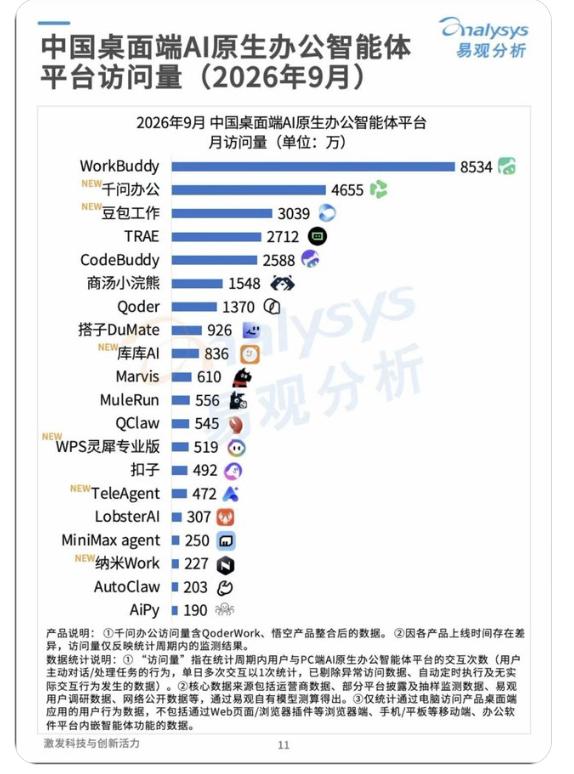
Recently, Analysys released the "Ranking of Monthly Visits to China's Desktop AI-Native Office Intelligent Agent Platform in September 2026".
Data shows that Tencent's WorkBuddy takes a staggering lead with 85.34 million monthly visits, almost twice that of the second place. It is followed by Alibaba's Qwen Office (46.55 million), ByteDance's Doubao Work (30.39 million), as well as ByteDance's TRAE (27.12 million) and CodeBuddy (25.88 million).
A netizen on X exclaimed: "In this artificial intelligence showdown, it seems that Tencent's WorkBuddy has already won. Baidu is lagging far behind."
In this ranking that reflects real desktop interactions, we see the fierce competition among the three giants of Alibaba, Tencent and ByteDance. However, it is extremely regrettable that Baidu, the first domestic player to shout the slogan of "All in AI", only ranks eighth with its promoted product "Baidu Dazi" with 9.26 million interactions, forming a huge gap with the top camps. In another multi-terminal monthly active user ranking from QuestMobile, Baidu Dazi ranks second, but on the desktop end that most tests "in-depth embedding of work processes", Baidu really failed to reproduce its dominance in the search era.
The office AI intelligent agent, a golden track that is regarded as the closest to the commercial implementation of large models and has extremely high customer unit price, why does it show such an extreme division? What exactly did Tencent do right? And why did Baidu gradually lose its voice on this battlefield where it was supposed to be best at?
Starting Early But Nearly Missing the Window: Tencent's "Interception" and WorkBuddy's Dimensionality Reduction Strike
We have deeply analyzed in previous articles that ByteDance was the first giant to make moves in the office Agent direction. From the full AI transformation of Feishu to the launch of the Coze platform, ByteDance once had the strongest combination of "let AI do the work for white-collar workers". But it is Tencent's WorkBuddy, which came from behind, that finally achieved scale effect and occupied the absolute leading position.
The core reason why WorkBuddy can achieve the staggering 85.34 million visits is that Tencent has extremely accurately captured the most real "pleasure point" of office workers.
First of all, it has an extremely lightweight "tool attribute" and imperceptible experience. Compared with ByteDance's heavy integration strategy of trying to embed Agent into the entire enterprise collaboration network, WorkBuddy adopts a single-point breakthrough route: no deployment required, available on multiple terminals including PC and mini-programs, users can directly generate reports, typeset documents and process data just by inputting natural language instructions. It does not require the whole company to cooperate in digital transformation, you can download it alone and start using it immediately. This "plug and play" experience greatly reduces the promotion threshold.
Secondly, it adopts an extremely smart model strategy of "not indulging in self-satisfaction". WorkBuddy does not force users to bind Tencent's own Hunyuan model, but fully embraces mainstream domestic open-source large models including DeepSeek and Zhipu. This inclusive open ecosystem allows users to freely choose the model with the highest cost performance and most suitable for the current task, reducing user migration cost to zero. For white-collar workers, they do not care about what parameter level the model is, they only care whether it can generate a chart that does not need rework within one minute.
The most core barrier is Tencent's social infrastructure and ecological openness. When WorkBuddy seamlessly integrates with WeCom, WeChat and Tencent Docs, it obtains extremely terrifying traffic entry and context acquisition capabilities. White-collar workers finish discussing work in WeChat, call WorkBuddy conveniently to process tasks, and even forward the generated files directly to the WeCom group. It is worth noting that WorkBuddy is not completely enclosed in Tencent's ecosystem, the official also supports access to DingTalk and Feishu. This strategy of "relying on the big tree but not being exclusive" further broadens its user base. This seamless experience based on social relationship chains is a dimensionality reduction strike that no independent App can match.
The Rapid Advance of ByteDance and Alibaba: The Game Between Heavy Integration and Cloud Ecosystem
The second and third places in the ranking are Alibaba's Qwen Office (46.55 million) and ByteDance's Doubao Work (30.39 million) respectively. The routes of these two giants are completely different from Tencent's.
Alibaba plays the heavy punch of "cloud + collaboration". Qwen Office (integrating products such as QoderWork, Wukong, MuleRun) is deeply integrated into the DingTalk ecosystem, and has extremely high penetration in the B-end enterprise service market. For large state-owned enterprises and manufacturing enterprises that focus on organizational management, process approval and data security, the combination of "DingTalk + Qwen" is the default option for digital transformation. Alibaba's cloud ecosystem that has been cultivated for many years is its deepest moat.
ByteDance is playing the in-depth reconstruction of the "full product suite". ByteDance integrates Feishu, TRAE (code generation) and Coze (Agent construction) into the Doubao system, trying to build an extremely in-depth "organizational super brain". Once this heavy asset route of "building a system" is successfully implemented, the moat will be extremely deep, because it obtains not only the surface-level work demands, but also the most core underlying confidential information and business flow of the enterprise. But for now, it is still in the friction period of digesting the drastic internal reorganization, and its visit volume temporarily lags behind Tencent.
The Lagging Baidu: Without "Entry", Even the Best Model Is an Isolated Island
Looking back at Baidu, which is the most thought-provoking.
Baidu has one of the earliest and most comprehensive Wenxin large models in China. In terms of technical scores and underlying architecture accumulation, Wenxin is no less inferior to Hunyuan and Doubao. But why did Baidu fail to enter the first echelon on the office intelligent agent track that can realize direct monetization?
The fundamental reason is that Baidu lacks a real "enterprise-level collaborative office entry".
This is an extremely cruel commercial reality. In the office scenario, large models are not used to write poems, but to be embedded in work processes. Tencent has WeCom and Docs, Alibaba has DingTalk, and ByteDance has Feishu. What about Baidu? The popularity and penetration of Baidu Ruliu cannot support a huge Agent ecosystem at all.
In the competition of desktop office intelligent agents, users will not specially download an App just to use a certain model. What they need is: "When I am writing a document, AI can help me typeset it conveniently; when I am replying to WeCom messages, AI can help me summarize the meeting minutes."
Baidu has long suffered from the trouble of "lacking super entries" since the mobile Internet era, and in the AI era, this fatal shortcoming is still dragging it down tightly. It can only sell APIs, sell computing power, or take customized large orders for To G (government) customers, but it has lost its dominant position in the office battlefield that belongs to white-collar workers' daily, high-frequency, C-end-oriented experience. This is not only a sorrow for technology, but also an inevitable result of strategic path dependence.
The Final Destination of Office AI: The Leap from Chatbot to Agent
This ranking reveals an extremely clear industry trend: the competition of large models has officially transitioned from the era of "Chatbot" to the era of "Office Intelligent Agent (Agent)".
In the past, everyone competed for who could write better love poems, who had stronger logical reasoning ability, and who had higher test scores. Now, everyone competes for whose Agent can really take over the mouse of the operating system and help users finish the work.
The victory of WorkBuddy proves that at the current stage, "lightweight entry + open model ecosystem + attaching to super Apps" is the optimal solution to win the recognition of white-collar workers. White-collar workers do not care about how many parameters the underlying model has, they only care whether it can help them save time from working overtime.
Of course, the current ranking does not represent the final outcome. If ByteDance's heavy integration gets through the painful period, it may burst out with extremely terrifying in-depth context capabilities; Alibaba's cloud ecosystem is still the first choice for large B-end customers. The competition of office Agent is a marathon, and the current leader must always be alert to latecomers overtaking on curves.
However, in any case, Baidu's performance on this ranking has sounded the alarm for all large model companies: on the To B battlefield, a model without traffic entry is like a pearl in an exquisite box — no matter how dazzling it is, no one will use this box to serve rice on the dining table at home.
When large models get rid of the aura of technological myth, the factors that ultimately determine the outcome are still the most simple business common senses: who is closer to users, who can solve specific pain points, who can build an ecological network that allows everyone to hitch a ride. AI without scenarios is destined to only stay in PPTs.
This article is from the WeChat official account "Tech Business", author: Tech Business, published with authorization from 36Kr.