Is the IPO market cooling off? Robot business owners burn incense, kowtow, and rake up old scores.
"I'm still waiting to cash out after the company goes public. The longer it drags on, the lower the embodied intelligence valuation feels to me."
The person who said this is an employee of an embodied robotics company that is rumored to be secretly submitting listing applications via the Hong Kong Stock Exchange's 18C Specialised Technology Route.
Holding considerable stock options and looking forward to the company's early listing, some engineers with an annual salary of millions are now busy with R&D and testing, while also taking time to track trends in the capital market, for fear that the longer they wait, the less valuable the options in their hands will become.
This anxiety is spreading across the embodied intelligence industry.
Almost everyone has an unpublicized perception: the IPO window for robotics companies has passed.
After Unitree was listed on August 19, the rhythm of robotics companies that had previously rushed to the capital market began to change.
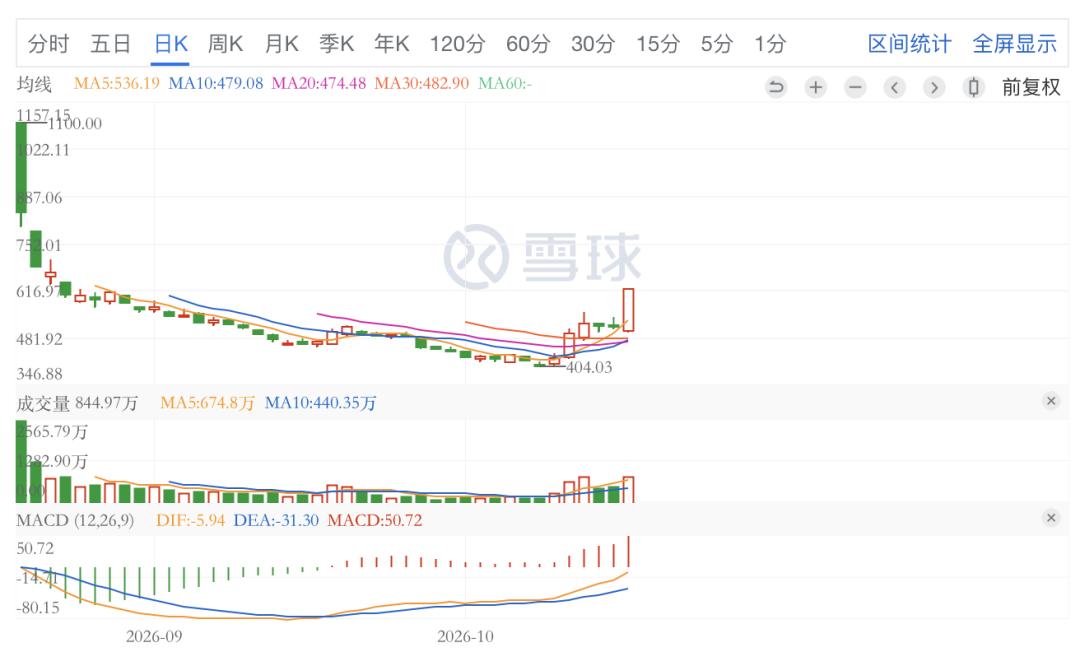
△ The daily K-line chart of Unitree Technology since its listing as of October 23, 2026
An industry insider told QbitAI that Agibot Robotics has abandoned its original plan to complete an IPO within this year.
Recently, multiple media outlets have reported that Agibot is advancing a new round of financing, with a scale of about 1 billion to 1.5 billion yuan and a valuation of about 50 billion yuan.
At present, Agibot has not yet publicly confirmed the news. If the information is true, after the closing of this round of financing, without a special exemption from the Hong Kong Stock Exchange, Agibot will need to wait at least 120 days after the completion of financing before it can be listed.
Counting the days, the Hong Kong stock IPO window within this year is basically closed. (doge)

On July 24 this year, Agibot publicly confirmed that it had launched preparations for a Hong Kong listing. At that time, investors expected the earliest listing to be in August, with a target valuation range of HK$40 billion to HK$50 billion.
During that period, news of secret listing applications spread one after another for embodied enterprises including LimX Dynamics, Qiang Robotics, Zibianliang Robotics, StarSeas Map, and Galaxy Universal.
However, more than two months later, Zhang Tao, a partner at a top-tier law firm, told QbitAI that the listing process of current embodied enterprises may not be as fast as previously expected, and the listing valuation may also drop compared with before.
Especially for companies whose commercialization capabilities have yet to be verified, subsequent operational capabilities (such as R&D, sales, etc.) and the resulting performance data will become important observation bases during the listing process and for stock price evaluation after listing.
"(Regulators) will most likely focus on the quality of enterprises. On the basis of conventional listing issues, they will further focus on factors such as whether embodied intelligence companies have verifiable technological leadership and whether their products have commercial landing potential. If these are difficult to prove through objective evidence, the listing process may slow down."
Huang Lichong, President of Winshare International Capital, has served as a listing sponsor for the Main Board and GEM of the Hong Kong Stock Exchange.
He also said that when an embodied intelligence company goes public, the hardest thing to explain to the capital market is how much of the value created by technology can finally remain on the company's own books.
Improved model capabilities and improved customer efficiency do not mean that the company's profits will also increase.
"Are customers willing to pay more? Does the company have pricing power? After deducting computing power, data processing, implementation and manual review, how much is left? All these need to be calculated."

Going public is a matter that relies heavily on "favorable timing, geographical advantages and harmonious human relations".
Enterprises may not be able to decide when the window opens. But when the IPO popularity picks up again, it would be a pity if they are blocked out by old problems such as equity, finance and compliance.
What exactly does a robotics company need to prepare in advance to seize the listing opportunity?
Recently, QbitAI talked with a number of securities lawyers and capital market practitioners, trying to dismantle the little-known details behind the journey of a robotics company from startup to listing.
IPO cools down, who is the most anxious?
Once the listing pace of robotics companies slows down, the first to get restless are often the investors behind them.
Behind the funds are LPs (limited partners), who need to consider how to exit at a certain point in time.
In the past two years, the popularity of embodied intelligence financing has continued to rise. Many robotics companies have received several rounds of financing before finding stable application scenarios.
Valuations have risen all the way, and the shareholder list has grown longer and longer. Expectations for the listing timeline have also accumulated accordingly.
But the R&D and commercialization of each robotics company has its own schedule.
From model training, scenario verification to bulk procurement by customers, it may not be able to keep up with the exit cycle of the fund.
Li Ming, a securities lawyer with more than 7 years of experience, often reminds entrepreneurs to be cautious about introducing investors and not to take any money that comes their way.
When the money is raised, everyone is often very happy.
Troubles sometimes do not truly emerge until several years later.

△ AI generated
Zhang Tao once came into contact with a technology enterprise.
The company was developing well, completed financing at a relatively high valuation, and then started preparing for an IPO.
Unexpectedly, the external industry market changed, and the enterprise's performance fell short of expectations, showing a downward trend, so the listing plan had to be put on hold.
To make matters worse, because the listing time was included as one of the valuation adjustment conditions in the investment agreement at that time, some investors immediately put forward repurchase requirements.
But the raised money had already been invested in R&D and business expansion, and the enterprise could not come up with a large amount of cash in a short time.
In accordance with the agreement arrangement, the founder may also face corresponding repurchase obligations.
A round of financing obtained several years ago has instead become a heavy burden when the listing progress is delayed and the valuation adjustment conditions are not met.
Moreover, the higher the valuation, the more troubles there are.
When a technology enterprise arranges equity incentives for its employees, it adopts a relatively high valuation. Later, when employees leave their jobs and request to exit their equity, the founder needs to take over the shares in accordance with the agreement.
As a result, the higher the valuation, the greater the repurchase cost.
The equity incentive that was originally used to attract talents has instead become a financial pressure on the founder.
In addition, the fair value recognition and tax treatment involved in equity incentives are also a considerable workload for IPO lawyers.

Although similar cases come from other technology enterprises, they are not far away from embodied robotics companies that are currently experiencing high-valuation financing.
What's more, the valuation in the primary market will be re-tested in the secondary market.
Huang Lichong does not quite agree to barely set the issuance price at a position lacking operational support just to maintain the valuation of the previous round of financing.
A robotics company with a post-money valuation of 50 billion yuan does not mean that secondary market investors are willing to take over at the same market capitalization after listing.
Especially for robotics companies whose commercialization is still in the early stage, they need to explain clearly:
Is the current valuation paying for the verified bulk business, or has it included the sales volume, production capacity and service income for the next few years in advance?
If revenue forecasts rely on untransformed pilots, investors will naturally discount the timeline for future revenue realization and capital requirements.

△ AI generated
Therefore, embodied companies also need to prepare plans in advance for scenarios where valuations fall short of expectations, the issuance scale shrinks, or listing is delayed.
Investors want to exit, founders worry about repurchases, and employees holding options also look forward to cashing out after listing.
All these people are waiting for the IPO.
But when it comes to listing, being anxious doesn't help.
To ring the bell, sort out these old accounts first
The thresholds of Yonghegong Lama Temple in Beijing, Mount Putuo in Zhoushan, and Nanyue Grand Temple that bosses from central China love to visit are almost worn out.
Some bosses go to worship specially before important review nodes to pray for good luck.
Others even calculate the day to submit the prospectus in advance.
What's more exaggerated is that some people even calculate the birth date of the sponsor to see if the two sides are compatible.
Talking about these unspoken rules in the industry, Li Ming sighed: "Belief in fate really does not depend on age."

But choosing an auspicious day does not mean that everything will be fine.
Some enterprises find that the equity and capital transactions in the early years are unclear before they reach the declaration stage; some have submitted applications, but cannot move forward for a long time.
Others have passed the review, but still failed to issue as originally planned in the end.
Where is the problem?
Senior securities lawyers, combined with years of IPO project experience, have summarized several points that are most easily ignored by embodied intelligence companies. Embodied intelligence companies preparing for listing may wish to check against them in advance.
Troubles may start from the first round of financing.
Zhang Tao came into contact with a technology enterprise that originally planned to sprint for the A-share market, but later turned to the Hong Kong stock market.
The problem lies in the shareholders.
The shareholders introduced by the enterprise in the early years involved overseas trust arrangements. At the stage of listing review, regulators paid special attention to the reason and rationality of trust shareholding. The enterprise needed to conduct further verification based on feedback inquiries, and the processing was quite complicated.
In accordance with regulations, trust shareholding itself is not a substantial obstacle to listing. The trouble is that under the special regulatory background, it is necessary to explain clearly to the review department and meet the corresponding review requirements.
When entrepreneurs raise funds, what they care most about is often the amount and valuation. When it comes to IPOs, lawyers also have to ask: Who exactly invested this money? Will the nature of the shareholders themselves cause unnecessary review obstacles to the listing?

△ AI generated
In addition, for people like Li Ming, the three most troublesome problems are: nominee shareholding, capital contribution defects and shareholder penetration.
For example, in the early days of starting a business, a shareholder held shares on behalf of a friend. At that time, everyone had a good relationship, and they might think it was no big deal.
A few years later, when the company prepares for listing, lawyers have to recheck who the shares actually belong to, whether there was an agreement signed at that time, and which account the capital contribution was transferred from.
Some shareholders' capital contributions are not standardized, or the source of funds cannot be explained clearly.
Lawyers can only dig out the bank statements from many years ago and check them one by one.
Li Ming has come into contact with several projects where the enterprises were originally doing well, but due to historical problems with equity contributions and capital sources, they ultimately failed to file applications or had to withdraw them midway.
"Once the bank statements exist, they can never be erased."

Then look at shareholder penetration.
Even if the apparent investor is only one institution, lawyers may need to continue to verify the actual beneficial owners behind it.
For example, check whether there is any situation where former employees of the securities regulatory system hold shares, and whether the employment experience, shareholding time and method of relevant personnel comply with the regulations.
It is not a problem as long as