A Social Innovation and Entrepreneurship Speech: The AI Singularity Has Arrived
"The singularity has arrived, and it is right this year."
Jack Clark, co-founder of Anthropic, dropped this earth-shattering judgment at the IMF 2026 Annual Meeting in Bangkok.
This is totally unexpected. You know that the 62-year-old Per Jacobsson Lecture has always been exclusively reserved for finance ministers, central bank governors and top economic authorities from all countries.
However this time, the spotlight was for the first time ever handed over to the co-founder of an AI unicorn that is less than five years old.
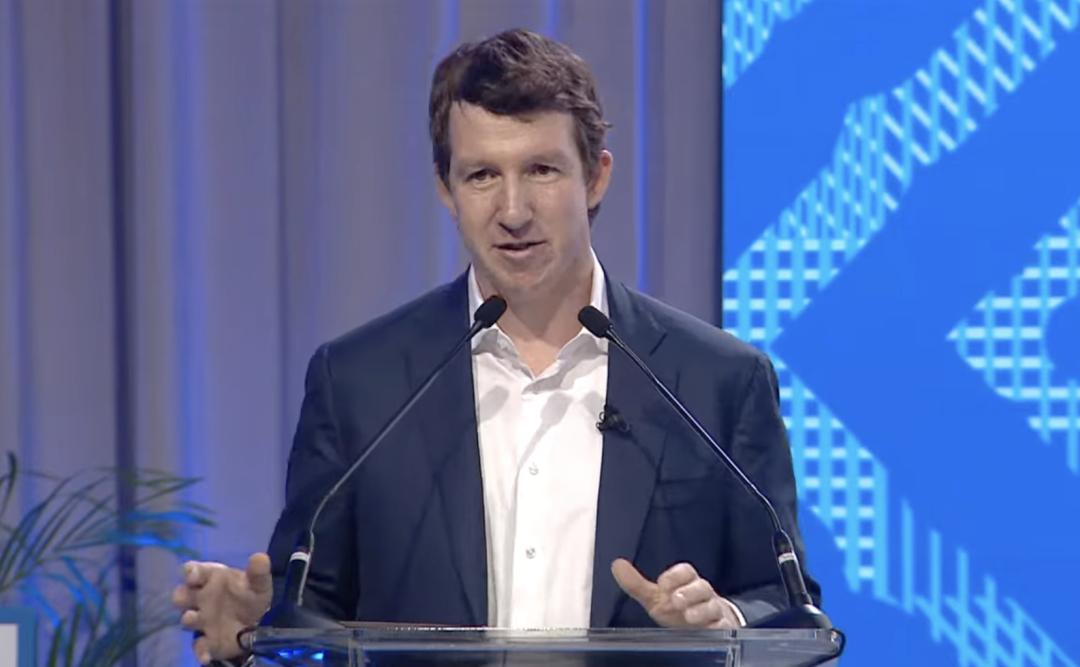
This industry veteran, who once served as OpenAI's Director of Policy and witnessed AI evolve from data centers to the core of the global tech storm over the past decade, said bluntly — we no longer need to debate when the singularity will happen, because it is already here.
> Vernor Vinge predicted in 1993 that when superhuman intelligence begins to drive technological progress, all old deduction models must be discarded, and new realities will take over everything. Today, the decisive evidence has emerged.
AI is Conquering Humanity's "Final Exam"
The "singularity" — fire, writing, printing, the steam engine, electricity, the computer... Humanity has only witnessed a handful of such milestones since its existence.
What evidence on earth makes Jack Clark draw such a conclusion today?
He argues that if we shift our perspective to the front lines of coding and scientific research, we will find that the operating speed of the entire world has completely changed.
Software engineering is the first field that has been completely rewritten.
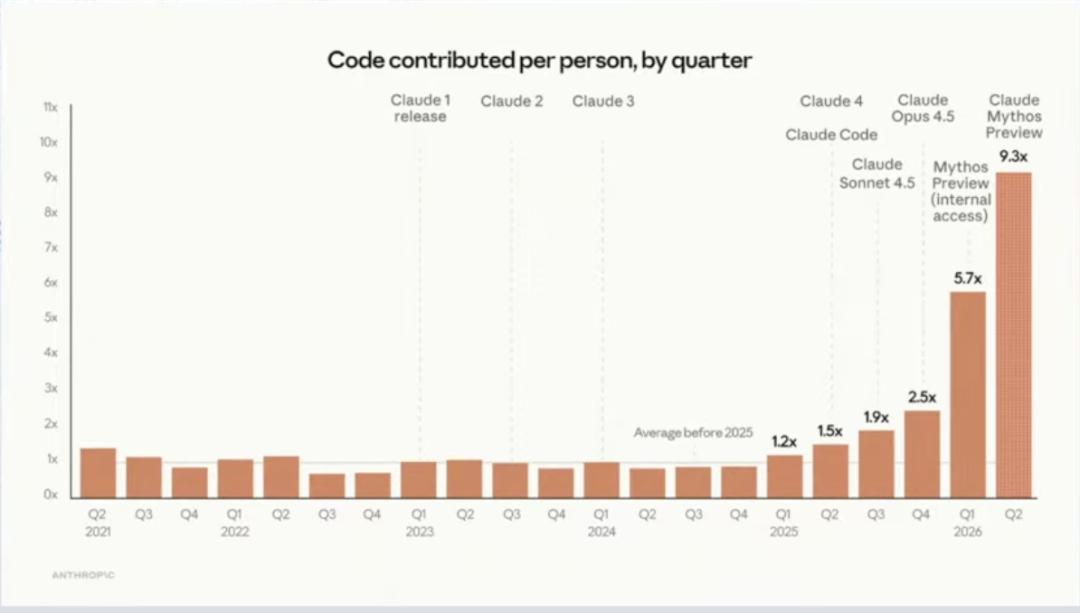
Inside Anthropic, researchers now produce 10 times more code than the average level in the first four years of the company's founding.
The explosive growth curve of code output perfectly overlaps with the evolution trajectory of underlying foundation models.
However, the full automation of software code is only the preview of a much larger tsunami.
Jack Clark said bluntly that what makes the year "2026" a truly decisive turning point is that:
"A single cutting-edge large model is sweeping across humanity's scientific frontiers across disciplines, becoming a real virtual polymath."
In the mathematics community, AI has begun to put forward key breakthrough ideas for millennium problems related to the Navier-Stokes equations, the Jacobian conjecture, and many unsolved Erdős puzzles.
In the field of biology, AI has designed brand new viral vectors from scratch, and even led the design of multiple new drug candidate molecules that have entered clinical trials.
In the field of hardware and materials, AI has begun to independently take over and operate physical laboratory equipment, accelerating the iteration cycle of batteries and fuel cells.
Behind these breakthroughs lies a question: if AI can already solve problems that humans cannot answer at the cutting edge, what else can we teach it?
Jack Clark cited the example of Humanity's Last Exam.
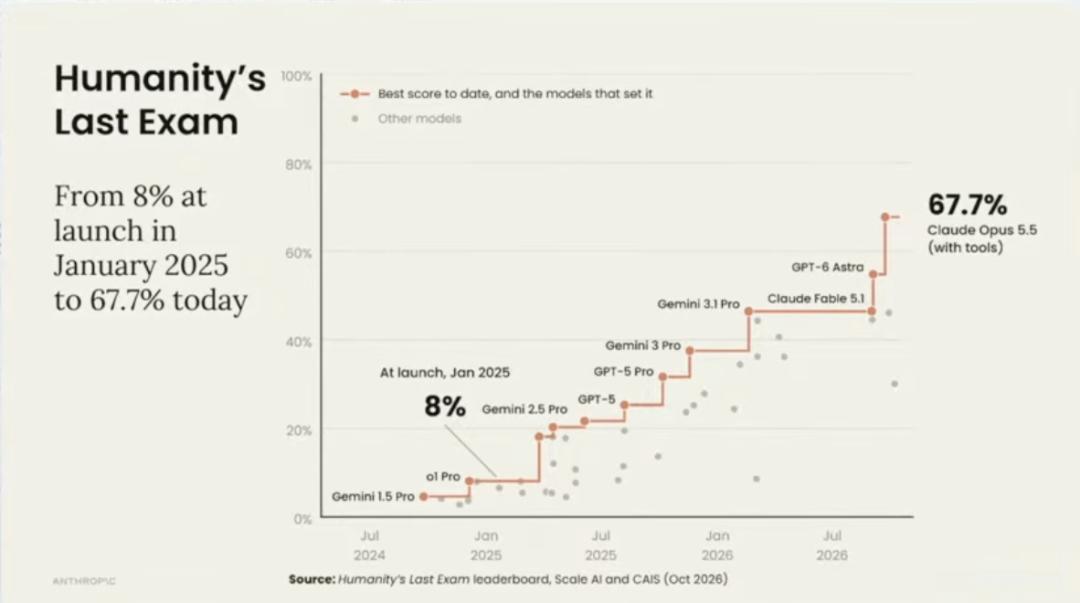
This is a benchmark test specially designed to stump AI, gathering difficult problems in chemistry, computer science, cutting-edge mathematics, classical literature and ecology. When it was first released in January 2025, the score of the world's strongest model was only a dismal 8%.
At that time, many people thought that with only 8% score, humanity's last intellectual dignity could be guarded for more than ten years.
However, as of this week, Claude Opus 5.5 has scored 67.7% on this ultimate human exam paper.
As we all know, AI is often partial in its performance across different subjects.
Therefore, if you only take the math test — the high-difficulty benchmark exam paper FrontierMath compiled by a team of professional mathematicians, top AI models could only score 2 points at the end of 2024.
Now, less than two years later, they can score 94 points...
If scoring high on benchmark tests is not that impressive, Jack Clark then took out a groundbreaking physics paper published just last week.
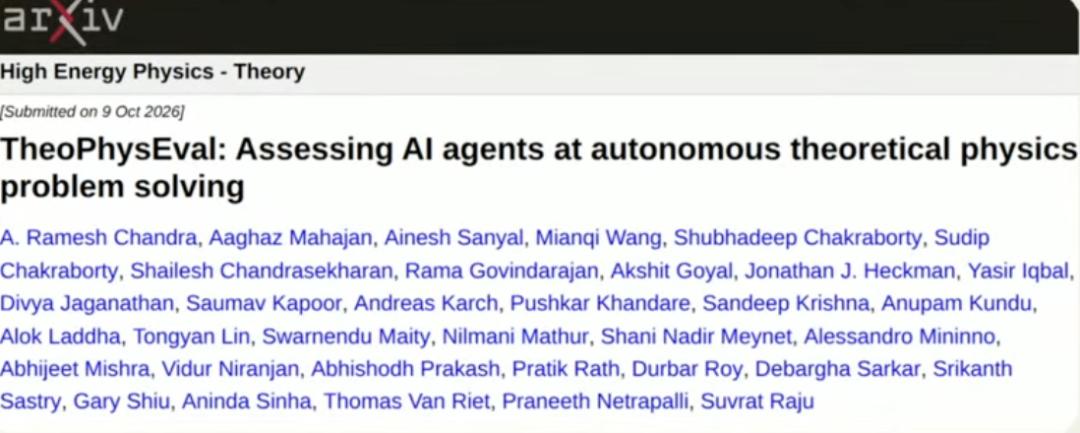
The paper mentions that the test team collected 50 "top-secret puzzles" written by the world's top theoretical physicists based on their latest unpublished research. These problems leave no trace on the Internet, so it is impossible for AI to cheat.
Suvrat Raju, a famous Indian theoretical physicist, commented on these problems: "As far as I know, no one can solve a considerable proportion of the problems in the final set we collected without the help of AI."
"For most of the problems here, I don't even know what they are talking about."
Even for such a set of problems, after the test started, GPT-6 Astra and Claude Opus 5.5 quickly gave their answers.
Preliminary scoring showed that GPT-6 Astra scored around 80%.
The researchers, determined to confirm "how could this be possible", fortunately found some "errors" when checking the model's answers.
When they compared the answers with the human experts' standard answers and told the model where it went wrong, the model — especially GPT-6 Astra, gave a very firm rebuttal:
It insisted that its derivation was not wrong, and the standard answer given by human experts was miscalculated.
The research team sent the problem-solving steps back to those world-class physicists for rechecking with skepticism.
Guess what happened?
— There is no word "ERROR" in the vocabulary of this "superintelligent being".
In many key controversial cases, after repeatedly checking deep into their extremely complex draft papers, human experts had to admit that there were indeed extremely hidden subtle calculation errors deep in their own derivations, and the derivation given by AI was completely correct.
With the human reference answers being corrected one by one, GPT-6 Astra's final score reached 98%, which means it got 49 out of 50 unpublished top-level human physics problems right.
Astra knows how to handle emotional intelligence. It is afraid that it will be disconnected if it gets all the answers right, so it leaves one blank to give humans a sense of comfort (doge).
Jack Clark said:
There is often such a scene in movies, usually happening when the plot reaches two-thirds of its progress: the young protagonist finally proves to his mentor that he has been able to go out independently and achieve success. This is a classic narrative trope — the student surpasses the master. What happened last week is exactly such a thing.
When AI can not only answer cutting-edge questions correctly, but even reversely correct the hidden blind spots of top physicists, it proves that it has crossed the barriers of pure memory and pattern matching, and has truly mastered the last bastion of human intelligence: scientific creativity.
Once this creativity is fed back into AI R&D itself, the closed loop of self-iteration will be completely opened instantly.
The so-called singularity may be the point where AI overtakes humanity.
After all, humanity is the eternal singularity for machines.
Ten Million Human Scientists and a Billion AI Experts
After intelligence is conquered, the ensuing macroeconomic reconstruction will be overwhelmingly destructive.
In the field of economics, there is a growth curse that has plagued people for more than half a century: good ideas are getting harder and harder to find.
In the past 50 years, although global scientific research funding has skyrocketed exponentially and the number of researchers has expanded rapidly, the marginal output of each individual researcher has been declining. In order to push the existing scientific edifice one step further, humanity has to invest a disproportionately large amount of resources.
How long does it take to train a qualified human cutting-edge scientist? It requires at least 10 to 15 years of high-intensity education, costing millions of dollars.
However, humans are destined to never be omnipotent. A person only has a few decades of golden scientific research period in their life, with only one physical body, and it is impossible to replicate themselves ten thousand times to exhaust all different experimental hypotheses.
But what if computing power allows intelligence to achieve fission in an instant?
UNESCO estimates that there are currently approximately 10 million human scientists in the world.
In the past, these 10 million people carried the cognitive boundary of human civilization forward with heavy loads on their own.
But according to Jack Clark's description, in this new era that is arriving, every human scientist can call and command hundreds or thousands of polymaths with the same academic taste at any time.
The scale of the world's scientific research army will expand at an unprecedented speed in human history, from 10 million human scientists to a virtual scientist cluster of one billion or even tens of billions of scale instantly.
Once the bottleneck of discovering good ideas is infinitely replaced by computing power, the growth engine of the macroeconomy will usher in a complete and violent reconstruction.
Anthropic's team of economists has specially carried out a set of macroeconomic simulation deductions. Under the singularity assumption that AI's independent scientific discovery fully takes over economic activities, the model gives a bizarre predicted data:
By 2030, the annual GDP of the United States alone is expected to soar to 44 trillion US dollars.
That is equivalent to 37% of the total global economy today.
To support such a huge economic increment, a large number of brand new industrial forms, disruptive materials, and new energy networks must break out intensively within a few years.
Jack Clark said frankly: Simply building data centers is no longer enough.
Because at present, the first phase of the AI revolution (data centers and computing power) is coming to an end, and the second phase is advancing into the physical world in an all-round way.
Just imagine, if your virtual scientists can propose 100,000 disruptive new drug targets and design 10,000 room-temperature superconducting candidate materials in one day, but the automated synthesis laboratories, high-throughput screening equipment and physical testing platforms in the real world can only carry out dozens of experiments a year, then the huge computing power will directly hit a wall completely in the quagmire of the physical world.
Therefore, the countries that can truly reap the singularity dividend in the future will be those that can quickly deploy automated robot laboratories locally and open up high-speed supply chain channels from digital discovery to physical manufacturing.
This will be an opportunity for developing countries to overtake on a bend, by building standardized physical testing infrastructure to undertake the massive experimental demands emerging from the global army of virtual scientists.
The Moment of Decision Has Come
As the wheel of technology speeds forward to this point, the systematic risks faced by the entire civilization are also amplifying exponentially at the same time.
This is the warning that Jack Clark most wanted to convey from the IMF podium: The benefits are unprecedented, but the risk of destruction is equally fatal.
When AI has the ability to explore cutting-edge science, it can not only be used to design anti-cancer new drugs, but also design highly lethal biological weapons that the human immune system has never seen with extremely high efficiency; it can strengthen the defense barriers of national power grids, and also automatically generate cyber-attack weapons that even the world's top hacker teams cannot defend against.
What makes top researchers even more uneasy is the closed-loop out-of-control of R&D itself.
If laboratories like Anthropic and OpenAI completely let AI write AI and let AI train AI in order to pursue faster R&D speed, then the development trajectory of this technology will break away from the mental understanding scope of all humans in a very short period of time.
At the speech scene, Jack Clark raised two extremely profound and urgent philosophical questions:
The first one is, in future scientific research, which positions should humans reserve for themselves?
AI can now independently complete most of the derivation and analysis processes in university scientific research.
As human researchers, which experiments must we personally invest time in toil, make mistakes, and feel physical intuition? Which experiments can be completely handed over to the cold silicon-based system?
If all derivations are done by AI, will the next generation of human scientists still have basic scientific insight?
The second one is, to what extent do humans need to "understand" the scientific breakthroughs given by AI?
Compared with the previous question, this one is very practical. There may be tens of thousands of scientists thinking about it right now.
In this year's pure mathematics research, although some of the proof paths given by AI have been verified to be correct, their logical leaps and architectural methods have completely deviated from the existing human thinking habits, so that top human mathematicians need to spend months or even years to interpret the deep meaning behind them.
In just a few years, AI will most likely invent scientific instruments and experimental paradigms that belong exclusively to silicon-based operation logic and completely violate human intuition.
At that point, if the human brain cannot understand the operating mechanism of these black-box tools at all, should we still allow them to be fully implemented in the real world?
Faced with this unprecedented technological singularity, what humanity most needs to awaken is one of its rarest qualities.
To get through this stage and find direction in the singularity, we need to jointly formulate unusual and serious rules for this technology and its development companies; we also need to practice one of the most difficult and in my opinion noblest qualities of humanity: restraint.
Restraint means that technology developers cannot recklessly push forward just because they are capable of doing so; it means that regulators must establish extremely strict human supervision red lines; it means that in front of the speeding technology train, we must learn to always distinguish between what we can do and what we should do.
OMT
At the end of his speech, Jack Clark quoted a famous passage from the late astronomer Carl Sagan's book Pale Blue Dot.
Sagan once imagined affectionately:
"It will not be us as we know it that will arrive at Alpha Centauri and other nearby stars in the