With the implementation of policies to cancel gold coin rewards and enforce anti-addiction regulations, the so-called "red-green battle" in the short drama industry has completely lost its feasibility.
Recently, Tencent's short drama mini-program Lv Paopao officially launched a public challenge to Hongguo Short Drama.
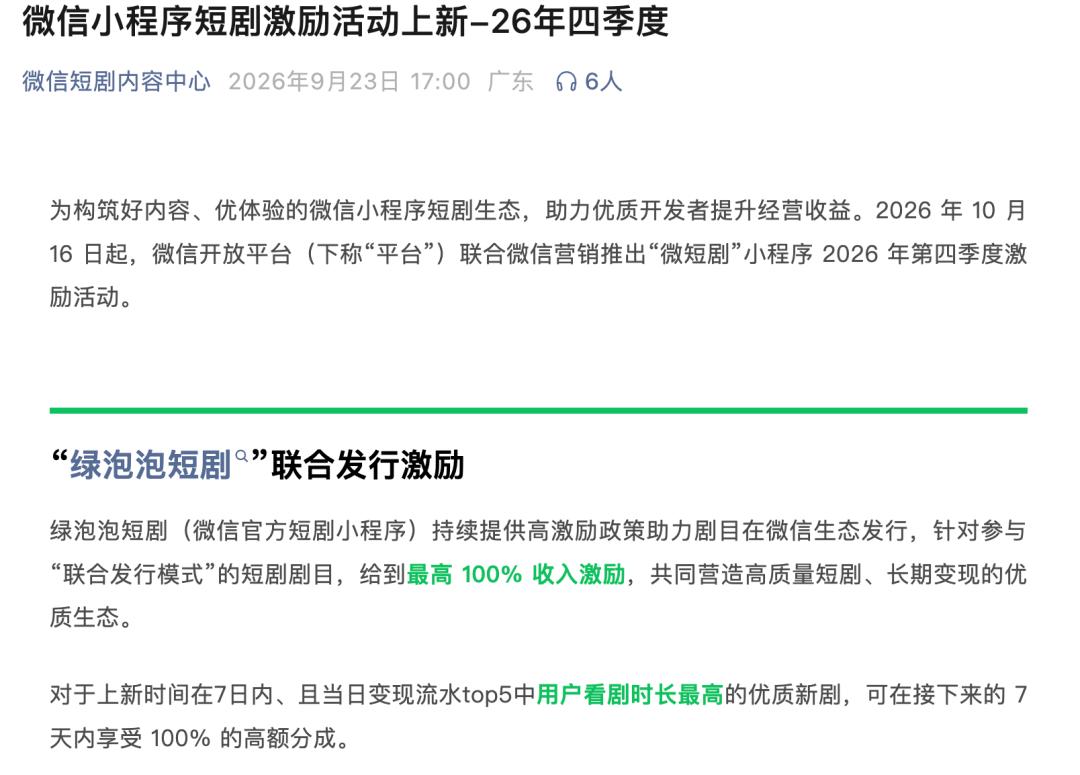
It first launched an incentive campaign: from the launch of the campaign to the end of the year, high-quality new dramas with the highest user watch time among the top 5 monetization revenue on their launch day can enjoy a 100% high revenue share for the next 7 days. Subsequently, it also launched micro short dramas adapted from official account novels, sourcing scripts from a pool of high-quality content.
However, in the face of the aggressive Lv Paopao, Hongguo Short Drama is not daunted by the pressure.
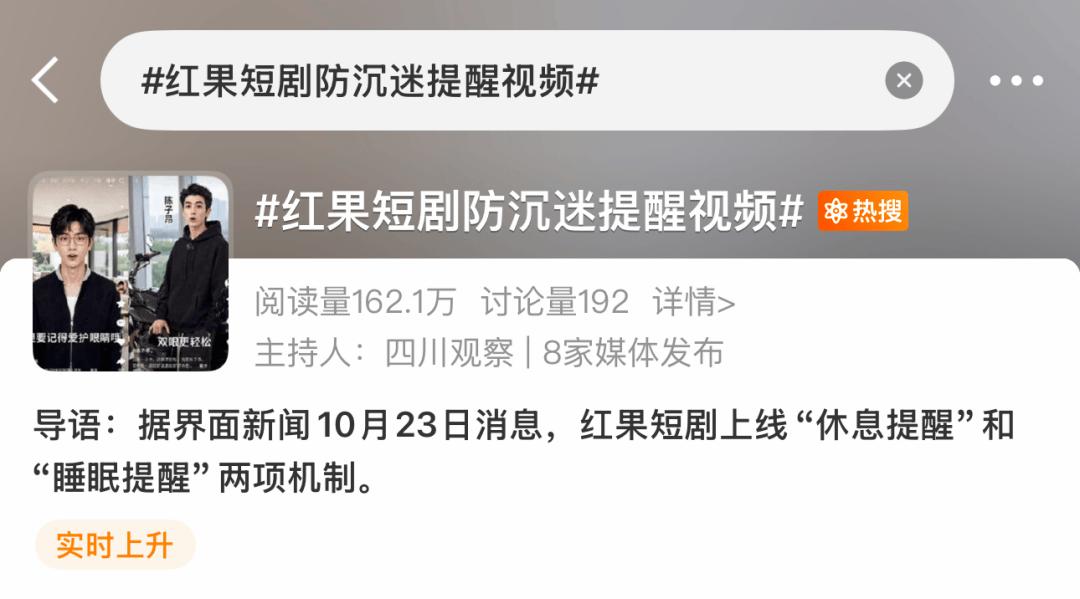
On October 21, Hongguo Short Drama announced that it would phase out the coin function, planning to stop providing coins to new users from next month, and fully remove the function for all users before the end of the year. Then on the 23rd, it launched two new mechanisms: "rest reminder" and "sleep reminder".
While its rival is still stuck in the last era of user acquisition for short dramas, Hongguo has directly entered the second half of short drama development where quality is the top priority. The strategies that are not even in the same league have made many industry practitioners sigh that they cannot get a share of the platform dividend from the "Red-Green War".
Throughout the history of the internet, platform battles have often driven the entire industry to run wildly and disorderly. Faced with challenges from latecomers, early entrants usually adopt strict defensive measures.
Now, Hongguo has taken a different approach, taking the initiative to move forward and choosing to lead the industry into the deep water of content competition, which to some extent reflects the confidence of a leading player.
After all, giving up part of short-term viewing time in exchange for more stable user habits and more sustainable content supply is a trade-off that only a leading platform can afford to make.
Several Forms of "Intellectually Dumbing Down Short Dramas"
Recently, the phenomenon of "intellectually dumbing down short dramas" has become a hot topic of discussion.
The so-called intellectual dumbing down refers to the fact that dense reversal hooks in short dramas may keep people in a state of continuous excitement. After watching for a long time, viewers are prone to feel tired, and their attention and comprehension may also be temporarily affected.
After rounds of discussions, many viewers have pointed the finger at low-quality AI-generated dramas and formulaic plots.
Take the recent viral short drama meme "no heartburn" as an example. As of October 23 this year, the number of views of topics related to "no heartburn" on short video platforms has exceeded 4 billion times.
This meme comes from a business-themed AI short drama. The original line is "It is a bit expensive, but it does not cause heartburn". The reason why a single line can become a national viral meme is exactly the mass replication and mindless adaptation of AI short dramas.
Once a line or a story gains popularity, creators will immediately change the story background, shifting the setting from a steamed bun shop to a noodle shop, from the catering business to other industries, while keeping the plot completely unchanged. Short dramas with identical plots are mass-produced overnight, which has become a peculiar internet phenomenon.
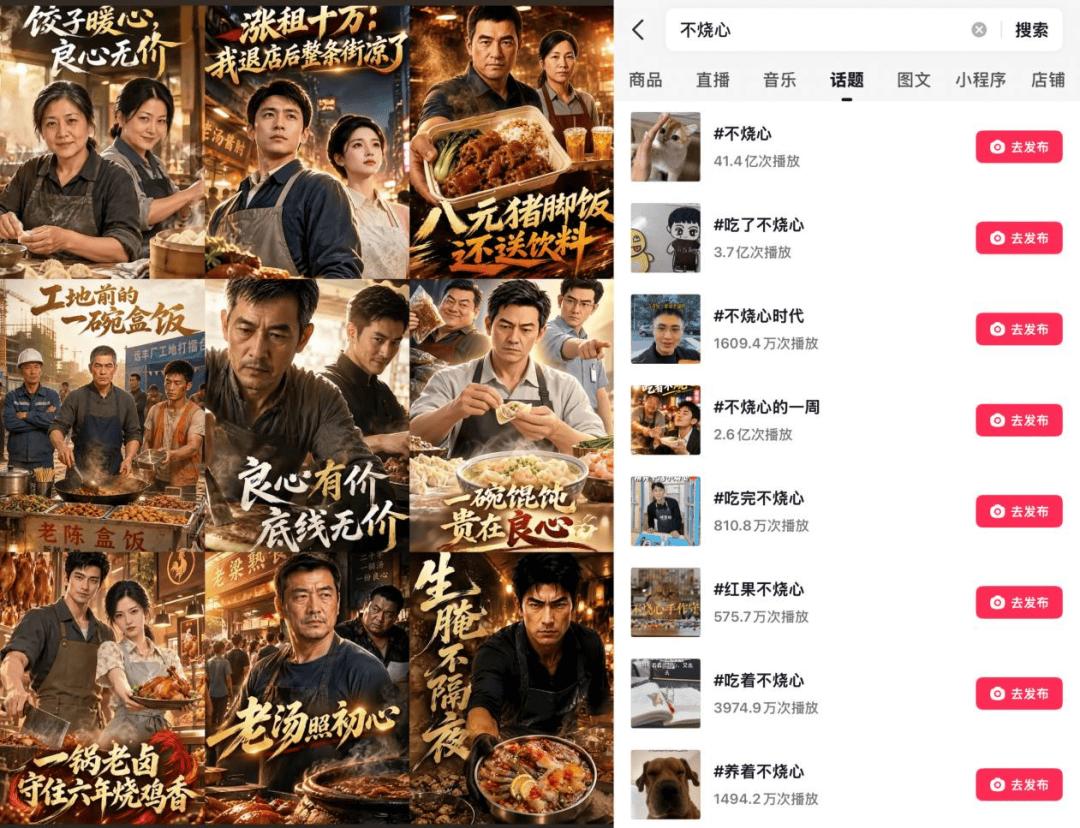
The emergence of this national viral meme presents a phenomenon of intellectual dumbing down in short dramas: Viewers do not need to have watched a specific drama, and as long as they hear a single line, they can directly guess the entire plot and all the twists and turns of the whole drama.
From the complaints about short dramas on social platforms, it is not hard to see that viewers do not reject storylines where the protagonist makes a comeback against all odds or gains extraordinary advantages after rebirth, nor do they require every short drama to convey profound life philosophies. What really makes people tired is the repeated emergence of similar plots, conflicts that come out of nowhere, villains that are one-dimensionally evil with no depth, and protagonists that can always solve problems with sudden unearned advantages.
These problems are often summed up with the label of "intellectually dumbing down", but there are actually different reasons behind them.
Broken and distorted images are production issues, plots that reverse for the sake of reversal are narrative issues, and storylines driven by constant humiliation, revenge and extreme conflicts involve creative habits and value expression.
For viewers, the most important thing is whether the story makes sense. This is a problem that AI cannot solve, and it requires production teams to put in effort to polish the scripts. Otherwise, even if the images are extremely realistic, viewers will still find it hard to be convinced if the characters' behaviors lack logic.
Short dramas and comic dramas certainly need to bring satisfying "cool feelings" to viewers. Most of the time, when viewers open a short drama, they just want to get a relaxing emotional release in a dozen minutes. But the feeling of satisfaction does not mean that logic can be omitted, nor does it mean that viewers cannot distinguish good works from bad ones.
The market feedback of *Armed to the Song Dynasty* is the best example. The fourth season of this AI live-action simulation short drama was launched in September 2026, and topped the new AI drama list of Hongguo the next day, with its popularity exceeding 50 million. Up to now, 9 seasons have been launched, and the popularity of each season remains high.
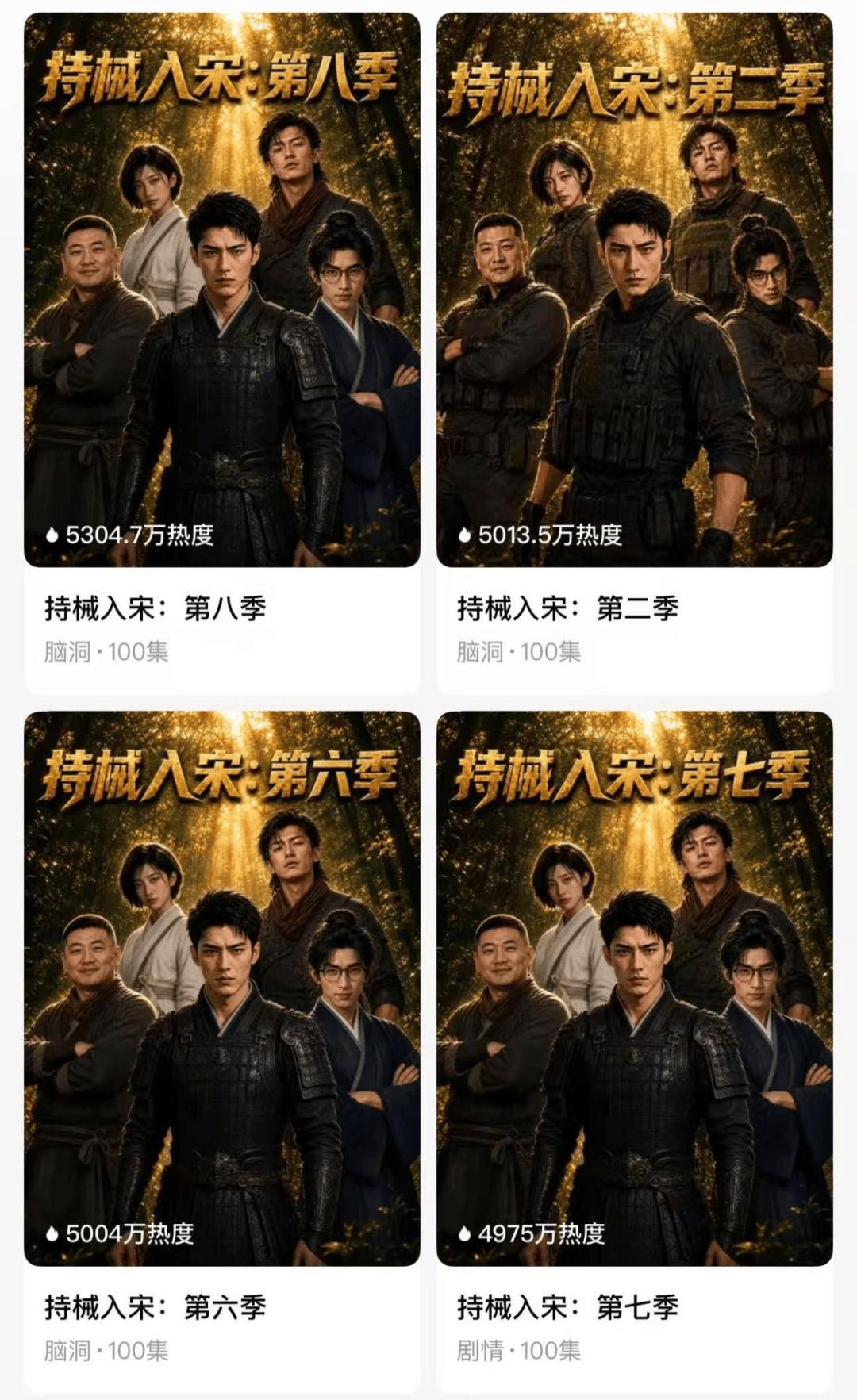
Even though it still adopts familiar popular drama elements such as time travel and dimensionality reduction strikes with modern equipment in its core setting, the narrative rhythm and behavior logic of *Armed to the Song Dynasty* are relatively rigorous, it does not arbitrarily break the settings of the original work, and maintains the basic rationality of the story.
Since there is no shortage of high-quality comic dramas in the market that viewers are willing to pay for, and viewers do not only care about satisfying plot points and ignore the quality of the story, why are such works still in the minority?
An AI short drama screenwriter told *Shixiang* (Market Insight) that the common script cooperation mode in the industry is: according to the requirements of Party A, refer to a work with good data performance, keep the general story framework, and only replace the characters, background or specific industry, just like the "heartburn" meme. As long as the imitation is similar enough, the project can be approved quickly.
However, works like *Armed to the Song Dynasty* that contain a large amount of professional knowledge and special settings are extremely difficult to replicate at low cost. The barrier of such works lies in solid plot advancement and detailed design. It is very hard to replicate the same narrative rhythm and viewer stickiness only by applying genre labels and IP reputation.
For creators, it is not difficult to make a good drama, but whether they can get equivalent returns is the key factor that determines whether production teams are willing to break away from formulaic routines.
How Far Are Short Dramas From High-Quality Content?
When relevant discussions are becoming increasingly heated, Hongguo quietly made a decision.
On October 21, Hongguo Short Drama announced that it planned to phase out the coin function, expecting to stop providing coins to new users from November 1, and fully remove the function for all users before the end of the year.
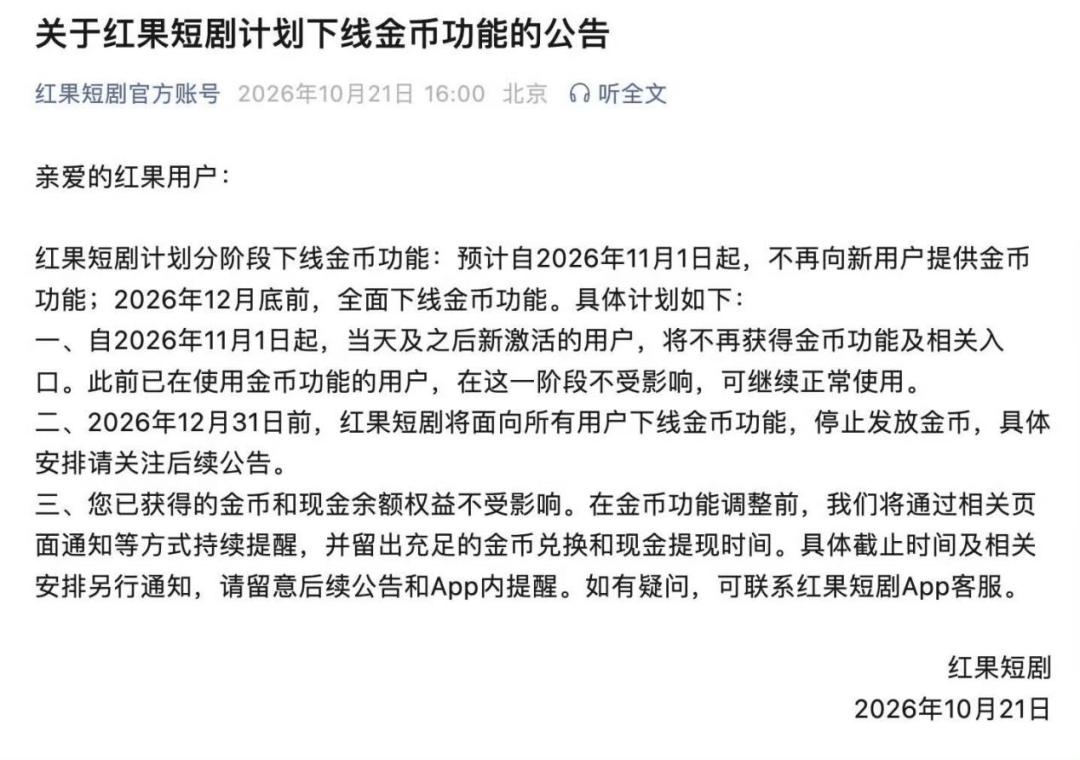
On short drama platforms, the essence of the coin function is that the platform pays to purchase users' viewing time and retention rate.
Now Hongguo's move to phase out coins also provides an opportunity to filter low-quality content, returning the right to define "good content" to real viewers. The retention pressure is directly transferred to the content itself, which is indeed conducive to the "high-quality development" direction that the platform has been promoting. But for production teams, can high-quality AI dramas really become a profitable and sustainable good business?
Some AI short drama practitioners said that at the beginning of 2026, the production quotation for standardized AI short dramas plummeted by more than 90% within half a year, and part of the cost was even compressed to 800 to 1200 yuan per minute. But this did not affect the explosion of content supply. In June alone this year, Douyin launched as many as 37,700 new AI short dramas.
According to DataEye data, among the 221,900 AI comic dramas launched on Douyin in the first half of this year, less than 1.3% of them could break even in the first half of the year, that is, reach the line of 50 million views, which means that only 1 out of about 77 new dramas can make ends meet.
Take "Soy Sauce Culture", which once dominated the comic drama rankings, as an example. It created a benchmark myth of 800 million yuan in revenue in 2025, but under the environment of falling unit prices and fierce industry involution this year, its founder Huang Haonan revealed that he had to lay off hundreds of employees in the company with a thousand-person workforce personally.
A comic drama practitioner in Zhengzhou told *Shixiang* that as the revenue of a single work decreases, they choose to increase the number of works. "Instead of putting all our money on one high-quality drama, it is better to invest in more low-cost projects, which gives us a higher chance of success."
Hongguo does not encourage this behavior, and the most direct manifestation is its continuous adjustment of the revenue sharing coefficient.
Since the beginning of this year, Hongguo has made intensive interventions on the revenue sharing coefficient of comic dramas: it refined the art style coefficient in February, lowered the coefficient for live-action simulation and 3D comic dramas in April, and raised the coefficient for voiceover comic dramas in July. In September, Hongguo launched the "High-Quality AI Drama Production Campaign 2.0", which not only included content safety and technical quality into the review standards, but also directly canceled the "series drama scale coefficient", using cash rewards to incentivize high-quality single-episode dramas instead.
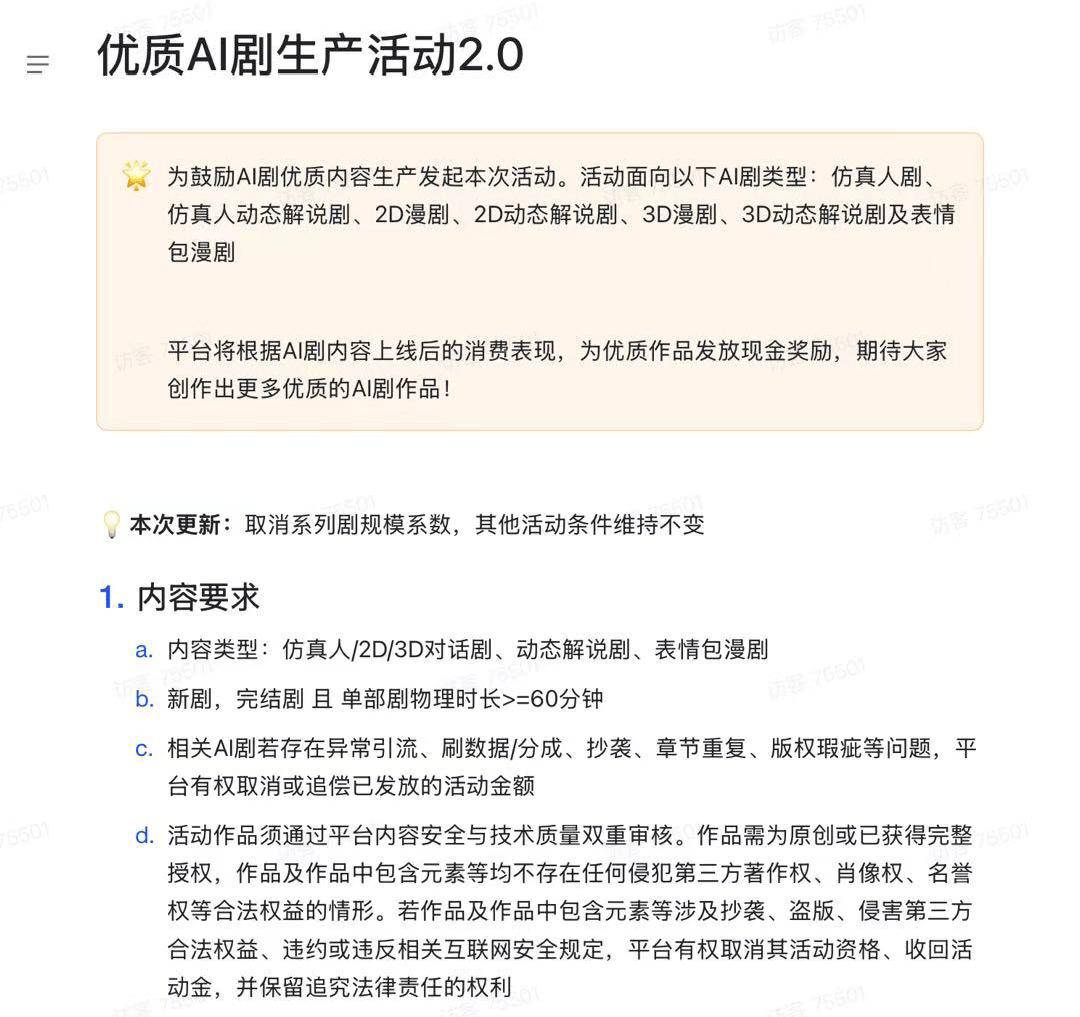
Obviously, Hongguo hopes that the revenue policy will no longer reward endlessly "skin-changing" low-quality series, and guide production capacity to tilt towards high-quality content. But it is still unknown whether this policy will work. Because the concern of production teams has always been that the trial and error cost of making high-quality dramas is too high.
"The cash rewards from the platform are 'post-payment', we are still taking a gamble."
AI drama practitioners told *Shixiang* that making a high-quality drama means investing multiple times of time and capital in script logic, character shaping and post-production storyboarding. But at the project approval stage, production teams cannot predict whether the work can pass the review and whether it can get the reward.
According to the revenue sharing rules of Douyin Group's Short Drama Copyright Center, the calculation method of free revenue sharing for comic dramas can be summarized as: Free revenue sharing for a single comic drama = Newly added effective viewing time in the current month × Unit price of viewing time × Comic drama type coefficient × Copyright coefficient.
Among the four factors, "effective viewing time" refers to the newly added effective viewing time of users within the settlement cycle. "Unit price of viewing time" is dynamically calculated by the platform based on the net profit of the free business, and is not publicly available for the time being; the copyright coefficient is related to the authorization cooperation method.
Therefore, the adjustment of only the type coefficient is far from enough for production teams, and the rest of the parts are still unknown to them. How much revenue a work can get depends on the newly added viewing time and the undisclosed dynamic base unit price.
Even if the production team spends a lot of money polishing a good story, once it fails to trigger the algorithm's recommendation mechanism in the first few episodes, or fails to meet the audience's short-term immediate stay indicators, the early investment will still be wasted directly.
"We have seen the type of works that the platform wants to encourage, but we also have to consider the reality. So now we have set up our own director and screenwriter team to make original scripts, but at the same time we have not stopped replicating hit works to make some so-called 'intellectually dumbed down' and low-end content. There are too many variables, after all, we also need to make a living."
Competition Enters the Second Half of High-Quality Content
Hongguo is phasing out the coin function, but its peers will not turn off this function at the same time, which may depend on the strength of each platform.
At present, Xifan Short Drama and Hippo Theater still have functions such as tasks, check-ins, coins and cash withdrawal; some small applications even directly use "watch short dramas to earn coins" as their product promotion slogan. The platform uses this function to acquire new users, exchange for viewing time, and cultivate users' first usage habits of the product.
In comparison, Hongguo believes that the coin function has completed its phased task, and the next step is to rely on high-quality content to retain users' viewing time. For Xifan, Hippo and a number of small short drama applications, the coin function is still a way to attract users to open the App.
The exit order of platforms depends on their own strength. Hongguo has a larger user pool, so after the coin function is removed, users still have reasons to open it; if smaller platforms shrink their business prematurely, they may not even be able to maintain the most basic usage frequency.
When high-quality content becomes the core of the second half of the competition, the pressure brought by Tencent's Lv Paopao's entry into the market has also become greater.
On October 15, Tencent launched the "Lv Paopao Short Drama" mini-program within the WeChat ecosystem, focusing on free short dramas and monetization through advertisements. Users can access it through WeChat search, Channels and mini-programs, without downloading a new App. The platform itself does not produce content directly, and the dramas mainly come from third-party production teams and copyright holders.
The attractiveness of Lv Paopao to production teams comes from its revenue sharing rules. From October 16 to December 31, dramas that are connected to Lv Paopao's co-distribution can get revenue incentives based on per capita viewing time, with the highest comprehensive incentive reaching 100%. Public reports show that the cash sharing ratio is different for ordinary dramas and high-quality new dramas, and there are also advertising fund subsidies.
Hongguo pays more attention to the newly added effective viewing time