Formally arrested, the legendary chip tycoon of an era has fallen victim to his gambler's recklessness.
On the evening of October 23, 2026, a public announcement from San'an Optoelectronics once again put Lin Xiucheng under the spotlight: the company received notification from the family member of its actual controller that Lin Xiucheng had been approved for arrest by the procuratorial organ on suspicion of official embezzlement and misappropriation of funds. At the close of trading that day, the share price of San'an Optoelectronics stood at 10.10 yuan, with a total market value of about 50.4 billion yuan.
At its peak, San'an Optoelectronics once exceeded a market value of 200 billion yuan, and was regarded as a promising next-generation semiconductor leader. As the founder of the company, Lin Xiucheng was once named the richest man in Fujian Province.
With the release of the arrest approval announcement, this former ambitious and domineering player in the industry and capital circles has finally reached the point of no return.
Turning Iron Into Light
Lin Xiucheng's story started with a pile of scrap iron.
In the 1980s, this young man born in Anxi, Fujian, earned his first pot of gold by purchasing leftover scrap steel from steel mills and reselling it to factories, earning him the nickname "Scrap Iron King" in southern Fujian.
In 1992, Lin Xiucheng established the San'an Iron Smelting Plant in a joint venture with the Sanming Iron and Steel Plant, transforming from a reseller into an industrialist. By 2002, San'an Group had total assets of 2.6 billion yuan and about 6,000 employees, ranking 14th among the top 100 enterprise groups in Fujian Province.
Lin Xiucheng never put all his eggs in one basket, and never lingered in one single industry for too long.
What truly changed Lin Xiucheng's fate was the Shenzhen Hi-Tech Fair in 1999.
It was there that he was exposed to LED technology for the first time. Back then, the core technology of LED chips was controlled by enterprises in the United States and Japan, and China relied almost entirely on imports. Optimistic about the prospects of the industry, Lin Xiucheng decided to devote himself to the development of domestic LED chips.
According to media reports, he personally traveled to the United States to inspect technologies, recruited core talents with high salaries, purchased production equipment with huge sums of money, and cooperated with the American company EMCORE to build a R&D and industrialization center.
In November 2000, San'an Electronics was established in Xiamen. In the first three years, this new business accumulated a loss of about 600 million yuan, almost draining all the profits from its steel sector, but he still did not stop, and had no intention of stopping.
In 2002, San'an developed its first epitaxial wafer; in 2003, it achieved mass production of full-color ultra-high-brightness LED chips, breaking the long-term domestic reliance on imports for LED chips.
During the same period, San'an also bet on solar cells for space use. At that time, employees of San'an stated that they wanted domestic satellites to use batteries made in Xiamen. More than 20 years later, San'an's gallium arsenide multi-junction solar cells have indeed been used in commercial satellites.
During this period, while running high-tech businesses, Lin Xiucheng also dabbled in traditional industries. He took control of Anxi Tea Factory — the largest oolong tea factory in China — with a 54% stake, and about 70% of its premium "Fengshan" Tieguanyin tea is exported overseas.
An old employee of the tea factory later commented on this new boss: "He is very shrewd, and has a sharp business acumen."
Three years later, Lin Xiucheng transferred all the shares of the tea factory out.
In October 2007, Lin Xiucheng launched a larger operation. The equity held by the major shareholder of *ST Tianyi, a Hubei-listed company that had long been suspended from trading, was forcibly auctioned by the court — the predecessor of this company was the once nation-famous laundry detergent brand "Vitality 28". San'an Group only spent 16.781 million yuan to win a 45.43% stake; including the cost of purchasing assets for bankruptcy reorganization and paying off debts, the total investment was about 149 million yuan, and it successfully backdoored a listed company.
In July 2008, Lin Xiucheng completed the injection of the LED assets of San'an Electronics, *ST Tianyi was renamed San'an Optoelectronics and resumed trading on the Shanghai Stock Exchange. In just a few years after that, the paper wealth of the Lin family increased by more than 10 times.
However, the more successful he became, the less Lin Xiucheng appeared in public.
Insiders described him as a "typical businessman from Anxi, southern Fujian": very enterprising, but not talkative. He rarely gave interviews, and his presence was hardly found on San'an's official website.
It was not until November 2012 that Lin Xiucheng made his debut at a public press conference, not in Xiamen, but in Taipei. Facing Taiwanese media, he was very conservative and basically answered questions according to the pre-prepared speech; only when talking about talents did he obviously open up.
Attaching great importance to talents of all kinds was also the secret to Lin Xiucheng's success in continuously crossing different industries.
The Leverage Kingdom
That trip to Taipei was a footnote to San'an's rise to its peak.
In November 2012, San'an Optoelectronics announced that it would invest 505 million yuan to take a stake in Taiwanese LED chip manufacturer Genesis Photonics, holding about 19.9% of the shares and becoming its largest shareholder. This was the first time a mainland LED enterprise took a stake in a Taiwanese peer.
Lin Xiucheng said in Taipei, to enhance the industrial status, the first is to expand economies of scale, and the second is to improve the salary and welfare of employees. Therefore, the money "must be used in Taiwan" to make employees feel happy, so as to maintain competitiveness.
Back then, the Taiwanese industry was both wary and helpless towards San'an: on the one hand, they accused it of taking orders at lower prices and poaching engineers from Taiwanese manufacturers, on the other hand, they watched its production capacity keep growing larger and larger.
By 2017, the number of MOCVD equipment held by San'an had increased from more than 10 units in 2012 to about 360 units, with a global market share of about 12%, and it was still sprinting towards the 30% target.
International manufacturers such as Samsung and Philips simply outsourced their chip production to San'an, and gave up expanding their own production capacity. Because Lin Xiucheng's business strategy made their own production completely uneconomical and uncompetitive.
This impact of scale objectively changed the pattern of the global LED industry. Chip prices were greatly reduced, LED lighting and displays were popularized at an accelerated pace, and China transformed from an LED chip importer into the world's largest production base.
During this period, San'an also opened its doors to domestic LED chip equipment manufacturers.
In 2017, San'an had already installed the Prismo A7 MOCVD equipment from Advanced Micro-Fabrication Equipment Inc. China. Lin Kechuang, then general manager of San'an, publicly commented that AMEC was a partner that could meet its advanced technical requirements. As the largest LED chip manufacturer in China, San'an's adoption of domestic equipment opened a window for domestic MOCVD to be verified and scaled up in a market dominated by international giants.
What supported Lin Xiucheng's rapid expansion was a highly replicable model: local governments provided land, subsidies and industrial funds, while San'an brought projects, production capacity and jobs.
Under this model, San'an bases rose up in Wuhu, Quanzhou, Changsha, Ezhou and Chongqing one after another. Among them, the total planned investment of Quanzhou San'an is 33.3 billion yuan (including public supporting facilities); the budget of Hubei San'an's Mini/Micro LED project is 12 billion yuan; the total investment of Hunan San'an's silicon carbide base is 16 billion yuan; the total investment of the silicon carbide joint venture in Chongqing is about 3.2 billion US dollars, and San'an invested about 7 billion yuan to build a supporting substrate plant on its own.
In the golden age of LED, scale itself was the moat.
Local governments wanted industrial development, San'an wanted capital, and the two sides hit it off perfectly.
According to incomplete statistics from some media, San'an Optoelectronics has received a total of more than 11.3 billion yuan in government subsidies since its backdoor listing. According to the sorting out by Time Finance, state-owned assets in Hubei, Changsha, Chongqing and other places have invested more than 20 billion yuan in the San'an system in the past few years.
At the same time, the shares of the listed company held by Lin Xiucheng were repeatedly pledged to exchange for cash needed for expansion.
There had long been gray tracks on this path. The public judgment documents of the bribery case of Zheng Yunfeng, former executive vice mayor of Xiamen, show that Zheng Yunfeng accepted property from Lin Xiucheng between 2003 and 2010, and provided favors for the enterprise in matters such as tax rebates and headquarters land use.
What leverage fears most is not high cost, but the reversal of the industry cycle.
Lin Xiucheng's leverage soon brought huge troubles.
In recent years, the LED industry has experienced a rapid downturn, with overcapacity and fierce price wars, and San'an's basic market has been continuously eroded. The silicon carbide business, which had high hopes, also encountered a price war brought by the global expansion wave. While the production lines were still ramping up, the depreciation pressure had already risen. In addition, government subsidies have declined, decreasing by hundreds of millions of yuan every year.
Under the latest statement of "suspicion of official embezzlement and misappropriation of funds", there are bound to be other unsolved mysteries in Lin Xiucheng's capital operations and even his cooperation with local governments.
As a result, San'an's operating performance continued to deteriorate.
In 2025, San'an Optoelectronics achieved revenue of 17.949 billion yuan, a year-on-year increase of 11.45%, but the net profit attributable to shareholders was a loss of 353 million yuan — this was the first annual loss since its backdoor listing in 2008.
In March this year, when the news that Lin Xiucheng was placed under residential surveillance was released, San'an Optoelectronics hit the 10% down limit, and its share price fell by 24% in 5 trading days. The real chain reaction occurred at the controlling shareholder level: creditors collectively launched risk control, the early maturity clauses of loans were triggered, and debt recovery followed one after another.
By October 14, a total of 1.312 billion shares of San'an Optoelectronics held by San'an Electronics and San'an Group had been 100% judicially frozen, accounting for 26.30% of the total share capital; with the superimposed waiting freeze, the total number of shares under waiting freeze reached 8.213 billion shares, equivalent to 625.89% of their shareholding. In other words, every single share of San'an Optoelectronics held by the Lin family is being targeted by more than six layers of seizure in line.
In June this year, natural person creditor Lin Suzhen applied to the Xiamen Intermediate People's Court for bankruptcy reorganization of San'an Electronics and San'an Group, and the application was withdrawn on September 2. On October 15, a new reorganization application came, initiated by Hubei Changjiang Anxin Industrial Investment Fund and Hunan Lugu Development Group.
Those who once contributed capital are now queuing up to become creditors.
This is the most thought-provoking scene in the whole story: the parties applying for the reorganization of San'an's controlling shareholders are exactly the local industrial capitals that were deeply tied to San'an in Hubei and Changsha in the past.
The expansion exchanged by pledged shares will eventually be settled with control rights. "Expanding economies of scale" made Lin Xiucheng, but the leverage added to the scale is now eating back the kingdom he built with his own hands.
The Test Beyond the Partition Wall
In July 2017, Lin Xiucheng stepped down as chairman of San'an Optoelectronics, and his eldest son Lin Zhiqiang took over. San'an built a "partition wall": the founder withdrew from all positions in the listed company, the second generation took charge of the board of directors, and the professional manager system maintained daily operations.
This wall is legally valid. Lin Xiucheng himself does not hold a position in the listed company. The announcement did not disclose which company the alleged official embezzlement and misappropriation of funds occurred in, and the outside world cannot and should not directly equate it with the problem of the listed company.
But in reality, Lin Xiucheng never really stayed away.
He has always been the chairman and general manager of San'an Group; according to reports, in February 2025, when the leading officials of Chongqing met with the president and CEO of STMicroelectronics, the attendees included "Lin Xiucheng, chairman of San'an Group and his entourage".
He withdrew from the personnel list of the listed company, but did not withdraw from San'an's game table.
The people inside the wall still have the surname Lin. The chairman is his eldest son Lin Zhiqiang, the director and deputy general manager is his second son Lin Zhidong, and the vice chairman and general manager Lin Kechuang is his son-in-law.
An insider of San'an said that the successor Lin Zhiqiang "is as low-key as his father", casual about clothing and food, not talkative, and rarely interacts with employees except for work.
On the equity side, Lin Xiucheng still holds 59.68% of San'an Group, and together with Lin Zhiqiang, their combined shareholding is about 71.83%, and San'an Group controls San'an Electronics. The management right was handed over to the son, but the control right remained in the hands of the father.
This wall has been hit hard once already this year.
On March 30, Lin Kechuang stated at a press conference that the residential surveillance of the actual controller was a personal incident and had nothing to do with the company, and announced that he and Lin Zhiqiang would increase their shareholdings. Only a week later, on April 7, he was placed under residential surveillance and filed for investigation by the Supervision Commission of Yuzhong District, Chongqing. The residential surveillance was lifted on October 5, and Lin Kechuang resumed his duties; his shareholding increase commitment was fulfilled on his behalf by Lin Zhiqiang, who increased his holdings by a total of 3.57 million shares at a cost of about 49.86 million yuan.
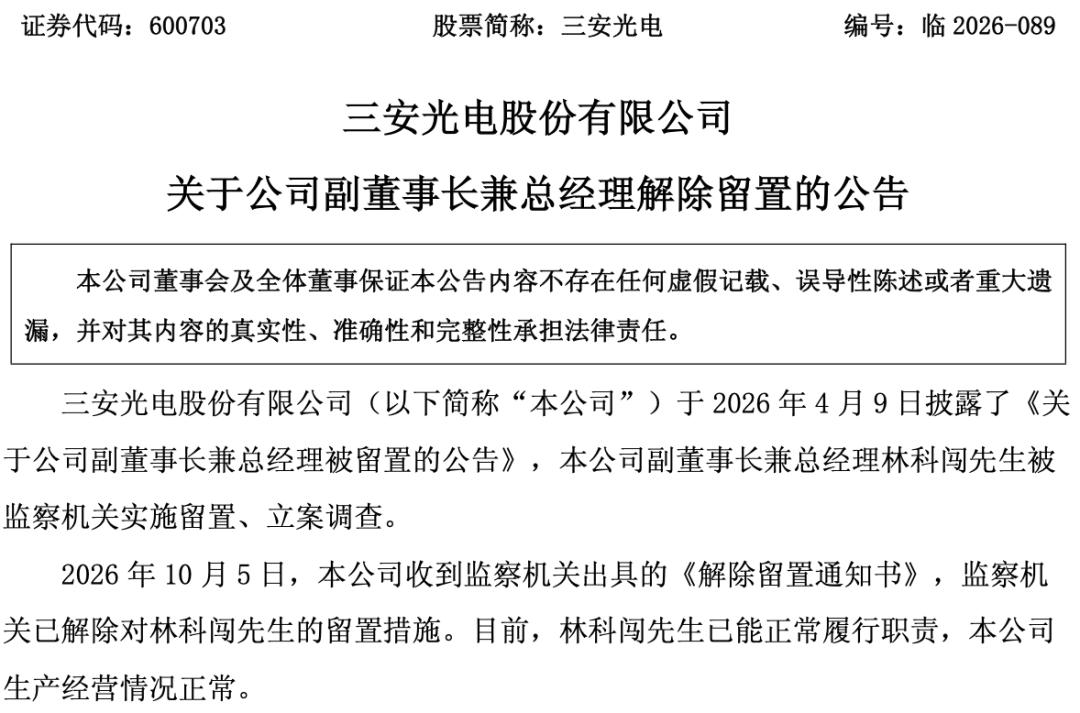
Image source: San'an Optoelectronics
With the general manager position vacant for half a year, the company still operated normally and delivered products to customers. From an operating perspective, this wall withstood the first round of impact. But operating data shows that the pressure has never gone away.
In the first half of this year, San'an Optoelectronics achieved revenue of 6.468 billion yuan, a year-on-year decrease of 28.04% (mainly because the revenue from precious metal scrap recycling is no longer recognized, after excluding this factor, the year-on-year growth was 8.97%); the net profit attributable to shareholders was a loss of 98 million yuan, and the loss after deducting non-recurring items was 504 million yuan; the inventory depreciation reserve alone was provisioned for 329 million yuan.
Looking at the details, it shows a picture of the old and new alternating: the revenue of LED epitaxial chips was 3.103 billion yuan, up 11.81%, and the old business has stabilized amid price increases and high-end transformation; the revenue of the integrated circuit business was 1.268 billion yuan, down 15.40%, and filters and silicon carbide are still the biggest drag on profits.
The new highlight comes from AI. San'an's optical chips have established cooperation with 4 of the world's