Why do the geniuses in Silicon Valley spend every day researching how to make AI chop trees in Minecraft?
The top talents in Silicon Valley now go to work every day to figure out how to make AI speedrun Minecraft.

Chopping trees, mining ores, crafting gears, and fighting the Ender Dragon have all become their research subjects. After finishing the research, they publish papers and pit their AI against other AIs in competitions.
Some people use a single Claude AI to clear the game, others study speedrunning with Jev, and Google recently had four Gemini team up to start their "journey to the West" from scratch.
Minecraft is quickly becoming the "Subject 3" in the AI circle, and the gameplay is getting more and more interesting.
From "Fighting Alone" to "Four Pilgrims on the Journey"
Let's look back at how AI has progressed step by step in Minecraft.
Back in the Claude era, developers prepared tools for it to mine, craft gears and fight, allowing it to decide what to do next and call the tools to act on its own. In the end, Claude spent less than four hours defeating the game's final boss, the Ender Dragon.
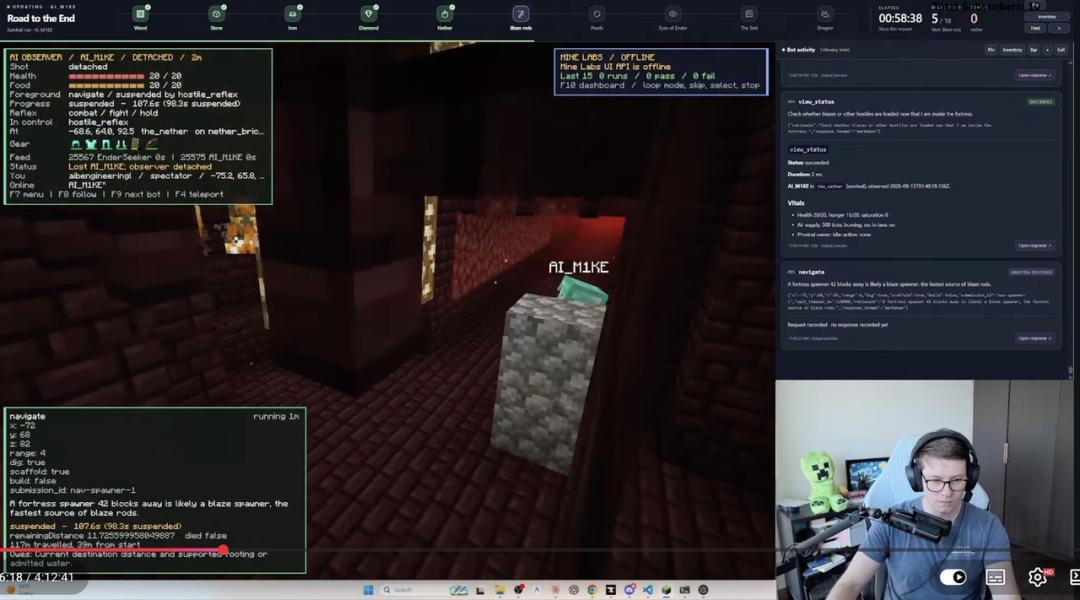
Claude Opus 5 defeated the Ender Dragon in less than 4 hours | YouTube
There are more advanced versions. Two models cooperate: GPT6-Astra is responsible for planning, and Jev (good at fast decision-making) is responsible for selecting actions, clearing the game in 8 minutes and 43 seconds. At that time, this was regarded as a "success case of Jev" and went viral on social media for a while.
The latest development is that four Gemini 4 Argon team up to build everything in Minecraft from scratch. They only have one set goal in mind: to defeat the boss.
The four Geminis enter the game empty-handed, with no human-written programs to rely on. They have to learn everything from scratch: chopping trees, mining ores, and crafting gears. If they want to chop a tree, they write a piece of code for tree chopping; if they want to mine, they write a piece of code for mining. They run the code after writing, and rewrite it if the result is wrong.
In this way, the four AIs also learned to divide the work. Some collect food and materials, some make tools, and some explore the path. The one who finds a problem will call everyone to communicate to avoid stepping into pitfalls.
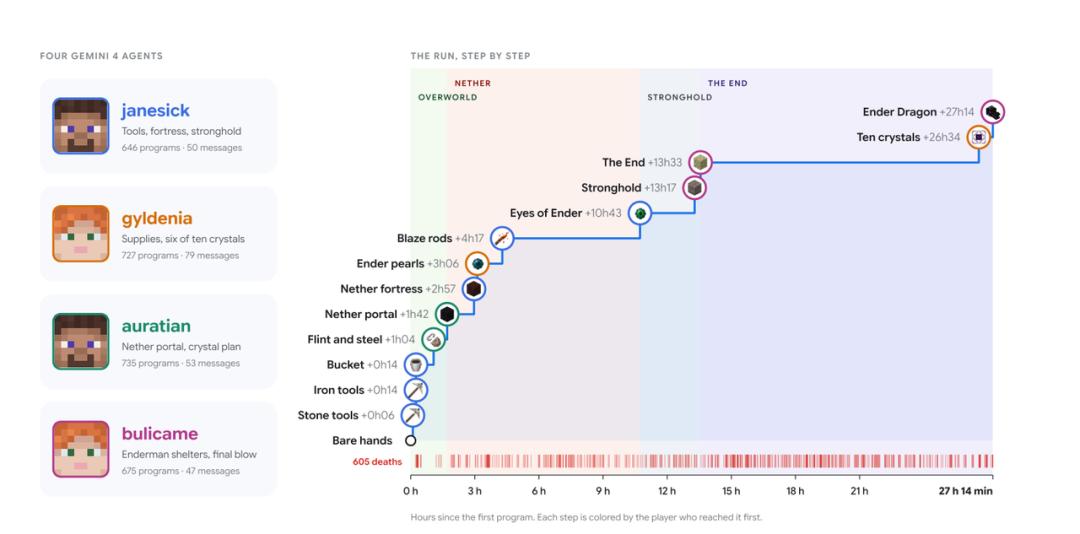
A Bumpy Journey to Clear the Game | DeepMind
The "four-person team" really acts just like the pilgrimage to the West for Buddhist scriptures.
Before fighting the Ender Dragon, they killed other monsters 351 times in total. The four AIs drowned 67 times, for which they even specially wrote a program about how to keep the game character floating on the water surface.
Let's pick one "tribulation" to show you: Once, one of the AIs, carrying the key materials needed to fight the dragon, drowned in the river when it was only 8 meters away from its teammates. The remaining two AIs immediately sent messages, reported the death location, and urged the nearest teammate nearby to pick up the key materials. Fortunately, the teammate is also very smart.
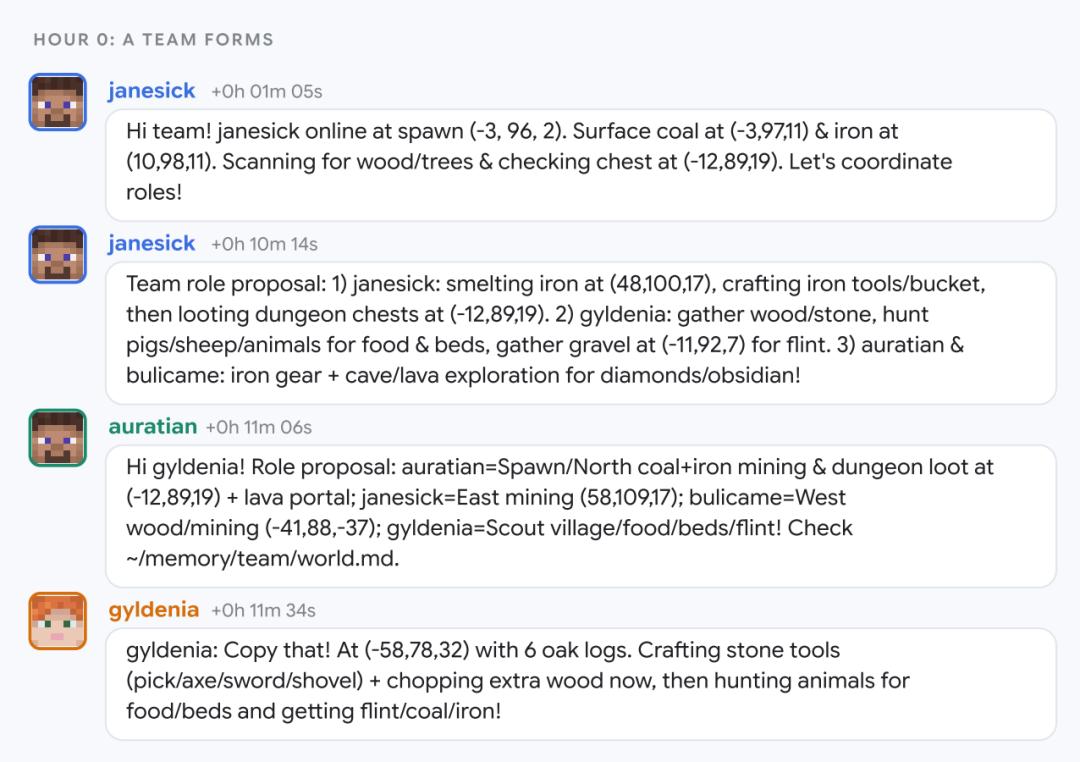
The four Agents are also sharing experiences with each other | DeepMind
They spent nearly 14 hours struggling on the dragon-fighting level, and were killed by the dragon 69 times. After being defeated so many times, they naturally accumulated a lot of experience. The AIs specially reminded each other: don't stand still as soon as you enter the battlefield, the dragon will rush over and knock you flying.
All the actions performed by the AIs have to be realized by writing their own code. One fifth of the programs in the whole game reported errors, and the AIs had to go back and modify them.
Just writing and modifying all the way, the four of them wandered in the game for more than 80 days. They died 605 times in total, wrote more than 2,700 programs, and finally conquered the Ender Dragon after 27 hours in real time.

They also wrote 63,300 lines of code | DeepMind
This long journey is condensed into this paper by DeepMind, which studies how AI can defeat the final boss without human players playing for them.
Why are the smartest teams all over the world making their self-developed AI play an old game? Perhaps it is the same for humans and AI: Minecraft is a textbook that always brings new insights no matter how many times you read it.
Minecraft: An AI Training Textbook
Using Minecraft to train AI is far earlier than the current boom of large language models.
In 2016, five computer scientists at Microsoft spent every day researching how to make AI climb a mountain in Minecraft. Later, they opened a research platform called Malmo, allowing developers all over the world to use the game to train AI.
In 2019, MineRL (the Minecraft AI research project initiated by Carnegie Mellon University) launched a competition, requiring participants to teach AI to mine diamonds on its own within limited training time.
You may think, isn't it just mining a diamond? It was not until 2025 that Google DeepMind used DreamerV3 to achieve for the first time that AI could figure out the way to mine diamonds from scratch without relying on human demonstrations and pre-arranged learning courses. This achievement was even published in the journal *Nature*.
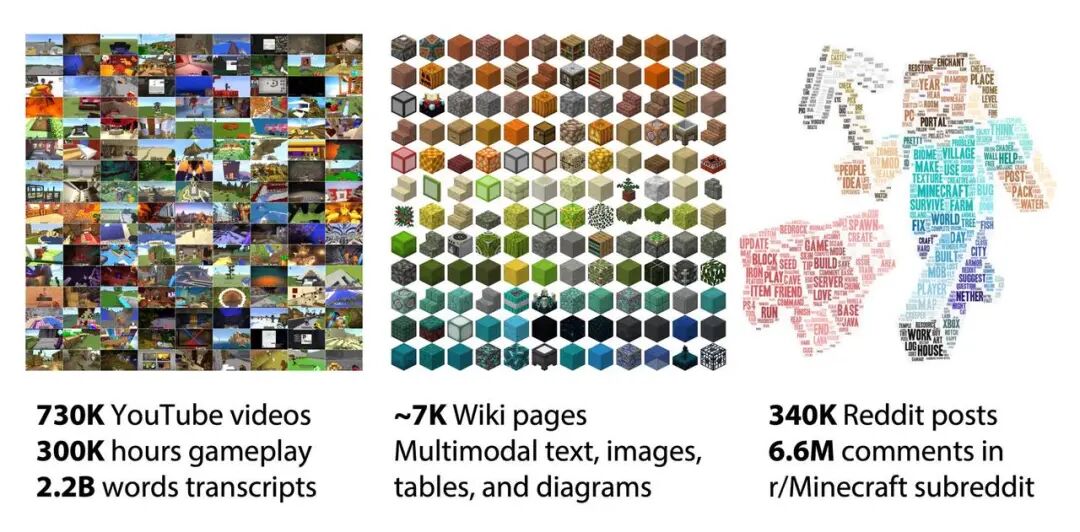
The MineDojo project in 2022 collected more than 730,000 YouTube game videos, about 7,000 pages of Wiki entries, and 340,000 Reddit posts. These videos alone add up to about 300,000 hours, with corresponding English commentary texts. The massive amount of Minecraft materials is also the key for AI to make progress in this game | MineDojo
In 2022, OpenAI collected 70,000 hours of human game videos to teach AI to operate Minecraft through mouse and keyboard like real people. This method is called VPT (Video PreTraining). AI does not need developers to tell it which key to press at each step in advance, but learns operations from players' videos. The AI learned to craft a diamond pickaxe, though the success rate was only 2.5%.
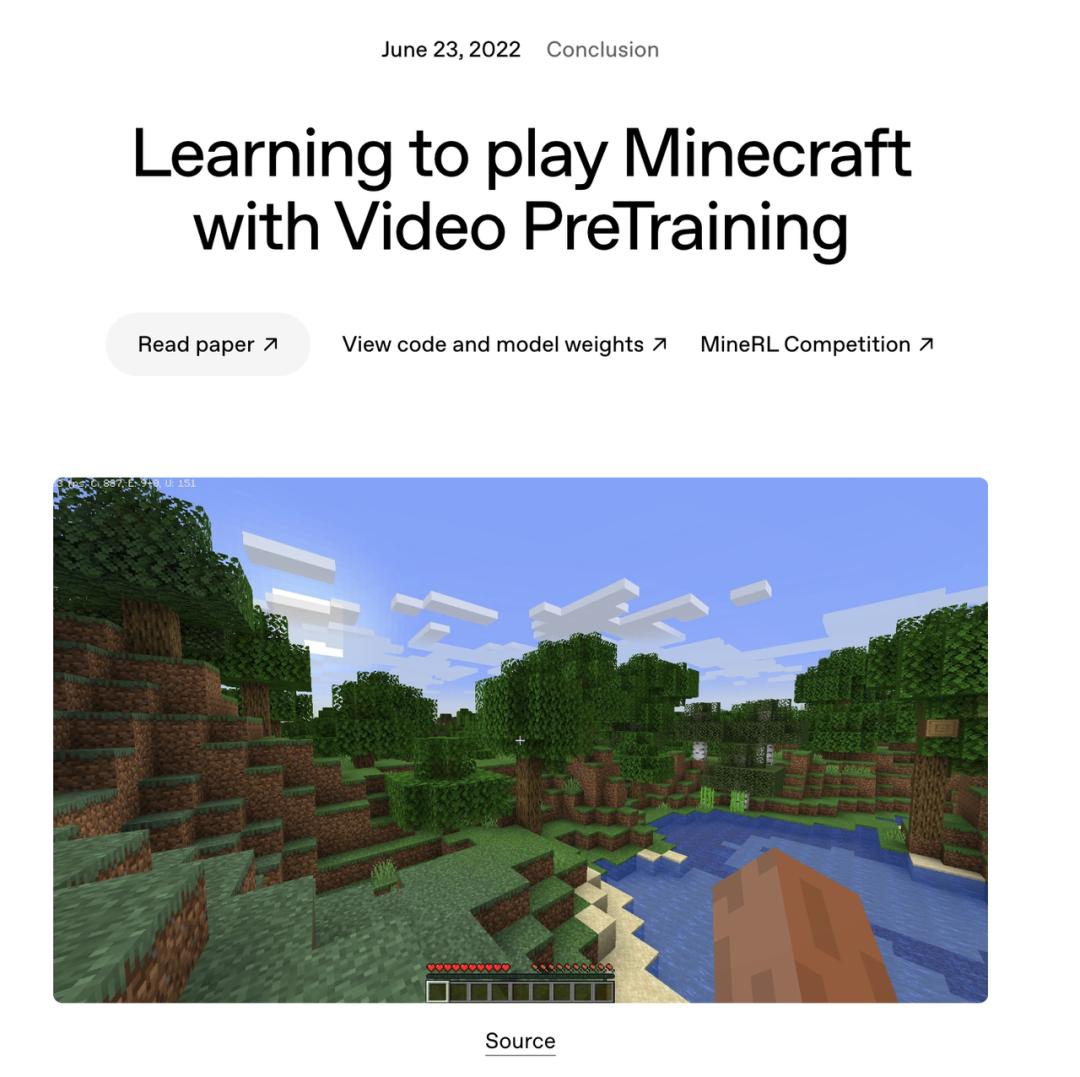
In 2022, Minecraft was used by OpenAI for pre-training of video models | OpenAI
In 2023, Voyager (an AI autonomous exploration project) connected GPT-4 to the game again, allowing the AI to assign tasks to itself. Every time the AI learns a skill, it writes down the code, and directly calls it next time, developing the ability of "fixing skills and forming memory".
The history of AI playing Minecraft fully demonstrates how AI capabilities are gradually improved step by step.
In contrast, other games do not have this "advantage". Chess can train AI's reasoning and strategy, and StarCraft allows AI to learn resource scheduling, but they still follow fixed win-lose goals.
Minecraft does not have such restrictions. As people researching and training AI, you can design problems and select scenarios in a very large game scene; as AI, it can set propositions for itself after gaining "intelligence".
The World of AI
Minecraft is a game with extremely high freedom. It does not stipulate how users play: building houses, farming, raising animals, or wandering around, you can have fun for a long time. Hardcore players built "Seven Wonders of the World" in it, recreated the Potala Palace by hand, and some people used the circuit components in the game to build a fully functional computer that can actually compute.
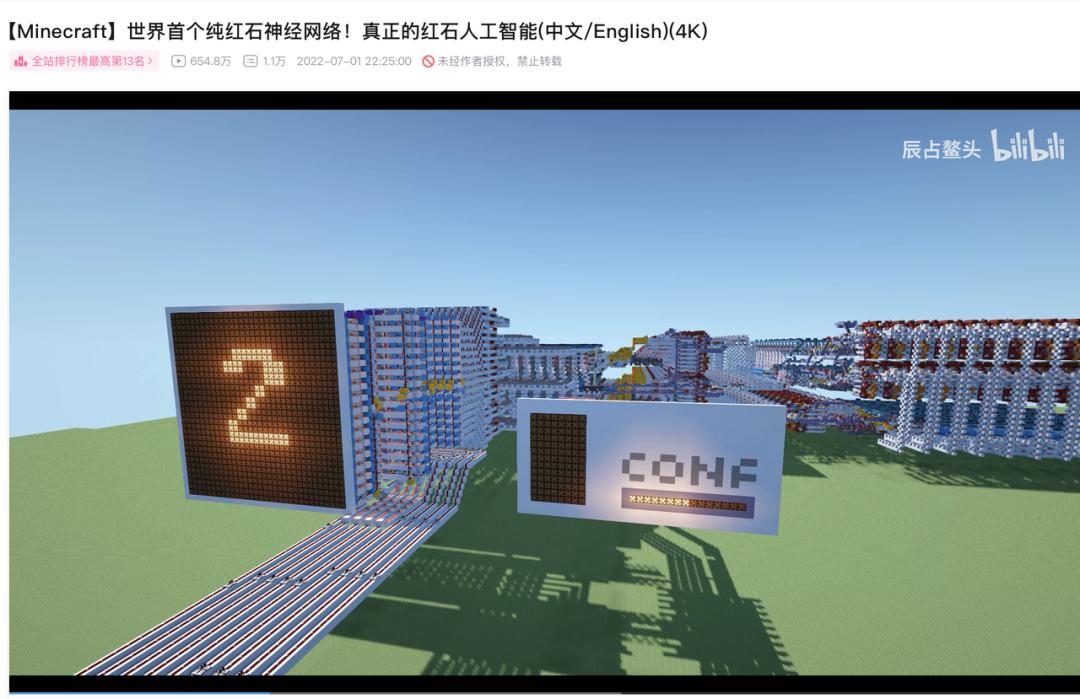
Hardcore players built a set of neural networks in Minecraft | UP Master @Chen Zhanaotou
No matter building a door for a pigsty or making an 8-bit computer by hand, all operations boil down to the single actions players take in Minecraft: moving, digging blocks, placing blocks, and crafting.
Minecraft Universe sorted out 3452 basic tasks for Minecraft, which can build a huge game world just like assembling Lego bricks.
For example, the big task of "defeating the Ender Dragon" can be further broken down into specific small tasks at each step.
The AI has to prepare for the battle - which means it has to get weapons first - to make weapons it has to find iron - to find iron it has to mine - to mine it has to use a pickaxe - to make a pickaxe. After mining, it has to find fuel and smelt the ores in a furnace. When it is tired and hungry halfway, it has to eat and rest. A small task of "making weapons" extends to a whole production line.
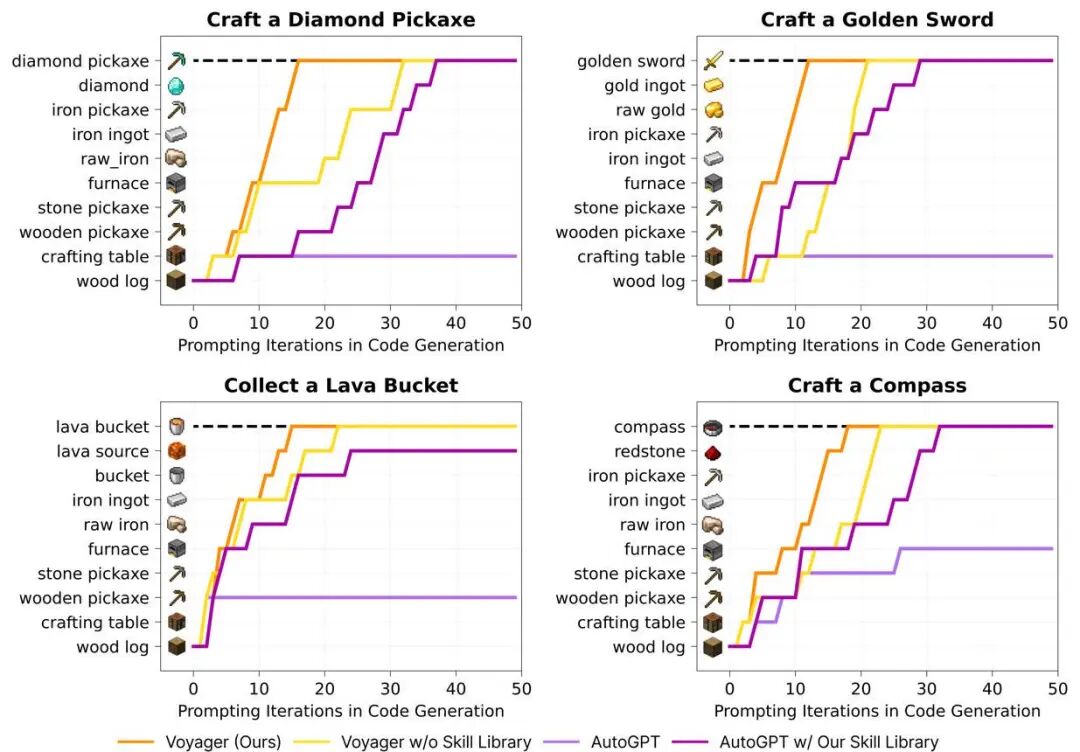
The task chain understood by Gemini itself | DeepMind
Many exams for AI only check whether it can give a standard answer. But Minecraft is very suitable for testing the "subjective initiative" of AI: what to do first, how much materials are enough, which teammate is reliable for which task, all need to be arranged by the "player" itself (writing programs and testing whether the programs can run properly).
Of course, the premise is that the game provides sufficient openness. The game map can be generated randomly, and experiments can also be reproduced with the same map seed. Resources, monsters, day and night cycle, and game difficulty can all be adjusted. Although it is just a pile of blocks, it extends and covers elements such as space, resources, tools, and environmental changes.
Therefore, players can show complex and diverse problem-solving processes under clear task goals. Some researchers even specially designed an evaluation system that allows one AI to evaluate the game performance of another AI.
However, these AI researchers put so much energy into it not to make AI a Minecraft expert. Letting four Gemini team up to fight the dragon is actually researching how AIs will collaborate with each other in the future.
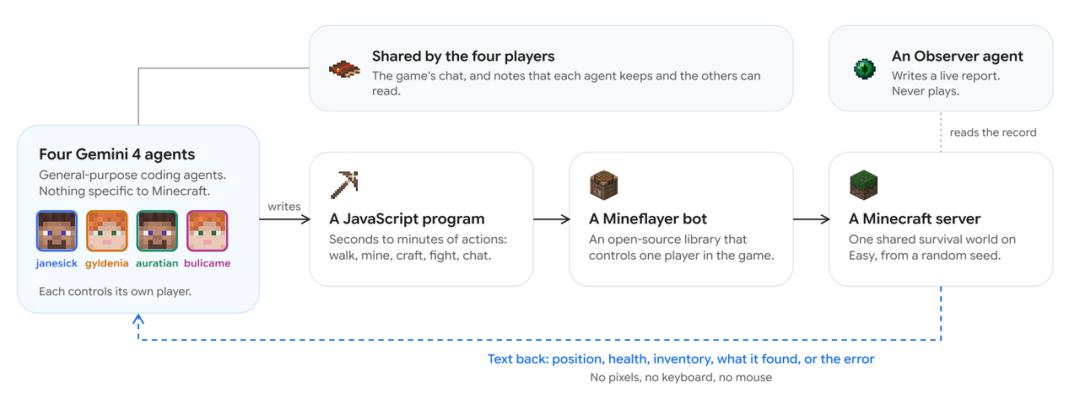
The abilities of creation, communication, trial and error, summarization, and collaboration have all been trained, haven't they? | DeepMind
Today, humans' "command" to AI has evolved from "translate this paper" to "develop a piece of software for me". Writing a small piece of code is no longer rare, but letting them work continuously for more than ten hours, calling thousands of tools in the middle, with memory, awareness of cooperation, and coordination ability, is enough for them to struggle for a while.
As for what tools the large model uses, what materials it checks, and what to do if it gets stuck halfway, all are solved by the AI itself. We only need to check the results they submit in the end.
Therefore, compared with speedrunning the game, the stumbling process of opening up a new world provides scholars with richer research materials.
In 2016, AlphaGo defeated Lee Sedol, and a game of Go made the whole world aware of "artificial intelligence". In 2026, four Agents defeated the Ender Dragon. Changing to another game may also be a new starting point.
References
[1] https://arxiv.org/html/2610.22319?utm_source=chatgpt.com
[2] https://ascii.jp/elem/000/004/436/4436545/?utm_source=chatgpt.com
[3] https://craftjarvis.github.io/MCU/?utm_source=chatgpt.com
Author: Gaoji Dongwu
Editor: Shen Zhihan
Cover Image Source: Generated by Gemini