Are overseas influencers collectively "recruited" by domestic Chinese factories?

Recently, Kim Kardashian and her entourage's visit to Shanghai has drawn widespread attention on global social platforms.
Meanwhile, Jiemian News reports that a group of overseas influencers have arrived in Guangzhou and Shenzhen, China, with the aim of finding factories to build their own brands. It is reported that the model of overseas influencers cooperating with Chinese factories to launch their own brands has been proven feasible. Some factories have already partnered with 20 influencers, and the number is set to continue growing next year.
U.S. influencer Ryan Tang is a typical example. He has accumulated more than 5 million followers on platforms including YouTube and TikTok, and his self-developed men's cologne is now available on the market. Instead of choosing OEM production in the United States, the perfume was developed and produced in the domestic supply chain in Guangzhou and Shenzhen.
Why are overseas influencers flocking to develop self-owned brands? The reason is none other than the increasingly saturated traffic-based business.
Statistics from creator marketing platform CreatorIQ show that the number of creators participating in brand campaigns through its platform in 2025 increased by 183% year on year, while revenue is further concentrated among top creators: the top 10% of creators took 62% of all payments, a figure higher than 53% recorded in 2023.
The feast of traffic is gradually coming to an end, and the path of monetization purely through content is getting narrower and narrower.
Creators who own large follower bases and high-quality content are trying to seize another lifeline for making a living before the boom fades.
Can China's domestic supply chain "absorb" the world's excess traffic?
In fact, converting traffic assets into self-owned brands is almost the ultimate monetization choice for global influencers.
Looking at the domestic market first, as the dividends of live-stream e-commerce narrow and competition among live-streamers for product sales intensifies, it has long been a repeatedly verified practice for influencers to build their own brands and bind themselves to the supply chain. In 2026, veteran influencer Wanwan launched her personal women's clothing brand, and her IP influence can still be effectively converted into brand assets.
It is reported that Wanwan's women's clothing store gained more than 40,000 followers only two days after its launch, and its sales in the first month easily exceeded 10 million yuan.
Overseas influencers have a long history of trying to build their own brands as well.
For example, MrBeast, who has hundreds of millions of followers, launched the chocolate brand Feastables, which once recorded an annual net income of 215 million U.S. dollars. YouTuber Logan Paul and British creator KSI co-founded the beverage brand Prime, which has entered retail channels across Europe and the United States. The skincare brand of American influencer Alix Earle was launched in March 2026, and its official account gained more than 500,000 new followers within two weeks.
Not to mention the "pathfinders" in this track, including Kardashian, Pamela, Li Ziqi, and Dong Zichu... However, compared with the past, a subtle shift has taken place in the "influencer brand building" trend: a large amount of the global excess traffic that was originally supposed to be undertaken by local supply chains in various countries has finally flowed to China's industrial clusters.
What on earth is the reason behind this?
First, European and American supply chains have long been designed around large brands, large orders and long cycles, while the orders brought by influencer startups and nascent businesses are usually small in volume. The characteristics of small batches, multiple batches and rapid iteration are naturally incompatible with the production rules of European and American manufacturing that usually run at the scale of millions or tens of millions of units.
If they forcefully connect with local supply chains, it will only raise costs and accelerate the failure of the inherently trial-and-error traffic business.
Data shows that the demise of influencer brands has become a business norm since 2000. According to research by Bain & Company, only 36% of influencer brands can maintain growth momentum within three years of their establishment. The industry's general consensus is that more than 90% of influencer brands cannot escape the fate of being a flash in the pan.
Even SKKN by Kim, the makeup brand founded by Kim Kardashian, the world's top influencer, was shut down only 3 years after its establishment. Up to now, Kim Kardashian has founded three beauty brands in total, all of which have ended up being closed. The experience of top influencers constantly reminds late entrants that influencer entrepreneurship requires prudence.
Second, the capacity of overseas manufacturing supply chains to undertake such orders has dropped significantly in the past two years.
Take the United States as an example. According to foreign media reports, due to massive imports, less than 4% of clothing sold in the United States was domestically manufactured in 2023.
This is not limited to the clothing sector. In May 2025, China Central Television's website reported that the number of products labeled "Made in USA" has been declining continuously. Statistics show that in the past 12 months, there were about 100,000 consumer goods and groceries labeled "Made in USA" in the United States, 2,000 less than the previous 12 months.
In 2025, the Economic Daily published an article titled *The Chairs That Cannot Be Produced, The Manufacturing Industry That Cannot Return*, which tells the story of an overseas design student who wanted to find a factory to produce a chair, but encountered numerous difficulties, and finally sent the order to a domestic OEM in China. Coincidentally, LV's factory in the United States had a scrap rate as high as 40% due to a large number of cutting and assembly errors.
At the same time, the cost remains extremely high. Take the aforementioned chair as an example, the local factory quoted a price as high as 2,400 U.S. dollars, and it would cost tens of thousands of dollars to get the ideal finished product.
In contrast, in China, the cost and speed of most factories are more suitable for the small-scale initial entrepreneurship of influencers. The flexible and agile supply chain has lowered the minimum order quantity to hundreds or even dozens of units, and compressed the delivery cycle to several weeks.
For example, Ryan's men's perfume brand XAV was successfully launched for sale in less than two months. Yicai Global also reported that a foreign businessman running a sunglasses business in India saw his profit increase by around 40% after directly partnering with the source factories in China.
To date, the obvious contrast between the two models at home and abroad has come into the view of most global influencer entrepreneurs.
Of course, the supply chain can only lower the threshold for trial and error, and cannot guarantee the permanent survival of a brand.
Kardashian's lessons remind everyone: traffic does not equal brand loyalty, and no matter how perfect the manufacturing capacity is, it cannot save an IP business that lacks product competitiveness. But for countless overseas influencers who own traffic and want to try to build their own brands, coming to China to find OEMs seems to be the most realistic choice.
Can the global influencer trend save the struggling small and medium-sized factories that are constantly losing profits?
How strong is China's current domestic supply chain?
Take the clothing track, the most common sector for influencer self-owned brands, as an example. For small and medium-sized factories in China, a minimum order quantity of 50 pieces and a delivery time of 7 to 15 days have become the basic threshold, and they can quickly cater to the "emotional dividend" of popular trends on the internet.
For example, in the spring and summer of 2026, the total view count of content related to "Egg Party Daily" on social platforms exceeded 4.7 billion. Soft and cute items such as plush sweatshirts, milky coffee-colored knit hats and cloud bags instantly became traffic hits, with search volume surging 210% month on month.
In the same period, data from 1688 shows that in Q1 2026, the GMV of the "small-batch custom printed sweatshirt" category increased by 183% year on year, and more than 60% of the suppliers in this category have realized the capability of "direct delivery per single unit + custom printing".
Of course, on the other side of the continuous improvement of the domestic supply chain's flexible capability, there are also hidden drawbacks: profits are declining.
Data shows that five years ago, the gross profit margin of OEM manufacturers could still stay at 10%-15%; now, the gross profit margin of a large number of factories has been compressed to 5%-8%. In low value-added industries such as clothing and simple hardware, the upside-down phenomenon where the ex-factory price cannot cover the cost has become a common industry norm.
Specifically, Bave, a leading beauty OEM, recorded a 21.15% year-on-year revenue growth in 2025, but its net profit dropped by 14.83%. Behind the increase in revenue without corresponding profit growth is a 3.57 percentage point decline in gross profit margin. Outdoor furniture manufacturer Yayi Technology directly turned from profit to loss in the first quarter of 2026, with its gross profit margin plummeting from 45% to 34.6%.
On the one hand, the OEM profit is continuously thinning; on the other hand, overseas influencers are pouring into the industrial clusters with traffic and small-batch brand demands.
So, can influencer orders really save small and medium-sized OEMs trapped in profit difficulties?
It is undeniable that with the popularization of social media, short videos and AI creation tools, coupled with multiple factors including the general environment, the global "influencer" camp is expanding at an accelerated pace. According to the latest report released by Goldman Sachs Research, the potential market size of the creator economy may double in the next five years, rising from the current 250 billion U.S. dollars to 480 billion U.S. dollars by 2027.
Meanwhile, the compound annual growth rate of global creators will reach 10% to 20% in the next five years.
Take India as an example. As of 2023, there were 80 million content creators in India. This is not unique to India: China, Europe, the United States, Japan, South Korea and other major economies around the world are all witnessing the same situation. Content creation and influencer entrepreneurship have become one of the most popular career choices for young people today.

An inevitable trend has thus emerged:
Against the backdrop of the growing number of influencers, the brand budget of global advertisers is declining. Forrester's *2026 B2C Marketing, Customer Experience and Digital Business Forecast* predicts that by 2026, top advertisers will cut their display advertising budgets by about 30%.
When the wave of national creation sweeps the globe, massive traffic floods into the market, intensifying the fierce competition in the global influencer industry, which will force a large number of creators to shift from taking advertising orders to building their own brands and operating physical businesses. This demand from the global traffic side is a rare opportunity for a large number of small and medium-sized factories in China.
Jiemian News reports that some factory owners say that a single video from an influencer can bring them 5 to 6 times the return.
However, this does not mean that domestic factories have found a new long-term patron. Looking back at the past few decades, the coastal OEM industrial clusters in China have long survived by relying on large orders from overseas big brands. In the past two years, external demand has continued to fluctuate, and the stability of orders has dropped sharply, leaving a large number of foreign trade OEMs on the verge of bankruptcy.
In April 2026, Guangxi Huasheng Yingfeng Toy Factory, which used to do OEM for Hasbro, Mattel and MGA, producing more than 30,000 toys a day at its peak with an annual output value of 380 million yuan, went into bankruptcy liquidation. The 30,000-employee Changrong Toy Factory in Dongguan ceased operations. A number of established manufacturing enterprises with more than 10 years of operating history, including Yingpai Electric, Xinfeng Electric and Yongsheng Electric, have also closed down one after another.
Even mature OEMs that rely on international big brands are in such a situation. It is self-evident how many factories' survival can be supported only by the fragmented small orders from influencer startups.
The tide has changed its direction, but the factories that survive by riding the tide are still drifting in the waves.
With the reshoring of local manufacturing, have overseas influencers gained more bargaining power?
It is worth noting for global influencers that with the maturity of cross-border e-commerce and against the background of the continuous decline in the stability of external demand orders, a large number of Chinese OEMs have begun to actively develop their own cross-border e-commerce business. It is reported that compared with doing OEM for brands, the profit margin of directly facing end consumers is much higher than that of taking OEM orders.
Public information shows that for the same product, there is a gap of several times or even ten times between the ex-factory price and the overseas end retail price. A set of professional sportswear with a supply price of 30 U.S. dollars can be sold for more than 100 U.S. dollars on cross-border platforms; a chair with an ex-factory price of 30 RMB can be priced at 49.99 U.S. dollars (about 350 RMB) on Amazon.
When OEMs skip brand owners and traders to directly reach overseas consumers, their combined income from manufacturing profits, channel profits, and even accumulated brand premium will greatly increase their profitability. Take JMT as an example: its gross profit margin of ODM/OEM OEM business in 2025 was only 13.39%, while the gross profit margin of its self-owned brand business reached 52.70%, nearly four times that of the OEM business.
The huge profit gap is driving a large number of small and medium-sized factories to move from behind-the-scenes supply chains to the end consumer market. For those overseas influencers who originally valued China's supply chain advantages and planned to build their own brands, the two sides will shift from supply-demand cooperation to head-to-head competition, and the value of pure traffic influencers is destined to be diluted.
Of course, overseas influencers do not have no way out. At present, many regions around the world are promoting manufacturing reshoring, with the United States as a typical representative. In the past, the large-scale relocation of U.S. manufacturing represented by the clothing industry brought serious industrial hollowing. Today, many local enterprises are refocusing on "Made in USA" and trying to rebuild the local supply chain system.
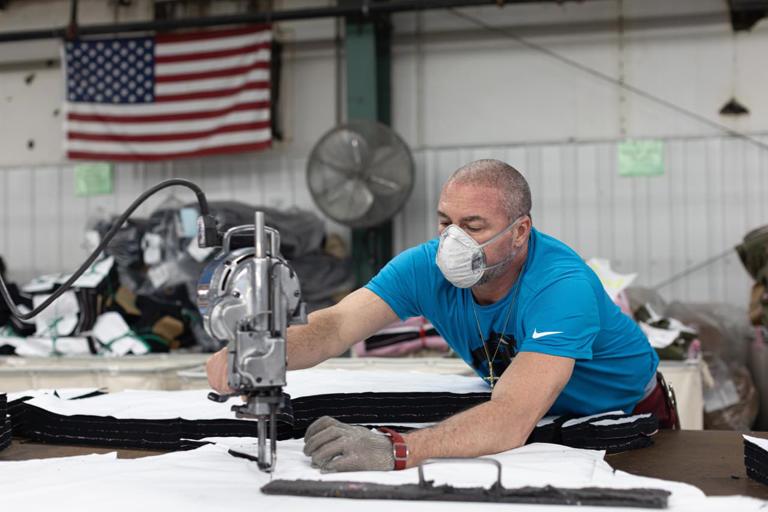
Take Walmart as an example. Recently, Walmart has launched a pure cotton T-shirt priced at 12.98 U.S. dollars.
This T-shirt is produced in the T-shirt factory under America Giants, a manufacturer in which Walmart has invested. It is reported that Walmart is working hard to build a fully local industrial chain: not only using locally grown cotton in the United States, but also completing the spinning and dyeing of yarn locally, and building a cutting and sewing factory in North Carolina.
This undoubtedly provides a new local supply chain option for influencers who want to create their own brands.
However, it is by no means easy to bring back the manufacturing industry that has been lost for many years and build a complete and mature new industrial chain.
Labor shortage and high capital cost are the realistic obstacles standing in the way.
Especially for the labor force, data shows that as of the beginning of 2025, 20.6% of factories in the United States believe that insufficient labor supply has limited their production capacity, and there is about a 50% gap in manufacturing jobs across the United States. Previously, an American talk show host said on the show: "