Who on earth is Song Xingyu, who became a global sensation with a flying skateboard?
In the movie *Fight Back to School* starring Stephen Chow, there is a plot where Chow Sing Sing insists on carrying out a mission all by himself. After Director Wang fails to dissuade him, he sighs at his back: "Young people these days are so courageous!"
Each generation has its own "courageous young people", and a video made Song Xingyu known to many people for the first time.
In the footage, a young man stands on a wheel-less, wingless hoverboard, skims low over the surface of the Yangtze River, passes through the streets of Badong County, and then turns into the Baren River Canyon. It does not look like a traditional aircraft, but more like the flying board under the feet of the "Green Goblin" in sci-fi movies. After the video was released, it went viral across all platforms, and netizens left a comment half in amazement and half in jest: "Chinese people really can fly."
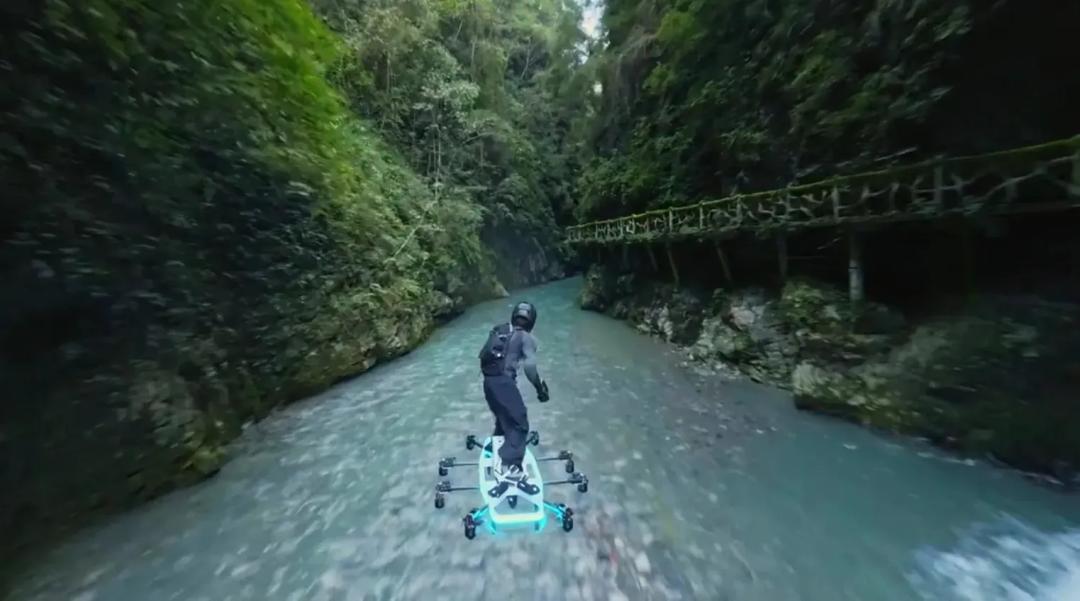
Song Xingyu, online alias "Magic Ayu", was born in 2000 in Badong, Enshi, Hubei Province. He is not a PhD from a top university, nor an engineer in a scientific research institution. After dropping out of school at the age of 14, he once worked in his father's wood workshop. Later, he taught himself mechanics, flight control and AI technology, turning seemingly impractical ideas one by one into works that can fly, land and be recorded by cameras.
A flying hoverboard made him suddenly step into the center of global traffic from a "handmade geek" in the mountains. But what is more worth exploring than his sudden fame is: Who on earth is he? How much is this hoverboard worth? Can it become a viable business? And what kind of China's innovation ecosystem does it reflect?
1.
/ From the shed lab to the sky above the Yangtze River /
Song Xingyu's starting point was not glamorous.
In his childhood memories, the earliest toy related to machinery was an old engine his father picked up from a junkyard. Crankshafts, pistons and cylinder blocks scattered in the attic became the most fascinating parts in the eyes of the teenager. Later, an old tablet computer let him watch foreign flight test programs for the first time, and the idea of flying took root ever since.
In 2022, he borrowed 19,000 yuan from his father to buy a second-hand van, and took out a loan of more than 20,000 yuan to transform his father's idle woodworking shed into his own laboratory. He did all the procedures by himself: laying wires, making workbenches and painting walls. He hung a sign marked "Ayu's Scientific Adventure" in a prominent position and started filming the transformation process. That video got 60,000 likes, and also made him confirm his direction:
Hardcore creation with the smell of soil and engine oil is his path.
In the following years, his resume was almost a "crash list".
In 2024, he spent 22 days making a remote-controlled "space shuttle", drove 2000 kilometers into the uninhabited area in northwest China, and tried to send it to an altitude of 40,000 meters with a helium balloon. Strong wind destroyed the camp, the launch rack was damaged, the separation system eventually failed, and the wreckage of the aircraft fell 600 kilometers away. Technically it was a failure, but the arc of the earth at an altitude of 40,000 meters was captured in the camera.
In November of the same year, he jumped from an altitude of 5000 meters with a self-made jet aircraft. At a speed of 340 kilometers per hour, the main parachute got stuck for a while, and the reserve parachute did not open until it was about 600 meters above the ground. Before jumping, he recorded his last words.
In 2025, the single-wing jet aircraft he spent a year and a half building stalled and crashed during a test flight, fortunately the forced landing was successful; later he welded and built a 20-ton three-story special ship in Hainan, which eventually sank into the sea due to being defrauded. To keep his promise, he refunded the cooperation fees, compensated the sponsors for their materials at a discount, and owed more than 2.4 million yuan in debt.
The turning point came in December 2025. Insta360 provided him with 1.8 million yuan in grants through its "Think Bold Challenge Fund" to pay off his debts. Insta360 emphasized that this grant is for creator support, not equity investment, and does not mean the company's layout in the flying hoverboard business.
For Song Xingyu, this sum of money is not a return on investment, but a "life-saving fund" that allows him to return to the laboratory from the edge of bankruptcy; for Insta360, it is not only a brand narrative, but also a "bold creation" story that the capital market is willing to believe in.
2.
/ The flying hoverboard is not a myth,
nor an ordinary consumer product/
The flying hoverboard that became a hit this time is already the 2.0 version.
The first generation was equipped with 5 turbojet engines, which deflagrated and caught fire during the combined test, burning all the oil circuits and circuits. He handed the test data to AI for analysis, and found that the engines were arranged too close, and the high-temperature exhaust gas was rebounded by the ground and sucked into the air inlet. AI suggested abandoning the turbojet and switching to the electric drive solution.
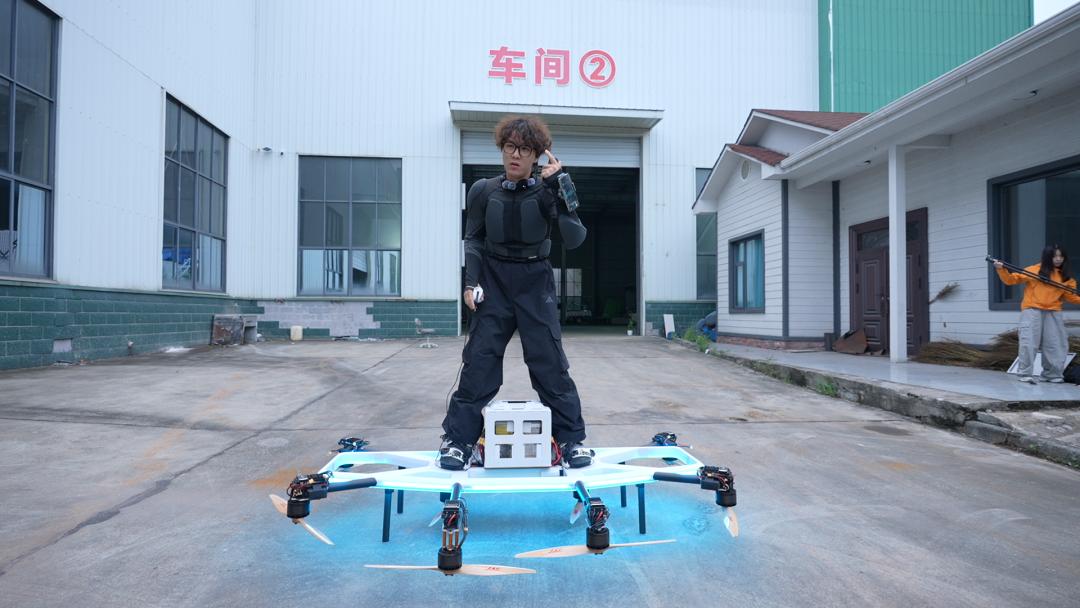
Two months later, the 2.0 version was born: 10 sets of brushless power assemblies, with a total thrust of about 300 kg, and a thrust-to-weight ratio close to 3. It is designed for a weight of 70 kg, and the throttle usage ratio has never exceeded 40% in previous public test flights. The current battery life is about 16 minutes, and the bottleneck lies in the battery discharge rate. The battery will heat up significantly after high-speed flight, and there is still remaining power when landing.
The most special part is its control logic. Song Xingyu holds two controllers in his hand: one is a self-made throttle handle, which directly controls the motor speed; the other is a finished remote controller purchased for more than 100 yuan, which only assists steering. The flight control chip does not participate in attitude control, and it is the human body itself that really maintains balance — vestibular perception, visual judgment and body attitude adjustment jointly complete the "flight control".
This explains why it is not like an ordinary drone. The human body is a flexible structure. If flight control and external remote control participate at the same time, it is easy to generate coupling oscillation; the fast maneuvering movements in the video are also difficult to achieve through ground remote control.
In response to doubts such as "fake flight" and "remote control", on October 22, Song Xingyu completed two indoor flights in front of many media reporters in a factory in Yichang, and completed a longer-distance one-shot demonstration outdoors. Hovering, turning, moving forward, landing, there was no trace of external force assistance throughout the whole process.
He emphasized repeatedly:
This is not a mass consumer product, but more close to extreme sports equipment such as wingsuits and skydiving parachutes. Ordinary people must not blindly imitate it.
3.
/ The account book of a hoverboard /
If you only look at the hardware, this flying hoverboard will hardly become a "goods-selling business" in the short term.
Its supply chain is not mysterious: batteries and motors are purchased as mature finished products, and the structural parts are designed by himself, then sent to surrounding stores for 3D printing, CNC machining and laser cutting. After the drawings are delivered, the parts can be obtained in as fast as two or three hours. This is exactly the embodiment of China's micro and small manufacturing capabilities, and individual creators can iterate at high frequency like a small R&D team.
But its commercial value does not mainly lie in the hardware selling price.
What is worth paying attention to is his IP value, with tens of millions of levels of communication across the whole network, official media reports, and attention from technology brands, Song Xingyu has become a highly recognizable hardcore technology creator. Brand sponsorship, technology co-branding, content commercial order, offline performance are all more direct monetization paths.
It can also be extended to extreme sports and cultural tourism experience. The flying hoverboard is not suitable for being sold to ordinary people, but it may become a high-end low-altitude experience project. Canyon scenic spots, flying camps, and technology exhibitions can all become its landing scenarios. However, this requires closed airspace, professional training, insurance system and strict safety standards.

What is also ignored is the value of the technical prototype. It is a niche exploration of the standing manned vertical take-off and landing aircraft, and has accumulated experience in multi-motor power matching, high-power thermal management, human body attitude perception and AI-assisted deviation correction. These experiences can be cooperated with low-altitude equipment teams, UAV enterprises or university laboratories in the future.
In addition, there is long-term imagination. If flight control, safety, battery life and regulations gradually mature, it may appear in scenarios such as emergency rescue, mountain patrol, and film and television performance. But urban commuting is not realistic, safety, airspace, noise, cost and supervision are all thresholds that are difficult to cross. Even some netizens have already started planning future application scenarios for the PLA uncles.
What is more thought-provoking is the reaction of the capital market. On October 20, 2026, the stock price of Insta360 hit a maximum of 106 yuan during the trading session, closed up 8.97% at 102 yuan, with a transaction volume of over 1.4 billion yuan. Its total market value once reached about 40.9 billion yuan, an increase of about 3.4 billion yuan compared with the previous trading day.
1.8 million yuan in grants in exchange for a 3.4 billion yuan increase in market value, which looks like a "stroke of genius" on the surface. But Insta360 soon clarified that the grant is not an equity investment. What the market really prices is not this hoverboard, but the story of "an ordinary person turning a sci-fi dream into reality".
4.
/ Who on earth is Song Xingyu?/
He is not an entrepreneur in the traditional sense, nor a typical scientist.
He is more like a new type of person appearing at the intersection of China's new manufacturing and new content, without prominent background, but he can use Taobao orders, 3D printing, AI analysis and short video platforms to quickly turn ideas into entities; without relying on large laboratories, he can complete the closed loop from design, trial and error to flight in the shed.
His growth path is full of risks. Crashes, debts, high-altitude skydiving, sunken ships at sea, these experiences are not romantic, even cruel. But he has a rare quality: he is still willing to continue investing after failure, still chooses to keep his promise under heavy debt, and remains restrained when the flood of traffic comes.
He is not in a hurry to set up a company, nor does he plan to sell flying hoverboards to ordinary people. He wants to make it safer and easier to use, and eventually turn it into extreme sports equipment; he also wants to return to his hometown Badong to build a scientific adventure base including airport runways, hangars, laboratory buildings and seaplane docks. Local officials said they are willing to support his idea.
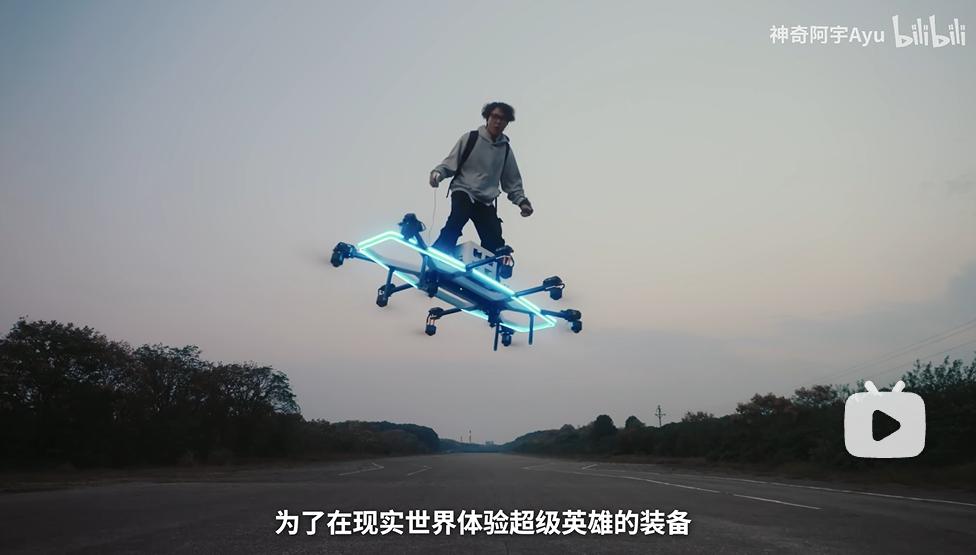
Song Xingyu said that he "first belongs to the mountains, and second belongs to the sky". This sentence sounds like a slogan, but it just summarizes the contradiction and unity on him: under his feet are soil, sheds, debts and supply chains, and in his eyes are the sky, flight, adventure and unproven future.
For a flying hoverboard, what is popular is the visual spectacle; but what is really worth remembering is how an ordinary young man pushes his childhood fantasy to the edge of reality with the help of the spillover capacity of China's manufacturing industry, the amplification effect of content platforms, and the capital's re-pricing of innovation stories.
He has not yet become a business giant in the traditional sense, and may not move towards mass production. But Song Xingyu has provided a new sample. In this era, innovation does not only happen in high-rise laboratories, and it may take off from an old shed in the mountains of western Hubei.
This article is from the WeChat Official Account "Finance Gossip Girl Channel" (ID: baguanvpindao), written by Jian Shan, and published with authorization by 36Kr.