Cambricon Q3: Profit Doubles, Market Cap Cools Down
The recently released Q3 financial report of Cambricon shows impressive performance when looking purely at profits.
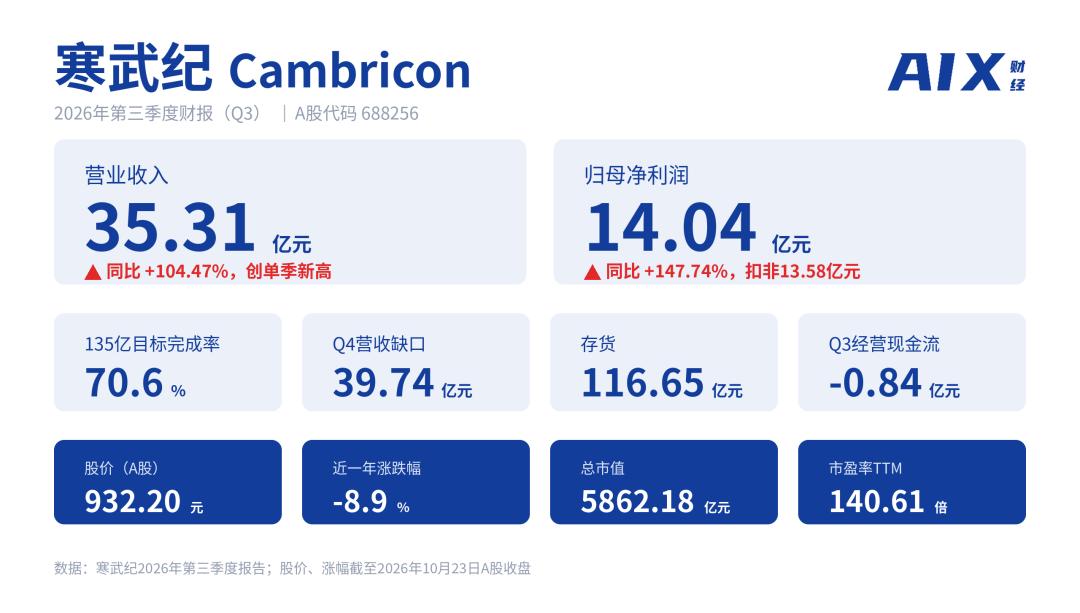
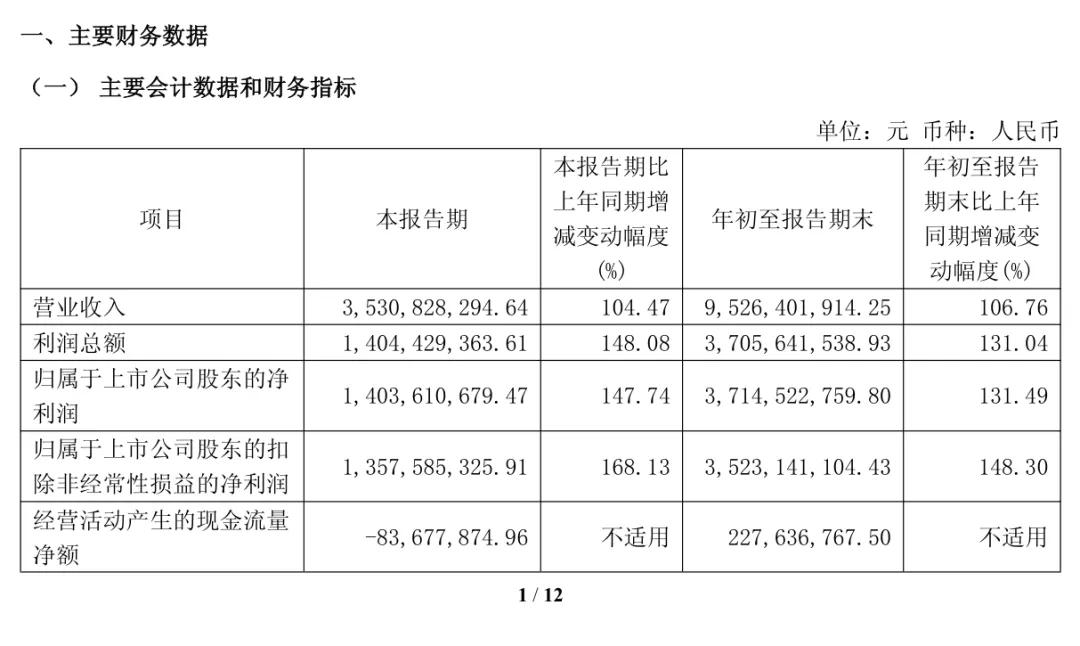
In the first three quarters, the company recorded revenue of 9.53 billion yuan, and net profit attributable to shareholders of 3.72 billion yuan. For Q3 alone, its revenue of 3.53 billion yuan doubled year-on-year; the net profit attributable to shareholders reached 1.4 billion yuan, representing a 147.7% year-on-year surge, with profit growth significantly outpacing revenue growth.
However, the current focus of the market is: how is the revenue target under the equity incentive plan progressing?
At the end of July this year, Cambricon launched an equity incentive plan covering nearly 1,000 employees, with 5 million shares to be granted, accounting for 0.80% of the company's total share capital, at a grant price of 750 yuan per share. The core threshold at the company level is revenue: 13.5 billion yuan in 2026, cumulative 40.5 billion yuan from 2026 to 2027, and cumulative 100 billion yuan from 2026 to 2028.
Cambricon has achieved 70.6% of its annual target in the first three quarters, meaning it needs to generate nearly 4 billion yuan in revenue in Q4, which is 440 million yuan higher than the record-high revenue of Q3, representing a 12.54% quarter-on-quarter growth. If we only look at this year, this target is far from unreachable.
The real test lies in the two longer-term assessment targets: if it hits 13.5 billion yuan in 2026, it will need to deliver 27 billion yuan in 2027, and 59.5 billion yuan in 2028.
On the last trading day before the release of the Q3 report, Cambricon's closing price stood at 932.2 yuan, corresponding to a total market capitalization of 586.2 billion yuan. More than three months ago, its market value once exceeded 1 trillion yuan. Calculated from the peak, the market capitalization has retreated by more than 40%, and the market has begun to reprice it. Two years ago, the market was concerned about when it would turn profitable. Now, break-even is no longer a suspense, and Cambricon needs to convince the market that it can deliver on schedule in Q4 and fulfill its revenue targets for the next three years.
With increasing capital occupation and a heavier asset model, Cambricon is increasingly moving away from being a light asset design company. What valuation it deserves has become a new problem facing investors.
01. The RMB 4 Billion Target in Q4 Rides on Delivery Capability
For Cambricon, whose revenue doubled year-on-year in the first three quarters, it is not very difficult to achieve nearly 4 billion yuan in revenue in Q4. The real difficulty lies in the fact that Cambricon's revenue recognition chain is longer than that of most chip companies.
After customers put forward computing power demands, Cambricon first needs to submit wafer orders to fabs, lock in HBM production capacity at the same time, then go through packaging and testing, transportation, deployment, optimization, and finally customer acceptance, before recognizing revenue. This chain can span one or even several quarters. How much revenue can be recognized in Q4 depends on whether the stocked goods can go through the deployment and acceptance process before the end of the year.
Therefore, Q4 is a test of execution capability for delivery.
Looking back at the first three quarters, delivery speed has increased significantly. Revenue in Q1 was close to 2.9 billion yuan, 3.11 billion yuan in Q2, and further rose to 3.53 billion yuan in Q3. To complete nearly 4 billion yuan in Q4, the delivery pace needs to continue to accelerate.
Core performance data Source / Cambricon Q3 Financial Report
The quality of profits is better than that in the half-year report. In the first three quarters, net profit attributable to shareholders was 3.72 billion yuan, with non-recurring profit and loss amounting to about 190 million yuan. The core business contributes the vast majority of profits.
Profitability is also improving, with gross margin stabilizing above 56.5%, 1.2 percentage points higher than the same period last year. At least from the perspective of gross margin, this round of growth is not achieved through price cuts.
The expense side is also optimized. The sum of sales, management and financial expenses in the first three quarters was about 200 million yuan, accounting for only 2.1% of revenue; although R&D investment reached 1.23 billion yuan, its proportion in revenue dropped to 12.9%. The expanding revenue is diluting expenses.
The pressure is more concentrated on the balance sheet and cash conversion. The net operating cash flow in the first three quarters was only 230 million yuan, of which the net outflow in Q3 alone was more than 80 million yuan. In the same period, the cash received from selling goods and providing services was 10.67 billion yuan, but the cash paid for purchasing goods and receiving services also reached 8.99 billion yuan. As revenue grows, more funds are continuously invested in stocking and production capacity.
The sum of inventory and prepayments increased by 9 billion yuan compared with the beginning of the year, and the two items now account for about two-thirds of the total assets. An investor who follows Cambricon said that the typical Fabless model should have light assets and relatively abundant cash flow, while Cambricon is now increasingly unlike a light asset design company.
There is another detail in the Q3 report: revenue in Q3 increased by 420 million yuan quarter-on-quarter, while accounts receivable increased by 720 million yuan. After revenue recognition, the pace of payment collection also needs to keep up.
The half-year report shows that the majority of inventory at the end of June was in raw materials and commissioned processing links, with finished goods inventory less than 100 million yuan; the Q3 report does not disclose the inventory structure, and what really matters next is whether these stocked goods can complete delivery, acceptance and payment collection before the end of the year.
Of course, hoarding goods also has a cost. In the first three quarters, Cambricon accrued 500 million yuan of asset impairment losses, compared with only 87 million yuan in the same period last year, an increase of more than 400 million yuan. The chip industry iterates rapidly. Once the pace of demand or product switching lags behind the stocking pace, impairment will also affect profits.
Morgan Stanley mentioned a key detail in its report on October 8: Cambricon's flagship product MLU692 has begun delivery and testing to major cloud service provider customers in Q3, and it judges that most of the revenue from this product will not be recognized until Q4. In this case, Q4 delivery includes both the conversion of previously stocked goods and the ramp-up of new products.
02. After Trillion Yuan Market Cap, the Market Recalculates Valuation
Cambricon's profits are rising, why has its market value fallen from the 1 trillion yuan peak to around 580 billion yuan?
The aforementioned investor told "Focus One" that the market is now concerned about whether profits can be sustained.
First, let's look at what Cambricon relies on to make money. In the first half of this year, 99.98% of its revenue came from the cloud product line, which includes cloud intelligent chips and boards, as well as intelligent complete machines equipped with self-developed chips. Cambricon's revenue is highly dependent on cloud computing power products.
The customer structure is also highly concentrated. In 2025, the sales from Cambricon's top five customers accounted for 88.7% of total revenue, and the customers are mainly large internet companies, operators and intelligent computing centers. The advantage of this structure is that orders can scale up quickly with strong explosive power; the downside is that performance is more sensitive to the procurement pace of a few large key customers.
Against the backdrop of restricted supply of high-end GPUs, the first procurement by large customers may be of a substitution nature; the second and third consecutive orders indicate that the product has truly entered the production system. For Cambricon, repurchase is more important than the first order, and the key to repurchase stickiness lies in the software ecosystem.
Large models are iterating every month. If every time customers switch to a new model, the operation and maintenance team has to modify the underlying software stack from scratch, the labor and time costs will be very high. The smoother the model migration and the more user-friendly the development tools are, the greater the possibility that customers will continue to make subsequent purchases.

Source / Cambricon Official Website
From this perspective, the adaptation progress disclosed in Cambricon's half-year report is very valuable. The inference software platform has completed adaptation to mainstream open-source models such as GLM, DeepSeek, Qwen, Kimi and MiniMax, and the training software platform is also promoting adaptation to series of models including DeepSeek, Qwen and Hunyuan. This is equivalent to building the scaffolding for customers in advance, lowering the deployment threshold after customers get the chips.
However, having only the ecological moat is not enough, as the competitive landscape is tightening significantly.
In terms of shipment volume, Cambricon is still a follower. According to IDC statistics, the total shipment of China's AI acceleration cards in 2025 is about 4 million units, of which NVIDIA shipped about 2.2 million units, accounting for 55% of the market as the absolute dominant player; domestic manufacturers shipped a total of about 1.65 million units, accounting for 41%. In the domestic camp, Huawei ranks first with about 812,000 units shipped; Alibaba's T-Head shipped about 265,000 units; Kunlunxin and Cambricon each shipped about 116,000 units. Cambricon accounts for about 3% of the overall market share, and about 7% among domestic manufacturers.
Then why was the market willing to give it a trillion-yuan valuation before? Because in the capital market, Cambricon is a special case. It is one of the few companies that focus on cloud AI chips and have achieved scalable revenue and consecutive quarterly profitability. Its Siyuan series products have also entered large-scale commercial deployment in core industries such as the internet sector.
The aforementioned investor said that this first-mover advantage in commercialization is more difficult to replicate than a simple lead in chip parameters. Once large customers migrate their business systems over, latecomers will need to pay higher adaptation and verification costs to poach these customers.
But this window of opportunity will not last long. If latecomers have better performance, better software compatibility and more competitive prices, large companies have no reason to tie themselves to a single supplier.
Morgan Stanley predicts that China's self-sufficiency rate in AI chips will rise from 35% in 2025 to 68% in 2027, and reach 95% in 2030. This forecast is very aggressive, but it also shows one point: a large number of domestic chip companies will enter the market in the next few years. The market pie is growing, but more players are coming to grab a share. After companies such as Moore Threads, Muxi and Enflame go public, Cambricon will inevitably be frequently compared with them, and its scarcity premium will naturally be diluted.
Therefore, the market capitalization does not necessarily rise along with profits. The key is whether the current profit growth can fulfill the previously extremely optimistic expectations of the market.
When Cambricon's market value hit 1 trillion yuan, the market was looking at the long-term imagination space for 2027 and 2028. On October 8, Morgan Stanley raised Cambricon's target price from 1408 yuan to 1700 yuan, and also shifted its research focus to the new product volume ramp-up after 2027.
Now the market has cooled down, shifting its focus from 2027 back to 2026, and paying more attention to one point: Profits have come out first, can cash flow, repurchase and market share keep up?
Cambricon is currently going through a critical stage. In the first half of the game, it pushed its market capitalization to 1 trillion yuan with continuously doubling revenue and profits. In the second half, the market will focus on both growth and profit quality. Only when the repurchase from large customers, cash collection and market share are all verified, will the market be willing to pay for the next trillion-yuan growth story.
*The cover image is from Cambricon official website.
This article is from WeChat Official Account "AIX Finance", written by AIX Finance Team, published with authorization from 36Kr.