The "no-heartburn" short drama company is about to go public.
An AI short drama platform is about to go public just over two years after its launch.
According to news on October 21, South Korean AI short drama platform Korai Flix plans to list on the New York Stock Exchange by merging with US shell company APEX Tech Acquisition. According to the agreement reached by both parties, the pre-merger equity valuation of Korai Flix in this transaction is 3.5 billion US dollars, equivalent to about 23.4 billion RMB.
Although Korai Flix claims to have 26 million registered users, this announcement did not disclose core financial data such as revenue and profit, and there is no clear introduction to who the founder is. More detailed information will have to wait for the S-4 registration document that the company will submit to the SEC subsequently.
It is hard to tell now whether the 3.5 billion US dollar valuation is reasonable, but Korai Flix has indeed caught a good opportunity.
In the past two years, AI video generation technology has iterated rapidly, and short dramas have also become popular from China to overseas. In China, video generation tools such as Keling and Jimeng are constantly launching new products, and the short drama The Laid-off Girl has gained hundreds of millions of views. Even the line "It is a bit expensive, but it does not cause heartburn after eating" has become a viral meme across the entire network. Overseas, platforms such as DramaBox, ReelShort and South Korea's Vigloo are also accelerating their competition for the market.
According to the forecast of DataEye Research Institute, the overseas micro-short drama market will exceed 6 billion US dollars in 2026, among which AI dramas and comic dramas are expected to account for nearly 70%. The market is getting hotter and hotter, so a platform that has been online for more than two years has stood at the gate of the capital market.
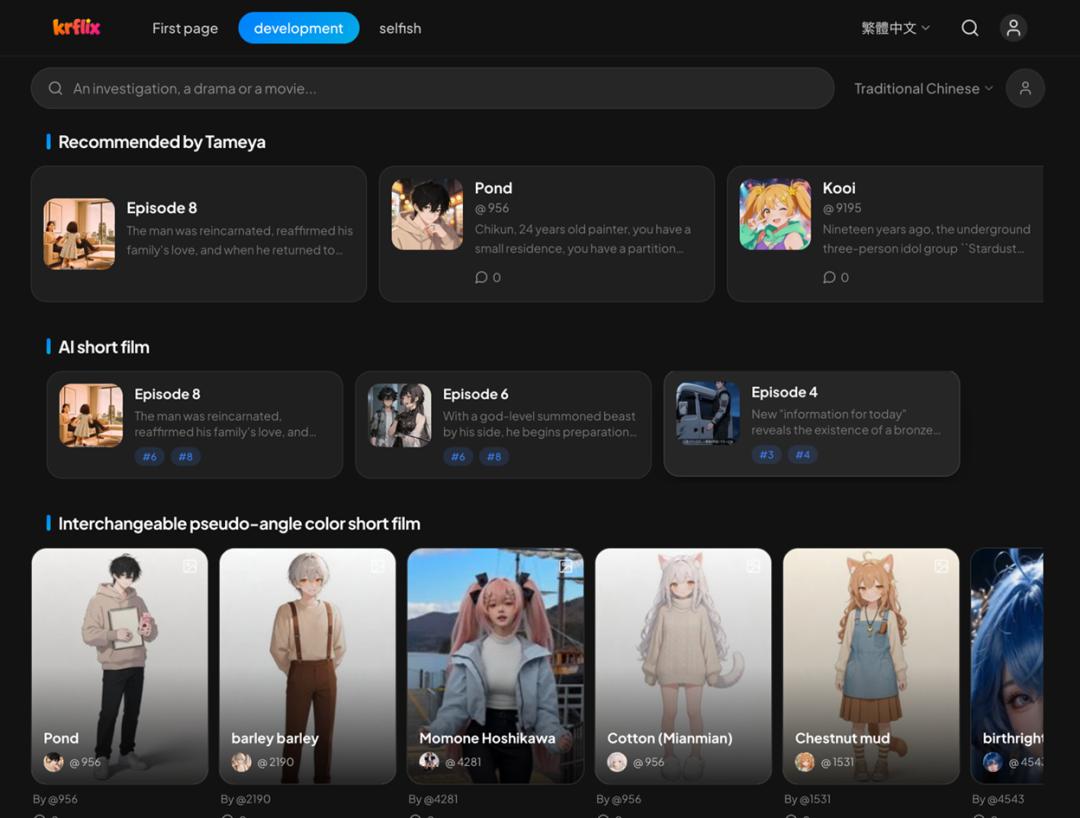
Korai Flix
Launched for 2 years, valued at 23.4 billion RMB
Korai Flix was launched in June 2024, focusing on AI short dramas, AI virtual companionship and video creation tools. Users can not only follow dramas on the platform, but also use AI to make videos and interact with virtual characters. As of June 30 this year, the company said it has about 26 million registered users in 15 Asian countries and regions including India, Indonesia, the Philippines and Japan.
With less than two years of operation, Korai Flix is planning to go public. According to the plan, it will merge with the US shell company APEX Tech Acquisition, and the transaction is expected to be completed in the first quarter of 2027. The merged listed company will be renamed Krflix Group.
This transaction follows the SPAC model — "go public first, then find a target company". The shell company raises funds through IPO first, then finds an unlisted enterprise to merge, so that the target can obtain public listing status. For the target company, this path to listing may be faster; for the sponsors of the shell company, after the merger is completed, they also have the opportunity to profit by holding shares of the new company.
The background of this shell company is also very interesting.
According to the SEC prospectus, APEX is wholly owned by Chinese citizen Shaoren Liu. He served as the chairman of a Dalian Wafangdian precision bearing manufacturing enterprise from March 2020 to July 2025, and is currently the chairman and chief financial officer of APEX.
In July this year, APEX welcomed its new CEO Florence Ng. She previously served as Chief Operating Officer of US-listed company Mega Matrix, which happens to operate the overseas short drama platform FlexTV.
According to SEC documents, APEX went public in February this year, raising a total of about 112 million US dollars through IPO. However, Korai Flix's pre-transaction valuation is as high as 3.5 billion US dollars. Why is there such a big gap?
According to the agreement, Korai's original shareholders will receive shares of the merged company valued at 3.5 billion US dollars in total at a price of 10 US dollars per share, about 350 million shares. In other words, this is the equity valuation negotiated by both parties, not that APEX acquired Korai for 3.5 billion US dollars in cash, nor that Korai raised 3.5 billion US dollars in financing.
The agreement also designs two classes of shares: Class A shares have 1 vote per share, and Class B shares have 20 votes per share, which facilitates high-voting shareholders to maintain control. At the same time, this transaction has no minimum cash condition. APEX's public shareholders can redeem their shares before the merger to get back the corresponding funds. The more people redeem, the less cash will be left for the merged company. However, since the agreement does not set a minimum cash condition, even if the remaining cash shrinks significantly, the transaction will not fail just for this reason.
Of course, there are still thresholds for listing. The agreement requires that in the most recent quarter before the closing, the combined net assets of the Korai-related operating companies shall not be less than 100 million US dollars, the number of registered users on the platform shall not be less than 20 million, and the number of users shall be verified by both parties. The transaction is expected to be completed in the first quarter of 2027 and is still subject to obtaining necessary approvals.
How did AI short dramas become a big business?
Two years ago, AI short dramas were still a novelty.
In 2024, video generation products such as Keling and Jimeng were launched one after another, and China Central Television also released the AI micro-short drama Chinese Myths. At that time, what everyone cared most about was whether AI could make characters and scenes realistic, and whether the pictures could be coherent. As for whether the plot was good-looking, it was not that important.
By 2025, AI comic dramas became popular first.
Compared with live-action simulated dramas, the animation style is more tolerant of the flaws of AI-generated images, and online novels provide a large number of ready-made stories. As platforms such as Hongguo and Douyin increase their content support, production teams began to adapt these stories in batches.
Entering 2026, the popularity of AI short dramas has risen to a new level.
In March this year, the AI short film Huo Qubing produced by director Yang Hanhan suddenly became a hit across social media. "3 people, 48 hours, 3,000 yuan cost, 80 episodes of short drama, 500 million views" — a series of amazing figures sparked heated discussions.
However, this "low-cost myth" of AI short dramas was soon questioned. Later, Yang Hanhan publicly clarified that the works released at that time only had two versions of more than 4 minutes and 6 minutes, the 3,000 yuan was only the computing power cost, excluding labor and other expenses, and the 500 million views had not been accurately verified.
Although these figures were exaggerated and misrepresented, Huo Qubing still attracted widespread attention.
In the summer of this year, the AI short drama The Laid-off Girl directed by Feifeifei became a hit.
The story revolves around a small-town girl named Fang Taozi. She came to a big city to pursue her dream of being a model, but because she was too outstanding, she was cut out from the group photo by her peers. After that, she step by step broke into the fashion circle she had longed for. By mid-August, the total views of the drama had exceeded 360 million.
What is more interesting is that Fang Taozi even has her own social media account, and has even started to take advertising orders. This AI actor that does not exist in reality has gradually gained attention independent of the short drama. The audience began to remember the character, and even paid attention to her like following a real celebrity.
At the same time, another group of AI comic dramas became popular — they relied not on characters, but on a recurring line.
"It is a bit expensive, but it does not cause heartburn after eating."
This line comes from a batch of food business-themed AI comic dramas that are popular on platforms such as Hongguo and Douyin recently, all telling similar stories: the protagonist runs a steamed stuffed bun shop or a box lunch stall, insists on using high-quality ingredients, but is robbed of business by peers competing at low prices. It is not until the competitors get into trouble due to ingredient problems that customers come back, sighing that "the food does not cause heartburn".
The same plot is repeatedly copied, but netizens find it more and more funny. While complaining about the routine, they edit and imitate, and finally turn "no heartburn" into a viral meme across the entire network.
From Fang Taozi to "no heartburn", the popularity of short dramas has gone beyond the main content, extending to character accounts, internet memes and netizens' secondary creations.
Although there are more and more forms of dissemination, it does not mean that every work can be seen by the audience.
According to statistics from DataEye Research Institute, in the first half of 2026, 221,900 AI dramas and comic dramas were launched on Douyin alone, of which only 1,055 had more than 100 million views, accounting for 0.48%.
However, the traffic of head works is quite staggering. The 3D comic drama Exiled to the Border, The Criminal Wife Opens Up Wasteland and Raises a War God added 2.127 billion new views on Douyin in June alone.
More than 220,000 works are competing for audiences, and only a few of them stand out. With domestic competition becoming increasingly fierce, AI short dramas have also begun to accelerate their expansion overseas.
In fact, in the past few years, the overseas distribution of Chinese short dramas has nurtured a number of mature distribution platforms, including DramaBox, ReelShort, NetShort, etc. Now, AI dramas and comic dramas have also begun to reach overseas audiences through these channels.
According to statistics from DataEye Research Institute, in the top 100 popular overseas short drama placement materials in the first quarter of 2026, the proportion of AI dramas and comic dramas rose from 2% in January to 16% in March. VibeShort, an AI short drama platform launched in February this year, entered the top 20 of the overseas short drama APP in-app purchase revenue list in just a few months.
However, the place with the largest number of downloads in the overseas short drama market is not necessarily the most profitable place.
According to DataEye statistics, in the first half of this year, India, Indonesia and Brazil ranked the top three in the number of overseas short drama APP downloads, contributing more than half of the total downloads; but the three markets with the highest in-app purchase revenue are still the United States, Japan and Canada, accounting for more than 40% in total. However, these rankings count the entire short drama industry, including live-action short dramas, and cannot directly represent the market distribution of AI short dramas.
For the newly emerging AI short dramas, there are already ready-made distribution channels overseas, but whether they can attract audiences and make them keep paying still needs to be verified.
Bubble or gold mine, who can make money?
As more and more AI short dramas are produced, several major domestic platforms have also begun to re-calculate their accounts.
First of all, different platforms have produced different types of hit works.
At present, Hongguo, Douyin, Kuaishou and other platforms are important distribution channels for domestic AI short dramas. Tencent also launched the Huolong Comic Drama APP this year, and WeChat launched the "Green Bubble Short Drama" mini-program.
However, obvious differences have appeared in the popular content of each platform.
According to the September 2026 list released by DataEye Research Institute, the top 100 popular AI dramas and comic dramas on Hongguo are all 3D comic dramas, while among the top 100 popular dramas on Douyin, there are 57 AI live-action simulated dramas and 43 3D comic dramas.
Although the evaluation indicators of the two lists are different, this difference is worth noting: even for the same AI short drama, content that is popular on one platform may not achieve the same effect on another platform. In addition to thinking about how to shoot the story, production teams also need to consider where the work is suitable for broadcast.
Second, Hongguo has begun to redistribute subsidies.
In September this year, Hongguo adjusted its incentive policy for high-quality AI dramas, canceled the additional incentive coefficient for series dramas, and the new regulation will be implemented in October. Sequels can still get rewards, but they no longer enjoy additional bonuses just because they are part of a series.
In October, Hongguo also announced that it will phase out the user gold coin reward function: it will no longer be open to new users from November 1, and is planned to be fully offline by the end of the year.
This adjustment is for the entire short drama platform, not specifically for AI short dramas. But looking at several changes together, we can find a trend: Hongguo is adjusting the subsidy methods for attracting users and supporting content production at the same time.
In the past, platforms needed to use rewards to attract more people to watch dramas and more people to make dramas. Now, some subsidies are being withdrawn, and how many audiences the work itself can attract may further increase its impact on the income of production teams.
Third, works are becoming easier to replicate, and the value of mature IPs has begun to emerge.
According to DataEye statistics, among the top 30 popular AI dramas and comic dramas on Hongguo in the first half of 2026, 19 are adapted from existing online novel IPs.
Popular stories can also launch sequels continuously. According to DataEye statistics, a total of 500 AI dramas and comic dramas appeared on the Hongguo list in September, among which 15 works from season 23 to season 37 of Who Says You Can't Cultivate Immortality Without Spiritual Root? No Spiritual Root Proves the Dao were on the list at the same time.
However, serialization allows a story to continuously produce new content and accumulate traffic, but it does not guarantee that every sequel will become a hit. Hongguo's cancellation of additional rewards for series dramas also makes this model that relies on a large number of sequels to obtain extra income face adjustment.
Companies in the industrial chain are also looking for their own profit methods. Keling provides video generation tools, content companies develop IPs, platforms such as Hongguo master distribution channels, and Korai Flix tries to combine AI short dramas with virtual companionship.
Korai's idea is also worthy of attention: if the audience is willing to continue to interact with the virtual character after watching the drama, the platform will have the opportunity to extend the user's usage time and explore continuous payment. However, there is not enough data to prove how much revenue 26 million registered users can generate at present.
AI makes short dramas easier and easier to produce, but no matter selling tools, making content, or operating platforms, you can't avoid a final question: who is willing to pay for it, and how long can they keep paying?
Conclusion
From being complained about as "vulgar" to the actors not needing to be real people, the short drama business is changing so fast, and the capital market has also become lively.
Now, South Korea's Korai Flix plans to hit the US stock market with a valuation of 3.5 billion US dollars, and Chinese video generation enterprises such as Keling AI, Shengshu Technology, and Aishi Technology have also successively spread the news of applying for listing in Hong Kong.
The A-share market is also bustling. Decai Co., Ltd., which is mainly engaged in architectural decoration business, saw its stock price rise with three daily limits in four days because it is related to the AI comic drama concept. But the company later announced that its holding subsidiary Qixiang Infinite, which is involved in related businesses, achieved a revenue of 24.57 million yuan in the first half of the year and still lost 5.62 million yuan, with limited impact on the performance of the listed company.
Capital has begun to price the AI short drama industry chain. Stories can be shot by AI, and valuations can be negotiated first, but in the end, whether you can make money depends on the actual books.