Embodied intelligence investors are collectively "losing money"
Embodied AI is arguably the most hyped track that has captivated investors this year.
Data from IT Juzi shows that in the first half of 2026, 312 financing deals for embodied AI were closed in China, exceeding the 227 deals for large models and ranking first among all AI sub-sectors.
While primary market investors are still scrambling to grab projects, early-entry institutions have already started losing money in the Hong Kong stock market.
This year, 13 robotics enterprises have gone public in Hong Kong, 8 of which are trading below their IPO offer prices. Cornerstone investors of 10 of these companies have invested a total of HK$4.861 billion, with a theoretical net floating loss of HK$855 million at present.
What is more frustrating is that their shares are locked up for half a year, leaving them no way to exit even if they want to.
VCs that entered the market even earlier are not faring any better. The median book return per share from the last round of financing for the 12 companies stands at only 70.4%. Under the current market conditions, losing money is a high-probability outcome.
Worse still, even after the lock-up period ends, these investors may not be able to sell their shares. The market value of institutional holdings in the 13 companies is conservatively estimated to exceed HK$20.9 billion, and 8 of them have an average daily trading volume of less than HK$20 million.
Assuming that institutions sell 20% of the market trading volume per day, static calculations based on current trading volume show that the median time required for all these institutions to fully liquidate their positions is as long as two years!
This has led to a satirical scene in the embodied AI sector: primary market investors are still competing to pour money in, while those who invested in earlier listed enterprises are worrying about how to get their money back.
This capital feast is gradually turning into a long and difficult exit dilemma.
Cornerstone Investors Become the Bagholders
In this round of robotics IPOs, cornerstone investors are the first group to get a harsh lesson from the market.
What is the original purpose of cornerstone investors? To endorse the issuance and stabilize the market. Theoretically, they are the first to get shares and enjoy the safest position. But for these robotics stocks, cornerstone investors have ended up being the last ones to hold the bag.
Since the beginning of this year, 13 robotics enterprises have listed in Hong Kong, 8 of which have broken their offer prices. 10 of them introduced cornerstone investors, who invested a total of HK$4.861 billion. Based on the latest stock prices, their theoretical net floating loss reaches HK$855 million — 20% of their principal has vanished.
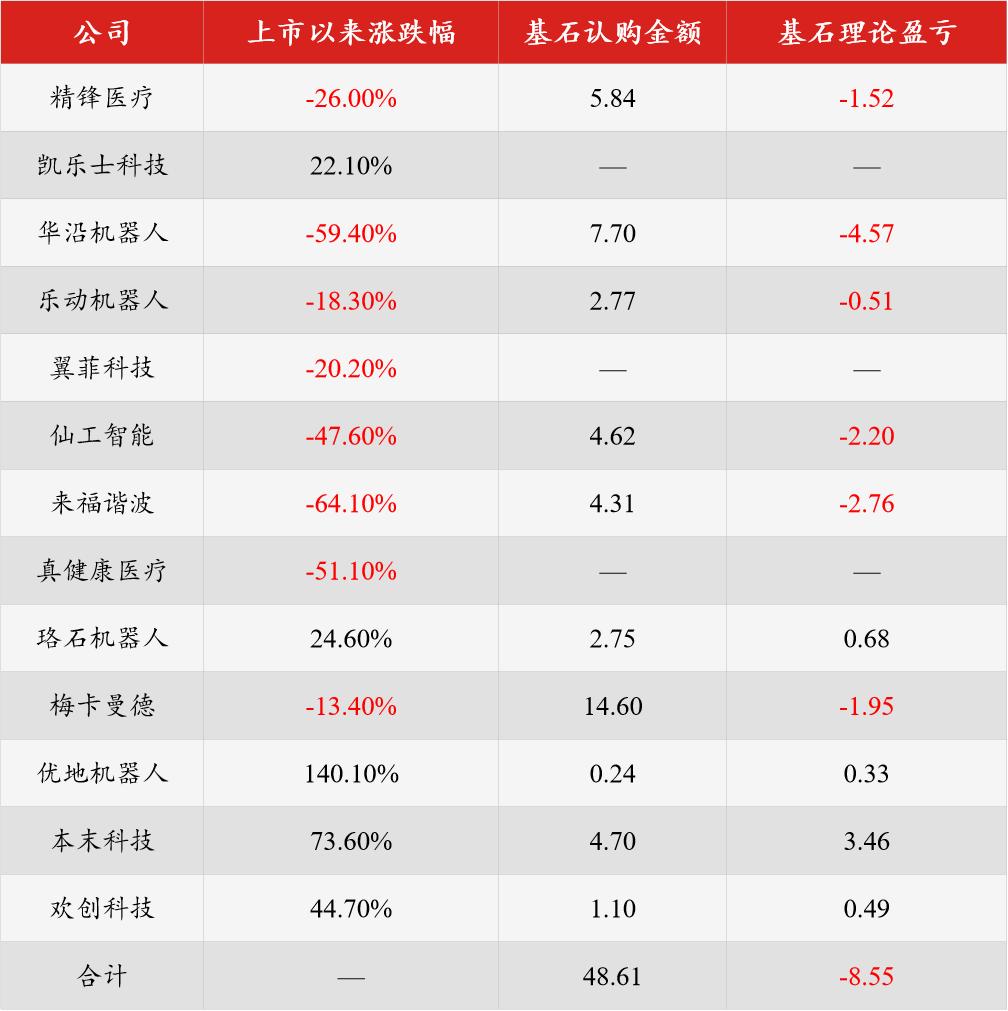
The most typical example is Laifu Harmonic. It went public at an offer price of HK$85.50 on June 30 this year, with 10 cornerstone investors including Oaktree Capital, Alphahill Capital, and Harvest International subscribing for a total of HK$431 million.
In less than four months, its stock price fell to HK$30.72, a drop of 64.1%. Calculated at this price, the total floating loss of the 10 cornerstone investors is about HK$276 million. For every HK$100 they invested, only HK$36 is left now.
Six months ago, they were invited to boost the market sentiment, but six months later, they found themselves trapped at the peak of the price plunge.
Worse still, most cornerstone investors do not even have a chance to stop their losses. According to subscription agreements, cornerstone investors of Hong Kong IPOs usually have to accept a 6-month lock-up period, and UDI Robotics even has a 9-month lock-up period.
As of October 20, among the 10 companies with cornerstone investors, only Jingfeng Medical and Huayan Robotics have lifted their share lock-up restrictions.
Yet lifting the lock-up does not necessarily mean relief. The two companies that have unlocked their shares have presented a harsh reality.
Jingfeng Medical develops the domestic version of the Da Vinci surgical robot. The company went public on January 8 this year at an offer price of HK$43.24, with 14 cornerstone subscriptions totaling HK$584 million, including the Abu Dhabi Investment Authority and OrbiMed.
When its shares became tradable on July 9, the stock price was only HK$39.92, resulting in a floating loss of HK$44.8 million. More than three months later, on October 20, the stock price fell to HK$31.98, and the floating loss expanded to HK$152 million.
The situation of Huayan Robotics is even more severe.
On March 30 this year, the company listed at HK$17 per share, with 9 cornerstone subscriptions totaling HK$770 million. GL Ventures-related entity HHLRA and GF Fund each contributed HK$235 million.
On the day the lock-up was lifted on September 30, the stock price stood at HK$8.25, down 51.5% from the offer price, with a floating loss of HK$396 million. By October 20, the stock price was HK$6.90, and the entire cornerstone group had a total floating loss of HK$457 million.
The two companies have lost a combined HK$609 million.
Of course, what is even more uncomfortable may be those institutions that are still making profits for now.
Among the remaining 8 companies that have not yet lifted their lock-up restrictions, the cornerstone investors of 4 have already recorded floating losses. The other 4, namely Luoshi, UDI, Benmo, and Huanchuang, still have book profits, but they may not be able to laugh to the end.
The most typical of the remaining 4 is Huanchuang Technology. It went public on September 30 at an offer price of HK$58.85, with its intraday peak price hitting HK$215.20 on the first day, up 266%. 20 days later, the stock price was HK$85.15, down 60.4% from the peak, and 83% of the maximum book floating profit had been wiped out. The most embarrassing thing is that Huanchuang Technology's cornerstone investors still have five months to go before their lock-up period ends.
Those who can sell have already lost money, and those who cannot sell can only watch their account value shrink. This is the current situation of cornerstone investors.
VC Returns Are As Thin As Paper, Book Return At IPO Round Is Only 70.4%
VCs that entered the market before the IPO are slightly better than cornerstone investors, as they still have book profits on their books.
Excluding Jingfeng Medical whose cost is difficult to calculate, the median book return per share corresponding to the last round of financing of the remaining 12 companies is 70.4%.
That sounds acceptable. But this arithmetic result cannot withstand scrutiny. At this rate of return, if the stock price drops by another 41%, all profits will be wiped out.
In the current robotics sector, a 40% drop is not even considered an extreme market condition. Yifei Technology's stock price fell by 62.3% only 43 days after its listing; Kailesh Technology is even more extreme, with its stock price dropping by 50.1% in just 19 days.
In other words, under the current market conditions, a robotics company only needs one or two months to completely erase all the book gains accumulated by VCs over the past few years.
What's more, these institutions still have to face continued share lock-up restrictions.
Compared with the usual 6-month lock-up period for cornerstone investors, shares held by institutional pre-IPO shareholders generally need to be locked for one year. After part of the shares are unlocked, there are still procedures such as H-share conversion to go through.
Even for Jingfeng Medical, the earliest listed company among this batch, the general lock-up restriction on relevant institutional shares will not be lifted until January 9, 2027, which is nearly three months away from October 20.
This means that by the time they can actually sell their shares, it is a high probability event that these VCs participating in the pre-IPO round of financing will end up losing money.
This is not the most troublesome problem. Compared with the falling stock price, there is a more thorny issue: even after surviving the lock-up period, the market may not have enough capital to take over the shares.
According to institutional position data, the lower limit of the market value of shares held by investment institutions in the 13 robotics enterprises has reached HK$20.955 billion.
What does that mean? This is equivalent to 4.3 times the total principal of the cornerstone investors of the first 10 companies. If these institutions seek to exit in a concentrated manner in the future, it means that more than HK$20 billion of potential sell orders will need to be gradually digested by the secondary market.
But the liquidity of the Hong Kong stock robotics sector is simply not enough to absorb these potential sell-offs.
8 of the 13 companies have an average daily trading volume of less than HK$20 million in the past 20 trading days.
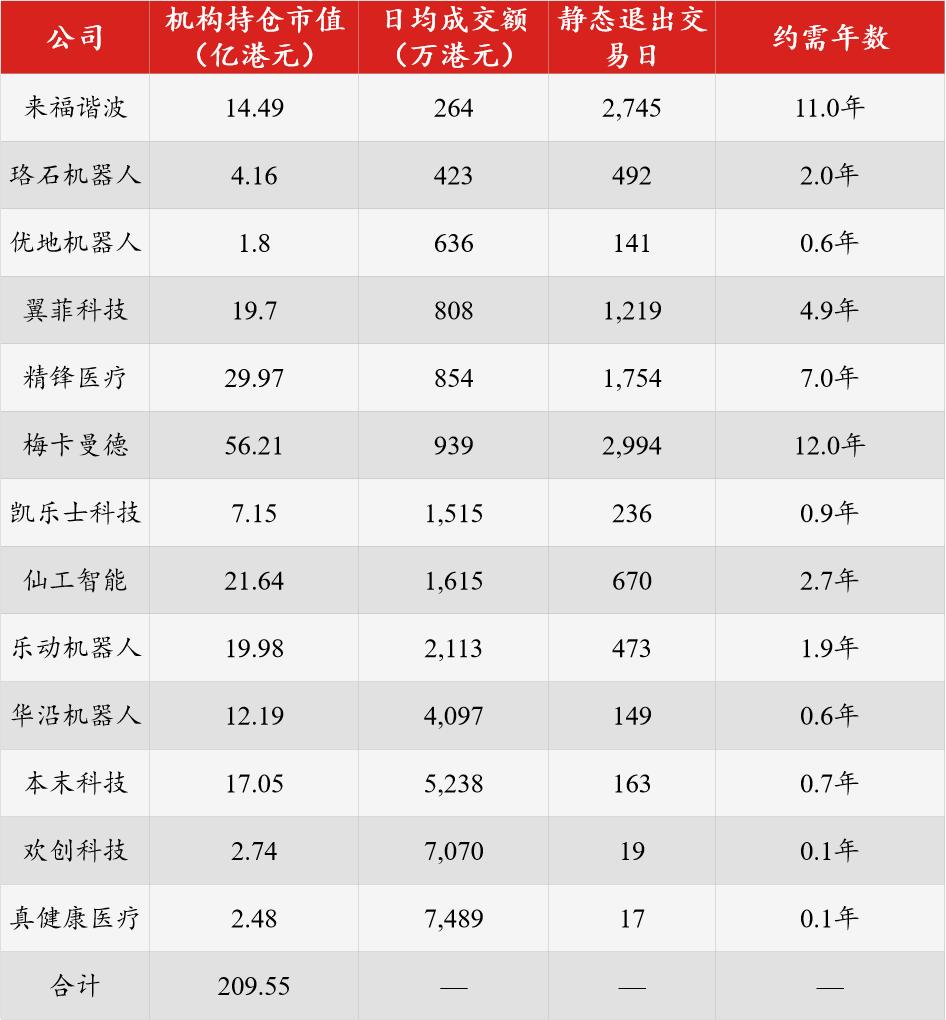
Assuming that institutions sell 20% of the market trading volume per day, static calculations based on current stock prices and trading volume show that the median time required for all these institutional holdings to be sold out reaches 473 trading days.
A full two years!
Note that this is only an idealized calculation: it assumes that the stock price and trading volume remain unchanged, and institutions can stably sell stocks equivalent to 20% of the market trading volume every day.
In reality, large-scale continuous selling is very likely to further push down the stock price.
Mech-Mind is a fairly representative example. At present, the verified market value of institutional holdings in Mech-Mind is about HK$5.621 billion.
But its average daily trading volume in the past 20 trading days is only HK$9.39 million.
In other words, the institutional shareholders of one single company hold stocks worth HK$5.6 billion, while the entire market trades less than HK$10 million a day.
Calculated based on the 20% share of trading volume, these institutions can only sell a total of about HK$1.88 million per day. At this rate, how long will it take to sell out the HK$5.621 billion position? 2994 trading days.
Calculated on the basis of 250 trading days per year, it is close to a full 12 years.
What does 12 years mean? The duration of a domestic RMB fund is usually "7+2", which lasts at most more than 10 years. That means by the time all these shares are sold, the fund may have already been liquidated.
What is more cruel is that before the old exit pressure is digested, new stock supply keeps pouring into the market.
At present, 16 robotics concept enterprises have publicly submitted listing applications to the Hong Kong Stock Exchange, 9 of which are related to robot bodies or mobile robots.
Star enterprises such as Agibot, Galaxy Universal, and Ex Dynamix have also successively released news of their planned listings.
This means that the Hong Kong stock robotics sector is likely to face an even more intensive IPO wave in the future.
On the one hand, hundreds of billions of Hong Kong dollars worth of institutional holdings behind listed robotics enterprises are waiting to exit; on the other hand, more high-valued robotics companies are competing to go public to continue raising funds from the secondary market.
All of them are ultimately competing for capital from the same market.
When the primary market pushes the valuations of robotics companies to a height that the secondary market cannot bear, someone will eventually have to bear the price difference. Now it seems that cornerstone investors have paid the price first, and those VCs who still hold large amounts of book profits are also starting to face the same test.
How much real money this robotics capital feast can finally leave behind may only be clearly calculated when all investors have truly exited the market.
This article is from WeChat Official Account "Silicon-based Observation Pro", written by Yuanyuan, authorized for release by 36Kr.