The Computing Power Battlefield Behind AI Terminal Innovation
The annual Consumer Electronics Innovation Conference (CEIC) was held in Shenzhen as scheduled. This year, embodied intelligent robots have become a new variable at the exhibition.
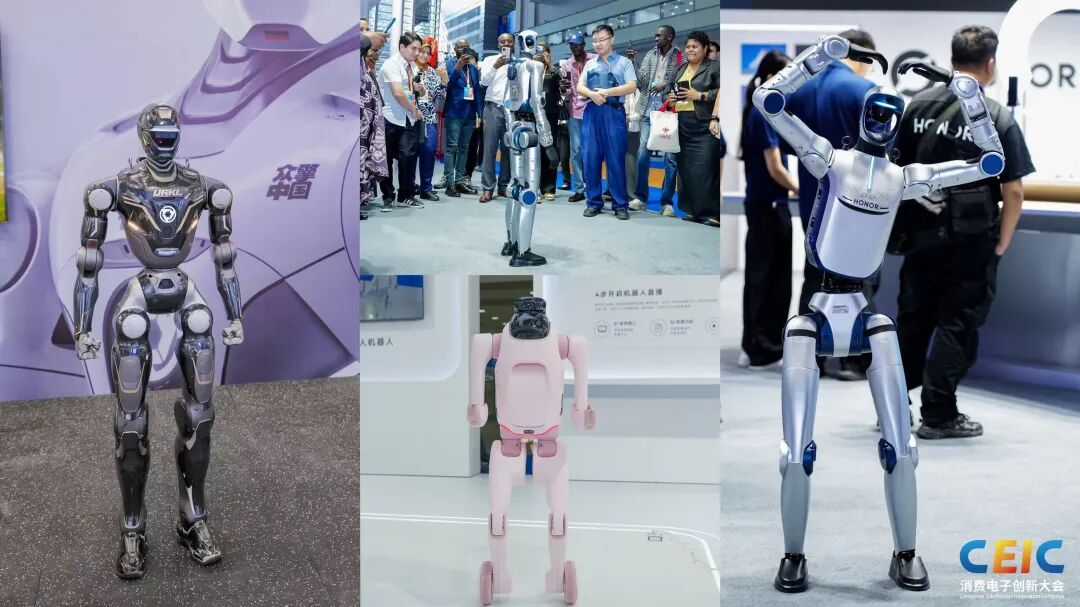
Compared with the past, the connection between these robots in instruction understanding, environment perception and action execution is much tighter, and their capabilities have gradually extended from completing a single action to handling multi-step tasks that may change at any time.
Behind these capabilities is the computing support that runs through the whole process of the task. After the robot receives the instruction, the on-board software can deliver the instruction and on-site information to the edge or cloud server for planning according to the established division of labor; when the cloud receives the request, multiple computing chips in the super node start to run the planning model collaboratively to generate the operation scheme; then the robot executes the actions according to the returned operation plan.
From task processing on the terminal to model computing on the server, and then to power supply and heat dissipation in the computer room, all links operate in coordination in this way, jointly supporting the diverse new capabilities of AI terminals at CEIC.
Computing power has undoubtedly become the core topic of the AI industry. By disassembling the computing power deployment and calculation process behind the terminal capabilities, it can be found that the previous isolated performance indicators and the actual experience brought by the terminal to users also involve systematic system design and deployment choices. How the terminal and the back-end divide the work, how computing resources are organized, and how different links cooperate all affect what an AI function can finally achieve and at what cost it can be continuously provided.
Around how to convert computing power into product capabilities, another competition behind AI terminal innovation is underway.
Computing Scheduling Takes the Lead in Response, Cloud-Edge-End Collaboration Returns to the Spotlight
After an AI terminal receives a task, task parsing and computing scheduling are started first. The system will first decompose the task by combining user instructions and on-site perception information, and then assign different links to the local terminal, edge device or cloud server according to response speed, computing load and network conditions.
Taking the task instruction of tidying up the desktop as an example, the camera and sensors of the embodied intelligent robot will continuously obtain information on the desktop, and the system will understand the specific meaning of the task, judge the placement positions of different items, and arrange the sequence of grasping and moving at the same time.
These calculations have different requirements for response speed and resources. Identifying user intentions and planning a series of operation steps may require running a large-scale model with relatively higher computing load; after the robotic arm extends out, the adjustment of position, force and collision risk needs to be completed in time based on the latest perception information, which cannot afford long network waiting.
Therefore, the more common computing division method for embodied intelligent robots is that calculations with high response requirements such as motion control and safety obstacle avoidance are kept locally on the robot; task understanding and complex planning that require strong model capabilities can be assigned to edge devices or cloud servers. After the calculation results are returned, the local control system of the robot converts them into specific actions of the joints and the robotic arm.
These computing divisions are usually determined at the stage of product design and model deployment. When the robot enters the actual operation process, the scheduler will send corresponding requests to different locations according to the established rules, network status and task requirements.
MIAO Fuyou, CTO of the Secretariat of the Global Computing Alliance (GCC), told 36Kr that this set of intelligent collaborative division of labor between cloud, edge and end has been discussed as early as the early stage of cloud computing development, when the main expectation was to improve response by shortening the communication distance. Today, the tasks that AI terminals need to process are more complex, and resource utilization, energy consumption and cost have also become important reasons for enterprises to rearrange computing division of labor.
In this context, the "Top 10 Global Computing Power Trends 2027" released by GCC during the CEIC conference also listed "cloud-edge-end global collaborative intelligence" as one of the top ten trends.
MIAO Fuyou took household robots as an example to further explain the change of cloud-edge-end collaboration to the computing power configuration method.
He said that when a robot plans complex tasks, it may temporarily require high computing power, but after entering repetitive operations, the computing demand will drop; when there is no task, high-performance chips may even be idle for a long time. If each robot is configured with local hardware according to the peak demand, enterprises and consumers will have to bear the cost for resources that are not used frequently. Placing part of complex computing in the cloud and allowing multiple devices to share computing resources can reduce the hardware burden of a single terminal.
In the factory scenario, computing may be deployed closer to the robot. When multiple devices work in a centralized manner, the edge server near the workshop can be shared by multiple robots, and can also reduce the time required for requests to be transmitted to the remote data center, which is more suitable for undertaking some tasks that require fast response but cannot be completed independently by local devices.
It can be seen from this that the computing scheduling between cloud, edge and end is a key link for AI terminals to convert model capabilities into product experience. Where the task is completed and which resources undertake it directly affect the response speed, battery life performance and service cost of the terminal.
However, MIAO Fuyou also admitted that such deployment puts higher requirements on the model design and engineering development of terminal enterprises. At present, the GCC Embodied Intelligence Industry Development Committee is researching the cloud-edge-end collaborative architecture, exploring how to distribute model inference tasks among the local, edge and cloud, so as to provide reference for enterprises to choose computing solutions suitable for their own products.
Super Nodes Accelerate Back-end Response
Assigning computing tasks to the edge or cloud solves the first problem of "where to compute". For the terminal, after the instructions and on-site information are sent out, it also needs to wait for the server to run the model, generate the operation scheme, and transmit the results back to the terminal. This process from receiving the request to returning the result is the back-end response.
As the tasks undertaken by AI terminals become more complex, the back-end needs to handle not only a simple operation, but also the model scale, context length and the number of requests initiated at the same time are increasing. How to undertake a large number of inference demands within a limited time has become a problem faced by the back-end computing system.
DeepSeek's recently publicly released V4.1 Flash inference system provides a reference. Its single production cluster currently serves about 155 trillion Tokens per day; inside the system, the pre-filling phase of processing inputs uses ordinary 8-card servers, while the decoding phase of gradually generating outputs uses 64 to 128-card super nodes. DeepSeek explained that large-scale expert parallelism can reduce the memory access pressure in each step of the decoding process and improve the efficiency of the system in processing Tokens.
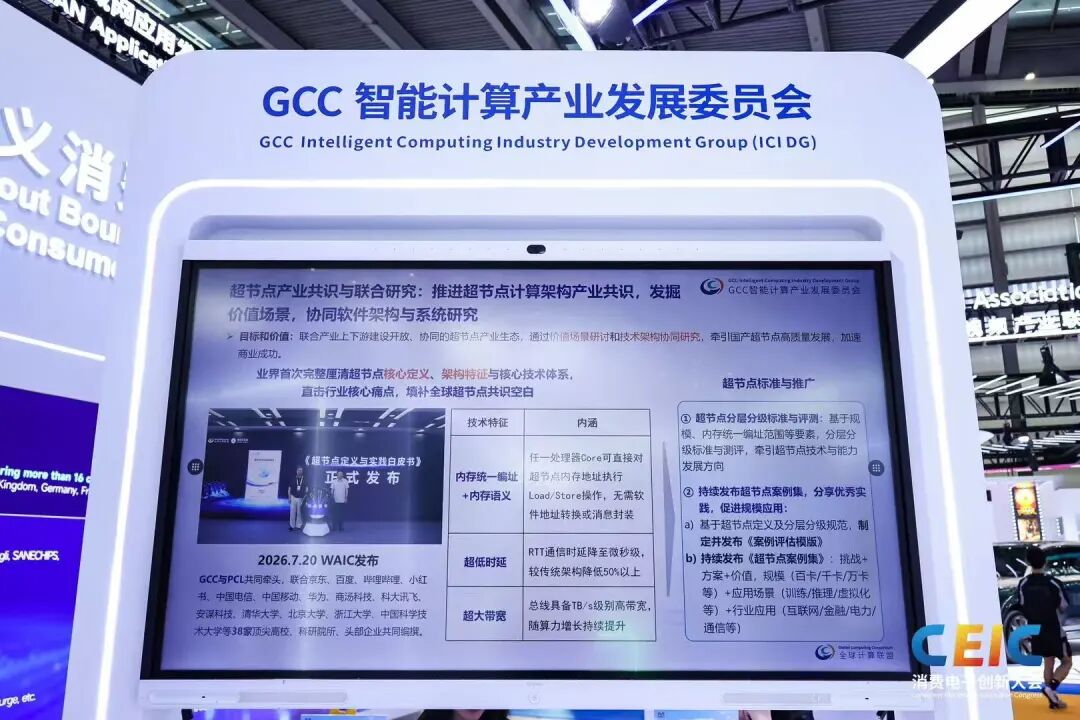
It can be seen that super node is a more effective architecture for organizing multiple computing chips to run models together at present. MIAO Fuyou told 36Kr that a large part, even the largest part of current and future computing power consumption, may come from large model inference. Different from traditional computing which can be split into multiple independent tasks and then aggregated after being completed respectively, different computing nodes need to continuously read data, exchange intermediate results and jointly promote the same task during the large model inference process.
Therefore, the role of super nodes is not to make a single chip calculate faster, but to reduce the time for data transmission and waiting between multiple chips through higher bandwidth, lower latency interconnection and more efficient memory access methods.
The "White Paper on Super Node Definition and Practice" previously jointly released by GCC and Pengcheng Laboratory explains that this architecture can shorten the data movement path and reduce the communication and synchronization overhead in large-scale parallel computing. Specifically for the task of tidying up the desktop, super nodes will play a role in the process from the request entering the model to the generation of the operation scheme: enabling multiple chips running the model to collaborate more efficiently, helping the back-end complete inference faster, or undertaking more robot requests in the same period of time.
This also means that the capabilities demonstrated by AI terminals depend not only on the chips and models on the devices, but also on whether the back-end can complete computing efficiently.
Connect the Real Carrier of Virtual Computing
It should be noted that super nodes, servers and network devices are not abstract resources suspended in the "cloud". They eventually need to be installed in real cabinets and computer rooms, continuously obtain power supply, and discharge the heat generated by operation. Therefore, the next layer of the computing system is how the computer room carries and guarantees the operation of these devices.
MIAO Fuyou told 36Kr in an interview that the life cycle of a computer room may last for two or three decades, while GPU almost has new versions every year, and may experience major generational changes in one or two years. Therefore, the construction party needs to consider whether the computer room invested heavily in fixed assets at present will still adapt to new computing devices several years later.
Chips can iterate rapidly, but the flow rate and temperature difference of cooling liquid are limited by realistic conditions, and supporting facilities such as power transmission lines also need to reserve space. For the planning of megawatt-level computing power systems and gigawatt-level data centers, power supply, cooling and building conditions need to be incorporated into system design earlier.
At the same time, how devices from multiple suppliers adapt to each other also affects delivery efficiency. MIAO Fuyou said that cloud vendors often purchase chips from different suppliers. If each type of chip needs to be individually designed with boards, nodes and cabinets, and the management methods are also different, the complexity of deployment and operation and maintenance will be increased.
It is also for this reason that the importance of forming a consensus around computer room design and management requirements is further highlighted. MIAO Fuyou told 36Kr that GCC is currently providing a set of applicable standards for such industrial coordination and cooperation. According to his introduction, the Open AI Infra community under GCC has set up project groups for computer room infrastructure, whole cabinets and boards, promoting users, construction parties, chip and whole machine suppliers to jointly discuss these issues.
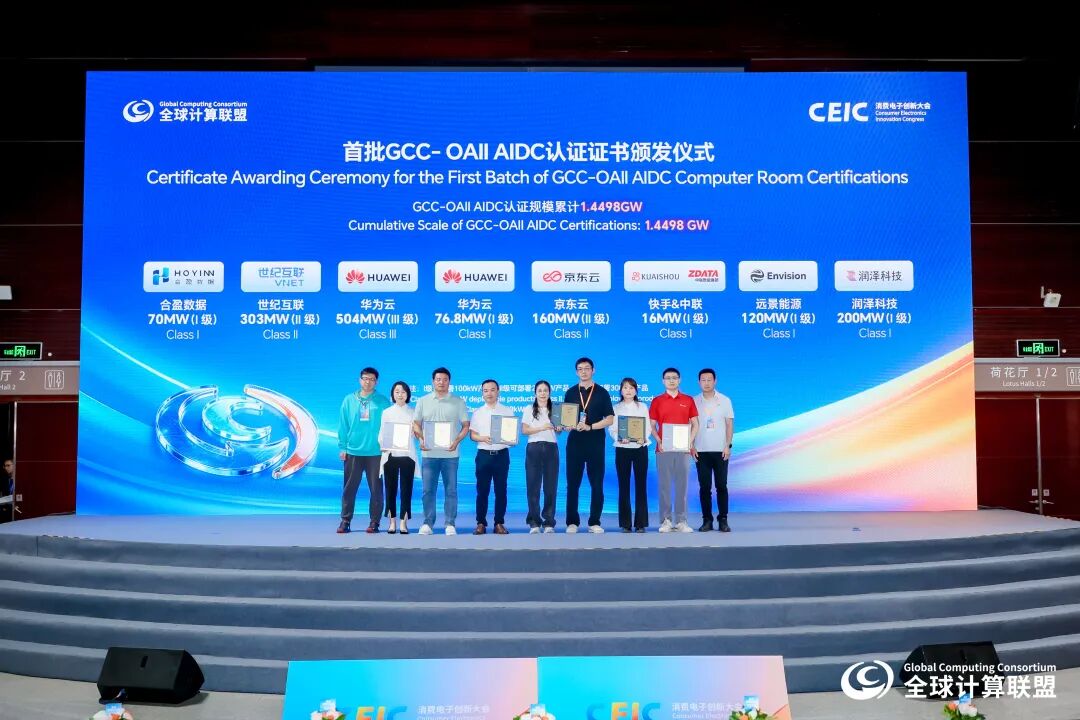
Among them, the AIDC infrastructure specification and supporting certification convert the conditions that the computer room needs to have into verifiable requirements that can be checked against, covering the building architecture, computer room environment, power supply and distribution, air cooling and liquid cooling, delivery and operation and maintenance, etc. For cloud vendors looking for computer rooms, this can help them judge whether the facilities meet the requirements of equipment deployment; for construction parties, it provides a reference for planning and delivery, promoting the infrastructure to be put into use as soon as possible.
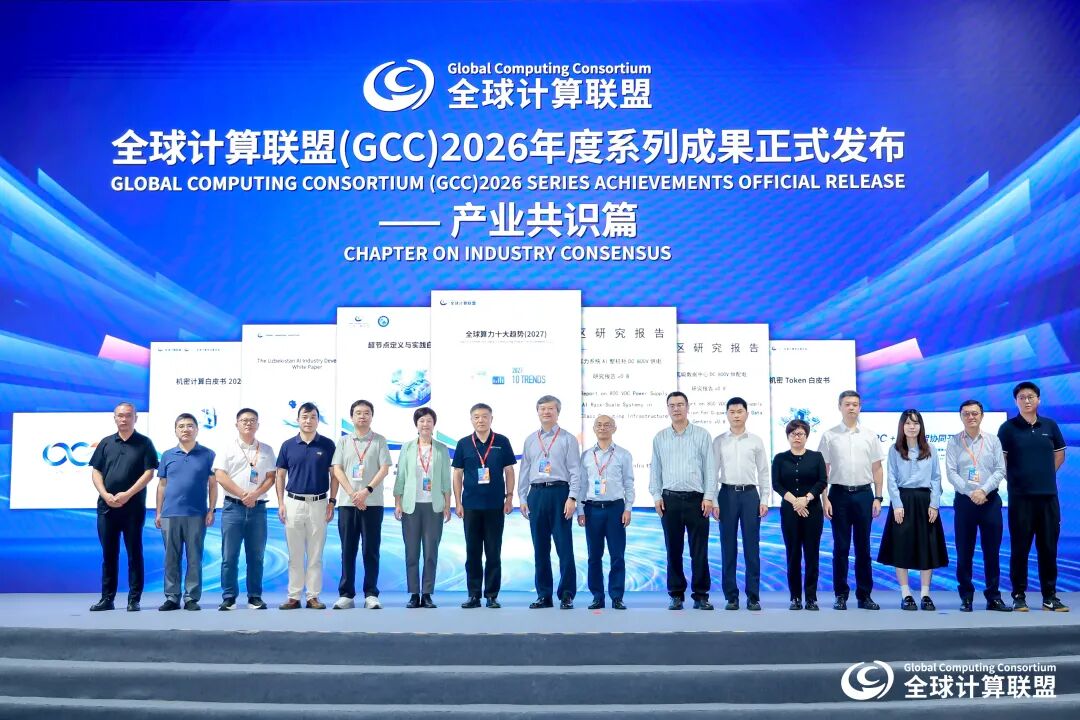
At the 2026 Global Computing Conference (CGC) held concurrently with CEIC, GCC launched 10 industrial consensus achievements, 9 association standards and technical specifications, and launched two key projects. The conference also held the first batch of GCC-OAII AIDC certification certificate awarding ceremony, involving 14 intelligent computing data centers under 7 entities, with the total IT power scale of certified projects reaching about 1.45GW.
After disassembling the computing power chain behind an AI terminal task, it can be seen that every smooth response perceived by users involves a whole long computing chain: the task first goes through task scheduling between cloud, edge and end, then enters the parallel computing of the back-end model, and this process also relies on the computer room to continuously provide power supply, heat dissipation and deployment conditions. Insufficient efficiency in any link may be manifested on the terminal side as longer waiting, greater energy consumption pressure or higher service cost.
CEIC presents the rapid expansion of AI terminal forms, and behind these terminals, the scheduling, organization and carrying methods of computing resources are also being reconstructed synchronously. The competition of AI terminal innovation is not only the competition between devices and models, but also about how to truly convert computing power into product experience with faster response, more stable operation and more controllable cost.