The myth of chip financing among major tech companies: chip companies spun off by Li Auto, SenseTime and other parties have raised an astounding 11.2 billion yuan this year.
On October 16, 2026, Li Auto made simultaneous disclosures through a Hong Kong Stock Exchange announcement and a 6-K filing submitted to the U.S. Securities and Exchange Commission: its chip subsidiary Maherxin Technology has completed its first round of financing, with a total subscribed amount of 1.625 billion yuan. Among the total, Li Auto itself contributed 1 billion yuan, while external institutions collectively contributed 625 million yuan. The post-money valuation reaches 16.63 billion yuan, and Li Auto still holds a 74.01% stake.
This makes Maherxin Technology rank among the chip unicorns with a valuation of over 10 billion yuan, and the company has only been established for more than two months.
It is worth noting that not only Li Auto, in the past few years, the chip departments of large corporations including Baidu, Alibaba, SenseTime, NIO, BYD and others have been spinning out from the groups in batches, becoming companies that can conduct independent financing, independent valuation, and even go public independently.
In 2026, their total financing amount once again reached a new high — exceeding 100 billion yuan.
9 Large Corporations Spin Off Chip Businesses, 4 of Which Garnered Financing Over 1 Billion Yuan in 2026
A company is identified as a chip entity spun off from a large corporation only if it meets two conditions simultaneously: the parent group retains control over the entity; and the entity introduces external capital or independently pushes forward the listing process.
According to statistics from IT Juzi, the total financing amount of chip companies spun off by large corporations in the primary market in 2026 is about 112.31 billion yuan. Four companies including Xiwang, Shenji Technology, Maherxin and Xinqing Technology each contributed an amount of over several billion yuan.
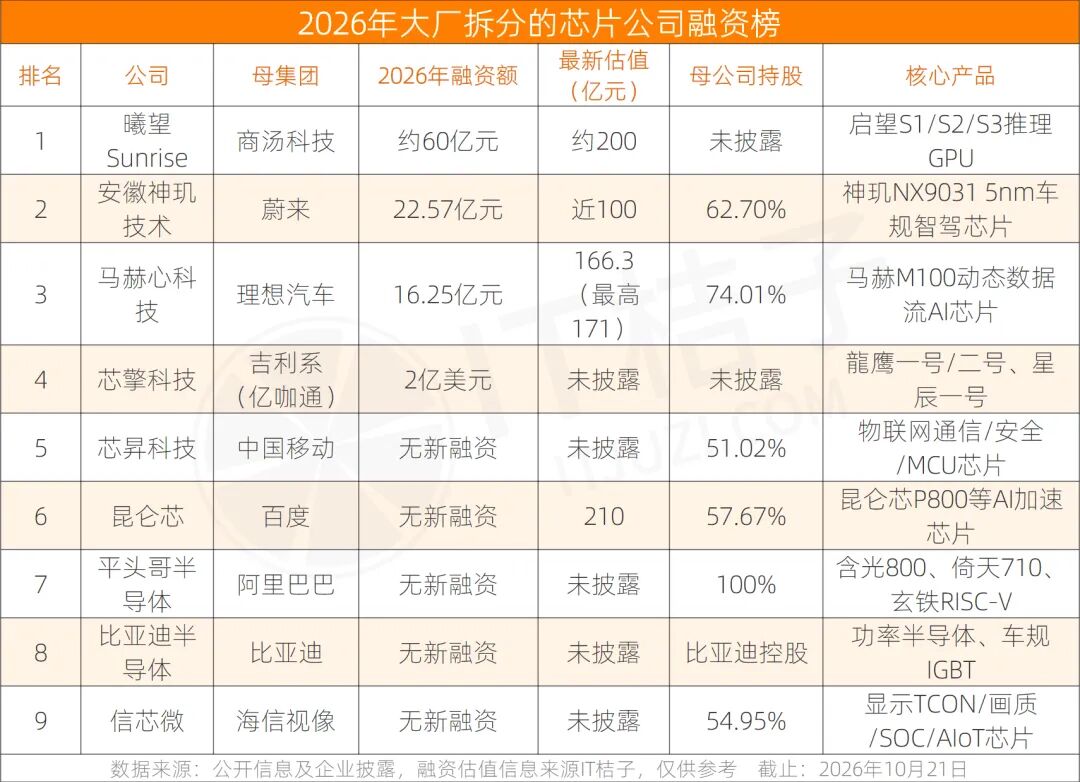
Among the large corporations that have spun off their chip businesses, the internet giant-affiliated entities (Kunlunxin, Pingtouge, Xiwang) only account for one third, the vehicle manufacturer-affiliated entities (Shenji, Maherxin, Xinqing, BYD Semiconductor) account for nearly half, with the rest being operator-affiliated (Xinsheng) and home appliance manufacturer-affiliated (Xinchunwei) entities.
This indicates that spinning off chip businesses is not a choice of a single industry, but a common action of manufacturing entities that have ambitions in the chip sector.
Judging from the spin-off paths and current capitalization progress,
3 companies are proceeding with spin-off and listing: Kunlunxin is the earliest, which submitted a main board listing application to the Hong Kong Stock Exchange in confidential form in January 2026, and launched the Sci-Tech Innovation Board listing counseling in May; Pingtouge was exposed to be preparing for independent listing, while Alibaba has not made any comment; Xiwang completed the shareholding system transformation and launched the IPO process in May 2026, which is the fastest one, taking only one and a half years from spin-off to IPO launch.
Four companies including Shenji, Maherxin, Xinqing and Xinsheng are still conducting continuous financing in the primary market.
Among them, Xiwang under SenseTime has raised a total of about 60 billion yuan through three rounds of equity financing in 2026, ranking first among the large corporation-affiliated chip companies, and has launched the IPO process. Xinqing Technology has the most intensive financing activities among the four, which has completed 8 rounds of financing since its establishment in 2018, and completed two rounds of Series C and Series C+ in the first half of 2026 alone, with a total amount of over 200 million US dollars.
In addition, there are 2 companies whose spin-off processes have encountered obstacles.
Xinchunwei was spun off by Hisense Visual Technology for Sci-Tech Innovation Board listing in January 2023. In June 2024, the review was terminated as the sponsor revoked its sponsorship. Hisense Visual Technology responded on the investor interaction platform that this is a "phased decision based on the current market environment"; BYD Semiconductor completed a total of 27 billion yuan of financing through 1.9 billion yuan of Series A and 800 million yuan of Series A+ rounds from 2020 to 2021, and its spin-off and listing process has been in a suspended state up to now.
It is worth noting that none of the 9 sample companies gave up controlling stakes as the bottom line in shareholding ratios. Except for Pingtouge (in January 2026, Alibaba was exposed to plan to restructure Pingtouge into an employee-owned entity for independent listing), the shareholding ratio of the rest parent companies ranges from 51.02% to 75%.
This range corresponds to two constraints: a ratio lower than 51% will lead to the loss of the consolidated statement qualification, while a ratio higher than 75% will dilute the pricing significance of external capital.
The Interval From Spin-off to Completing the First Round of Financing Is Shortening
By arranging the timelines of all parties, a clear acceleration trend can be observed:
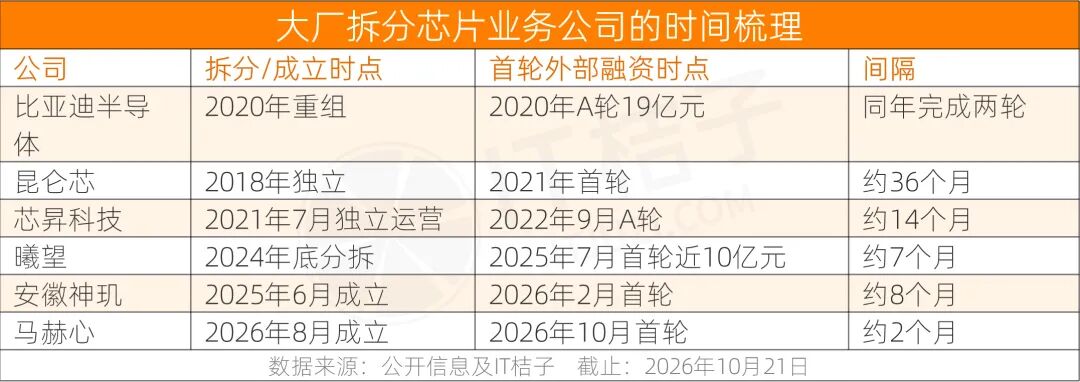
It took Kunlunxin about three years from independence to introducing the first round of external capital, while Maherxin only took two months from establishment to the first round of financing. Why is the pace from spin-off to financing getting faster and the interval getting shorter?
The variables include the popularity of the capital market, and the most critical progress is whether the chip has completed mass production verification first.
According to observations, almost all spin-off entities that can obtain external capital have completed mass production verification in advance.
For example, Shenji NX9031 was mass produced and installed in vehicles in 2025, and Li Bin disclosed in July 2026 that its cumulative shipment volume exceeded 300,000 units; Maher M100 started mass production and delivery in May 2026, with the delivery volume exceeding 50,000 units by the end of August, which is equipped in models including L9, L8, L6, MEGA, i9 and others; The self-developed Dragon Eagle No.1 of Xinqing ranks first among automotive SoC suppliers in China in terms of the installation volume of smart cockpit domain control SoC chips in 2025.
Why Do Large Corporations Spin Off Their Chip Businesses
"Why do large corporations insist on turning their chip businesses into independent companies". Five conclusions can be drawn from this batch of samples.
1. Fixed Costs Require a Larger Denominator
The fixed expenditures of chip tape-out, IP authorization, team and production line adaptation are expanding generation by generation. If the business stays within the group, there is only one apportionment object for this fund — the company's own vehicles or self-operated businesses. Only after being spun off can the entity seek external demands: Shenji, together with Aixin Yuanzhi and OmniVision, established Chongqing Chuangyuan Zhihang with a registered capital of 100 million yuan, and authorizes chip technologies to external parties in the form of cooperative R&D; Maherxin clearly stated in its financing announcement that it will carry out chip and domain controller businesses for customers in non-automotive fields.
Su Qing, Vice President of Horizon Robotics, put forward a straightforward judgment: The chip industry is an infinite game where you need to pay tolls for tape-out, IP and production lines every year. Without a sufficiently wide downstream market, full self-development is a fragile story.
2. Seize the General Trend of the Industry: Inference Dividend
Spinning off AI chip businesses in this key window period of the past two years also benefits from the outbreak of large AI models and the growth of computing power demand. The industry consensus is that more than 90% of the computing power demand will eventually come from inference. In 2026, inference computing power has accounted for two thirds of the total AI computing capacity, and the market space has exceeded 300 billion yuan.
Xiwang goes all-in on inference, Shenji expands from intelligent driving to embodied intelligence, and Maherxin targets end-side AI, all of which are seizing this industry opportunity.
3. Open a New Valuation Space Beyond the Valuation of the Main Business
In the first half of 2026, Li Auto delivered 193,472 vehicles, with a revenue of 48.6 billion yuan down 13.4% year on year and a net loss of 3.98 billion yuan; As of the close on September 21, US Eastern Time, the share price of Li Auto dropped by about 33% in the past six months, NIO by about 37%, and XPeng by about 44%. The valuation logic of the complete vehicle business is being suppressed by price wars and weak consumer confidence.
Packaging the chip business into an independent entity for separate valuation is to open up a new valuation reserve land beyond the main business. Now with the help of capital operation, the pre-money valuation of Maherxin reaches 15 billion yuan, the post-money valuation of Shenji is nearly 10 billion yuan, and the post-money valuation of Xiwang is about 20 billion yuan.
4. Equity of Independent Entities Serves as a Carrier to Retain Core Talents
The R&D cycle, assessment system and compensation structure of chip R&D are very different from those of the internet and complete vehicle main businesses.
Jin Yihua, head of software R&D of Li Auto's chip team, and Dai Jie, head of the first front-end design group, have left their jobs successively, and more key employees are flowing to the embodied intelligence startup boom.
According to reports, the human resources department of Li Auto has communicated with employees of the chip department to adjust their labor relations, because after independent financing, a separate equity incentive scheme can be properly arranged. It is reported that the first round of financing structure of Shenji is 62.7% held by NIO, 27.3% held by external investors, and 10% for employee equity incentive; Maherxin has set up two equity incentive plans for employees and senior executives, with the total maximum authorized quota of 20%.
5. Turn Cost Items Into Revenue Items
If the chip business stays within the group, it is a R&D expense; after being spun off, it becomes a revenue entity that can supply products to external parties.
The customers of Xinqing have covered FAW Hongqi, Geely LYNK & CO and Geely Galaxy, Volkswagen Group Germany, Changan Automobile; The IP of Xiwang S1 has been authorized to enterprises including Sony and Xiaomi; Xinsheng Technology introduced China Southern Power Grid in its Series C round, and directly obtained orders from the power grid scenario. The significance of revenue items and cost items in financial statements is completely different.
Not All Large Corporations Spin Off Chip Businesses, Some Choose Not to Spin Off
Spin-off is indeed a very good choice, but it is not suitable for all large corporations.
Manufacturers such as Huawei, Xiaomi, XPeng and others have considerable scale of chip businesses, but they have not implemented spin-off, and keep the businesses within the group. Some of them do not need to make capital stories, some have met their business demands through internal collaboration, and some do this out of the consideration of strategic autonomy and controllability.
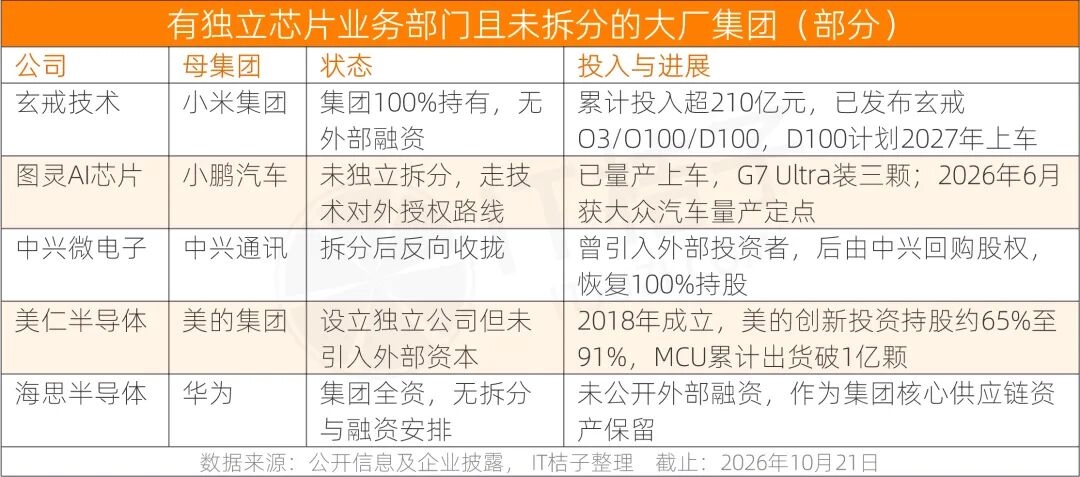
Among them, ZTE Microelectronics is the most special one, which once went through the spin-off path, and then reclaimed all the equity to become a wholly-owned subsidiary.
This indicates that not all chip businesses under large groups are suitable for independence. Whether to spin off or not is a reasonable choice.
After reviewing these chip companies spun off from large corporations, one question remains — whether their actual shipment volume and external customer scale can support such a high valuation, which will be left to the capital and market for verification.
Note:
The above spin-off criteria for large corporations exclude two types of companies: First, companies that are funded or participated by large corporations but not spun off from internal businesses, a typical example is Qianhe Yibang jointly incubated by NetEase. Although NetEase Youdao is the second largest shareholder, the founder Zhang Xiangjian himself has never worked in NetEase; Therefore, although the company completed a Series B financing of over 2 billion yuan in August 2026, it is not included in the statistical sample of this time.
Second, startups founded by former employees — the founding team left the large corporation to start their own business, and has no equity relationship with the large corporation.
This article is from the WeChat Official Account "IT Juzi" (ID: itjuzi521), written by Wu Meimei, and authorized for release by 36Kr.