The miHoYo project team has teamed up with top talents from Tsinghua University and Peking University to open-source an AI model for game operation, a similar move that ByteDance has also made before.
On the night of October 22, an open-source project carrying the logos of miHoYo, Tsinghua University, University of Chinese Academy of Sciences and the University of Hong Kong suddenly appeared on GitHub, with the prominent title "Scaling in Games", which took everyone by surprise — did miHoYo quietly make a big move?
After carefully reviewing the project introduction, Putao Jun found that the situation is not that significant. According to the information of the paper authors, this is most likely a research result jointly released by several interns from the miHoYo Honkai AI R&D Team, which may not be a strategic-level research project at the corporate level of miHoYo. The paper is currently only published on the arXiv preprint platform (that is, it has not yet undergone peer review).
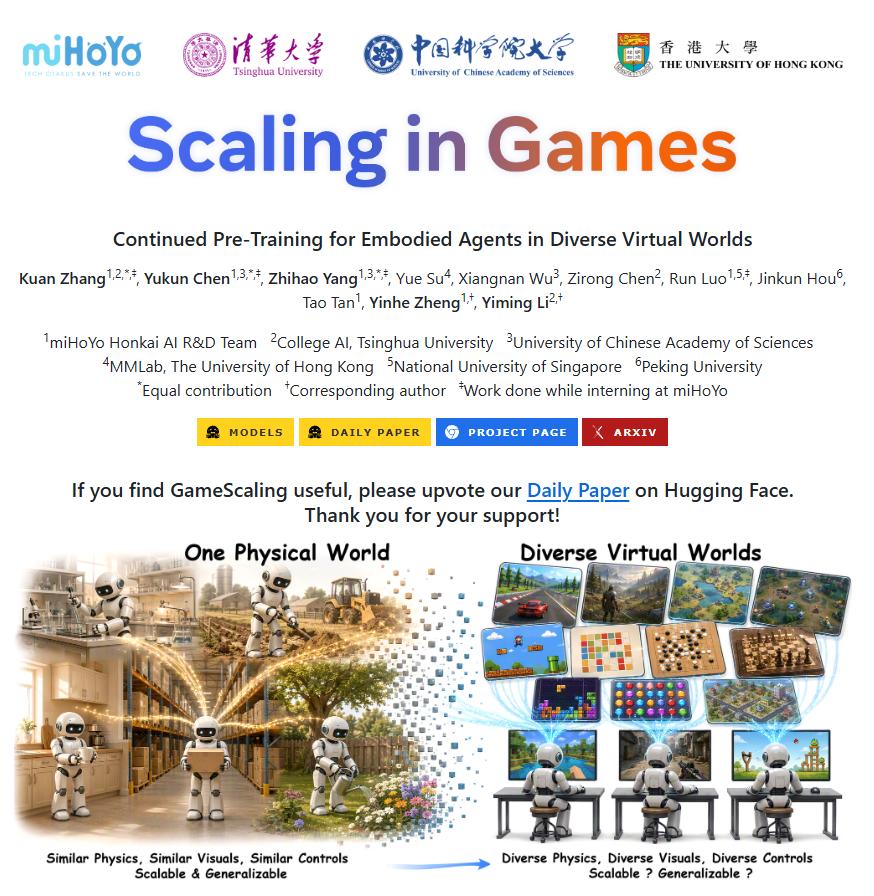
Embodied intelligence has relatively generalizable understanding of the physical laws of the real world, but the rules of the virtual game world are not consistent. Can AI quickly adapt to the unfamiliar rules and control methods of different games like humans?
It is worth noting that some of the authors' affiliations are not miHoYo, but the University of Hong Kong, Tsinghua University, Peking University and so on. However, there is no public information about the specific cooperation mode of the project for the time being.
Although the incident is not that major, the research direction of this paper still has considerable value.
What does the paper talk about?
According to the paper, the team seems to want to go a step further on the matter of "AI being able to get started with games", to explore: after AI learns a large amount of game operation experience, can it draw inferences from one instance and smoothly get started with more games it has never encountered before?
During training, the team took the Qwen3.5 vision-language model as the basis, and continued to train the model with game screens and corresponding keyboard and mouse operation records, so that the model can learn what actions to take under a certain screen. This process is somewhat similar to the operation of a real human player in the game: the AI first sees the screen, then judges the situation, then takes action, and then continues to adjust according to the next screen.
Specifically, this experiment tries to figure out three questions:
First, the larger the model, the better the AI is at playing games? — They prepared four AI models of different scales, with parameter volumes of 800 million, 2 billion, 9 billion and 27 billion respectively. Generally speaking, the larger the number of parameters, the higher the potential of the model to learn and process complex information, but the operating cost is usually also higher.
Second, the more game data the AI learns, the better it is at playing games? — They prepared game training data of different scales, corresponding to game records of 50 hours, 100 hours, 200 hours, 400 hours, 800 hours and 1600 hours respectively.

Third, the richer the games learned, the easier it is for AI to learn unfamiliar games? — In this experiment, some training schemes only used the game operation data of *Minecraft*, while others mixed in data from other games, including different types of products such as *Apex Legends*, *Counter-Strike 2*, *PUBG: Battlegrounds*, *Monster Hunter Wilds* and so on.
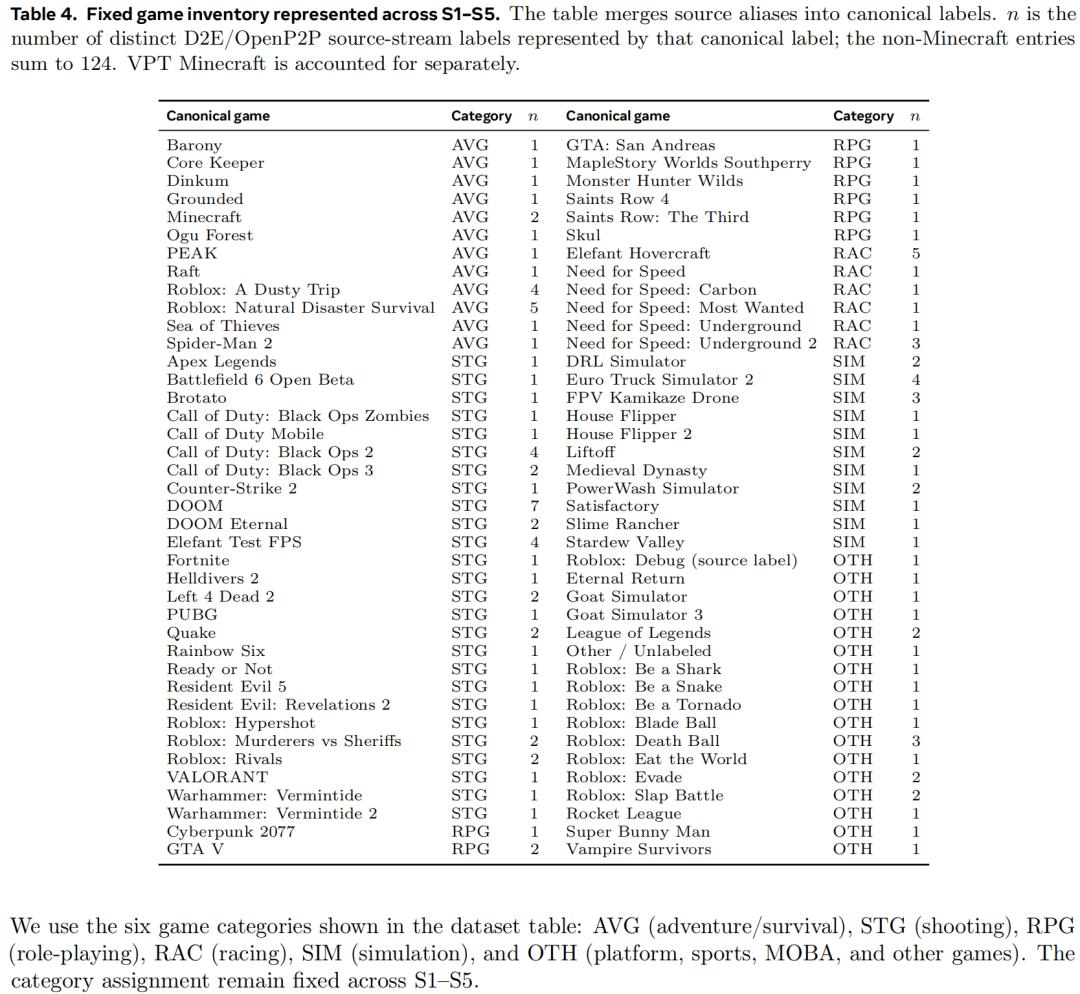
These are the learning materials for the model
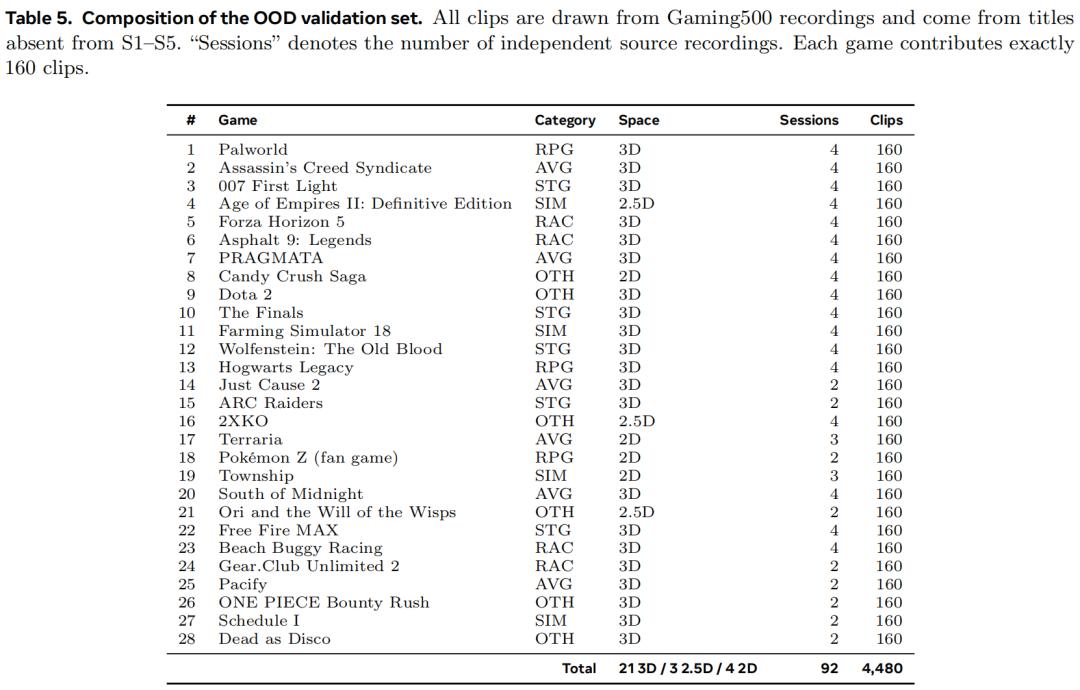
Another 28 games that did not appear in the training data were used to test the AI's prediction ability of unfamiliar game operations
According to the experimental results, first of all, a larger model does not necessarily mean that the AI is better at playing games.
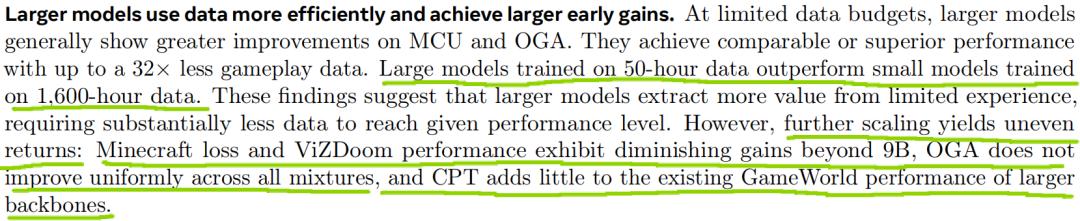
Larger models can usually learn better operation capabilities with less game data. Some large models only need to learn 50 hours of game data, and their performance exceeds that of small models that have learned 1600 hours of data. But this does not mean that infinitely expanding the model scale can solve all problems.
Because when the model reaches a certain scale, the benefit brought by continuously adding parameters may become smaller and smaller.
Moreover, they also found the limitations of large general-purpose models in learning to operate games: the "mind" can keep up, but the "operation speed" is hard to say.
In the time-paused test (the game pauses when the AI thinks and generates operation instructions, and continues to run after it makes a decision), Gemini-3.8-Flash performs quite well; but in the real-time operation test (the game does not pause), the score of Gemini-3.8-Flash drops, while GameScaling-9B-S3 performs better instead.
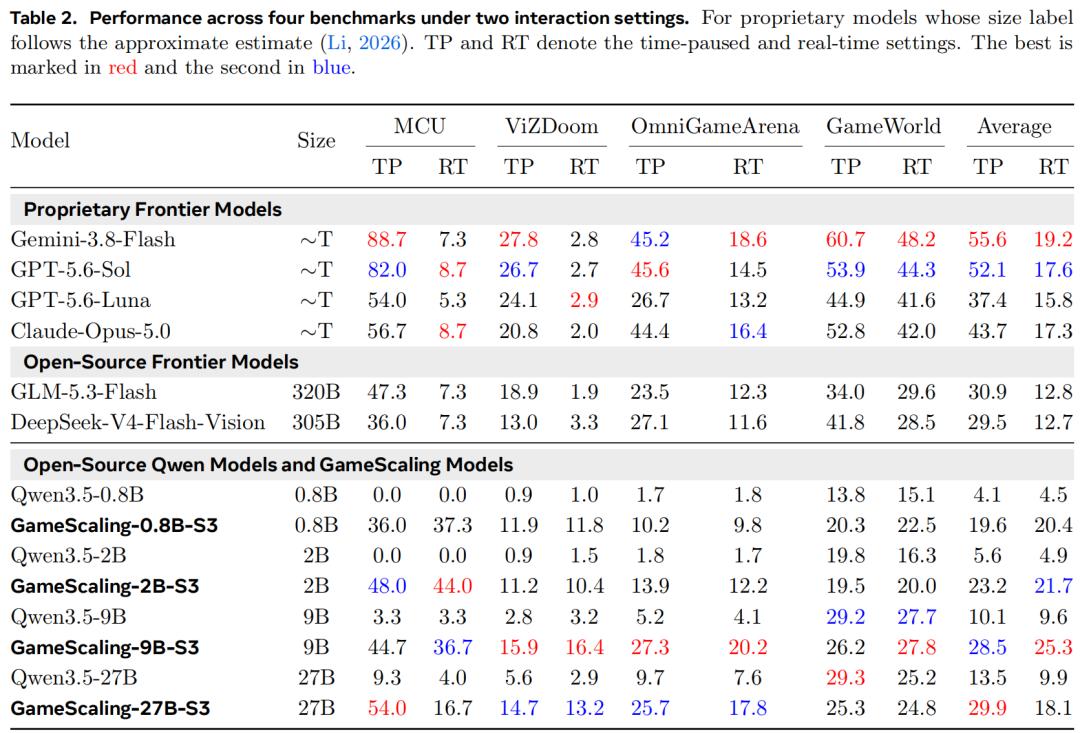
TP stands for time-paused, which allows pausing, and RT stands for real-time, which does not allow pausing
The reason for this result may be related to the response speed of the model. Although large general-purpose models have stronger understanding and reasoning capabilities, they usually need to spend more time thinking.
Furthermore, Gemini is called through the service provider's API, while GameScaling runs on the team's own server. Therefore, the performance difference may also be affected by the deployment environment and response latency.
This is not a problem when the game allows pausing. But once the game keeps running, a slow operation may miss the best opportunity.
Secondly, the more diverse the games the AI learns, the more likely it is to get fully familiar with similar new games quickly.
The team found that in the first dozens of hours of training data, the model's prediction ability for keyboard and mouse operations improved very quickly. In other words, it was mainly learning how to manipulate game characters at the very beginning. Even when facing unfamiliar game screens, its prediction of keyboard and mouse operations will be more accurate.
However, after the initial learning stage, if the AI continues to learn data from a single game, its performance in other games will not necessarily improve accordingly — if the model keeps learning *Minecraft*, it will become more and more familiar with the operations of *Minecraft*, which does not mean it can "play" other games well.
Allowing AI to be exposed to more similar games seems to help improve its performance in unfamiliar games.
The team found that with the same 1600 hours of game data for training, compared with the model that only learned *Minecraft*, those models that learned multiple games had an overall score in the OmniGameArena test system (7 3D game environments built based on Unreal Engine 5 to test whether AI can get started with 3D games with similar operation modes) increased to about 2.8 times that of the former.
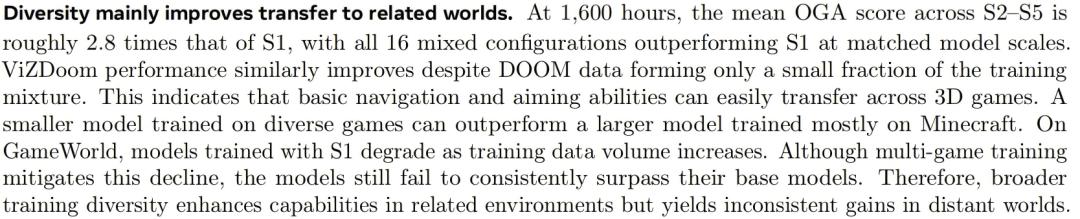
That is to say, between games with similar operation modes, AI can indeed draw on the experience it has learned before — for example, after the model learns how to move, turn and aim in *Minecraft* and other 3D games, these experiences can still come in handy when it comes into contact with another unfamiliar 3D shooting game.
What if the span between games is larger? If AI can already skillfully get started with 3D games, can it quickly adapt to 2D games? This leads to the last point: learning more games does not mean that AI can adapt to all games.
In addition to MCU (*Minecraft*, including 30 tasks) and OmniGameArena, the test system in the experiment also includes ViZDoom (*Doom*, including 4 test scenarios), and GameWorld (including 34 game environments and 170 tasks, many of which are 2D and 2.5D games, involving different gameplay such as arcade jumping, 2048, Sokoban and so on).
If switching from *Minecraft* to another 3D shooting game is to let AI try to apply the information it has learned, then switching from *Minecraft* to 2048 is more like letting it re-learn a whole set of rules.
The results show that AI is not so good at dealing with such changes, and may even become more difficult to adapt as a result —
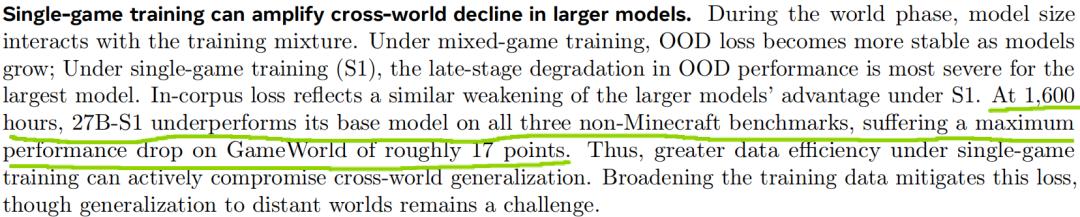
The team used 1600 hours of *Minecraft* game data to continue training a 27-billion-parameter model. It turned out that although its performance in *Minecraft* improved, its performance in tests of *Doom*, other unfamiliar 3D games, and some 2D and 2.5D games was even worse than the original model that did not go through this round of training.
This means that targeted training for a certain game may even weaken the AI's adaptability to other games.
At the end of the paper, the team stated that the current GameScaling still has obvious limitations.
At present, it mainly learns by imitating the existing game operation records of humans. Although the trained AI can already operate games independently, it has not formed an autonomous learning loop of "trying on its own, making mistakes, and then learning lessons from failures". When encountering unfamiliar games that are very different from the training materials, its adaptability is still limited.
At first glance, this experiment just let different models play a bunch of games, and finally proved the simple truth that "now they cannot understand rules and adapt to operations as quickly as humans". But in the long run, whether this research can prove that "AI can become a skilled game player" may not be important — exploring how model scale, training data volume and game types affect the AI's game operation ability, and figuring out what methods are effective and which methods fail, is equivalent to paving the way for future research in advance and listing the problems to be solved.
After all, looking back at the development of AI in recent years, from the curious scene of Will Smith eating noodles to the indistinguishable real and fake AI eating noodles, technological iteration has never been achieved overnight. Sometimes figuring out why a certain path does not work is often an important step towards the next round of iteration.
The Kingly Path of miHoYo
In the AI+game field, how to make AI learn to play games has always been a popular research direction.
Last November, the Lumine team under ByteDance released a real-record video of more than 25 hours on Bilibili, mainly showing the process of AI playing *Genshin Impact*, *Honkai: Star Rail* and *Wuthering Waves*. In the related paper, they called themselves "the only AI agent that can complete several hours of tasks in a 3D open world" at that time.
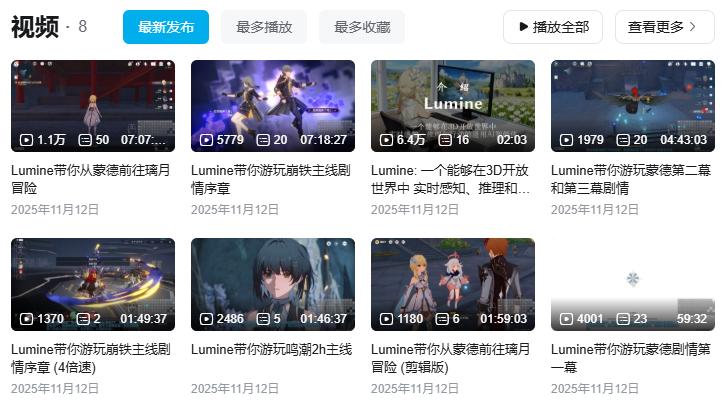
Although Lumine did not gain huge dissemination among C-end users, as a researcher in the AI field, it is somewhat ironic that miHoYo was preempted by Byte to make achievements and attract traffic using its own games...
Many people may think, what's the value of making AI learn to play games? But in fact, many industry leaders have reached a consensus that the ultimate goal of AI in Game is to realize embodied intelligence in the virtual world, let agents achieve autonomous goals in a long cycle, and finally emerge a virtual-reality integrated world like that in *Ready Player One*, as well as related new gameplay. After all, games have lower cost than the real world, are more realistic than simulators, and support large-scale human feedback, which is naturally a test field that helps to realize AGI.
From this perspective, this should also be the reason why miHoYo's Honkai project team is willing to provide support for this research even if it does not directly help game projects for the time being — what they value is its contribution to the entire industry's AI+game research.
By the way, I guess that apart from academic exploration, the Honkai project team's willingness to support such projects also considers attracting talents.
Although the game industry has always been "choosing miHoYo if there are options", the so-called "tech nerds save the world" has also made many technical experts regard miHoYo as the most worthy game company to join. But in the broader AI industry, miHoYo faces much fiercer competition.
In this field, Internet companies, AI companies and even all walks of life are competing for talents, and the supply of top talents is obviously less than the demand. The boss of a leading game company said that many things that top talents care about, such as the extremely high salary and massive graphics cards written into the contract, are very difficult for game companies to fight for internally. Some candidates even said very bluntly: "The tuyere only lasts for a few years, and I just need to earn enough money for the rest of my life in these few years."
Facing this situation, if you blindly go head-to-head with large factories to recruit high-end talents, no matter how high the investment is, you can't get much results. Finding high-potential talents from universities, training them from scratch and growing together is the right solution — it seems a little slow, but the pace will be more stable.
Judging from the actions, in recent years, not only Da Wei has personally given speeches at campus recruitment activities, miHoYo has also begun to hold