The broader market keeps falling nonstop, while bank stocks have quietly hit new highs.
The recent A-share market has once again become the target of complaints for many people, retail investors are collectively frustrated, and there is no end in sight to recovering their losses! It seems that no sector can serve as a safe haven.
However, when the broader market continues to decline, bank stocks in the capital market have been advancing triumphantly all the way, bucking the trend to register an independent rising market.
Let's look at the market performance on October 22:
Industrial and Commercial Bank of China: +1.66%, closed at 8.59 yuan, its share price hit a new all-time high, with a total market value of about 2.86 trillion yuan.
China Construction Bank: +1.48%, closed at 11.66 yuan, also refreshing its all-time high, with a total market value of about 3.05 trillion yuan.
Agricultural Bank of China: +1.51%, closed at 7.40 yuan, with a total A-share market value of about 2.59 trillion yuan.
The broader market keeps falling, many retail investors can't help but ask: Is it because the banks themselves have become extremely profitable recently, or have the funds in the market really all flocked to bank stocks to seek refuge?
Net Interest Margin, the Core Logic Behind This Round of Bank Stock Rally
We know that the rise and fall of a stock, apart from its current performance, is largely driven by the market's expectation of its future valuation. For bank stocks, the core source of profit for banks is the interest spread between deposits and loans. In the past few years, the net interest margin of banks has continued to narrow, and the market has been worried about this for a long time. Many institutions have continued to be bearish on the performance of the banking industry, which is also the core reason why the valuation of bank stocks has remained depressed and their share price performance has been weak for a long time in the past.
However, entering 2026, some new changes have taken place in the market environment. Institutional analysis points out that high-interest rate time deposits in the previous cycle are maturing one after another, and a large amount of principal is due for redemption in a concentrated manner recently; while the interest rate of newly issued deposit products continues to decline, the interest cost that banks need to pay to depositors decreases accordingly. As long as the deposit cost falls faster than the loan interest rate, the net interest margin of banks will have the opportunity to stabilize, or even improve marginally.
Therefore, this round of rise in bank stocks is not due to a sudden surge in current bank profits, but a consensus expectation formed in the market: the most difficult stage for banks' net interest margin has most likely passed, and the downward pressure on profitability is expected to ease.
Of course, there is another key driving force: the attractiveness of bank dividends has become more prominent. The 10-year Treasury bond yield is only 1.67%. After comparing returns, many long-term funds pursuing steady returns such as insurance funds and pension funds find through calculation that the allocation value of state-owned bank stocks with continuous high dividends has suddenly become prominent.
We used AI to count the dividend data of 8 banks, with a dividend yield ranging from 3.4% to 5.5%, which is far higher than the Treasury bond yield.
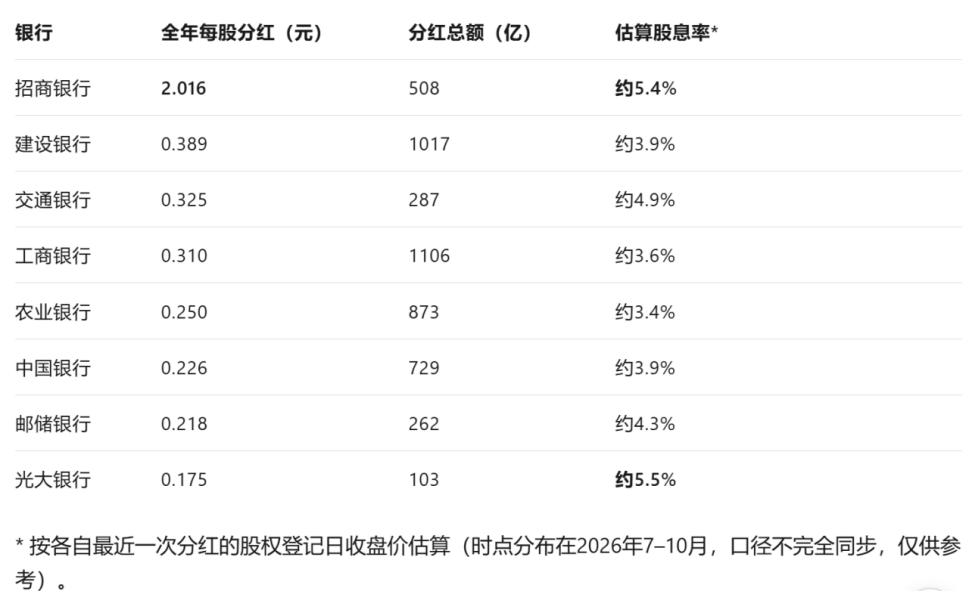
At present, the dividend yield of the six major state-owned banks is about 3.4%–4.9%, which is significantly higher than the overall average level of the A-share market. They belong to the high dividend sector together with coal, oil and petrochemical industries, which is also the core logic of the "Valuation with Chinese Characteristics" market in recent years.
A stock market commentator mentioned a very interesting contrast phenomenon: retail investors spend a lot of time studying popular technology themes and chasing short-term hot spots, while long-term institutional funds are quietly and continuously deploying the banking sector.
Seeing that large state-owned banks continue to hit new highs, many people will naturally ask: Since the logic is so smooth, are all bank stocks suitable for buying without careful consideration now?
Differentiated Banks, Cautious Market
It should be noted that obvious differentiation has emerged within A-share bank stocks, and not all banks can enjoy the dividends of this market rally. Since the beginning of this year, the bank with the highest increase in the sector has risen by 43% cumulatively, while the weakest performing bank has fallen by 18%, forming a situation of extreme disparity.
In the second quarter of this year, the net profit of large state-owned banks increased by 0.8% month-on-month, showing strong operational resilience; in contrast, the profitability of small and medium-sized banks is under obvious pressure. According to the data disclosed by the State Administration of Financial Regulation, the profit of rural commercial banks across the country decreased by 12.5% year-on-year, and the non-performing loan ratio rose by 0.04 percentage points month-on-month. Many local urban commercial banks and rural commercial banks are trapped in a predicament of high non-performing pressure, reluctance to expand credit supply, and stagnant revenue and profit growth, and the gap between their fundamentals and large state-owned banks continues to widen.
Many stock investors still believe that the broader market is in the era of sector rotation a few years ago, where sectors and individual stocks may rise and fall alternately. But the reality is that that was a period of booming industries and expanding asset scale. As long as credit volume increased, all banks, large and small, could share the dividends.
But in the era of stock economy, this set of logic has failed. The current differentiation comes from the differences in their own basic conditions, which is a long-standing gap. Large banks have nationwide channels, government and public resources, and large central enterprise clients, so they can access low-risk high-quality credit such as new quality productive forces and infrastructure construction; regional banks are restricted by geography, their client pools are concentrated in local real estate, small, medium and micro enterprises, and the supply of high-quality assets is scarce.

Source: Internet
High-quality credit resources themselves are scarce, and will continue to concentrate on leading players in the future. High-quality projects will first be connected to large state-owned banks with strong capital strength, sound risk control systems, and the ability to provide comprehensive financial services. Even if small and medium-sized banks are willing to lower interest rates to compete for projects, it is difficult for them to obtain high-quality corporate lending targets.
In the long run, the valuation system of the banking sector will also be reconstructed: large state-owned banks will enjoy certainty premium, while some regional banks with weak fundamentals will maintain low valuations for a long time, and it will be difficult for them to welcome valuation recovery. This differentiation is not caused by short-term sentiment, but a long-term pattern shaped by credit resource allocation, customer structure and liability capacity.
Can You Buy Bank Stocks Without Thinking Twice?
The answer is no.
Facing this round of market rally, many retail investors may think that seeing ICBC, CCB and ABC hitting new all-time highs one after another, they can default that all banks have the potential to replicate this rally. But the reality is that large state-owned banks have obtained higher-quality credit cakes in the stock economy era: new quality productive forces, major infrastructure construction, supporting financing for central enterprises, these low-risk, large-volume credit resources naturally tilt towards large banks. Coupled with the liability cost dividend brought by the continuous maturity of high-interest deposits, their net interest margin takes the lead in stabilizing and recovering, and the bottom of profitability has been confirmed. With stable and continuous dividends, in the environment of falling 10-year Treasury bond yield, for long-term funds such as insurance and pension funds, large bank stocks have become highly cost-effective bottom position allocation besides bonds.
In contrast, the predicament of small and medium-sized banks is not a short-term cyclical disturbance. Restricted by local operations, their credit assets are highly tied to local real estate, micro and small enterprises and retail demand. At present, retail credit demand is weak, risks of micro and small enterprises are rising, and the supply of high-quality assets is insufficient. At the same time, their shortcomings on the liability side are difficult to make up: due to insufficient brand trust, they can only rely on higher deposit interest rates to attract deposits, and their liability cost is more rigid; some rural commercial banks continue to face growing non-performing pressure, falling into the predicament of being reluctant to lend, stagnant revenue and declining profits. Even if a few high-quality small and medium-sized banks maintain high net interest margin relying on micro and small business, it is only a few special cases, which cannot represent the whole sector.
From the perspective of ordinary people's investment, the banking sector is no longer a defensive haven that can be allocated without careful consideration. Funds will continue to concentrate on leading state-owned banks with low liability cost, asset structure that fits the direction of economic transformation, solid risk control and stable dividends; most regional banks still have to bear the pressure of profitability and asset quality.
Of course, compared with some concept-driven theme stocks, their long-term risks may still be relatively smaller.
This independent rally of large state-owned banks is not just a short-term fund gathering or the national team bailing out the market, but the market is re-pricing the banking sector. The days when the entire banking industry rose and fell together are gone, and the fundamental gap between different banks will not disappear with a single wave of market rally.
This distinct situation of stark difference between hot and cold within the banking sector is actually a reflection of the K-shaped characteristics in the current economic transformation on the capital market.
References
1. "The Two Sets of Accounts of Bank Stocks", Consumer Finance Circle
2. Four More Banks Hit New Highs Together, Bank Stocks Have Embarked on a 4-Year Long Bull Market, Yicai Global
3. Banks Are Differentiating, Read Finance
This article is from the WeChat official account "Chief Business Review" (ID: CHReview), author: Xing Ying, authorized for release by 36Kr.