Sam Altman remarks that OpenAI's in-house capabilities are far beyond the reach of existing publicly available models, programmers will not be eliminated by AI and may even earn more than they used to.
If one day AI is able to complete the most complex mathematical proofs, discover new laws of physics, and even find cures for major diseases, what else do humans need to do?
In the eyes of Sam Altman, CEO of OpenAI, this is no longer a distant question. As AI begins to participate in real scientific discoveries, humanity is entering a new stage. He predicts that in the next few years, AI is expected to help find candidate treatments for major diseases. But compared to medical advances, what excites him personally the most is the potential major breakthroughs that may emerge in the field of physics.
However, the more capable AI becomes, will humans necessarily live better lives?
Recently, in a 45-minute conversation with AI blogger Matthew Berman, Altman talked about a rather contradictory reality: AI is already able to take on more and more work, but people do not seem to have become more leisurely as a result.
Programmers are a typical example. In the past, people generally worried that AI programming would make developers unemployed, but Altman found that programmers are instead likely to be busier than ever, create greater value, and even earn more money. One of the reasons is that humanity's demand for software far exceeds previous imaginations.
This change has also happened to Altman himself. He revealed that he has not read a single line of code for about a year, and may never program in person again in the future. Rewriting code when he is old may only be done to commemorate the past.
But what makes him feel emotional is not only the change in working methods, but also the sense of loss brought by technological progress. For many people, personally solving a difficult problem and writing a beautiful piece of code is an important source of a sense of achievement in itself. When AI can complete all this faster, while gaining efficiency, humans may also lose part of the fun in the creation process.
Talking about the next-generation personal AI assistant, Altman believes that existing models are already smart enough, and what is truly missing is more mature products, more powerful computing power, and new types of hardware that can continuously perceive the real environment. When asked how many GPUs will be needed in the future, his answer is quite straightforward: "Infinite. I want as many as I can get."
The conversation also touched on more controversial topics, including whether AI has consciousness, whether models should be granted legal personality status, and the risk of loss of control that recursive self-improvement may bring. Altman believes that today's AI does not have consciousness in the usual sense, and AI should serve humanity instead of deciding humanity's future. He also admitted that the models that have not yet been made public within OpenAI have reached a level that existing public models cannot match on some mathematical research tasks.
As CEO of OpenAI, Altman also talked about a side rarely seen by the outside world: some mornings, he also does not want to get up due to enormous pressure. But he still believes that since he has decided to make great efforts, he should choose to work on truly important things.
Throughout the interview, what is perhaps most thought-provoking is his expectation for the future of AI. He said frankly that he does not like the industry's repeated emphasis on the claim that "AI will cure cancer". It is not because this is unimportant, but because material prosperity alone is far from enough. If humanity loses autonomy, creativity and the ability to decide its own future as a result, then technological progress may go to the other extreme.
He hopes that what AI brings is not another industrial revolution that makes people busier, but a renaissance that gives people more freedom and more room for creation.
The following is the essence of this conversation, sorted and edited, with deletions made on the premise that the original meaning remains unchanged.
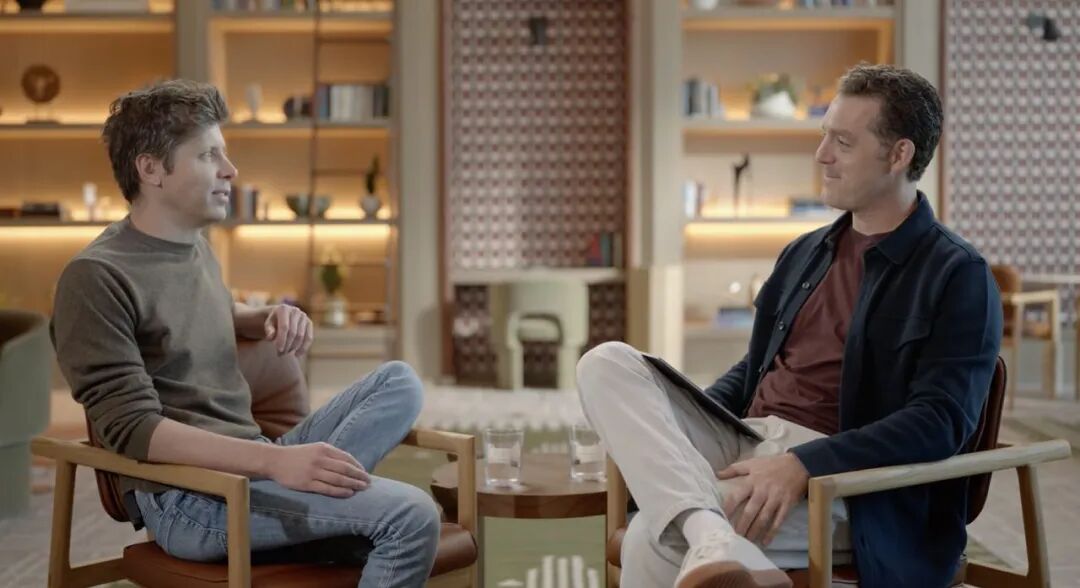
AI may produce candidate treatment plans for major diseases in the next few years
Matthew Berman: First of all, I want to talk about some of the results you announced last week, including mathematical proofs and scientific discoveries. I think these advances are incredible, but for ordinary people who have not followed this field in depth, can you explain what exactly these achievements mean?
Sam Altman: I think we are entering an era where AI can help humans discover important new knowledge.
We have been talking about this topic for a very long time. Such changes may have started to appear earlier this year, but now the situation has become very clear: AI is completing some extremely difficult tasks, solving very complex problems, and discovering truly important new knowledge.
I believe that the methods that have worked in the field of mathematics can also be applied to biology, materials science and energy research. It can help us develop new drugs, find new energy sources, and drive scientific discoveries in more fields.
This has always been one of the most exciting things for me.
I think this progress will have a huge impact on people's lives. However, most people may not directly feel that they are using AI. They will only find that the world is getting better and society is moving forward normally.
But in my opinion, the impact behind this will be transformative.
Matthew Berman: Starting from the daily life of ordinary people, what tangible and perceptible changes do you think these scientific discoveries will bring? How long do we probably need to wait?
Sam Altman: I hope that within the next few years, we will see some major achievements.
Of course, the FDA (U.S. Food and Drug Administration) approval process takes time.
So I want to distinguish between two points in time: one is when AI helps us discover a treatment or cure for a major disease, and the other is when such a solution is actually tested and finally applied in clinical practice.
I hope that in the next two years or so, we can find the first truly significant candidate treatment for a certain major disease. But it still needs to go through subsequent tests. I think we may need to reform part of the process after new drugs are discovered, so that these treatment plans can benefit patients faster.
However, I am not saying that the existing regulatory and testing mechanisms are not valuable. On the contrary, I am very glad that we have such a process.
Any system has room for improvement, especially in the field of drug research and development and approval. But when we take a drug, it is a very good thing to know that it has been tested for safety and is generally considered safe.
Matthew Berman: Are there any specific AI-driven or AI-discovered research projects that excite you particularly right now? Do you think it is likely to make a breakthrough soon?
Sam Altman: Emotionally speaking, what excites me the most is still major breakthroughs in the field of physics. I hope such discoveries will come soon. Of course, I don't know if this is necessarily the most important thing for all of humanity, but this is the direction I personally look forward to very much. I have a feeling that we will really usher in a major physical discovery. Just thinking about it makes me feel very excited.
"AI allows developers to earn more money"
Matthew Berman: Some people in the mathematics community react to AI breakthroughs by saying: "We didn't ask it to do these things." This reminds me that when AI first started writing a lot of code, software engineers once had similar reactions. Where do you think this resistance comes from? And how will it evolve in the future?
Sam Altman: Programming is a very interesting example. Before discussing why people have such emotions, I want to talk about what has already happened in the programming field. Before, many people thought that programmer jobs would disappear, and humans would no longer need to write code in the future.
But what we see now is that programmers may be busier than ever, their impact may be greater than before, and they may earn more money.
Of course, the specific content of the work has changed a lot. But we still need to hire people to let computers complete various tasks. Moreover, this demand seems to last much longer than many people originally expected.
You know, just six or twelve months ago, many people were very convinced that things would not develop in this direction. There is a lot of experience worth summarizing here.
A particularly interesting finding is that the world's demand for software actually far exceeds what any of us previously imagined.
Matthew Berman: But mathematical research may be different?
Sam Altman: Yes. I think the reason why some mathematicians react to the development of AI in this way is that we are not yet sure whether there will be such a huge new demand in the field of mathematics as in software development.
However, I have begun to see some changes similar to those in the programming field. For example, we may no longer need to rely entirely on humans to independently discover new mathematical theorems or complete mathematical proofs.
Perhaps this part of the work is coming to an end, or at least undergoing fundamental changes. But at the same time, we also find that some extremely complex and incomprehensible mathematical proofs do not necessarily directly help people.
Now, some people have begun to take an interest in another type of work: understanding these new mathematical ideas, figuring out what they mean, then translating them into content that ordinary people can understand, or writing beautiful and clear mathematical proofs.
I believe other new jobs will emerge.
There is no doubt that what it means to be a mathematician last year will be different in some respects next year. We may find that there are many other jobs for mathematicians that people really need, and with the help of AI, they can do these things better.
As for whether this will mean that society's overall demand for mathematicians will increase, I do not know. But I think there is indeed a very important change here.
Matthew Berman: You mentioned before that you have never been as busy as you are now, with endless things to do every day. This is actually a bit counterintuitive. Many people originally thought that AI would make humans more and more leisurely, and even leave us with less work to do.
Sam Altman: Yes, maybe one day in the future it will be like this. But now, things are far from as simple as they seem. I have always hoped that people can work less, not be so busy, and have more time to do other things in life. I think technology is supposed to help us achieve this. I also sincerely hope that such a future will come. But the reality is, we seem to be particularly good at constantly asking for more things from life, constantly asking the world to provide more things, and finally making ourselves busier.
Matthew Berman: I think this is human nature. If we were content with the standard of living a hundred years ago, with today's production efficiency, we might only need to work one hour a week. But the reality is not like this. Moreover, I think this tendency in human nature to constantly pursue more is actually a beautiful thing. For example, a few weeks ago, my video editor started using Astra to edit our shows. They are still responsible for directing the videos and deciding what the videos should look like, but they no longer need to operate the editing timeline in person. This is incredible, and it happened almost overnight. As a result? We made more videos, and the editors became busier than before.
Sam Altman: What surprises me is that I now often hear other people tell almost exactly the same experience. More and more people are saying that AI helps them complete the work they originally needed to do by hand, but instead of being free, they start to take on more tasks.
If AI discovers major scientific achievements, will OpenAI make them public or retain commercial advantages?
Matthew Berman: Talking about AI-driven scientific discoveries, I am curious how you will handle the relationship between the disclosure of scientific results and commercial interests? Suppose AI or OpenAI discovers an important mathematical proof, or makes a scientific breakthrough with great commercial value. Will you choose to make these results public? How do you balance the company's competitive advantage with the benefits of public results to all of humanity?
Sam Altman: I will answer this question later. However, I found that I did not fully answer another question you raised at the beginning, which is why some people feel lost when AI takes over work that originally belonged to humans.
I think innovation and solving difficult problems are in themselves an important source of fun in many people's lives. We must face the reality squarely: AI will be very good at completing these tasks. Of course, some problems will always belong to humans. For example, what things are worth cherishing and what things are truly valuable, these are always questions that humans need to answer themselves.
In addition, we will also very much want humans to participate in how to interpret research results and how to make others understand these results.
But at the same time, I do accept this trade-off. I hope we can find cures for diseases as soon as possible, even if it means that some people lose the opportunity to spend decades personally overcoming these problems.
I believe most people will agree that we should not delay the discovery of disease treatments in order to retain the pleasure of this kind of research.
But I also admit that in this process, we are indeed losing something real and precious. For many people, solving difficult problems is a great enjoyment in itself. Take my own work as an example. What makes me feel most satisfied are often those really difficult problems. Maybe they are not the most pleasant part of the work process, because they are really difficult to solve.
But when I finally solve a difficult problem, I will have a special sense of satisfaction: I have completed a difficult thing, I am proud of myself, and I know that my ability has improved again.
I don't have the answer to this change yet. But I can understand why some people will feel a sense of loss, even a kind of sadness, due to the progress of AI.
Matthew Berman: It's a bit like making a choice between two things. On the one hand, there is the pleasure of completing the work in person, such as writing code, or writing very beautiful code. On the other hand, there is the final delivery of a product. AI is making it easier and easier to deliver the final product, but at the same time, people have fewer and fewer opportunities to personally participate in the specific creation process.
Sam Altman: I think people are finding the joy of creation in new ways. Think back a long time ago, when programmers stopped using punch cards and started writing programs that could be handed over to compilers, some people might lament: "The art of programming is gone."
They might think that if you only need to write code and let the compiler handle it, then the old craft of completing every step in person will no longer exist. But I do understand this feeling. I myself have felt similar changes in many ways. Even so, I am still excited to move towards such a future. I believe that we will all find new satisfaction in the end, and hope that these new satisfactions can be better than before.
"I haven't read a line of code in a year, and I may never program in person again in the future"
Matthew Berman: Is there anything recently that you have already handed over to AI to complete? That is to say, you no longer perform a specific task in person, but raise your role to the level of supervising and managing AI agents?
Sam Altman: I think this is exactly an example of what we just discussed.
I suddenly realized that I might not have read or even looked at a line of code for about a year. I never needed to program for work, but in the past I occasionally did some small personal projects. For example, when I suddenly needed a certain tool, I would write a very simple program by myself.
This is actually a very interesting thing. At least occasionally writing code in person is still a lot of fun. But I don't think I will ever do that again. Even if I start writing code again one day, it will probably be like people reenacting historical scenes from the American Revolutionary War, which becomes a nostalgic activity.
When I get old and feel bored, maybe I will want to recall the good old days - those glorious years of writing code in person.
Matthew Berman: I understand this feeling.
Sam Altman: Also, going back to the question about scientific discoveries just now. I think some basic scientific achievements should belong to the whole world, and we should promote this kind of research as a public good. Until not long ago, we did not really have models with end-to-end capabilities to discover important new knowledge. For example, past models could not independently complete the design of an entire chip.
Today, if a company wants to discover a new material, it can organize a group of researchers to use Codex or a large number of API call quotas to complete related research with the help of AI. But as models become smarter and more capable, the situation may change. Just as AI has been able to solve extremely difficult mathematical problems, in the future, as long as it has enough computing resources and enough data from the real world, it may be able to directly discover new materials