Exiting the market in just 188 days, AI products from major tech companies are undergoing accelerated reshuffling.
A product codenamed "Lobster" is about to be phased out, and the next round of competition for Personal Agent has already begun.
On September 24, Tencent QClaw announced that due to business development adjustments, it will cease operations on December 24, 2026, and provide tools to help users migrate their data to another Tencent product, WorkBuddy. Only 188 days have passed since QClaw entered public beta on March 20 until the announcement of the server shutdown arrangement.
On the other side, major tech companies are stepping up their layout in new tracks. On October 13, Alibaba Qwen announced that it will soon release the personal assistant product "Qwen Go!" to help users handle affairs such as flight delay claim, shopping price comparison, and telephone reservation. Earlier, ByteDance was also exposed to be advancing its personal assistant product, and the related project was once codenamed "Spell".
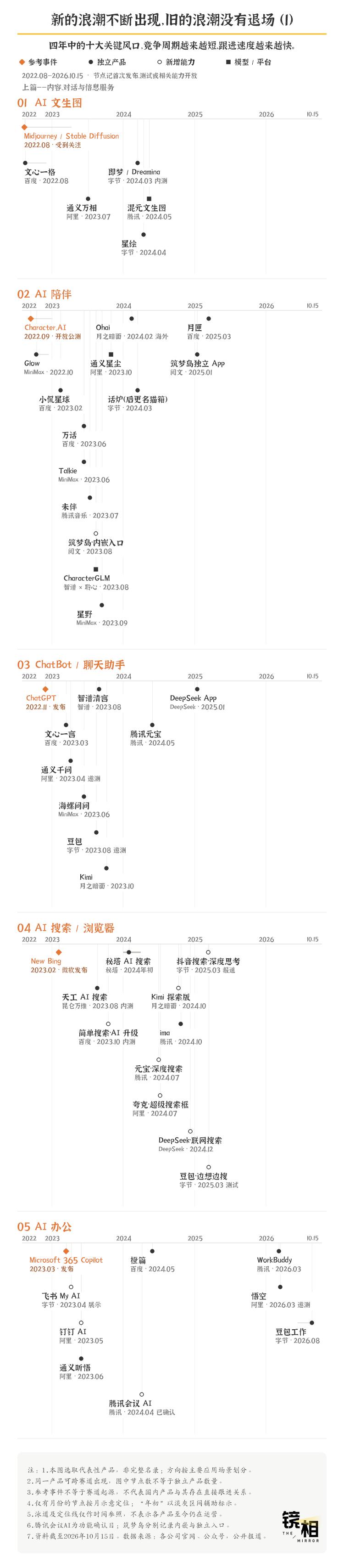
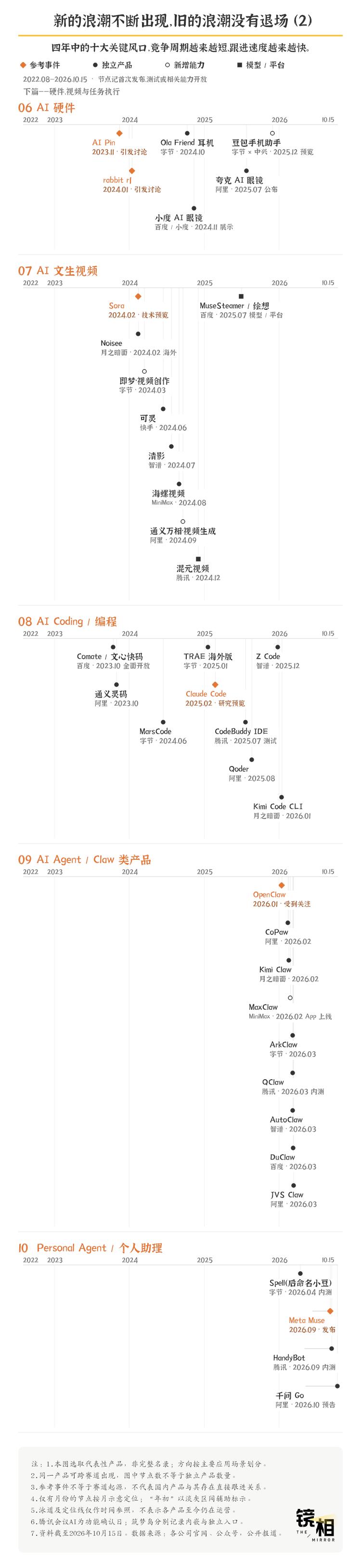
Such scenarios have occurred repeatedly in the past four years. We have sorted out the product actions of eight companies including Tencent, Alibaba, Baidu, ByteDance, Moonshot AI, Zhipu AI, MiniMax and DeepSeek on ten major AI tracks.
The data presents two core characteristics: first, the competition cycle is shortening extremely rapidly. From text-to-image generation and ChatBot to video generation and AI Agent, new industry trends keep emerging one after another; second, the product life cycle is getting shorter. Renaming, integration and service suspension have become the norm, and independent products are continuously converging to general assistants and underlying platforms.
Companies are constantly expanding the scope of what AI can do, and constantly correcting what scenarios are worthy of being made into a separate independent product.
Four years and ten tracks: more and more industry trends, and major companies are following up faster and faster
In the past four years, the popularity of landmark AI products often drives the entire industry to redistribute attention, and these changes have left clear marks on the timeline.
In 2022, text-to-image generation tools such as Midjourney and Stable Diffusion attracted widespread attention. The experience of "typing one sentence to generate an image" became the starting point for many people to get to know generative AI. Domestic companies followed up rapidly, and products such as Baidu's Yige by ERNIE and Alibaba's Wanxiang by Tongyi were launched one after another, and AI officially entered scenarios such as painting, design and content creation.
Subsequently, the large language model ChatGPT pushed this boom to a wider audience. In 2023, products such as Baidu's ERNIE Bot, Alibaba's Tongyi Qianwen, ByteDance's Doubao, and Moonshot AI's Kimi were unveiled intensively. The chat box has gradually become the basic form of AI applications, and different demands such as search, office and companionship are also developed around it.
By 2024, the industry is exploring in two directions at the same time: on the one hand, it is multi-modal video generation, and products such as ByteDance's Jimo, Kuaishou's Keling, Zhipu AI's Qingying, and MiniMax's Conch Video have emerged one after another; on the other hand, it is AI hardware. Alibaba, Baidu, ByteDance and other companies are trying to install smart assistants into devices such as earphones and AI glasses to seize user entrances beyond mobile apps.
Popular AI tracks are emerging one after another, the competition cycle is getting shorter and shorter, and the follow-up speed of various companies is also getting faster and faster.
Taking the "Lobster" product as an example, from January to March 2026, various "Lobster" products came one after another. In March alone, five companies including ByteDance, Tencent, Zhipu AI, Baidu and Alibaba publicly launched their own "Claw-like" products. Compared with the long months from the release of ChatGPT to the follow-up of domestic large models, the waiting time left for companies for new hotspots is running out.
These waves are not a simple "sequential substitution". While new directions are constantly emerging, investment in old directions is still continuing. What companies are facing is not only to find the next industry trend, but also to decide in the continuously overlapping layouts: which products are worthy of continued investment, which capabilities can be merged, and which experiments should be ended.
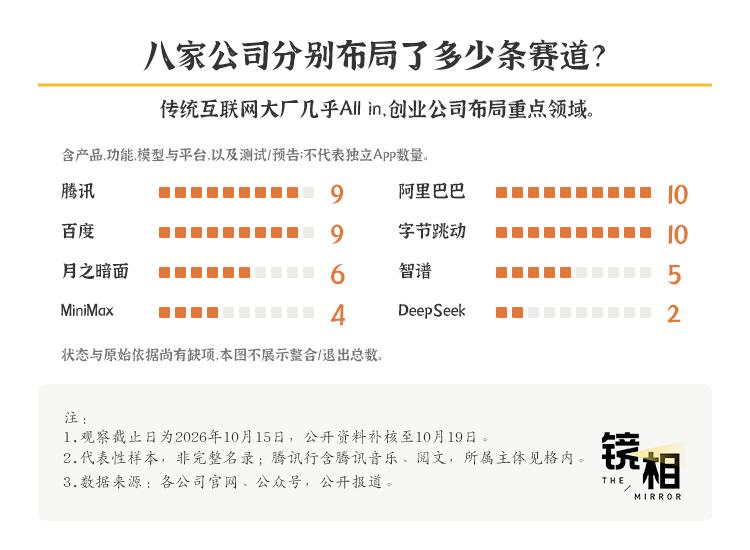
Major tech companies "want all", while startups "focus on key tracks"
Among the ten tracks counted this time, Alibaba and ByteDance cover all ten tracks, and Tencent and Baidu cover nine each. In contrast, among the four new AI startups, Moonshot AI covers six tracks, Zhipu AI covers five, MiniMax covers four, and DeepSeek only covers two.
Behind this difference lies the difference in resource endowment and business focus of the companies. For large internet companies, AI is not only a way to open up new businesses, but also a tool to transform their original ecosystems. No matter it is search, content, office, e-commerce or hardware, their huge existing users and business scenarios provide them with sufficient test fields, and also give them more markets that they need to hold.
AI startups with a weaker foundation need to make strategic trade-offs: decide where to allocate core resources first.
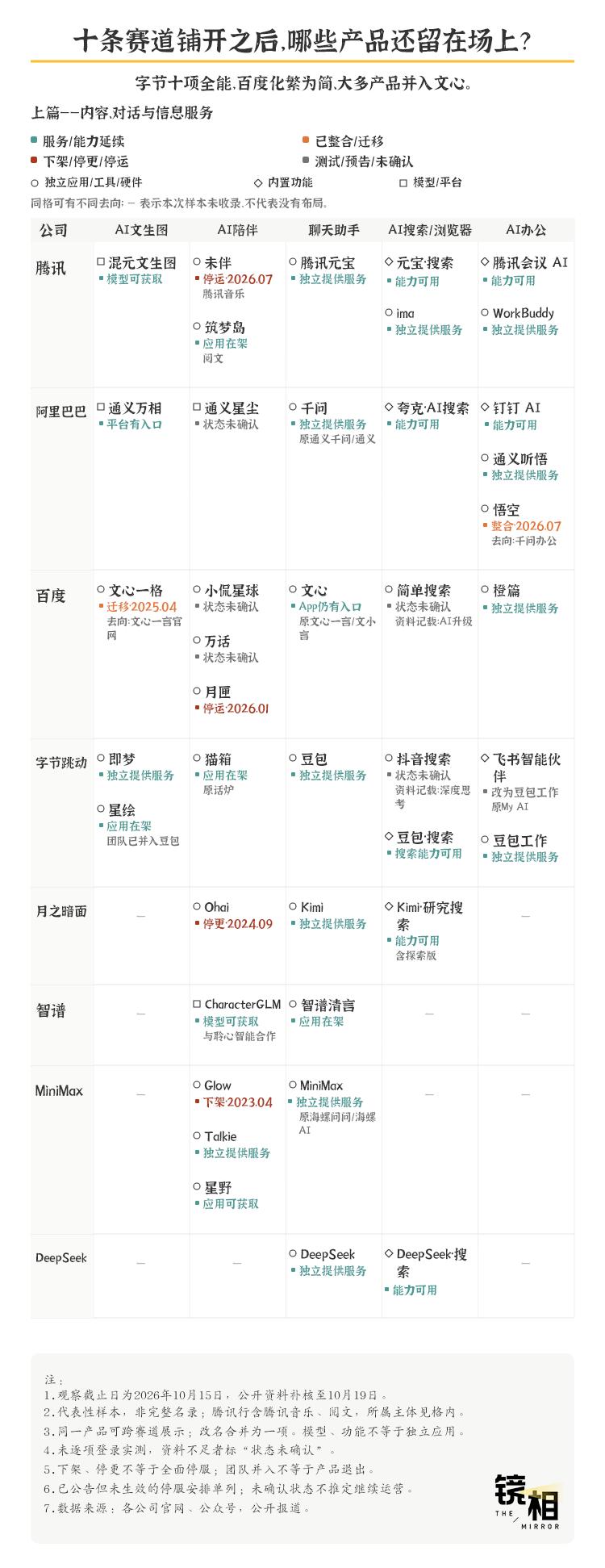
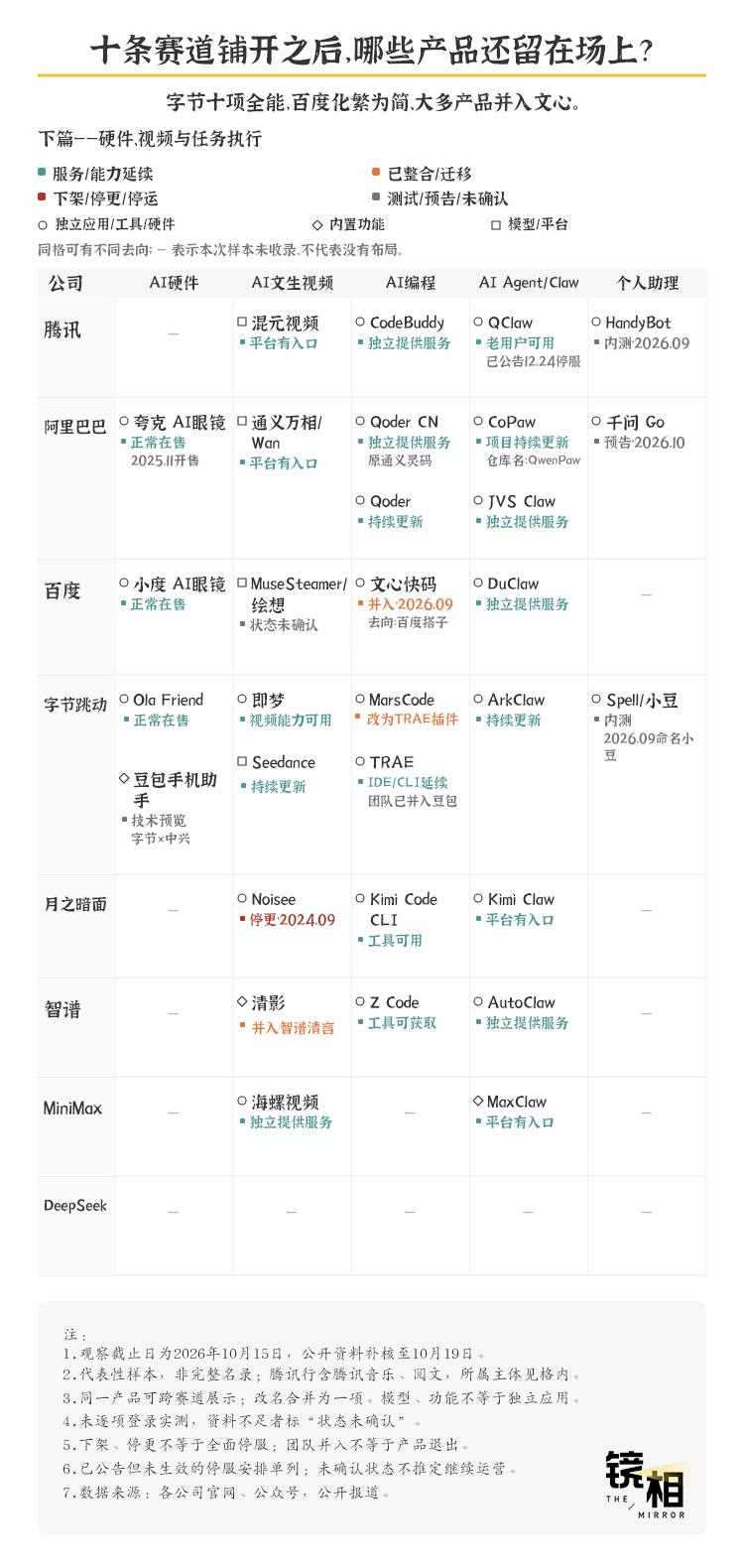
After the tracks are fully laid out, which products are still on the field?
Entering a track does not mean that you can always maintain an independent product. It can be seen from the statistical chart that after the tracks are fully laid out, all companies are constantly adjusting the form and retention of their products.
All companies retain the basic entrance, while other tracks are reshuffled frequently.
All eight companies have deployed chat assistants, which is the basic entrance for undertaking search, creation and task processing. But in other directions, product withdrawal and service suspension happen from time to time.
Take AI companionship as an example. In the past four years, MiniMax's Glow was removed from shelves, Moonshot AI's Ohai stopped updating, Tencent Music's Weiban and Baidu's Yuexia ceased operations. But in the same track, products such as Talkie, Xingye and Maoxiang are still operating normally.
After spreading their layout widely, major tech companies generally move towards internal integration and convergence.
ByteDance is characterized by a wide layout, and constantly adjusts the division of labor between products. Doubao, Jimo and Maoxiang undertake different demands respectively, the Xinghui team was merged into Doubao, the MarsCode programming assistant was changed to a TRAE plugin, and the TRAE team was later merged into the Doubao system...
Some of Baidu's capabilities are converging to its existing system. Yige by ERNIE was migrated to ERNIE Bot; ERNIE Speed Code was merged into Baidu Buddy; the chat assistant experienced renaming and entrance migration from "ERNIE Bot" to "Wenxiaoyan" and then to "Wenxin". While it continues to participate in multiple directions, it reduces some independent entrances.
Alibaba and Tencent also have integration phenomena. Alibaba's "Wukong" was integrated into Qwen Office in July 2026; Tencent's QClaw has announced that it will stop service in December 2026, and guide users to migrate to WorkBuddy.
The paths of startups have diverged.
DeepSeek's consumer product layout is relatively concentrated. Compared with other companies that constantly launch new names and new entrances, it mainly adds capabilities around smart assistants. Zhipu AI's text-to-video product "Qingying" was merged into "Zhipu Qingyan"; MiniMax's general assistant "Conch AI" was later renamed MiniMax, and the original brand was shifted to the video business.
Product suspension or integration not only involves changes in user demands and intensified market competition, but also stems from internal resource trade-offs of the company. The layout at the time of release is only a starting point. After continuous investment, companies can decide which products are worthy of independent existence.
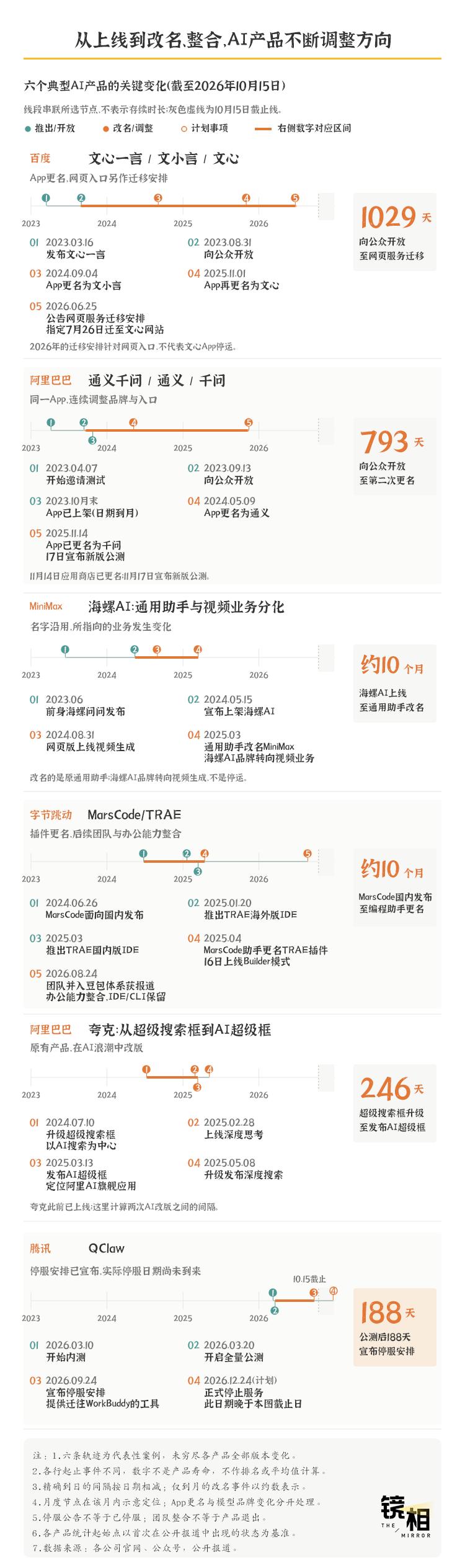
Trajectories of six typical products: renaming, business divestiture and merger
Observing the iteration trajectories of six typical products, a recurring action is: renaming.
Baidu's ERNIE Bot was first renamed to Wenxiaoyan, and then to Wenxin; Alibaba's Tongyi Qianwen was first simplified to Tongyi, and then renamed to Qwen. From the public opening of the products to the second renaming, the two processes took 1029 days and 793 days respectively.
The change of name is often accompanied by the company's rearrangement of product positioning and business boundaries.
About ten months after MiniMax's Conch AI was launched, its general assistant was renamed MiniMax, and the original "Conch AI" brand was shifted to the video business. The name still exists, but the main purpose it points to has changed.
About ten months after ByteDance's MarsCode programming assistant was released in China, it was renamed to TRAE plugin. With the launch of the TRAE independent development environment, the original programming assistant was put into a larger product system and became one of its usage modes.
Quark continues to revise along its original product. From upgrading the "Super Search Box" in July 2024 to releasing the "AI Super Box" in March 2025, 246 days have passed. It tries to expand the familiar search entrance for users into an AI application that can handle more tasks.
Of course, some products did not wait for the opportunity to "rename". Tencent's QClaw entered public beta in March 2026, and announced the service suspension arrangement in September (it is planned to stop service in December). Only 188 days passed from public beta to the announcement of service suspension. The life cycle of less than half a year reflects that the fault tolerance rate of product trial and error in new tracks is decreasing sharply.
For companies, integration can concentrate investment and reduce redundant construction; for users, frequent renaming and migration also mean that they need to re-identify the entrance and adapt to the operation mode.
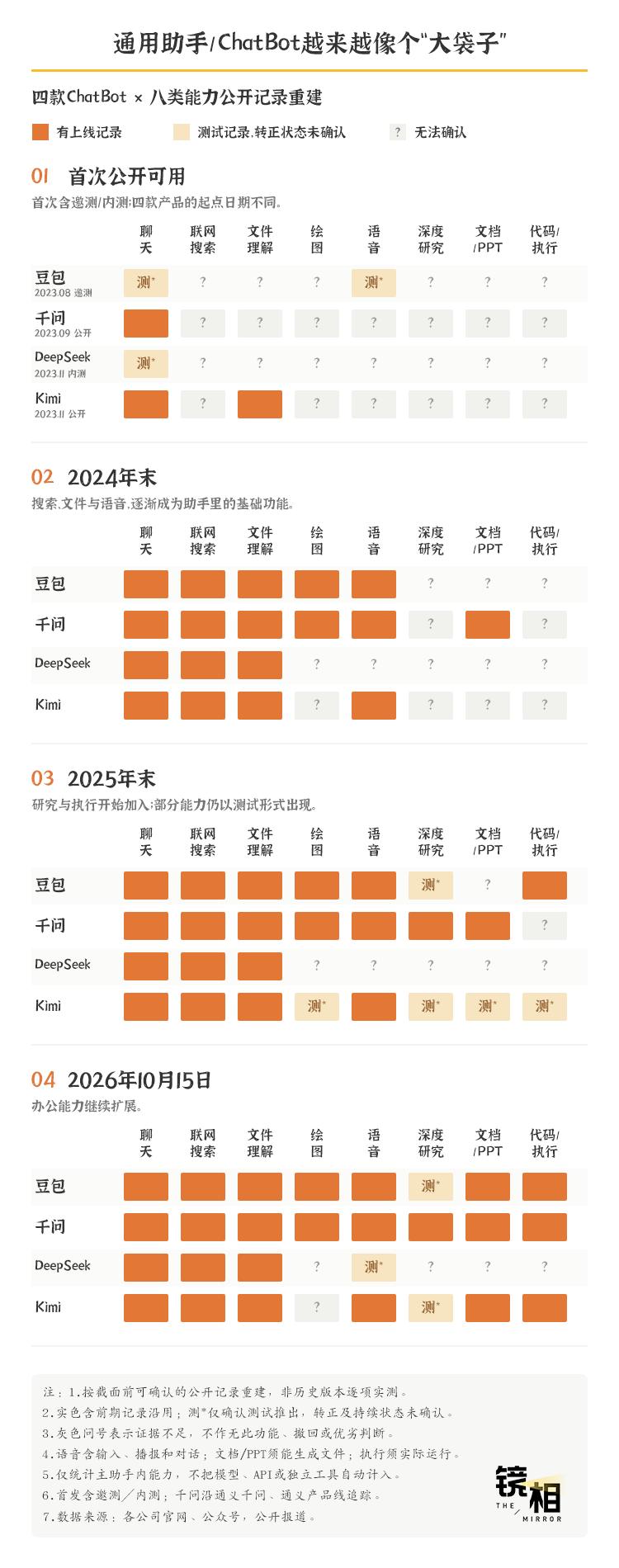
General assistants are becoming more and more like a "grab bag of functions"
Independent products are constantly differentiating and integrating, and general assistants can do more and more things.
From chatting, to web search and file understanding, to drawing, speech, in-depth research, document generation and code execution, the product directions that were originally discussed separately are gradually integrated into the same assistant.
The public records of four sample products show that by the end of 2024, Doubao, Qwen, DeepSeek and Kimi already have three common capabilities: chatting, web search and file understanding. After that, research, office and execution capabilities continued to be added to some assistants. By October 2026, Doubao, Qwen and Kimi have all launched document generation and code or tool execution capabilities, and the product differences of general assistants of various companies are getting smaller and smaller.
Independent products need to re-acquire users and cultivate their usage habits. Adding functions to existing assistants can continue to use the original accounts, entrances and user relationships. For users, a complete task often spans multiple directions — first search for materials, then read files, and finally make reports or PPT. Being able to complete these steps continuously may be more attractive than having multiple disconnected tools.
However, when more and more general assistants can search, write and generate content, the difference is no longer only determined by the function list. Whether the result is reliable, whether the task can be completed continuously, how many times the user needs to correct it repeatedly, and whether the service price is reasonable, all will affect which product the user finally chooses to stay and use.
The wave has surged for four years, and the ten major tracks are already full of products. QClaw's 188-day exit is not an isolated case, but the norm in this brutal competition. Old products are exiting or moving towards integration one after another, and the competition among all companies for the next generation of super entrance has just begun.
This article is from the WeChat official account "Mirror Studio", written by Huang Yiting, published with authorization from 36Kr.