Xtep's sales declined in the third quarter. Why did its "marathon dominance" fail to prop up its performance?
Today (October 23), Xtep International (01368.HK) announced that in the third quarter of 2026, the retail sales of Xtep's main brand in mainland China recorded a mid-single-digit year-on-year decline. Compared with the same period last year, the retail sales of Xtep's main brand posted a low single-digit year-on-year growth.
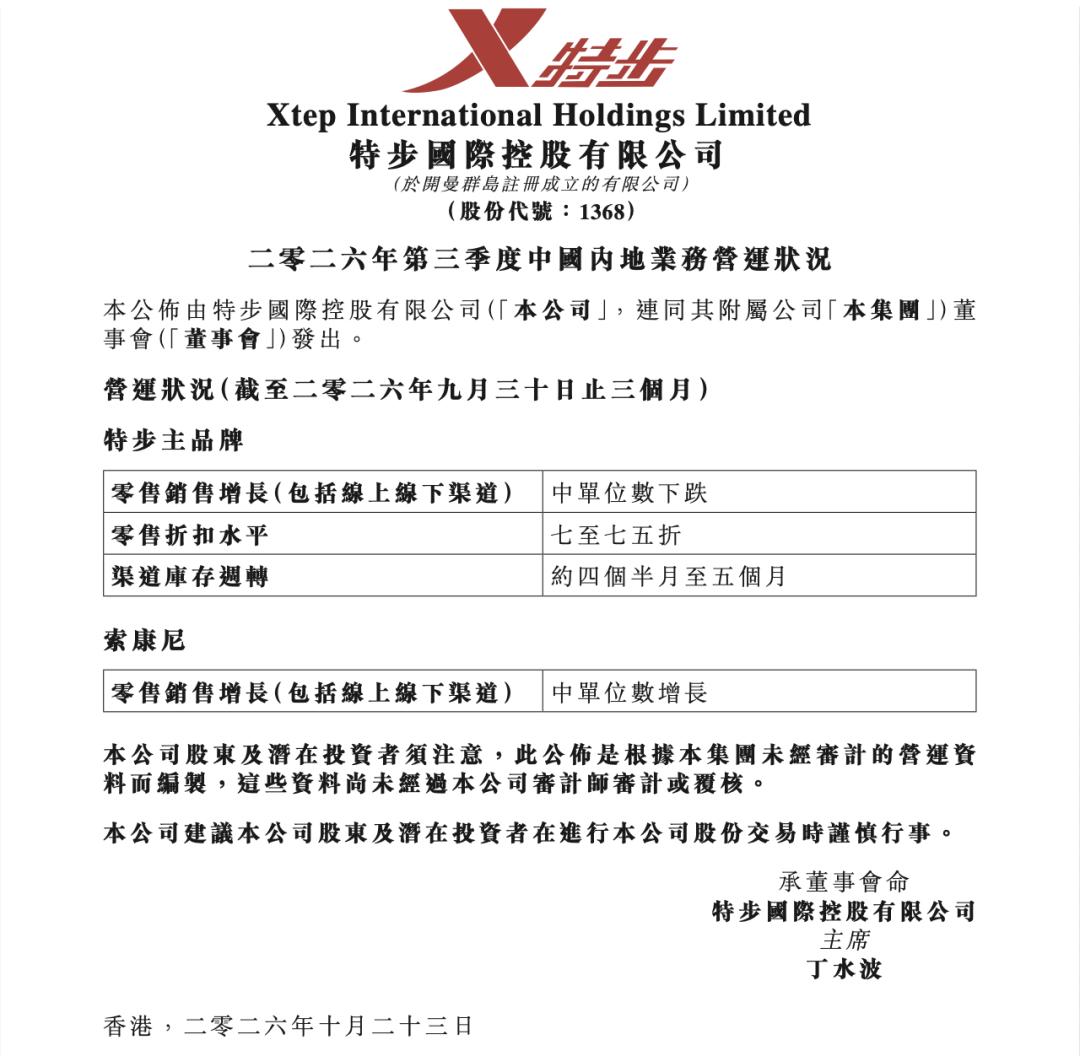
The inventory turnover period of Xtep's main brand has lengthened, rising from 4-4.5 months in the same period last year to 4.5-5 months.
However, on the running track, there is hardly any sign of loosening in Xtep's dominance.
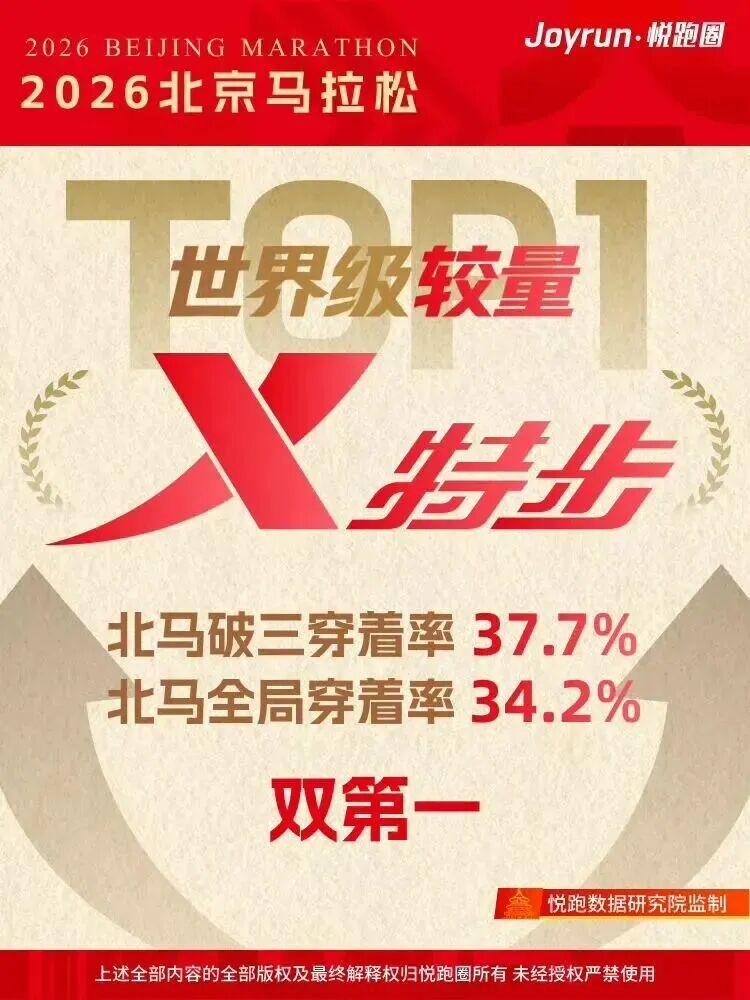
On October 18, the 2026 Beijing Marathon (hereinafter referred to as "Beijing Marathon") kicked off at Tiananmen Square. Xtep not only ranked first for the fourth consecutive year with an overall wearing rate of 34.2%, but also achieved a 37.7% wearing rate among sub-3-hour runners, also topping the list.
To visualize this data, on average, 1 in every 3 sub-3-hour runners wears Xtep products, leading the second place by more than 20 percentage points.
According to Spicy Chili's understanding, Xtep's sports marketing strategy is to sign well-known runners in the marathon circle as much as possible. The signing fee for top marathon athletes is about millions of yuan per year, while second-tier athletes usually adopt a single-event cooperation model, with a cooperation fee of hundreds of thousands of yuan each time. In addition, Xtep has also cooperated with a huge matrix of athletes.
However, a more fundamental problem remains unsolved: Xtep's wearing rate in the marathon track has reached an "unrivaled leading" level, but why is the corresponding performance not reflected in its financial reports?
The Global Carbon-Plate Running Shoe Trend Cools Down, Xtep's "Over-Professional" Positioning Becomes a Shackle
Looking at the international market, you will find that professional carbon-plate running shoes are ebbing globally, which is exactly Xtep's core competence.
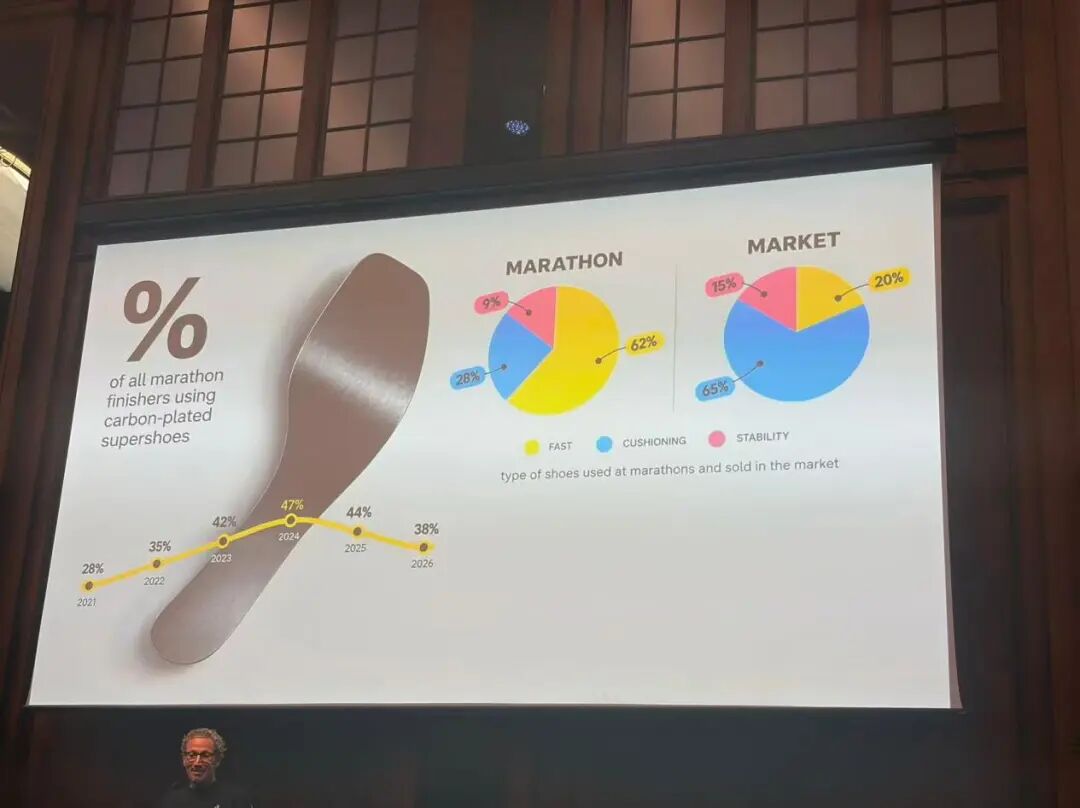
Data disclosed at the just-concluded 2026 Global Running Conference shows that from 2021 to 2024, the number of marathon finishers wearing carbon-plate running shoes worldwide rose from 28% to 47%. After 2024, the wearing rate of carbon-plate running shoes among marathon runners has shown an obvious downward trend. In 2026, this figure has dropped to 38%, indicating that the number of marathon runners willing to wear carbon-plate shoes may be close to saturation.
Cheng Yang, General Manager of Anta Running, also confirmed this judgment on a podcast. He could not find carbon-plate running shoes on the shelves of Foot Locker, an overseas sneaker dealer store. "Most of the products are Nike's mass cushioning shoes Vomero, without carbon plates, no top-level configurations stacked, and they sell for comfort." The proportion of carbon-plate training shoes is shrinking, while the proportion of entry-level cushioning daily shoes is growing. Cheng Yang also shared a detail: when the first generation of PG7 was launched, it was criticized for being too soft, Anta adjusted it to be harder, but the result was poor sales. "Chinese consumers say they need support, but they choose soft shoes when paying."
The shoe selection logic of consumers and the changes in the global market are very helpful for understanding Xtep's current situation.
In 2019, Xtep launched the first generation of 160X running shoes, which was mainly equipped with full-palm carbon plate + XTEP ACE midsole technology, positioned as marathon racing shoes. It was 2020 that really made this series popular. At the Nanjing Marathon that year, athletes including Peng Jianhua, Yang Shaohui, and Duobujie wore the 160X series and achieved excellent results, and the 160X began to be known by mass runners.
At the 2023 Wuxi Marathon, He Jie and Yang Shaohui, wearing the 160X 3.0 PRO, won the championship and runner-up respectively, both breaking the Chinese men's marathon national record that had been dusty for more than 15 years. This pair of shoes thus became the label of serious runners.

Xtep's investment in the marathon track over the past few years is essentially to build a "professional" label among the runner group. However, the purchase logic of mass runners is not exactly the same as that of professional runners.
In the view of some industry insiders, runners will become more and more professional in the next five years, "The narrative of packaging professional-level equipment as the top configuration that everyone should have is losing its effectiveness."
The carbon-plate shoe market has peaked and declined on the marathon track, and the mass market may be the real growth point for brands in the future. Xtep's professional advantage in the carbon-plate track is facing the risk of category penetration peaking.
Xtep wants to move towards the mass market, but the marathon track and the mass market are two completely different brand logics. For brands, the professional arena is a winner-take-all circle, while the mass market is highly fragmented, where every brand has the opportunity to reach consumers, and it is a comprehensive competition of channels, prices, product matrices and brand awareness.
There are many product posts about Xtep on social media, a large part of which talk about the loyalty of runners to the Xtep 160X series. One runner said: "I have worn the 160X series from the 3rd generation to the 7th generation, and a pair of shoes can basically run 2000 to 3000 kilometers." This is the choice of core runners, but it does not automatically spread outward.
"The top of the pyramid is propped up, but when it comes to mass consumption, people no longer recognize the premium of Xtep," an industry insider told Spicy Chili. This sentence points out Xtep's current shackle: the professional reputation accumulated by the brand among elite runners has encountered attenuation when transmitted to the mass market. "Consumers know that Xtep is very strong on the marathon track, but they don't think it has anything to do with buying a pair of daily running shoes for themselves."
The Xtep Running Club Members Are Still There, But Xtep's Private Domain Traffic Is "Losing Blood"
Xtep spent ten years building almost the most complete running ecosystem among domestic sports brands: event exposure, athlete endorsements, the Xtep Running Club community, and offline touchpoints of running clubs. The design logic of this link is very clear: runners see Xtep on the track, scan the code to join the association, become members, then go to the local running club to store bags, take showers, buy shoes, and finally be repeatedly activated by the community to form repurchases.
The problem is that this link is breaking from the middle.
The first breakpoint is price.
It is not a problem that running clubs and specialty stores sell the same products. The problem is that the price consumers can buy online is lower than the purchase price of club franchisees. According to reports, the 160X 3.0 PRO has been continuously restocked and replenished on e-commerce platforms, the online price was once reduced to about 40% of the tag price, while the purchase discount for club franchisees "cannot be that low". The 160X 7.0 PRO released last year has experienced billions of subsidies and dealer clearance on e-commerce platforms, with an average discount rate of 50%, while it still maintains a 20% to 30% discount in physical stores.
This means one thing: after trying on shoes in the store, members of the running club can completely take out their mobile phones and place an order on the e-commerce platform at a lower price. The physical store bears the costs of experience, fitting, and community services, but cannot get the transaction.
In the second half of 2026, Xtep has a total of 63 running clubs, compared with 71 half a year ago. A reduction of 8 stores in half a year is the first obvious contraction of Xtep's running clubs since the first one opened in 2016.
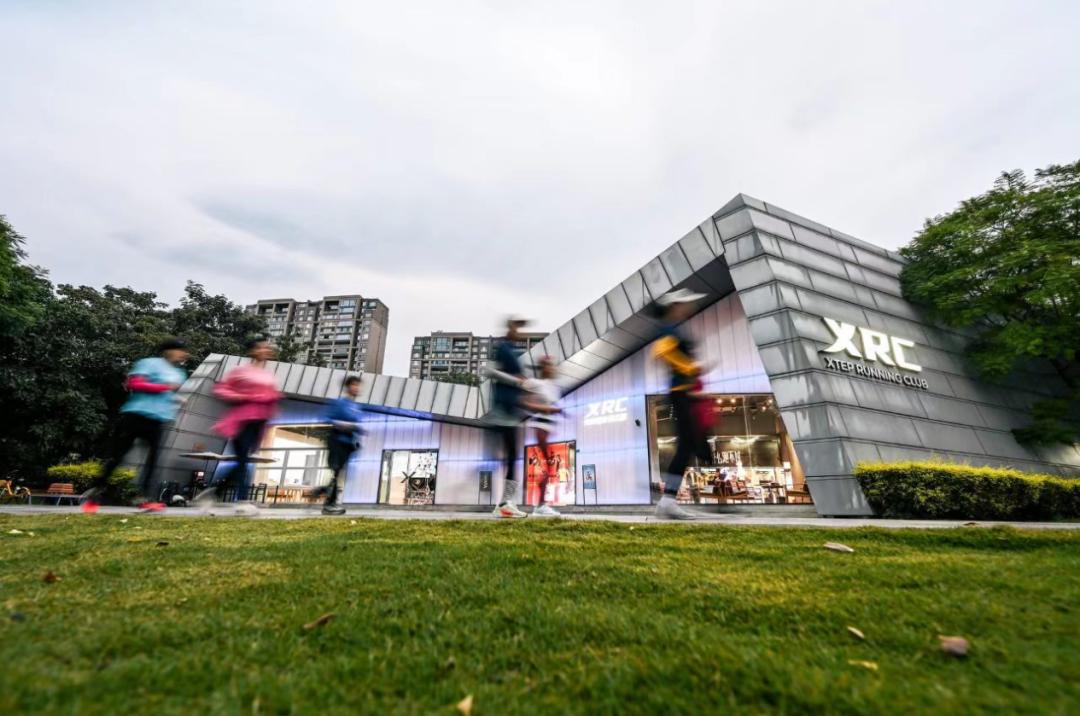
The second breakpoint is the community.
The number of Xtep Running Club members has exceeded 2.5 million, and the total number of running groups has exceeded 7,000. This figure is almost unrivaled among domestic sports brands. But quantity does not equal activity.
The core of Xtep Running Club is still serious runners. Running clubs are located at running landmarks such as parks and gymnasiums, providing services including bag storage, shower, and professional running shoe sales. These services precisely meet the needs of marathon runners, but ordinary runners who only run 5 or 10 kilometers at a time can hardly find a reason to step into the Xtep Running Club community.
The fundamental problem of Xtep's community operation is that it has been serving the small group of people at the top of the pyramid, but has not designed an entry for the broader group of casual runners.
In comparison, according to statistics from Spicy Chili, KAILAS's "Rock Solid Action" held more than 200 offline events in the second quarter of 2025, covering different levels of outdoor enthusiasts from rock climbing, cross-country to hiking. On's "On Run Club" organizes weekly night runs in multiple cities without pace requirements, which can be undertaken by ordinary stores. HOKA's "Fly Run Carnival" relies on key stores in key shopping malls across the country, combining running with music and markets to attract a large number of non-core runners to participate. The community operations of these brands have one thing in common: they are not highly dependent on professional runners, and are open to all people interested in the sports lifestyle.

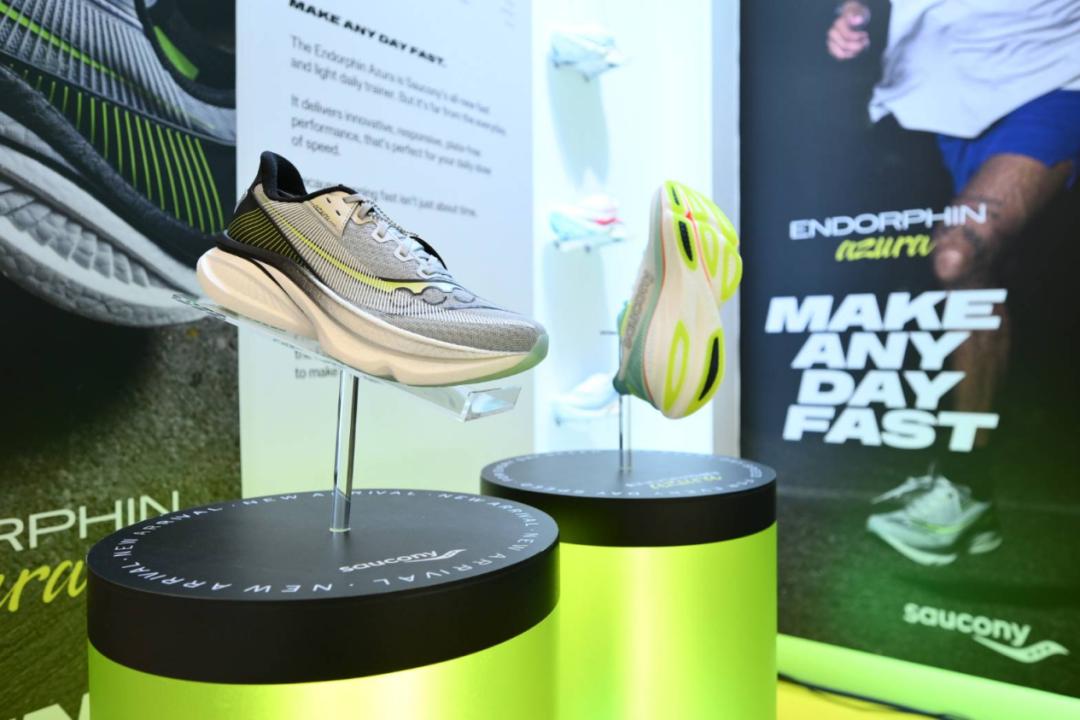
The practice of Saucony, a sub-brand under Xtep, is more worthy of reference. Although the brand signed Cai Xukun in the first half of this year, Saucony did not put all its resources on star endorsements. Their strategy can be clearly summarized as "using communities to replace stars". In 2026, Saucony opened a pop-up space called "House of Endorphin" in Bangkok, positioned as a meeting point for runners and a product experience place, which is planned to operate for about six months. At the same time, it launched "The Maze" running event, which does not compete for speed, focuses on participation and fun, and targets ordinary running group members.
Saucony's product line is also cooperating with this strategy: the TRIUMPH LFS WOOOLLY lifestyle shoe is positioned to "balance commuting and light sports scenarios", while the GUIDE 19 is officially labeled as "suitable for daily jogging, gym training and all-day wear". By transforming running shoes from "running-specific" to "daily wearable", Saucony's path is to let the public wear the shoes first, rather than making them look up to professionalism first.
Xtep's marketing resources are highly concentrated in event sponsorship and athlete signing. The brand has spent money and indeed made a lot of noise in the market, but behind this, "the closed-loop link from event naming to community conversion is too long, and Xtep's refined operation is not enough."
In most cases, to achieve the closed loop of the entire link, brands need more participation and commitment from non-governmental community organizations. What community operations require is continuous human, material resources and refined operation. Multi-department collaboration, product side upgrading, and sales team support cannot be solved by a single press conference or a single spokesperson.

The contraction of running clubs, on the surface, is because franchisees cannot make money, and in the deep sense, Xtep's private domain has not been truly established. Xtep's wearing rate advantage on the marathon track is not fully synchronized with its profitability in the running business, because the brand ultimately relies on mass-produced products, which are commonly known as "casual shoes" and "walking shoes".
The wearing rate measures the market share on the track, but the activity of the community depends on whether it can retain people. With the contraction of physical stores and the fault of the community, traffic will inevitably be lost. The running ecosystem built by Xtep over ten years is starting to loosen from the node closest to runners.
Professional Reputation Is a Barrier, But It May Also Be a Wall
For the whole year of 2024, Xtep continued to sponsor marathon events, with a brand revenue of 12.327 billion yuan, a growth rate of 3.2%. Within the Xtep Group, the scale of the main brand still determines everything. To support this scale,