Major shakeup in the smartphone sector: Huawei and Apple have held their ground, while Xiaomi, Oppo and Vivo are bleeding.
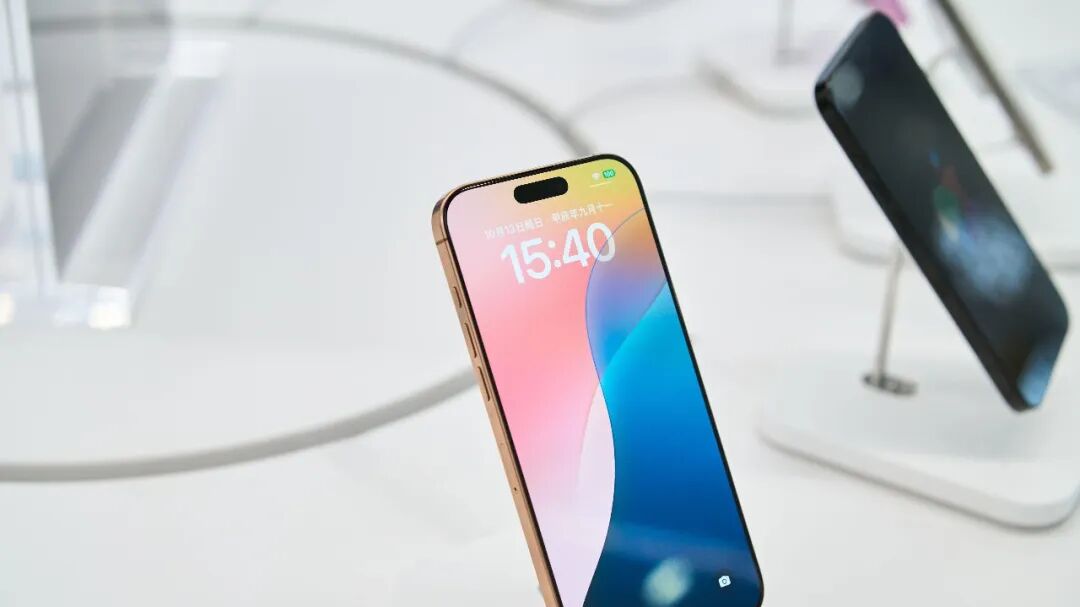
People who intend to switch to a new phone in September this year will most likely encounter two situations: the flagship model they have their eyes on is 1,000 to 3,000 yuan more expensive than the equivalent model last year, and the base iPhone model they were waiting for has not arrived.
Phones are getting more expensive, and fewer people are buying them. In the third quarter of 2026, data from three institutions IDC, Counterpoint and Omdia show that global shipments fell by 20% to 22% year-on-year. Among them, the 22% decline counted by IDC is the largest single-quarter drop on its record. The Chinese market decreased by 10% to 15.4% year-on-year, hitting the lowest level in the same period for more than a decade.
The gap between manufacturers is also widening. In the Chinese market, Huawei and Apple rank first and second respectively in all three lists, and the two together account for about 40% of the market share, 8 to 10 percentage points higher than the same period last year. OPPO, vivo, Xiaomi and Honor all suffered collective losses. According to IDC's statistics, their shipments fell by 17% to 25% year-on-year.
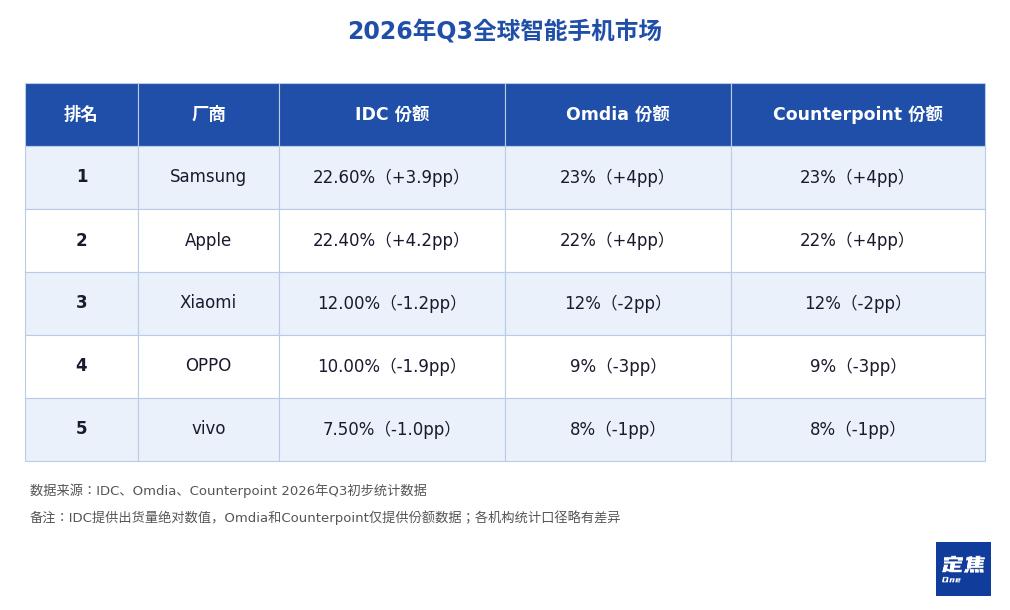
In the global market, the top five rankings from the three institutions are completely consistent. The top two, Samsung and Apple, together hold a combined share of about 45%, up 8 percentage points year-on-year. According to IDC's statistics, the total share gap between the two and the three domestic manufacturers Xiaomi, OPPO and vivo has widened from about 3 percentage points a year ago to about 15 percentage points.
Behind this is the memory chip crisis. Memory prices have skyrocketed by about 350% in a year, forcing end products to raise prices. But what is more noteworthy than the price increase is the change in the way mobile phone manufacturers respond: delaying the release of base models, stocking up in advance, and adjusting product lines. When and how many products to ship are no longer solely determined by consumers' willingness to purchase, which also leads to opposite results for the same manufacturer in different lists.
01. Domestic market: Huawei and Apple hold 40% market share, four Android brands collectively suffer losses
First look at the overall Chinese market. The overall shipment decline counted by the three institutions ranges from 10% to 15.4%. IDC counts that shipments in the third quarter were about 57.9 million units, down 15.4% year-on-year; in the first half of the year, the Chinese market only fell by about 4% year-on-year, and the decline accelerated significantly in the second half of the year.
The three institutions give consistent reasons: the memory cost pushes up the terminal selling price, and consumers delay replacing their phones. Counterpoint data shows that the global retail price of smartphones has risen by 20% since 2026. A mobile phone dealer told "Dingjiao One" that among leading domestic Android manufacturers, new flagships of all brands in September are generally 1,000 to 3,000 yuan more expensive than the previous generation.
Falling volume and rising price is the common conclusion of the three lists.
Then look at the shipments of each brand. IDC data shows that Huawei grew by 17.3% year-on-year, the only brand among leading manufacturers that achieved double-digit growth. Apple fell slightly by 4.3%. The four Android brands saw a large decline: OPPO fell by 17.6%, Xiaomi by 20.4%, Honor by 24.2%, and vivo by 24.9%.
As shipments change, market share is redistributed accordingly. Huawei's share rose from about 15% a year ago to 21.1%, and Apple's share rose from 15.8% to 17.8%. The shares of the four Android brands are all between 13% and 15.5%, all declining. The attribution of the third place varies among the three institutions: IDC shows that OPPO leads vivo with 15.5% to 15.3%, Counterpoint counts that the two are only 0.1 percentage points apart, and Omdia lists the two as tied for third place.
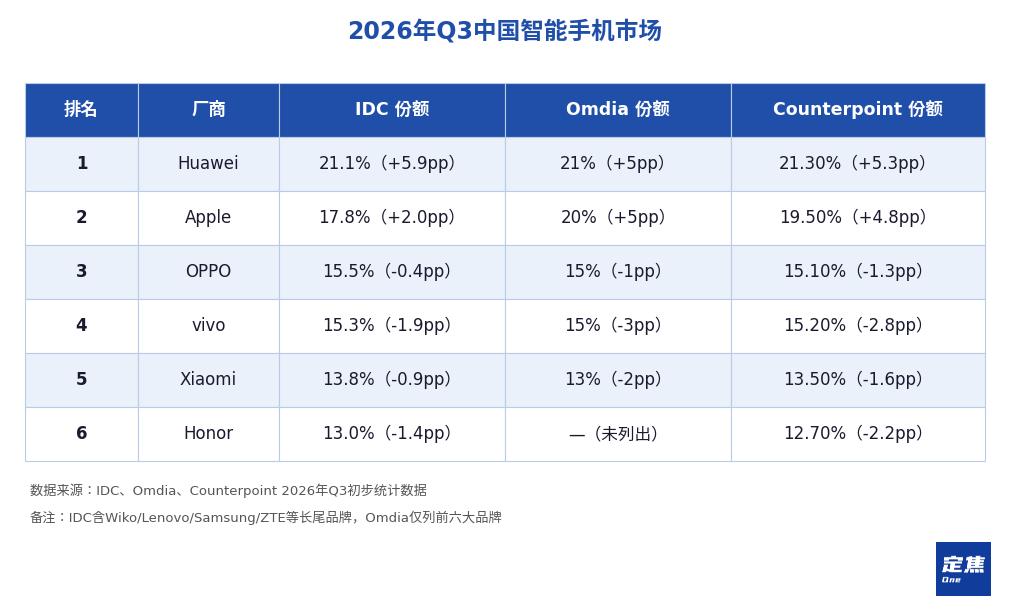
Specifically, Huawei is the manufacturer with the least divergence in the three lists, with its share hovering around 21% and shipment growth rate between 17% and 19%.
Why can Huawei continue to grow? The aforementioned dealer believes that it is "stable enough": the price increase of its main models ranges from several hundred to one thousand yuan, about half of its peers, and it retains the group of users who want to replace their phones but are scared off by price hikes. Its product line is also comprehensive enough: high-end users can buy the Mate 80, mid-range users can choose the nova 16, and users with a budget of more than 1,000 yuan can pick the Enjoy 90 Pro Max, the three models that are also named as core products by Counterpoint.
In addition, in terms of timing, Huawei officially raised prices from September 1, and the stocking and purchasing demand before the price hike was concentrated and released in July and August.
Apple ranks second in all three lists, with its share between 18% and 20%. It does not compete head-on with memory costs, but adjusts its shipment schedule. At Apple's autumn launch event on September 10, it only released the iPhone 18 Pro (starting at 9,999 yuan, 1,000 yuan more expensive than the entry-level storage version of the previous generation), the Pro Max, and the first foldable iPhone Duo (starting at 15,999 yuan, with the top configuration priced at 26,499 yuan), pushing the high-volume standard digital model to next year. After the absence of the base model, some users turned to the Pro series.
However, the three institutions give different answers to whether Apple's shipments in China rose or fell in the third quarter. Omdia shows a 15% year-on-year increase, Counterpoint's share data translates to an approximate 19% growth, while IDC shows a 4.3% decline.
It needs to be clarified first that shipment statistics count how many units manufacturers distribute to dealers, operators and retailers. Each institution estimates through supply chain and channel research, and different estimation methods will lead to different results.
The discrepancy this quarter is concentrated on Apple alone. The difference between IDC and Omdia's estimates of the overall Chinese market is about 1.4 million units, of which about 1.3 million units are the difference in Apple's data: according to IDC's share conversion, Apple's shipments in the third quarter are about 10.3 million units, while Omdia estimates it as 11.6 million units. The two institutions' estimates of Huawei and Android manufacturers are basically consistent.
The reason why Apple's data is difficult to estimate is that the structure of its shipments in the third quarter of this year is different from previous years. Due to the absence of the standard model, a considerable part of the shipments in the third quarter are stocks that channels prepared in advance for the old iPhone 17 series. Omdia believes that the change in Apple's release cycle, which moves products such as the standard digital iPhone to the next year, has changed Apple's annual shipment curve. IDC's view is that the popularity of new products exceeded expectations, but the number of models released this year is reduced, leading to a slight year-on-year decline in shipments.
As for the four Android brands, they are all adjusting their product lines in different ways.
One way is to widen the price range. vivo, OPPO and Honor have all added Pro Max models to their flagship series to raise the price level; OPPO and Honor also use mid-to-low price segments to fill positions: OPPO added the entry-level Find X10E (starting at 4,999 yuan) to the Find X10 series, creating a price gradient from the standard version which is 1,100 yuan more expensive than the previous generation; Honor launched the more affordable Magic9 Ultimate Edition (starting at 4,499 yuan). After widening the price range, manufacturers can not only raise the average selling price, but also minimize the impact of price increases on sales volume.
vivo also absorbs price hikes by adjusting configurations and making finer price stratification. The entire X500 series is 1,100 to 1,800 yuan more expensive than the previous generation. The standard version removed the 16GB memory option at its first release, and added the Pro Max starting at 6,999 yuan to take over the price range of the previous generation's Ultra model.
Xiaomi's choice is to cut volume to maintain price. The Xiaomi 18 standard version was delayed, and only the 18 Pro series was released in September (starting at 5,999 yuan, 1,000 yuan more expensive than the previous generation). This move is carefully calculated: Xiaomi's mobile phone ASP (average selling price) rose to 1,351 yuan in the second quarter, a record high, but the gross profit margin of mobile phones dropped from 11.5% in the same period of last year to 8.5%. The average price rose, but the cost rose even faster. Lu Weibing, President of Xiaomi Group, echoed this statement at the second quarter earnings call, saying that the company will no longer simply pursue mobile phone volume in the short term, but seek a balance between scale and profit.
The overall decline of the Chinese market is smaller than that of the four Android brands, relying on Huawei's counter-trend growth and Apple's basically stable shipment volume. High-priced brands retain the group with the strongest purchasing power in the stock market, hedging the collective losses of the Android camp.
02. Global market: The ranking remains unchanged, the three Chinese brands Xiaomi, OPPO and vivo face greater difficulties in overseas markets
The global mobile phone shipment decline is steeper than that of the Chinese market. IDC counts that global shipments in the third quarter reached 255.3 million units, down 22% year-on-year. Counterpoint gives a 20% decline, the worst third-quarter performance in 14 years.
First look at shipment volume. The top five in the three lists are the same: Samsung, Apple, Xiaomi, OPPO, vivo. The ranking has no suspense, but the decline levels are quite different. IDC data shows that the declines of Samsung and Apple are both in single digits, down 5.8% and 4.0% respectively; the three domestic brands all saw a decline of around 30%, with Xiaomi down 29.2%, vivo down 31.5%, and OPPO down 34.5%.
Then look at market share. IDC data shows that Samsung's share rose from 18.7% to 22.6%, Apple's rose from 18.2% to 22.4%, and the two together account for about 45%; Xiaomi's share fell from 13.2% to 12.0%, OPPO's fell from 11.9% to 10.0%, vivo's fell from 8.5% to 7.5%, and the three together account for about 30%, giving up about 4 percentage points in a year.
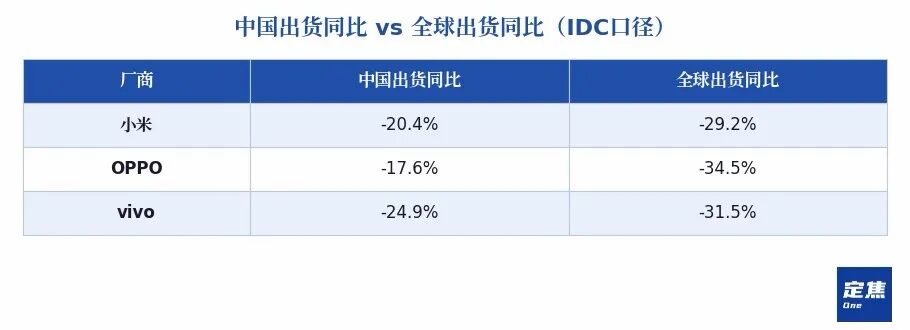
The losses of the three domestic brands are mainly concentrated in overseas markets. Take OPPO as an example: its global shipments fell by 34.5%, while its shipments in China only fell by 17.6%, and the extra decline came from overseas.
Since none of the six lists publish shipments by region, we can only look at the trend. By subtracting China's shipments from global shipments, we can roughly estimate the situation of markets outside China: the combined share of Samsung and Apple in overseas markets rose from about 42% to about 53%, gaining more than 10 percentage points in a year; the combined overseas share of the three domestic brands fell from about 30% to about 25%. The positions they gave up were almost all taken away by the two brands.
Why is the decline in overseas markets more severe?
The first layer is demand. Omdia analysts pointed out that manufacturers need to ensure shipment scale while maintaining profitability, "this pressure is particularly prominent in emerging markets, where local consumers are more price-sensitive". The entry-level and mid-to-low-end models that Chinese manufacturers sell the most in India, Southeast Asia, and Latin America are exactly the products with limited profits.
The second layer is cost. In the first quarter of 2026, Omdia estimated that memory accounts for nearly 60% of the material cost of mobile phones priced below 400 US dollars, while the proportion in high-end models is significantly lower. The same price increase pressure almost all falls on mid-to-low-end models. A price increase of several hundred yuan will make a mobile phone exceed the local consumers' psychological price range, and not raising prices will lead to direct losses.
The third layer is supply, which is also the most easily overlooked part. Samsung can steadily rank first, because its supply guarantee is better than its competitors, and its parts supply is stable. Samsung's mobile phones can use its own memory, while Apple is the world's largest terminal purchaser, and long-term contracts cover most of its demand. Domestic manufacturers do not have such conditions.
The three brands have three different decline patterns in overseas markets.
vivo is the most passive. According to IDC's statistics, its overseas shipments are about 10.2 million units, accounting for more than half of its global total, with a decline of about 36%. Its main battlefield India is a representative of price-sensitive markets. Price hikes have made some of its entry-level models exceed the key price range, and inventory shortages have further restricted shipments.
Xiaomi's overseas shipments are estimated at about 22.7 million units, accounting for nearly three-quarters of its global shipments, down about 32% year-on-year, but this contraction is a choice made by itself. It has reduced investment in low-priced products and some non-core overseas markets, raised selling prices and tightened shipments.
OPPO has the largest decline, and the reasons are relatively complex. OPPO is integrating the products and operations of OPPO, realme and OnePlus to reduce internal overlap, and at the same time shifting supply resources from low-profit niche markets to higher-return markets and models. Its overseas decline includes both passive volume loss and active retreat.
Even if manufacturers actively shrink to maintain profits, there is no no-cost solution. Some analysts warn that maintaining profit margins by reducing shipments has long-term risks: shrinking market layout may weaken brand exposure and channel influence, and rebuilding these advantages may take several years.
In the second quarter, Samsung has taken over the market share vacated by domestic brands in Latin America, the Middle East and Africa. Judging from the overall overseas estimates for the third quarter, this transfer is continuing to expand. When memory prices fall, if domestic manufacturers want to come back, they will no longer face empty positions, but shelves that have already been filled by Samsung and Apple.