Spotify: "De-risking" Earnings Report Passes the Test, Is the Production-Investment Mismatch Phase Nearing Its End?
Spotify released its 2026 Q3 earnings report before the US Eastern Time market opened on October 22. The Q3 performance results can be summarized as:
The operation side passed steadily, and the key indicator of net new subscriptions met the buyer's expectations (the capital expectations before the earnings report had already been revised downwards). The "lower-than-expected" free cash flow mainly came from offline projects and working capital, which did not hurt the essence of operations.
Overall, although this earnings report is not amazing on its own, the non-explosive performance guidance (net user growth, gross margin) and the implied expectation that the investment period is coming to an end can ease the pre-earnings-report capital concerns that audiobook expansion and AI investment will weaken profitability, and that AI Agents will erode Spotify's ecological entry.
The following is the detailed analysis
1. Net Subscription Growth Outperforms Guidance, Monthly Active Users Slow Down as Planned
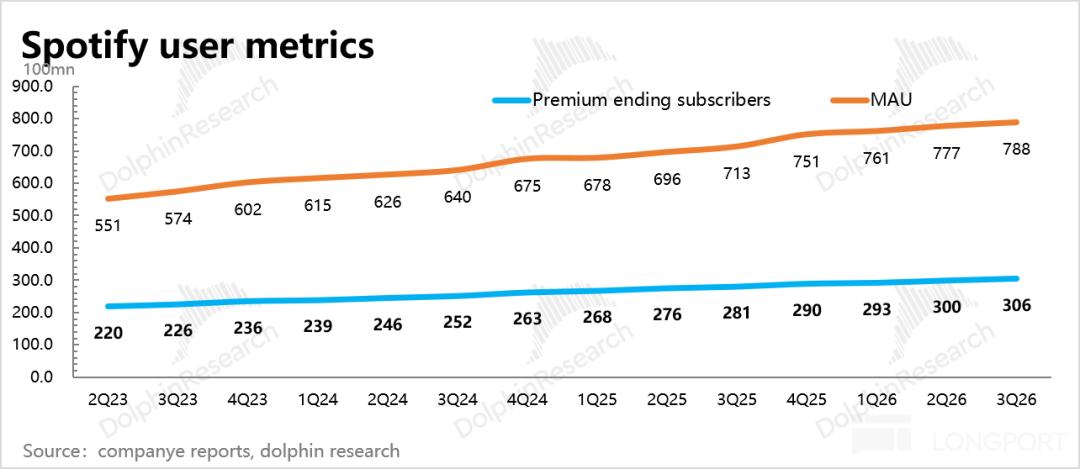
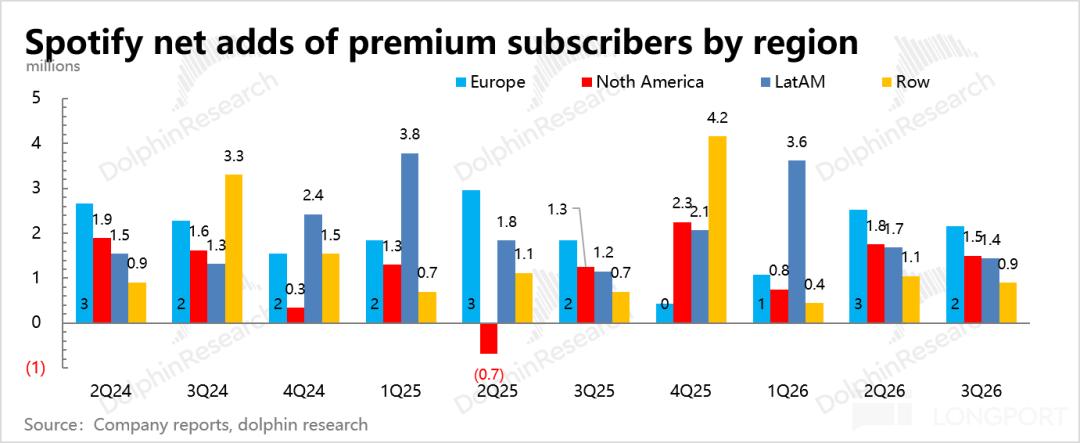
The user-side performance in Q3 was decent, with net paid subscription users increasing by 6 million to 306 million, 1 million higher than both the company's guidance and consensus expectations; monthly active users (MAUs) saw a net increase of 11 million to 788 million, fully in line with the guidance.
By region, subscriptions and MAUs in Europe, North America, Latin America and other regions all maintained steady growth, among which the other regions performed relatively well in MAU expansion. Combined with Sensor Tower data, this is likely mainly driven by Asia, specifically markets such as Japan, Pakistan, and Australia.
Dolphin Research believes that this may be related to Spotify's use of AI to improve personalized content experience and the expansion of audiobooks in emerging markets, so user scale growth can be quickly seen in countries and regions with low penetration rates.
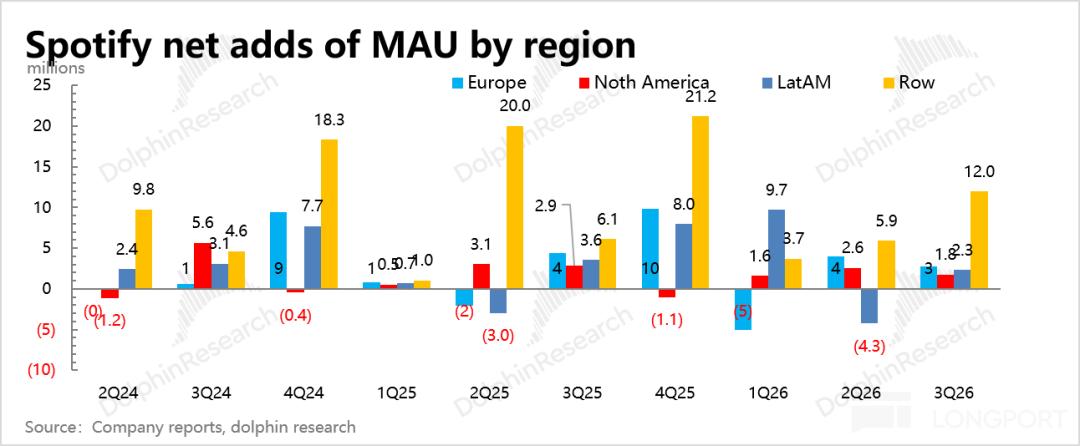
However, subscription monetization is currently driven by European and American markets with higher payment power. The 6 million net new subscriptions in Q3 exceeded both the company's guidance and buyer capital expectations.
2. Subscription Price Hikes Driven by New Features, Advertising Recovers as Expected
Total revenue in Q3 reached 4.97 billion euros, up 16% year-on-year (14% at constant exchange rates), slightly lower than expectations.
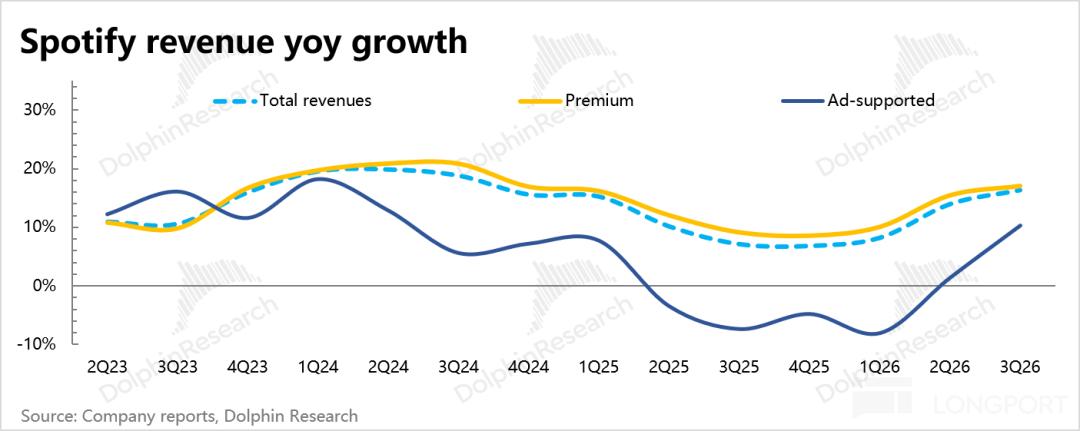
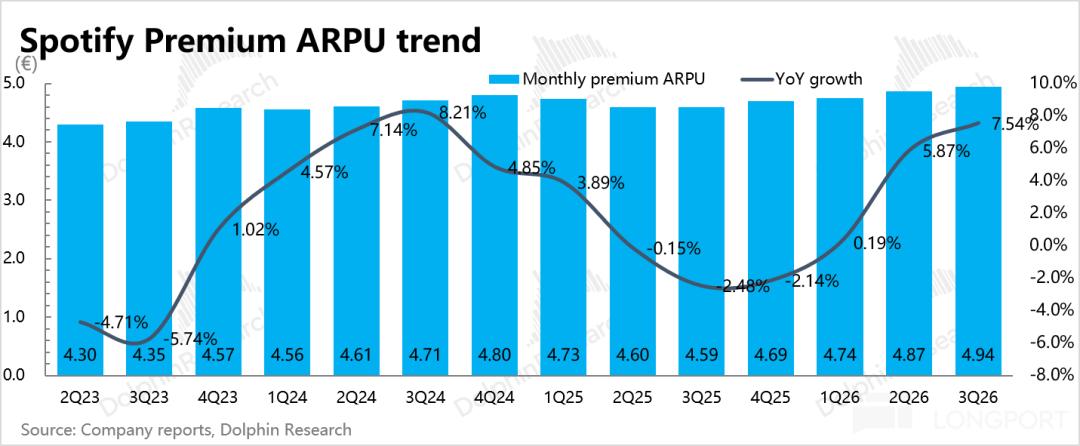
Among them, subscription revenue was 4.49 billion euros (+17%), driven by both volume and price. Subscription ARPU reached 4.95 euros (+9.3%, +7.5% at constant exchange rates), with the number of subscriptions growing by 8.9% year-on-year;
However, as penetration in developed countries matures, the effect of pure price hikes will be discounted accordingly. The company expects to launch new features while raising prices opportunistically.
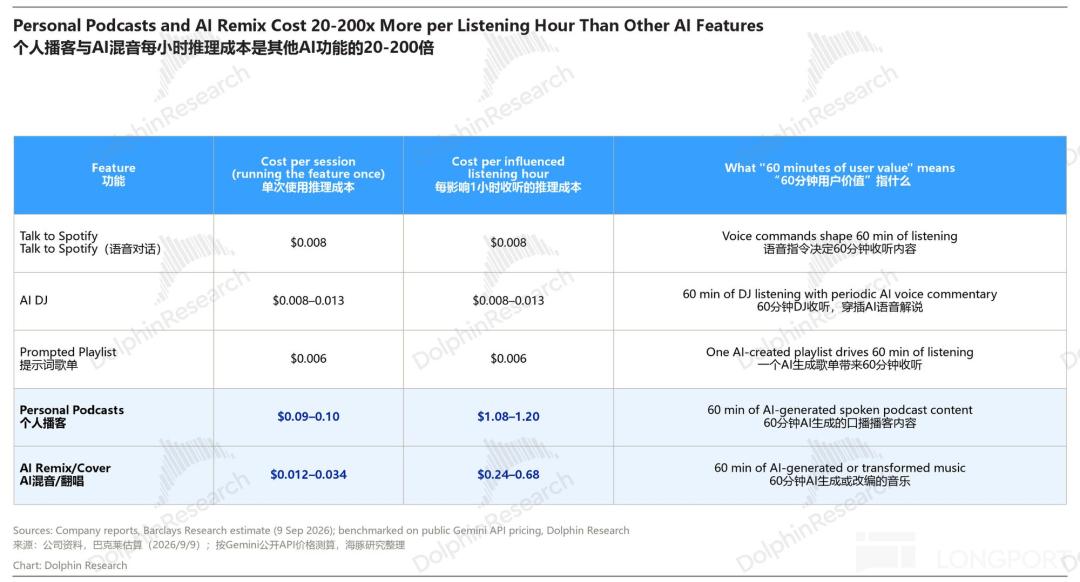
New features have been launched intensively this year (Reserved concert tickets, personal podcasts, Running Mode, MV, etc.), and the currently heavily promoted AI features — AI DJ, Talk to Spotify, prompt-generated playlists, etc.
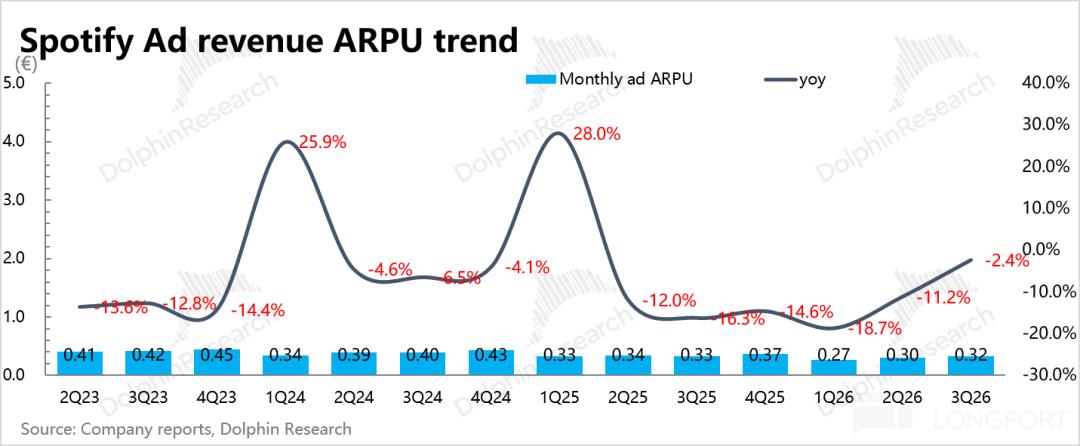
Advertising revenue reached 480 million euros, up 10% year-on-year (+9% at constant exchange rates), fulfilling the promise of "returning to double-digit growth in the second half of the year" mentioned at the Investor Day. However, the volume and price breakdown shows that advertising still sees "volume rising while price falling", indicating that the conversion efficiency of advertising itself is relatively average.
3. In the Investment Expansion Period, Gross Margin Remains Stable
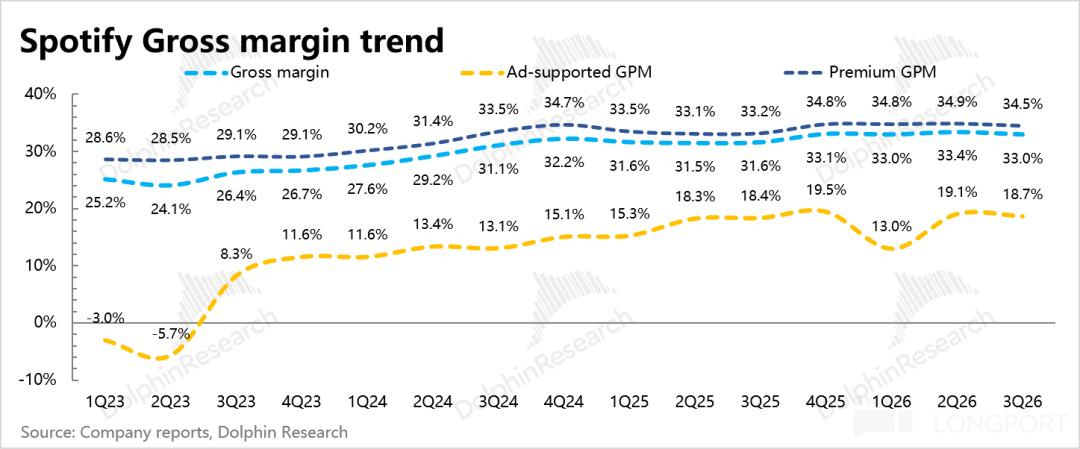
Q3 gross margin was 33.0%, up 1.4 percentage points year-on-year, slightly higher than the 32.9% guidance; the gross margins of the subscription/advertising segments were 34.5%/18.7% respectively, both up about 1 percentage point year-on-year.
The overall gross margin is stable, which is quite remarkable during the short-term window when audiobook expansion and AI function costs are recorded in advance.
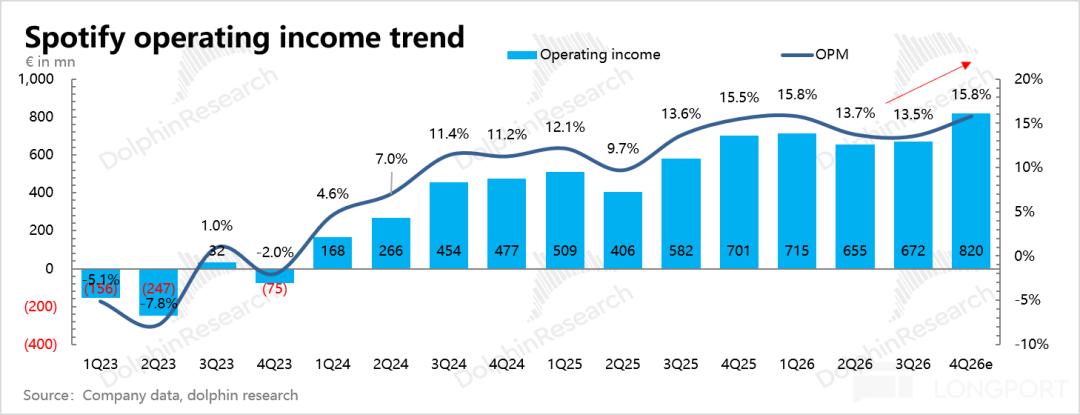
Q3 operating expenses were 967 million euros, up 26% year-on-year, still up 19% after excluding exchange rate effects and social security expenses, mainly due to marketing and cloud/AI investments. Operating profit reached 672 million euros, slightly exceeding the 670 million guidance and basically in line with consensus expectations, with the operating profit margin at 13.5%, a slight year-on-year decrease of 0.1 percentage points.
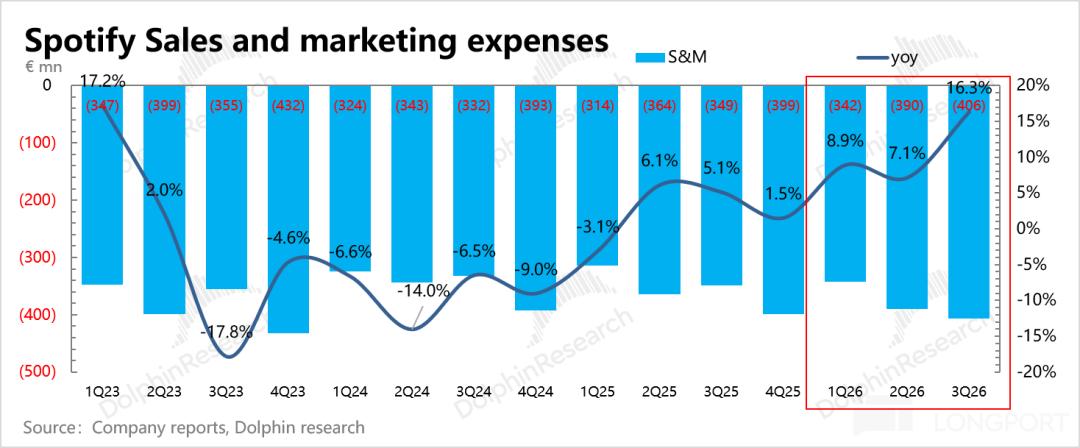
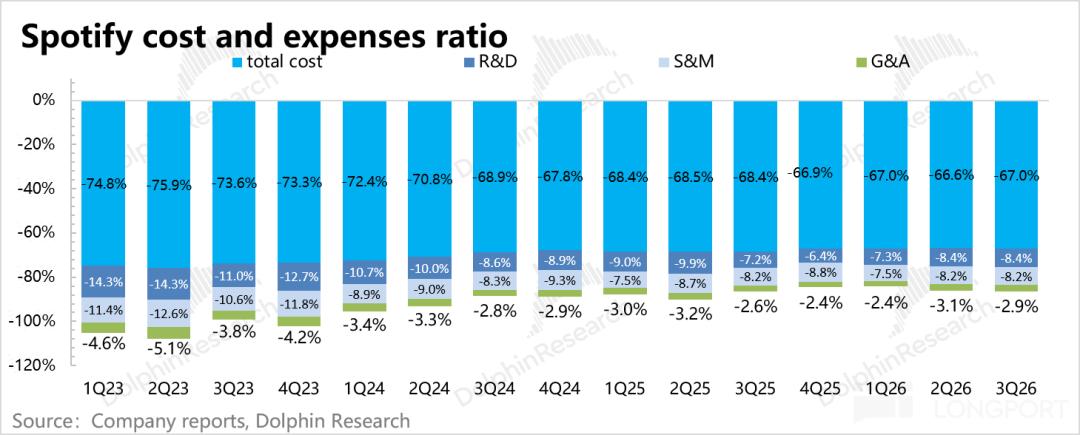
4. Free Cash Flow Decline Does Not Hurt the Essence of Operations
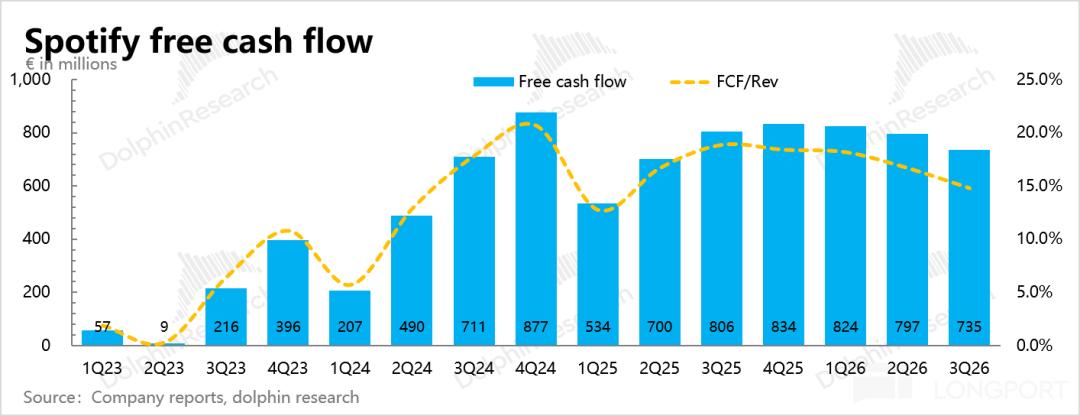
Q3 free cash flow was 735 million euros, down 9% year-on-year and 17% lower than expected. This is mainly dragged down by working capital caused by a sharp increase in accounts receivable. The company did not give too much explanation in the earnings report. Dolphin Research speculates that this may be related to the extended overall account period for advertising (advertising recovered significantly in Q3), which will be confirmed at the earnings call later.
In addition to changes in working capital, there is also the increasing amount of actual cash tax payments as profits improve this year. The effective tax rate in Q3 has risen to 27%, while Spotify was still a large tax-exempt entity last year.
Cash and short-term investments at the end of the quarter amounted to 9.9 billion euros. Exchangeable notes have been repaid within the year, and there is basically no debt except for leases.
From the beginning of the year to October 21, a total of USD 1.1 billion of shares have been repurchased. Since the resumption of share repurchases in August 2025, a total of about 3 million shares have been repurchased, accounting for about 1.5% of the outstanding shares.
5. Performance Overview
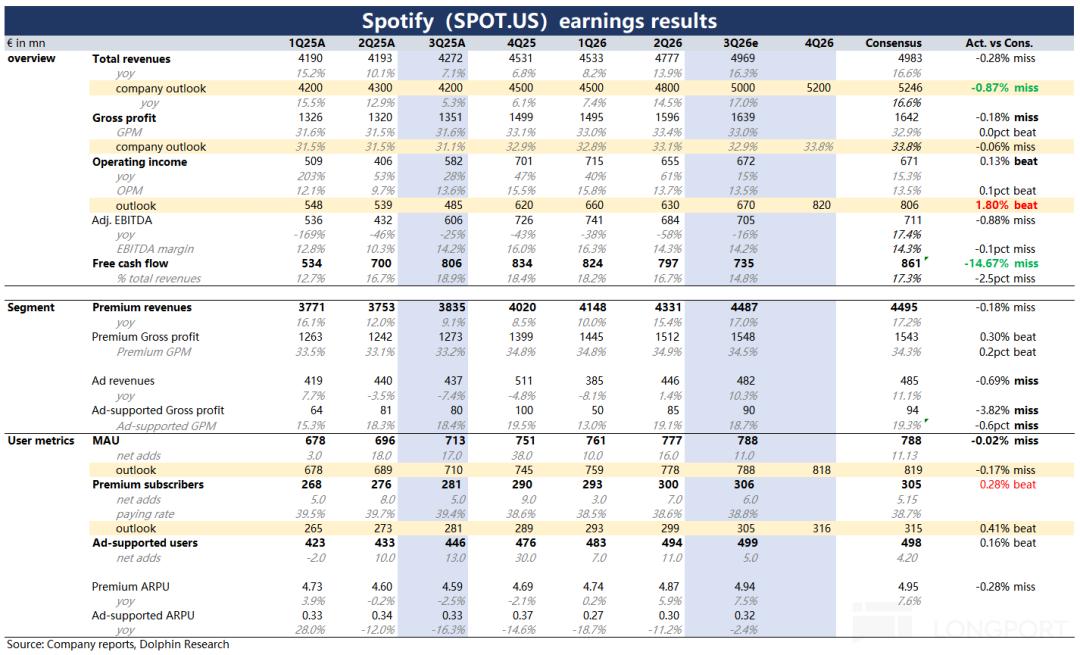
Dolphin Research View
As mentioned at the beginning of this article, Spotify's Q3 earnings report is not amazing (growth slows down at constant exchange rates), but against the backdrop of multiple pre-earnings-report capital concerns, this "risk-eliminating" earnings report can bring some sentiment repair.
There are three main pre-earnings-report concerns in the capital market: (1) Whether the gross margin in Q4 will be dragged down by new investments such as the globalization of audiobooks and the expansion of the Podcast Creator Program (SPP); (2) Whether the expense growth rate in 2027 can fall back as scheduled; (3) After the launch of Meta Muse, the narrative of "AI entry subverting streaming media" will make a comeback.
This earnings report has "eliminated the risks" for the first two points:
The Q4 gross margin guidance is 33.8%, in line with expectations and flat quarter-on-quarter. Operating profit guidance is 820 million euros, which means that the year-on-year expense growth rate in Q4 will drop significantly from 26% in Q3, slightly exceeding expectations. This corroborates with the management's statement at the Investor Day that "2026 is the year of investment, and the pace will slow down starting from Q4".
At the same time, the slightly better-than-expected user performance has at least weakened the power of the AI Agent panic narrative in the short term. Although in the long run there will be a certain degree of impact and migration, for now, the most serious erosion is not in the music listening scenario, which leaves Spotify some time to make more responses.
According to the framework of the May Investor Day (double-digit revenue growth, gross margin of 35%-40% by 2030, operating profit margin above 20%), 2027 will see the inflection point from the current investment period to the monetization period. From the perspective of "increasing revenue and cutting costs", Dolphin Research believes that we should mainly focus on two points:
(1) Increasing Revenue: The Sustainability of Price Hike Drives
On the one hand, it is the natural price hike in the industry. At present, Spotify's price is at the top of the industry, so the driving force for price hikes comes from peers and including more content into membership benefits.
Audiobooks will expand from 22 markets to more than 180 markets by the end of the year. Historically, Spotify usually follows up with price hikes 6-12 months after launching audiobooks. In addition, Apple Music took the lead in raising prices in July, reducing the obstacles for Spotify's natural price hikes.
On the other hand, it is the innovation of AI features, so as to add more paid tiers, leverage copyright advantages, and combine AI features to create more high-quality experiences.
A typical example is the launch pace of the AI remix/cover tier: Currently, UMG, Merlin and Kobalt have signed contracts, and WMG's contract will expire and be renewed around February next year. The market generally expects the AI tier to be launched in the first half of 2027. This is the core variable of the "add-on package" part in 2027 ARPU. Since it is difficult to make an accurate effect estimate, the mainstream market expectations have not fully included this part of potential increment.
(2) Cutting Costs: Expenses Decline, after the upfront R&D investment and marketing promotion are gradually reduced, expense contraction is expected to be seen next year. At present, the market generally expects the operating expense growth rate to fall back to the mid-to-high single digits in 2027, and the operating profit margin to increase by about 2 percentage points to around 16.8%, but there is still a certain distance from the company's long-term target.
Finally, looking at the valuation, following Dolphin Research's consistent valuation method for Spotify, using the 2027 after-tax operating profit as the performance base (effective tax rate of 15%), the current valuation is at the lower edge of the reasonable range, but it is not