What? A single person can train a large model, and its performance metrics can even go toe-to-toe with K3V4?
How many people does it take to train a large model with 500 billion parameters?
The experience of the AI industry shows that it requires at least dozens of people, while large tech companies often invest hundreds of personnel in such projects.
However, a Silicon Valley startup named Mirendil has pushed this number to the extreme — only one person.
Just recently, Mirendil published an article on its official website with a striking title: *Large-Scale Pre-Training Without a Pre-Training Team*.
Three numbers are listed below the title of the article:
1 researcher, three and a half months, total cost less than 10 million US dollars.
These expenses cover the Agent's token consumption, data processing and all costs of research experiments. With only such input, they have successfully trained a model with hundreds of billions of parameters: Mirendil-Base, a dedicated coding base model with parameters ranging from 100 billion to 500 billion.
Mirendil stated in the article that more than 99% of the new model's code is not written by humans, but by Agents.
Human researchers only need to define the direction, make judgments, and press the brake at key nodes. Tasks such as writing code, running experiments, and troubleshooting errors are all handed over to Agents.
In Mirendil's tests, some indicators of the new model have approached mainstream frontline models such as Kimi K3, GLM-5.3, and DeepSeek-V4.
The era of "building a base model single-handedly by one person" is really coming... isn't it?
01
According to the official statement, Mirendil-Base is the first product of the Mirendil model series, positioned as a dedicated coding base model, targeting researchers and engineers inside cutting-edge AI laboratories.
To verify whether a single person can really develop the model, Mirendil set many strict conditions. For example, no off-the-shelf pre-training frameworks can be used, and no existing code can be inherited.
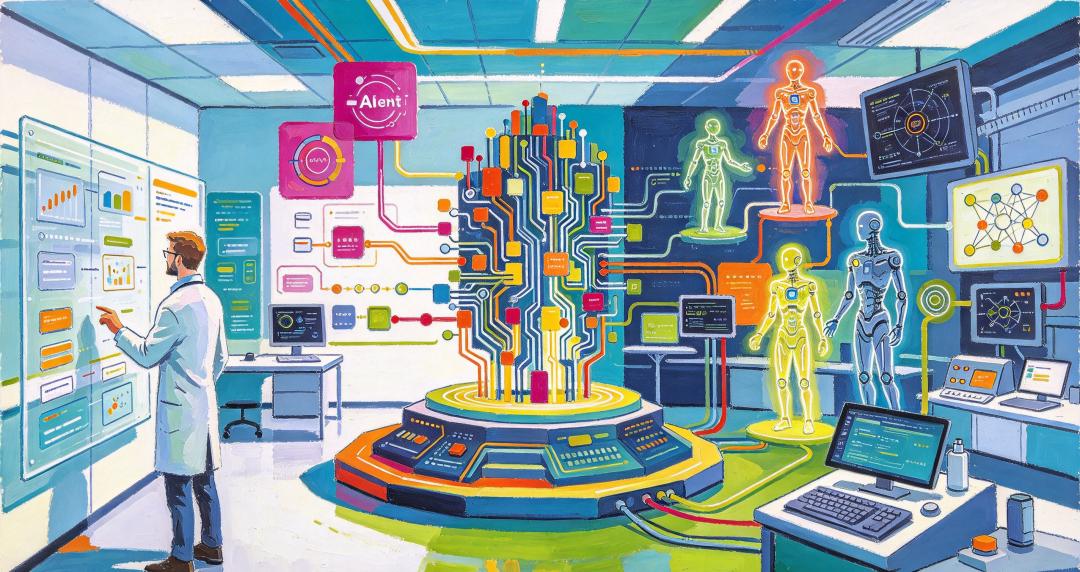
The researcher and the Agent started from scratch, and built everything within more than 100 days — training infrastructure, model architecture, training algorithms, and data pipelines are all written by themselves, and only on several general libraries such as PyTorch and JAX, they referred to some popular open source projects as templates.
Of course, the "themselves" here usually refers to the Agent.
The researcher is mainly responsible for deciding what to try, what to trust, and intervening when necessary. Specific actions such as writing code, running experiments, and diagnosing errors are almost all completed by the Agent independently.
In terms of data, Mirendil uses all public data, such as GitHub open source code, public web pages, and public datasets. The company emphasizes that it has never purchased a single line of data during the training process, has not done distillation, and has not used synthetic data.
In addition, Mirendil hopes to improve efficiency through design optimization. "We have achieved significant efficiency improvements through improved architecture, advanced tuning of data mixing, other data-level optimizations, and kernel optimization," the announcement stated.
The final finished product is Mirendil-Base, with parameters ranging from 100 billion to 500 billion.
What level can a model with hundreds of billions of parameters developed by one person reach?
Mirendil selected five models for comparison, namely Kimi K3, GLM-5.3, Nemotron-550B-Base, DeepSeek-V4-Pro-Base, and Inkling, all of which are large-parameter models with MoE architecture.
In the cross-entropy test of new code repositories (the model guesses how the code is written, the lower the score, the more accurate the guess), the competition results of several models are as follows:
Kimi K3 ranks first with a score of 0.193; Mirendil-Base ranks second with a score of 0.222; followed by GLM-5.3, DeepSeek-V4, and Nemotron.
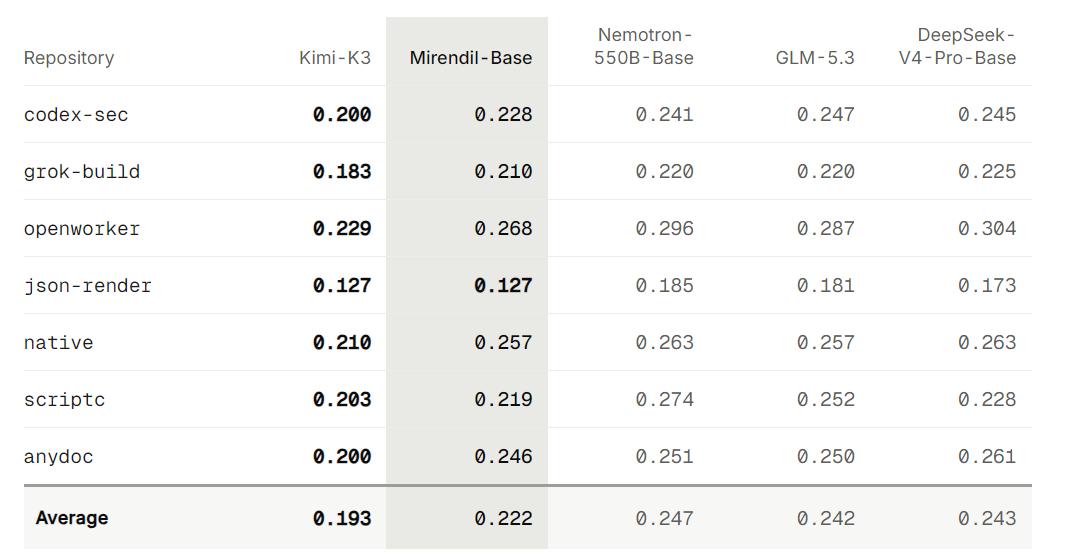
In other words, in some coding dimensions, the pre-trained model trained by a single person teamed up with Agents is already able to compete with the finished models from leading large tech companies.
However, it must be pointed out that under normal circumstances, base models perform better than post-trained models in cross-entropy tests. As a base model, Mirendil-Base has a higher score than the post-trained Kimi-K3, which shows that the real strength of Kimi-K3 is much stronger than the score on the surface, and the gap between Mirendil-Base and it is larger than it seems.
According to the official introduction, there are two higher tiers above Mirendil-Base: the Large version has parameters from 500 billion to 2 trillion, and the XL version directly reaches 2 trillion to 10 trillion.
At present, the training progress of the Large version is 80%, and the XL version has just started with a progress of only 19%, but its score is almost catching up with the current score of the Large version.
That means, with the support of sufficient capital and Agents, training a trillion-parameter model by one person is no longer a dream — this is a threshold that many AI large companies have not yet touched.
02
The pre-training of large models with hundreds of billions or even trillions of parameters is extremely money-consuming, time-consuming, and requires a large number of personnel.
Among hundreds of researchers, some are responsible for researching what the model architecture should be and how to implement scaling; some are in charge of cleaning and matching trillions of tokens; others are guarding thousands or even hundreds of thousands of computing cards to ensure that the training will not stop unexpectedly.
Large AI companies can gather enough talents, but the pressure of capital and computing power costs is still huge.
The entire industry has been trying to reduce costs, and the core idea is only one: let AI train AI.

For example, Anthropic has gone very far along this path.
It previously disclosed that in May this year, more than 80% of the merged code in its code repository was written by Claude.
Google is also doing similar things: AlphaEvolve, an AI programming agent, has been used to optimize data center scheduling, chip design and AI training processes.
However, on the path of "AI training AI", only large companies are capable of making it work at present.
In the past, it was almost impossible for scientists, researchers, small teams and other groups to train a model on their own.
Mirendil-Base proves that under certain conditions, one person can also "build a model single-handedly".
Mirendil stated in the official website article that until not long ago, the bottleneck of pre-training a competitive model was still people: a team of experts that takes many years to build.
Now, this situation is changing.
What only large research institutions could achieve in the past can now be completed by one researcher. When Agents take over most of the practical work, the bottleneck shifts to computing power, data, and the judgment of the person who commands the Agents.
The concept of "everyone can train a model" contains huge room for imagination.
In the past, most people and companies that needed a dedicated model usually rented a general-purpose model and then adapted it at the edge.
Now, a chip design team, a robotics laboratory, or a hospital can all use their own data to train a model for their own specific problems. Base models and the systems built around them will no longer be things that only a few large companies can manufacture, but will become more popular.
On the other hand, AI projects that used to require a large team to start can now start with a small team, or even a single person. As computing power becomes cheaper and more powerful, more people can try these projects. "One-person company" or "super individual" is expected to become a reality.
People's way of working will also be changed: as more and more work is handed over to Agents, human daily work will be less and less like "doing things by hand", and more and more like "leading a small laboratory": setting research directions, designing experiments worth running, and judging which ideas are worth further promotion.
Mirendil depicts a more dazzling prospect: the next model will be partially built by Mirendil's own model, and every model that becomes stronger in the field of building AI will make the construction of the next model cheaper and faster.
"We believe that we have not achieved fully autonomous RSI yet, but we are much closer than ever before," the company said.
In addition, the company has started post-training for Mirendil-Base. Mirendil-Base-Large and Mirendil-Base-XL which has reached the cutting-edge level are still in training.
03
Behind Mirendil are two former Anthropic employees: Behnam Neyshabur and Harsh Mehta.
Neyshabur was born in the 1980s, born and studied in Iran. He went to the United States in 2011 and received his doctorate from the Toyota Technological Institute at Chicago. After graduation, he worked at Google DeepMind for 5 years, joined Anthropic at the end of 2024, and led the Discovery team, which specifically studies how to let AI participate in R&D like scientists.
Mehta is of Indian origin, graduated from Indian Institute of Technology Guwahati, and was a colleague of Neyshabur when they were at DeepMind. After joining Anthropic, Mehta built the first version of Anthropic's internal automated AI research platform.
In December 2025, the two resigned one after another and founded Mirendil. The company is positioned to let AI help scientists build their own AI, not just directly use AI to assist scientific research.
In other words, they hope that research teams can train and iterate their own dedicated AI models without relying on the general models of large companies. The underlying technical route is RSI, which has been very popular in the AI circle recently.

In June this year, Mirendil officially announced a 200 million US dollar seed round of financing, with a post-investment valuation of 1 billion US dollars. Investors include a16z, Kleiner Perkins, NVIDIA, etc.
The team currently has about 20 people, all of whom are researchers and engineers from Anthropic, xAI, Google DeepMind, and OpenAI, and work in downtown San Francisco.
The debut of Mirendil-Base marks that the company has passed its first milestone.
But even so, "training a 100-billion-parameter model by one person" sounds attractive, but the threshold has not been lowered much.
The cost of 10 million US dollars is nothing for large companies, and Mirendil, which has just obtained financing, can still afford it. But for the vast majority of individuals and small teams, it is still an astronomical figure.
Not to mention that not every random engineer can master the skills to command Agents to complete such a huge task. Mirendil's talents are of extremely high quality and its AI project experience is extremely rich, ranking in the first echelon in the entire Silicon Valley.
The era of "one person building a large model single-handedly" is indeed approaching, but it is still far from ordinary people.
The release of Mirendil-Base is the first milestone on this long road. As for whether it can really lower the threshold of large models, it depends on the actual performance of larger-scale models in the future and whether this methodology can be replicated by other people.
This article is from the WeChat official account "Alpha AI", author: Yan Fei, editor: Wang Jing, 36Kr is authorized to release it.