The Nasdaq and chip stocks plunged, Jensen Huang's stock touting failed to work, and the market dealt a heavy blow to AI bulls.
"There is little possibility of memory surplus before 2029."
On October 21 local time, Jensen Huang expressed his full support for the memory industry and backed the demand of the memory sector in a media interview during the GTC conference in Berlin.
This move to reassure the upstream industry is not a new practice. At Computex 26, Jensen Huang publicly stated that "Marvell is the next company with a market value of one trillion US dollars". Right after that, Marvell's share price closed up 32.25% in the trading session on June 2, marking the largest single-day increase in the company's history.
However, the market does not seem to buy this statement this time.
On October 22, Thursday of the US stock market, the NASDAQ Composite Index fell by 2.6%, posting the largest single-day drop since June; the Philadelphia Semiconductor Index dropped by about 6.72%. Chip stocks including NVIDIA, AMD, Intel, Micron, TSMC all slumped collectively, and Meta's share price also fell by nearly 7%.
From upstream equipment vendors, memory manufacturers, wafer fabs to Fabless design companies, and further downstream computing power customers and model developers, no stock has avoided a decline.
This pullback did not happen without any warning. Data from Goldman Sachs' prime brokerage division shows that semiconductor stocks have kept falling for consecutive days in the past week, and hedge funds have accelerated the reduction of their holdings in tech stocks. In this process, retail investors are still buying stocks related to chips, storage and AI cloud computing.
In contrast, Michael Burry, the prototype of "The Big Short", has shifted most of his short option positions to put options on the Nasdaq 100 Index and semiconductor ETFs. Another well-known short seller Jim Chanos has targeted new cloud computing companies that build data centers with borrowed funds and lease out AI computing power.
At present, the market is using changes in share prices to test risks in different links including the valuation of chip stocks, the supply and demand of computing power, and the financing cost of AI infrastructure.
01 AI Trading Slams on the Brakes
On October 22 local time, the concentrated sell-off of US tech stocks once again put the market's concerns about the return on AI investment on the table. The direct trigger was Meta's quarterly performance report: affected by a substantial increase in capital expenditure, its free cash flow turned negative to 2.12 billion US dollars.
At the same time, the situation in the Middle East pushed up oil prices, adding new uncertainties to the outlook for inflation and interest rates. When financing costs and operating costs are facing upward pressure, the market's tolerance for large-scale capital expenditure of tech companies is also declining. Investors will inevitably ask when these aggressive investments can be converted into sufficient revenue and profits.
However, this is not a sudden adjustment. By October 16, the Philadelphia Semiconductor Index had fallen for eight consecutive trading days, with a cumulative decline of more than 15%. The pullback of semiconductor stocks started earlier than the concentrated sell-off on October 22, and the previous strong trading momentum of the AI industrial chain has loosened.
Griffin, the founder of Citadel, clearly emphasized in an interview with foreign media on October 20 that investors "are almost certain that there is an AI bubble".
He used the aviation industry as a metaphor to question how long the computing power price can be maintained after the GPU supply increases. He said: "GPUs, like airlines, have extremely low marginal operating costs. If we reach a point where GPU supply exceeds demand, marginal pricing will actually free fall."
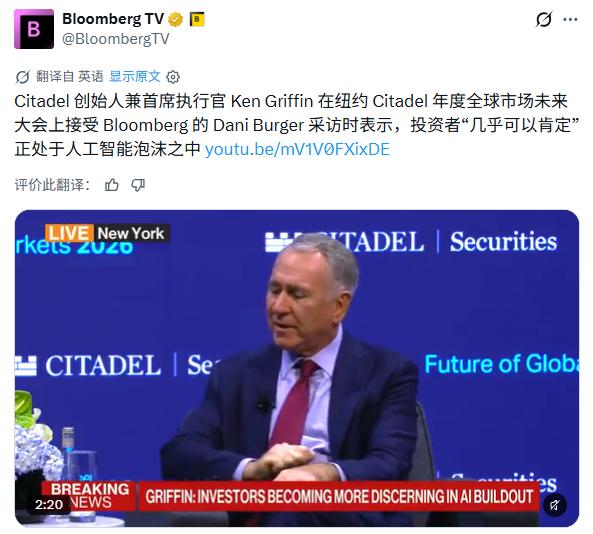
On the corporate expenditure side, Griffin mentioned: "The entire US business community is looking at the bills from Anthropic and OpenAI and saying, 'Okay, we need to figure out how to make sure we get productivity gains from this.' But he does not deny the long-term value: "The companies on the other side of the bubble will be the market leaders for decades to come."
Griffin's judgment echoes the drop in chip stocks on October 22.
In this round of "violent pullback" of tech stocks, the market is not only worried about whether AI demand will grow, but also about whether the demand growth can support the current chip prices, computing power lease prices and valuations of related companies. In other words, when the invested funds can be earned back, and whether it can be earned back faster.
Michael Burry has long been emphasizing the bubble. He believes that the market may hit a major top in the next nine months, and warns that the rise in the final stage of the bull market may be more drastic.
In the drastic market pullback, institutional investors are the group that moves the fastest.
Data from Goldman Sachs' prime brokerage division shows that in the five trading days ending October 15, the speed at which hedge funds reduced their holdings in tech stocks reached the fastest level in at least ten years, and semiconductor stocks are one of the sectors with the largest reduction amount. Of course, this data only represents the transactions of customers covered by Goldman Sachs' prime brokerage business, and does not represent all positions of the entire hedge fund industry.
Nikolaos Panigirtzoglou, a strategist at JPMorgan Chase, also pointed out in the capital flow analysis that the performance of semiconductor stocks is correlated with the risk exposure of equity long-short funds. When related stocks start to fall, funds constrained by risk limits may further reduce their positions, thus amplifying selling pressure.
02 Liquidation During Market Holiday
"Yeah, it's just small fluctuations in October."
The investment blogger @aleabitoreddit known as the "White-haired Stock God" recently shared his position situation. He said the market is experiencing a large number of forced liquidations and panic selling. He has still obtained considerable returns since the beginning of this year, but some of his positions have pulled back recently.
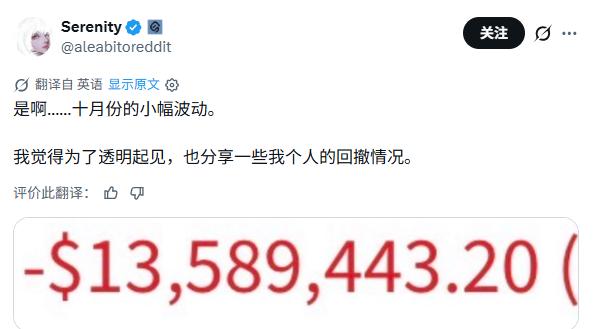
@aleabitoreddit did not disclose the specific loss amount, nor did he say he encountered liquidation. This post presents the real feeling of individual investors in the market adjustment: even if there is still profit for the whole year, short-term pullback is hard to avoid.
Apart from the spot market, leveraged trading around chip stocks has also started concentrated liquidation.
CoinDesk cited data from CoinGlass that during the US stock market holiday on October 17, about 51.6 million US dollars of forced liquidation occurred in 10 minutes on cryptocurrency perpetual contracts linked to chip stocks and semiconductor ETFs, of which about 38 million US dollars came from long positions betting on price rise.
Specifically, the forced liquidation amount of SOXL-related contracts tracking triple long semiconductor stocks is about 12.7 million US dollars; positions related to Sandisk and SK Hynix each had about 10.8 million US dollars of positions forced to liquidate.
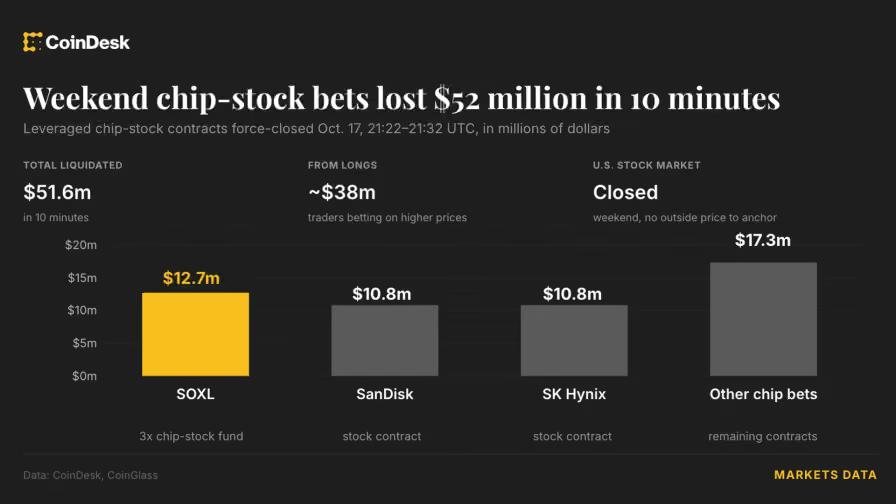
During the US stock market holiday on October 17, about 51.6 million US dollars of positions on chip stock-linked cryptocurrency perpetual contracts were forced to liquidate in 10 minutes, with long positions accounting for 38 million US dollars.
@davidyjeong, CEO of trading firm Tread.fi, analyzed the order flow at that time on X. He observed that large sell orders of Sandisk and Micron related contracts first appeared on Binance, and then related transactions spread to the stock-linked contract market on Hyperliquid in less than a second.
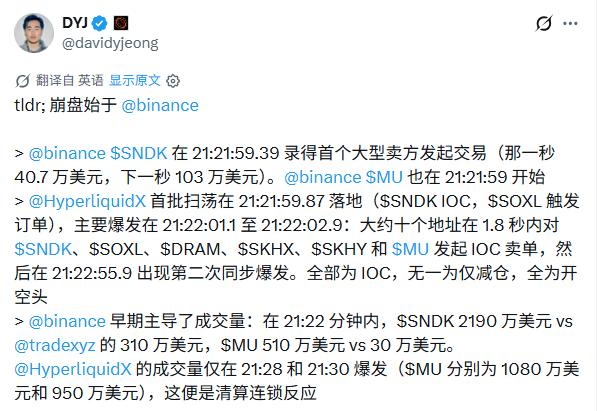
The core of forced liquidation lies in leverage.
When the price moves in an unfavorable direction and the account equity falls below the margin level required by the platform, the platform may automatically liquidate the position. For high-leverage long positions, even if the related stocks rebound later, the positions may have already been liquidated.
51.6 million US dollars of positions were forced to liquidate in 10 minutes, which does not represent the total liquidation amount in the US stock market. But it is like a butterfly effect, triggering more fluctuations in the spot market. It can also be said that transactions around the AI industrial chain have extended to the 24/7 leveraged market, and price fluctuations can trigger liquidation before the traditional stock market opens.
03 Short Sellers Make Huge Profits, Retail Investors Buy the Dip
While institutional investors are reducing their holdings in tech stocks, some retail investors are "buying the dip" on stocks in the AI industrial chain.
Capital flow analysis data from Arun Jain, a strategist at JPMorgan Chase, shows that between October 15 and 21, individual investors increased their purchases of chip manufacturers, storage device companies and new cloud computing service providers. The purchase scale of single tech stock rose to the highest level since the market momentum reversed in July, but the purchase intensity of the "Big Seven Tech Stocks" weakened.
On the other side, investors who short companies related to AI infrastructure have obtained considerable paper profits.
On October 22, foreign media cited data from data analysis institution ORTEX and reported that as of that day, investors betting on the share price decline of new US cloud computing companies and data center operators had obtained about 6 billion US dollars of paper profits in the current month. Among the floating shares of companies such as CoreWeave, IREN, Nebius, Applied Digital and Core Scientific, about 20% to 26% are shorted.
Among them, the paper profit of CoreWeave short sellers in this month is close to 1.7 billion US dollars, and the company's share price fell by nearly 30% in the same period. The paper profit of Nebius short sellers in this month is about 2.94 billion US dollars, but the year-to-date figure still records a paper loss of about 3.33 billion US dollars.
It should be noted that the short sellers' profits are concentrated in some AI computing power and data center companies. At the same time, the example of Nebius also shows that the monthly paper profit does not mean that a short selling trade is profitable from beginning to end.
The well-known short seller Chanos' doubts about this kind of company just explain the logic of part of the short selling transactions.
The investor, famous for shorting Enron, revealed in early October that he is shorting most of the new cloud computing companies. Chanos believes that although they are valued by the market as tech growth stocks, their business model is more like a highly leveraged asset leasing business — they buy AI chips and build data centers with borrowed funds, and then lease out computing power to customers.
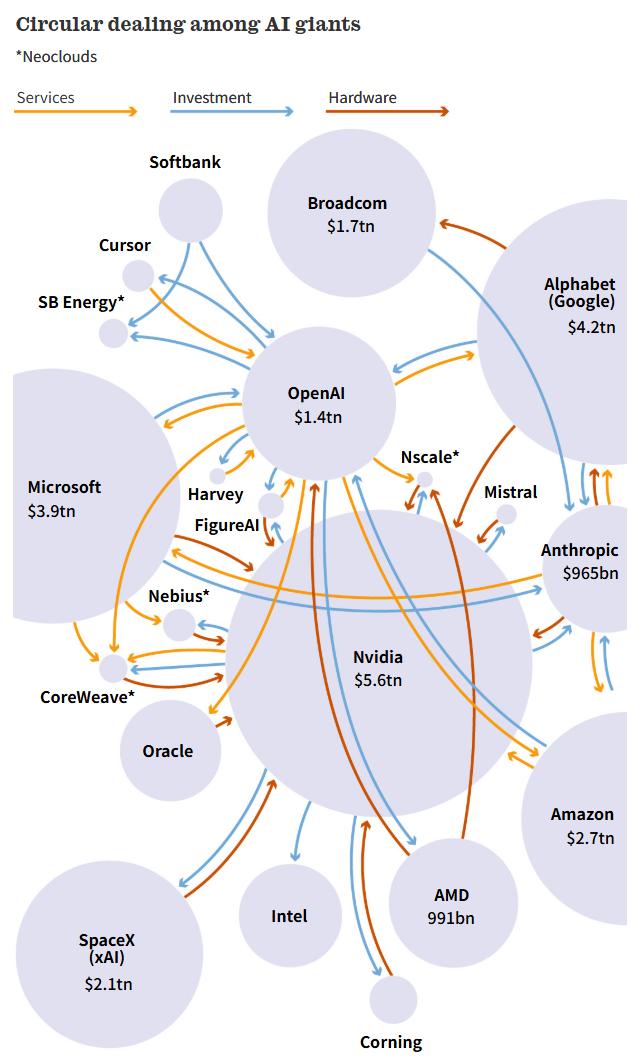
Circular transactions between AI giants
The risk of this model lies in that enterprises need to invest a large amount of funds to buy chips and build data centers first, and then rely on future computing power lease income to repay the financing cost. If the demand, lease price or equipment utilization rate falls short of expectations, the debt pressure may be amplified.
The overall performance of the US stock market does not mean that all stocks fall at the same time.
In fact, on October 22, nearly two-thirds of the S&P 500 constituent stocks closed up. The reason why the S&P 500 Index still fell by 1.21% is that the index allocates weights according to the market value of companies, and the fall of a few large tech stocks dragged down the index performance.
Statistics from Bespoke Investment Group show that since at least 1990, the S&P 500 Index has only once seen a more significant divergence between positive market breadth and negative index returns — that is, the index is falling, but most constituent stocks are rising.
The last more extreme situation happened in January 2025, when DeepSeek launched a new AI model, triggering the market's doubts about the competitive advantage of large US tech companies and the rationality of their huge capital expenditure.
Next, whether the decline of semiconductor concept stocks can ease, whether institutional position reduction will continue, and whether the financial reports of tech giants such as Microsoft and Amazon can further explain the return on AI investment will be several specific clues to observe market changes.
Special translator Jin Lu also contributed to this article
This article is from "Tencent Tech", author: Su Yang, editor: Xu Qingyang, published with authorization from 36Kr.