The only subway plan approved in the past two years is finally about to start construction.
Has the new signal of "unlocking" subway approval really emerged?
01
Not long ago, the station names for Phase I of Chengdu Rail Line 12 were publicly announced. We previously judged that this marked an important progress and would lay a critical foundation for the project to start construction within this year.
Now, the long-awaited move has finally landed. The recently released "Notice on the Mid-term Adjustment Plan for Municipal Government Investment Projects of Chengdu in 2026" (hereinafter referred to as the "Notice") clarifies that for Phase I of Chengdu Rail Transit Line 12: construction is scheduled to start in November 2026 and be completed in February 2033.
This line has drawn widespread attention, as it is the longest route in the 5th Phase Chengdu Metro Plan. More importantly, its start of construction means this metro plan that was approved nearly two years ago is finally entering the substantive construction stage.
And the 5th Phase Chengdu Metro Plan is the only metro construction plan that has obtained official approval across the country in the past two years. Therefore, its progress is naturally endowed with vane significance.
According to the Notice, this line has a total length of 33.83 kilometers, with a total investment of nearly 28.6 billion yuan. The construction start time is adjusted from June this year to November this year; the completion time is postponed from December 2031 to February 2033.
Against the current general background, the prudent attitude conveyed by this arrangement is self-evident.
02
In addition, there are two other key highlights in the latest news about the 5th Phase Chengdu Metro Plan.
First, this is the first official disclosure of the approved version of the 5th Phase Chengdu Metro Plan. According to the Notice, the plan covers a total of 10 lines, with a total mileage of nearly 140 kilometers and a total investment of over 1200 billion yuan.
Compared with the early publicly released version, the total approved mileage has been reduced by about 60 kilometers, with multiple lines shortened and stations streamlined. However, a positive signal is that no line has been completely cut. Overall, this is in line with the general trend of continuous tightening of national metro approval in recent years.
Second, the number of lines included in the first batch of construction projects has been reduced from four to one. Public information shows that the Phase IV of Line 10, Phase IV of Line 18, and Phase II of Line 27 were previously included in the first batch of construction projects.
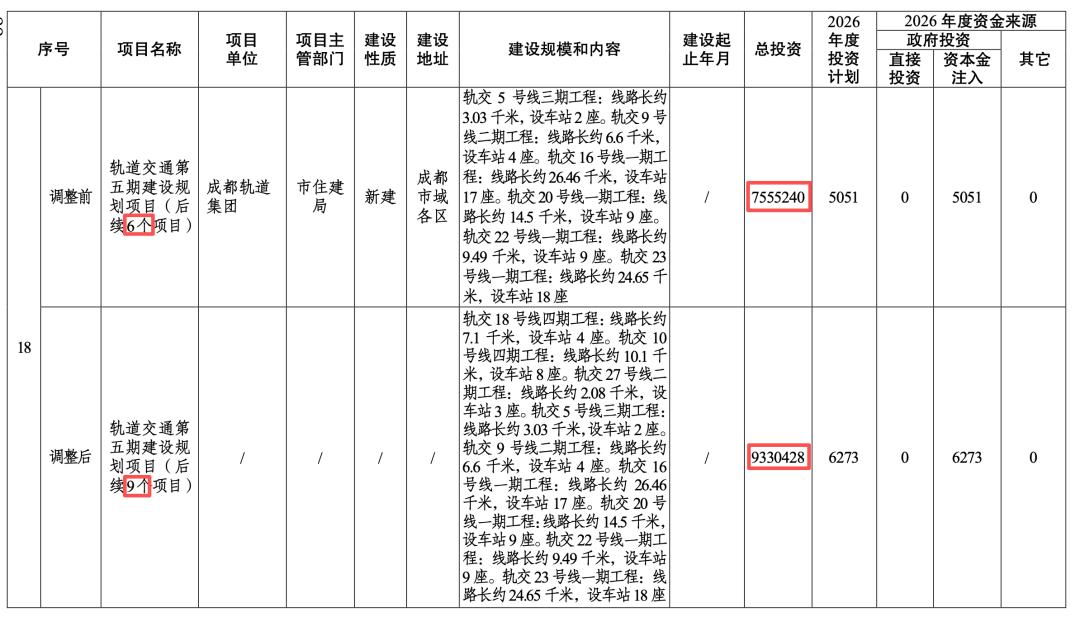
But now only Phase I of Line 12 is listed as a new construction project. As the only new project among the four lines, Line 12 being included in the priority construction sequence also reflects a pragmatic attitude. The remaining 9 lines in the 5th Phase Plan are all classified into the sequence of accelerating preliminary work, which means the specific construction time is not yet determined.
This kind of adjustment is also the most widely discussed point this time. After all, the construction progress of many lines has attracted much attention, and without clear construction timelines in the short term, uncertainty has increased.
In particular, the suspension of the three lines that were originally included in the first batch of construction lists has forced some residents along the lines to adjust their expectations.
However, from another perspective, the official announcement of the clear construction start time of Line 12 at least indicates that the construction of the 5th Phase Chengdu Metro Plan will be officially launched, which is a positive signal in itself. At the same time, against the national general background, such progress can be said to be extremely hard-won.
In fact, slowing down the pace is not necessarily a bad thing. At the current stage, the importance of prudence in all fields is continuously rising. The projects are still retained in the overall plan and still have the possibility of implementation, which is already a rare buffer space.
For example, there have been recent news that the northern extension Phase II of Changsha Metro Line 1, which was approved as early as 2023, has been clearly replied by relevant authorities: the population density along the line, development degree, passenger flow conditions, etc. do not meet the national passenger flow benefit assessment requirements, and do not meet the construction application conditions in the near future.
The signal conveyed here is very clear, that is, obtaining approval does not equal getting a construction permit, and subsequent continuous assessment and inspection are still required. In a word, the approval standard will only become more and more prudent.
03
So, the upcoming construction start of Chengdu's 5th Phase Metro Plan, does it mean that the approval of metro plans in other cities is opening a new window period?
Public information shows that many cities are currently promoting the approval process of a new round of metro plans.
For example, the Xi'an municipal government work report this year clearly proposed to speed up the approval of the 4th Phase Rail Transit Construction Plan. The 4th Phase Hefei Metro Plan was clearly submitted at the end of June this year and is currently under approval. The recently released "15th Five-Year Implementation Plan for the Construction of Chongqing Metropolitan Area" also clarifies that the promotion of the approval and implementation of the 5th Phase Rail Transit Construction Plan projects will be carried out.
Therefore, according to conservative forecasts, cities that meet all the indicators of the new regulations, with excellent passenger flow and long-term operation capabilities, may theoretically get the chance of approval.
However, the overall expansion space is very limited. Even if approved, the scale will most likely shrink, and the construction cycle may also be extended.
It can be basically concluded that not only the number of 54 rail transit cities is difficult to increase, the operation scale of quite a number of metro cities has also reached its peak.
Moreover, for most cities with mature rail transit networks, compared with the pursuit of continuing to expand the operation scale, the more realistic issue is how to ensure that the approved projects are implemented steadily, completed smoothly, and operated sustainably.
As the saying goes, the subway is ultimately a public product to meet actual demand. Its construction scale must match the city's demand and operation capacity. The stage of using rail transit to enhance the city's image or drive incremental development has come to an end, and the policy level no longer supports such practices.
This article is from the WeChat official account "Western City Insights", author: Xibu Jun, published by 36Kr with authorization.