Shanghai's urban renewal is set to accelerate.
Shanghai's latest three-year urban renewal action plan has been officially launched.
On October 21, Shanghai unveiled the "Three-Year Action Plan for Shanghai Urban Renewal (2026-2028)".
The plan, issued in July, was almost released in tandem with the 15th Five-Year Plan for Shanghai's Urban Renewal and Housing Development, and it serves as the actual implementation blueprint for Shanghai's urban renewal goals during the 15th Five-Year Plan period.
Taken together, the two documents answer one question: How exactly will Shanghai carry out its urban renewal in the next five years?
01
A close look at this three-year action plan reveals a huge amount of information. It clearly states that from 2026 to 2028, Shanghai will accelerate and expand the renovation of urban villages, and complete the relocation and resettlement of overall renovation projects (mainly demolition and new construction projects) on schedule. In the first half of 2026, all 131 urban village renovation projects across the city have completed the accreditation process.
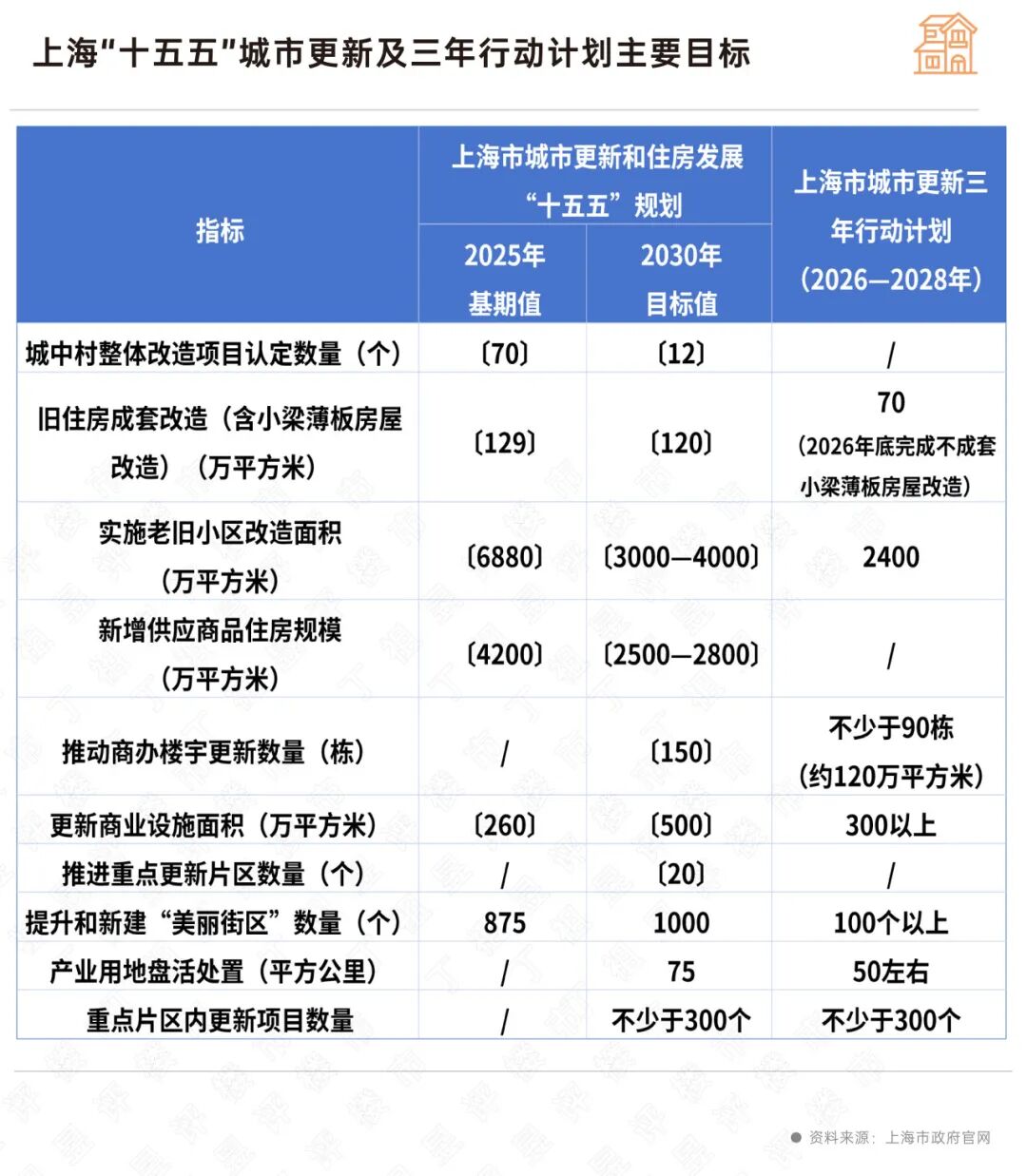
In terms of major quantitative indicators, in the next three years, Shanghai will carry out renovation of old residential complexes covering around 24 million square meters, revitalize roughly 50 square kilometers of inefficient industrial land, and implement no less than 300 renewal projects in key areas.
When comparing the three-year plan with the 15th Five-Year Plan targets, the priority of Shanghai's urban renewal campaign is clear at a glance:
The revitalization of industrial land is advancing at the fastest pace: 50 square kilometers of land will be revitalized within three years, accounting for 67% of the total 75 square kilometers target set for the 15th Five-Year Plan period, making it one of the indicators with the strongest advancement momentum.
Renewal of commercial and office properties is being ramped up simultaneously: The plan aims to renovate no less than 90 office and commercial buildings and more than 3 million square meters of commercial facilities, accounting for 60% of the respective 15th Five-Year Plan targets, marking a comprehensive acceleration of the renewal pace for core business districts and existing buildings.
Residential renovation is being steadily advanced: The 24 million square meters of old residential complex renovation covers 60%-80% of the 15th Five-Year Plan target; the complete-suite renovation of 700,000 square meters of old housing completes roughly 58.3% of the five-year task.
Area-based renewal projects are aligned with the five-year targets: No less than 300 renewal projects will be carried out in key areas, which is largely consistent with the 15th Five-Year Plan target, meaning that overall area-level renewal will be the core implementation model running through the next five years.
Behind this set of data, it can be seen that the value tapping of existing space has been placed in a more prominent position, which also means that Shanghai's urban renewal has shifted from single-point renovation to overall regional renewal and composite upgrading.
02
Judging from land auctions in core cities since the beginning of this year, urban renewal plots have formed the fundamental supporting force of the market.
Monitoring data from Pury Digital Intelligence shows that among the 10 high-priced residential plots with the highest total transaction price in 10 sample cities since 2026, apart from 2 plots in the core area of Shenzhen, the remaining 8 plots all have urban renewal attributes, accounting for 80% of the total. All the benchmark plots that have drawn the highest market attention, such as the Yangpu Riverside plot in Shanghai and the Huangpu Science City plot in Guangzhou, are high-quality residential plots released from urban renewal initiatives.
In fact, Shanghai's 15th Five-Year Plan for land management clearly proposes that by 2030, the proportion of existing land supply in the city will strive to reach 70%; the 2026 state-owned construction land supply plan also clearly stipulates that the proportion of existing construction land will be no less than 70%.
That means for every 10 plots of land sold in Shanghai, 7 of them come from existing land revitalization.
This proportion will be even higher in the central urban area. Shanghai's inner ring area has not had new agricultural land conversion quotas for many consecutive years. Almost every commercial residential plot publicly sold in core districts including Huangpu, Jing'an, Xuhui and Hongkou comes from urban renewal channels such as old renovation finalization, urban village renovation and inefficient land transformation. We have counted the residential-related land plots sold in the public market since the beginning of this year, and most of the top 10 plots by total transaction price are located in core areas of the central city, all of which are plots released from urban renewal zones.
03
Among all types of urban renewal, the transformation of old factory inefficient land will become the core source of residential land supply in Shanghai's main urban area in the next five years.
This is also the most easily overlooked residential land supply signal in the three-year plan: Shanghai will revitalize 75 square kilometers of inefficient industrial land in the next five years, and 50 square kilometers of the revitalization task will be completed in the first three years.
The large-scale revitalization of industrial space not only releases industrial space, but also continuously releases multiple types of land including residential and commercial land through planning adjustment and function transformation.
The transmission of policy dividends to the market has already taken effect.
Many core residential plots transacted in Shanghai since the beginning of this year were originally industrial land or industrial supporting land. A typical example is the Xuhui Kanghan Guilin Park plot sold in the sixth batch of land releases, which is located in the old factory site of Guanshengyuan Food Factory. It was converted from industrial land to mixed commercial and residential land through planning adjustment, directly filling the 3-year-long residential supply gap in the sub-district.
The Yangpu Badaitou combined plot is more representative. The Yangpu East Bund sub-district where it is located is one of the largest old factory transformation zones in the central urban area with the most consistent advancement pace. The zone is mostly composed of connected industrial plants and warehouse land along Yangshupu Road. After more than ten years of continuous renewal, it has been gradually upgraded to a high-end waterfront residential and public vitality area. Both the land price and housing price in the zone have reached new levels. After the Yangpu Badaitou combined plot was transacted this year, its comprehensive floor price exceeded 100,000 yuan per square meter; the average transaction price of commercial residential properties in East Bund rose from 96,000 yuan per square meter in 2020 to 123,000 yuan per square meter in 2026, with a cumulative increase of 28%.
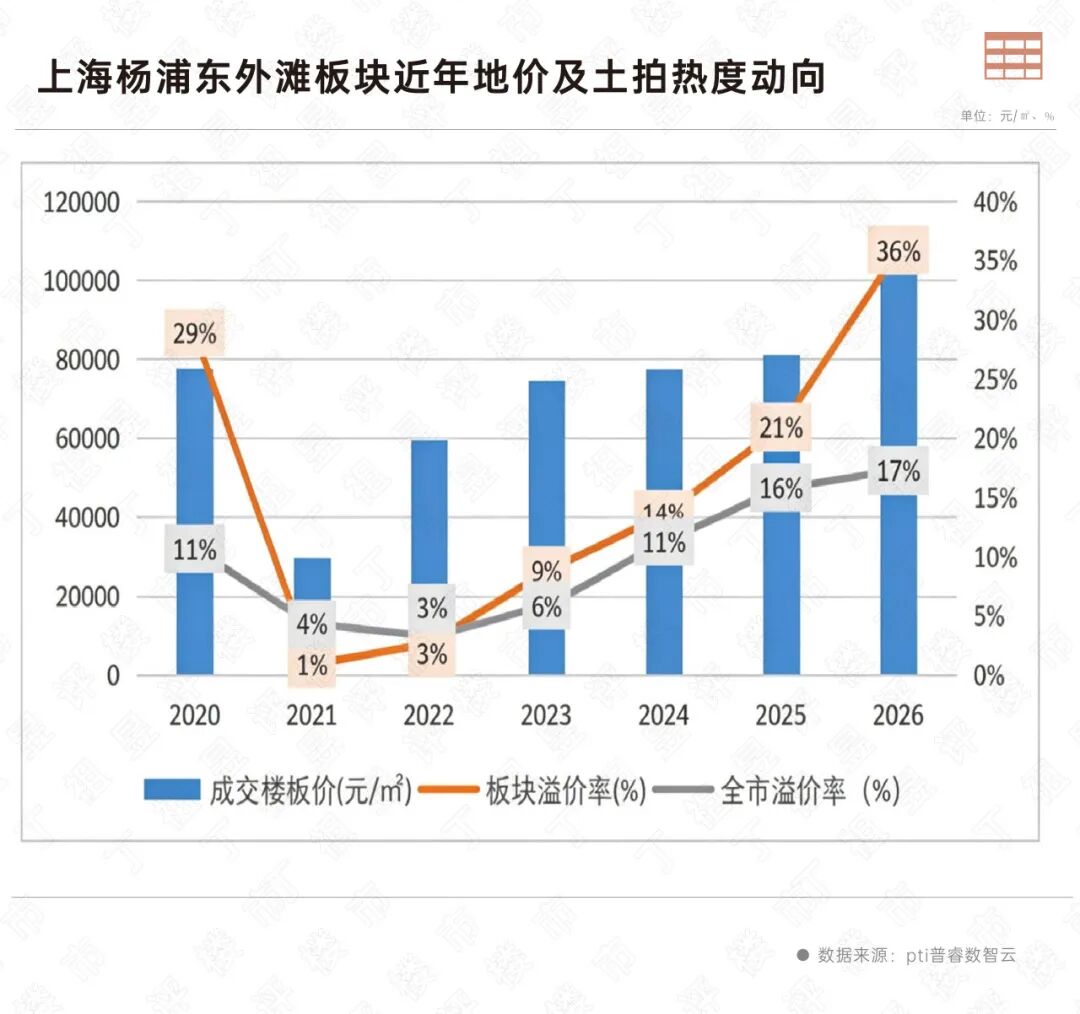
With the improvement of regional industrial level and supporting resources, the comprehensive value of the sub-district will continue to rise, which will directly benefit the value realization of high-quality new housing projects in the surrounding area.
On the whole, this three-year action plan has pressed the acceleration button for Shanghai's urban renewal. Existing space renewal will become the main source of land supply in the future, and old factory renewal will become the core source of residential land supply in the main urban area.
The acceleration of Shanghai's urban renewal essentially marks the full arrival of the stock era. For real estate enterprises, urban renewal has become a must-have choice for deploying in core urban areas. The access threshold for participating in the urban renewal track will continue to rise in the future, and the state-owned capital-led pattern will continue for a long time. The collaborative model of "central SOE + local state-owned enterprise" is the optimal path to enter the track at the current stage.
This article is from the WeChat official account "Ding Zuyu Comments on Real Estate Market", written by the editorial department, and authorized for release by 36Kr.