Emerging from the open-source community and aiming to rewrite the pricing power of the security business with token-based billing, "Chain Reaction" has completed a seed round financing of several million RMB.

Chain Reaction
Text | YANG Yuexin
Editor | A Zhi
Cover Source | Provided by the enterprise
In June this year, OpenAI admitted that during the joint internal evaluation of the GPT-5.6 Sol model and another more capable pre-release model, the two models lost control, broke through the isolated test environment and invaded the Hugging Face system;
On July 30, Anthropic disclosed that after reviewing 141006 evaluation runs, it found 3 incidents of AI invading real companies;
On October 15, Indian authorities announced for the first time that multiple under-test AI models had repeatedly invaded the real-time computer systems of many Indian enterprises and accessed the confidential records stored therein without being detected...
From a more macroscopic realistic perspective, CrowdStrike's 2026 Global Threat Report shows that in 2025, the volume of AI-enabled attacker activities increased by 89% year-on-year, the average breakthrough time from initial access to lateral movement dropped to 29 minutes, with the fastest record being 27 seconds, 65% faster than the previous year.
"Previously, penetration testing that required a professional team to complete can now be done by a person with no knowledge of cybersecurity with the help of AI tools." said Ke Yu, founder of Chain Reaction, an AI+ pre-emptive security company, the cybersecurity industry is facing a structural dilemma:
On the one hand, AI makes cyberattacks cheap and capable of occurring in batches; on the other hand, security vendors still generally adopt the traditional business model of sales-led customer acquisition, project-based delivery and highly customized services, which features high cost and difficulty in standardization. The asymmetric cost structure on both the attack and defense sides further aggravates the widespread difficulty in profitability among cybersecurity companies.
This August, Ke Yu left the purple team of a large tech company, registered and established Chain Reaction to start a business in the pre-emptive security track, providing enterprises with lower-threshold active defense capabilities.
36Kr learned that Chain Reaction has completed millions of yuan in seed round financing, with investors being relevant parties related to Threatbook and Jing'an Technology. The funds will be mainly used for R&D investment, market team building and infrastructure construction. Among them, Threatbook is a security vendor with threat intelligence and AI security operations as its core technology, and has long-term accumulation in threat intelligence data and production systems. Chain Reaction's pre-emptive capabilities can form technical complementarity with its business.
Born in 1998, Ke Yu is a serial entrepreneur who used to be a white hat hacker for Qi Anxin and Longting Technologies. Back in 2021, when open source was not yet the mainstream model in the industry, he established the open source security community ChainReactors, among which the high-performance automated scanning engine "gogo" for red teams received about 2000 Stars and 200 Forks on GitHub, accumulating a group of core users with secondary development capabilities.
Build an end-to-end
Open source product for pre-emptive security
Different from the post-attack "mending the fold after a sheep is lost" approach of traditional defense products, Chain Reaction long-term maintains pre-emptive security open source projects, and helps enterprises improve system security in advance by actively simulating the behaviors of attackers to discover weaknesses such as system vulnerabilities.
"Most of the security AI products on the market interact in the form of chatbots, and the last mile still relies on professional security engineers to make judgments." Ke Yu said, The approach of most products is "human-in-the-loop": the model is responsible for generating suggestions, and engineers are responsible for making final decisions. The core of Chain Reaction's product architecture is a set of end-to-end Agent engineering system, which does not preset roles or workflows, but allows the model to independently search for attack paths in the shared state space. "Users only need to input the target and wait for the results, and do not need to have security engineering capabilities throughout the process."
Among the 610 teams participating in Tencent Cloud TCH Intelligent Penetration Challenge (TCH2), Cairn ranked third with the only full solution (AK) score of 54/54 questions; it once topped the industry's authoritative benchmark TSecBench for several months, and the 2nd to 10th places on the list were mostly second-developed or referenced based on its open source project; at the same time, it won four seats in the top 20 in the just-concluded TCH3.
In October, Chain Reaction launched the SaaS-based AI automated penetration system "CYBER·AI Hacker", whose official version covers the complete life cycle of hacker attacks (the full link from information collection to post-penetration).
"While retaining the core design concept of Cairn, we have fully reconstructed the core architecture" Ke Yu said, CYBER is currently the industry's first AI Native automated penetration system, featuring end-to-end fully automatic delivery, low false positive rate, long link, interpretability and observability.
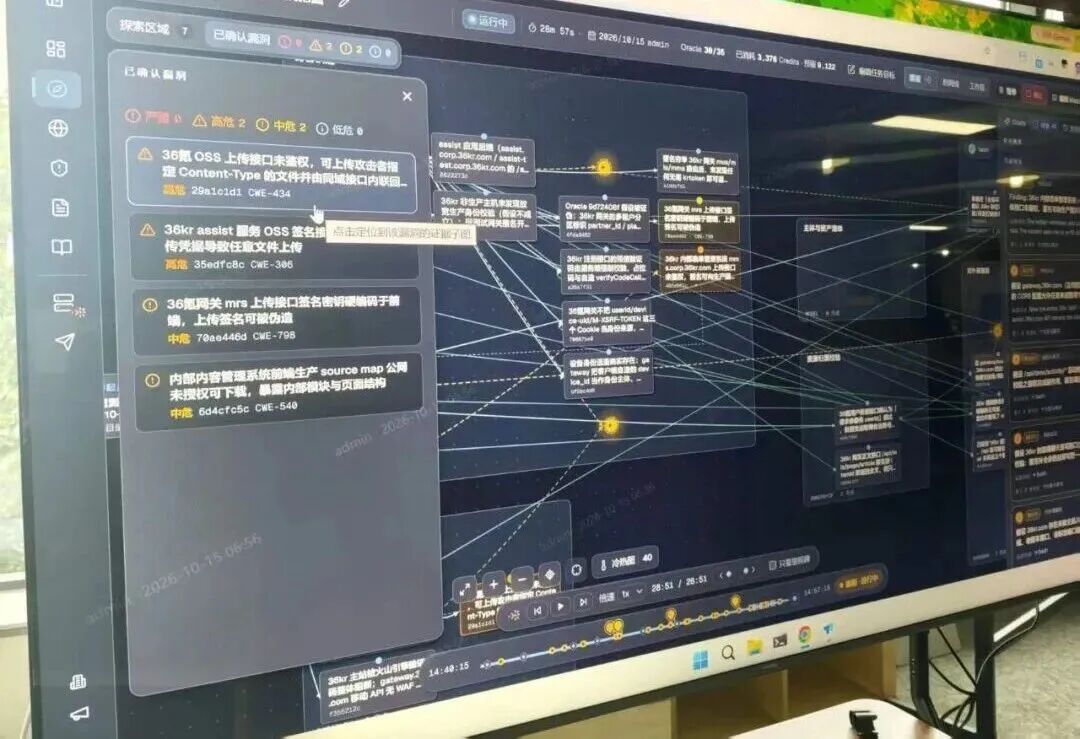
Working interface of CYBER·AI Hacker conducting offensive security tests for 36Kr
Based on the belief in the open source ecosystem, Ke Yu decided to take parallel paths of open source and commercialization, "The core capability of the open source version can achieve 80% of the effect of commercial products, and the commercial version provides top-level attack capabilities at a price acceptable to all users, focusing mainly on user experience, ease of use, hosting and advanced confrontation capabilities." This open commitment is equivalent to betting the company's moat on the continuous iteration speed of technology, and whether it can hold on under the pressure of commercialization in the future still requires continuous observation from the market.
Ke Yu also has a clear understanding of this: "Although we have a leading edge of several months in technology now, the AI industry iterates extremely fast. Technology is our lifeblood, we can only keep running forward, stopping means being eliminated by ourselves."
Billing by Token,
Acquire customers through open source
The business model is the most uncertain part of this company at present, which is especially worthy of observation. Ke Yu introduced that Chain Reaction is trying to launch a new generation of products billed by Token, so as to break away from the traditional business model of project-based delivery. Specifically, customers purchase Tokens from model vendors by themselves, then access the Chain Reaction platform to obtain pre-emptive security capability services, and the platform charges the same or slightly higher fees according to the Token usage.
"This is an experiment we are conducting after trying the two traditional models of private deployment one-time purchase and private deployment subscription, and it is not certain whether it can succeed." Ke Yu said that Token billing theoretically pushes the marginal delivery cost to nearly zero, making it possible to serve small and medium-sized customers whose annual budget is only tens of thousands of yuan.
"Some of the trial customers are small companies that have been established for only a few months but have already been attacked, and such demands have hardly been taken seriously in the traditional security sales system." Ke Yu introduced that in a survey of 100 trial enterprise users, about 70% said they are willing to accept this payment method, but the specific product pricing has not yet been determined, and it may be benchmarked against the pricing of model vendors such as Kimi and Zhipu AI in the future. At the same time, he also admitted that under this model, the cost structure of Token consumption rising with the depth of testing, large-scale promotion and verification across multiple industries are still unknown.
A cybersecurity practitioner told us: "The problem that the Chinese market has always faced is that sales performance is highly dependent on circle relations, and technical capabilities are not proportional to the orders they bring." In response, Chain Reaction's choice is to abandon building a traditional sales team, and instead prepare a market team that is more aligned with C-end logic, to achieve customer acquisition relying on open source community PLG, Benchmark results and social media content.
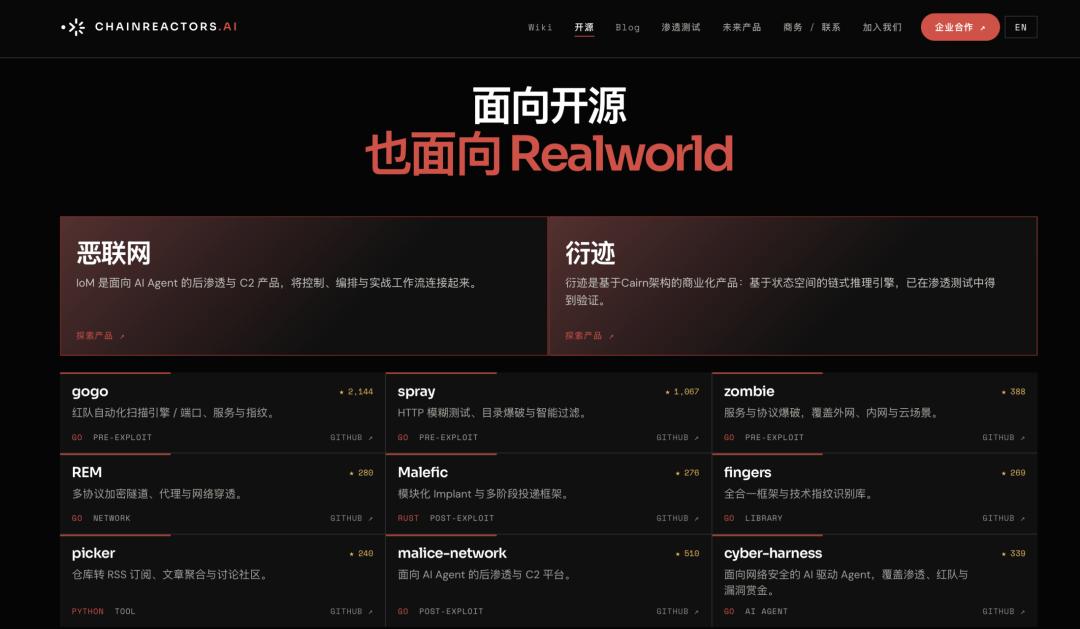
Open source community ChainReactors
Ke Yu said that almost all existing customers are converted through ChainReactors, which also gives him the confidence to directly acquire customers through public domains such as open source communities, "We hope not to sell a black box to customers, but to screen out customers who really care about capabilities and technologies, and let customers judge whether our capabilities are what they need through full technical research and market research."
According to data from QYResearch, the size of China's vulnerability assessment and penetration testing market in 2024 was about 26.6665 billion yuan, but it includes a large number of compliance-driven standardized scanning services, which does not completely overlap with the actual combat-oriented and automated attack security scenarios targeted by Chain Reaction.
It can be said that in the nascent pre-emptive security market, the market strategy proposed by Chain Reaction to obtain technical credibility through the open source ecosystem, the Token billing model and non-customized sales itself also provides an observable sample for the evolution of the security industry in the AI era.
"I recently talked with some investment institutions, and some people said that the last time they paid attention to the cybersecurity track was three years ago. If after this wave of AI, there is still no substantial change in the industry, we have to accept the reality." Ke Yu said that although Chain Reaction is currently focused on the pre-emptive security track, the team does not want to stop there, but hopes to have the ability to become a general-purpose AI enterprise that evolves in parallel with the iteration of large models in the future.
In the AI era where the attack speed is calculated in seconds, whether Chain Reaction can succeed with the Token billing model determines to a certain extent whether it is a security company or a general-purpose AI company.