2026 China Brain-Computer Interface: Medical Insurance Outpaces Commercialization — Is It a Boon or a Bane?
On October 9, the Central Committee of the Communist Party of China and the State Council issued the Opinions on Developing New Quality Productive Forces. In the policy framework, brain-computer interface, alongside quantum technology and nuclear fusion, is designated as a forward-looking future industry for strategic layout.
What no one expected is that for brain-computer interface, the first breakthrough achieved is not in technology, but in institutional arrangement.
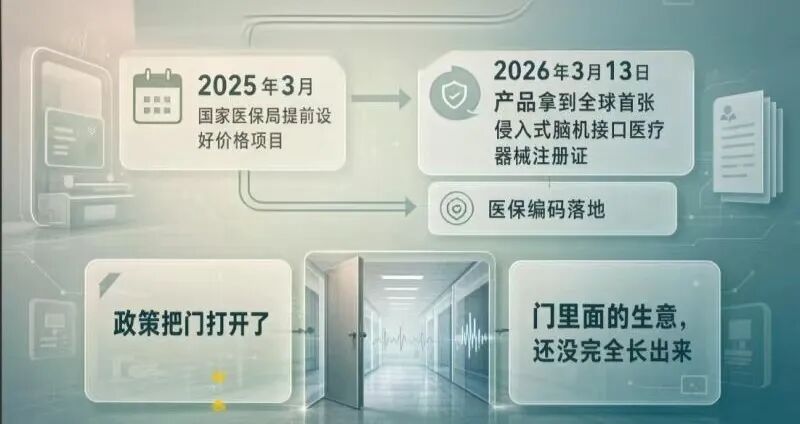
On March 13, 2026, the implantable brain-computer interface product of Nurox obtained the world's first medical device registration certificate for invasive brain-computer interface. Two days later, its medical insurance code was officially launched; one week after that, it was listed on the medical procurement platform in Shanghai. From approval to getting the official "billing identity", the whole process took no more than ten days.
The National Healthcare Security Administration even set up the corresponding price item back in March 2025 in advance: the invasive implantation fee is set at 6,000 to 6,600 yuan per session, and the non-invasive adaptation fee is about 960 yuan. Before the technology is widely adopted in hospitals, the payment channel has been fully established.
This pace is extremely rare in the history of innovative medical devices in China. However, it is precisely this "institution-first" arrangement that has pushed the brain-computer interface industry to a very delicate position: the policy door has been opened, but the business behind the door has not yet fully taken shape.
The prospectus is a well-timed cold splash of reality.
The core product of Nurox, NEO-ONE SCI, has an on-platform listing price of 475,000 yuan per set. From the completion of the first commercial implantation in July to the disclosure of the data, 13 sets have been sold, 8 sets have been implanted at the terminal, and the orders in hand and intended orders exceed 70 sets. It doesn't sound too bad, right? But according to the data from CIC, the ex-factory price of such products is expected to be only about 200,000 yuan, and the actual recognized revenue will be even lower. What actually supports the revenue is the "simple" non-invasive product line — the electroencephalogram acquisition system, which accounted for more than 70% of the main business revenue in 2025. For the star invasive product, the registration certificate has been obtained first, but the revenue has not come in yet.
In my opinion, this is exactly the most authentic snapshot of the entire industry at the moment. The media is keen to discuss "mind control" and "human-computer symbiosis", and capital is chasing the valuation narrative of Neuralink at 420 billion US dollars. However, a company sprinting to become the "first brain-computer interface stock" is currently supporting its operation by selling electroencephalogram caps. This is neither shameful nor abnormal. It just reminds us that brain-computer interface is first and foremost a business that requires clinical verification and closed-loop payment, and only secondly a story about the future.
However, if we only focus on the stark reality of Nurox, we will miss the other side of the picture.
Guotai Haitong Securities once put forward a point of view: "Brain-computer interface is a 'century-old industry'. The industry is still in its early stage, and long-term investment and continuous verification are still required in the future, no matter in terms of technological breakthrough, clinical verification or commercial implementation." The industry is experiencing a situation of "extremes of hot and cold": few people paid real attention to it in the past two years, but now almost all top-tier institutions are keeping a close eye on it, and it is even "very difficult to grab" the financing share of leading enterprises. The coexistence of the definition of "century-old industry" and the phenomenon of "unavailable share" itself shows that capital is pricing not the current revenue, but the entrance status ten years later.
Li Zhao from China Renaissance breaks down the bubble issue more bluntly: "A real bubble is usually driven only by narratives, with no real products or real demand. The current brain-computer interface industry already has real clinical data, clear registration progress, substantial benefits for patients, and strong support from policies and the medical insurance system." I agree with this distinction. The presence or absence of real products is the watershed between bubble and non-bubble.
However, "having real products" does not mean "having real profits", nor does it mean that every company labeled with brain-computer interface deserves its valuation. In a report by the Economic Observer, Zhang Yutao, partner of Heyin Capital, found after contacting more than 300 companies that some enterprises are just assembly companies that only hold open-source solutions without core patents. Li Xiaojian, founder of Wellead Medical, even said bluntly that some capitals are participating in a "game of passing the flower" and hope that enterprises can "amplify the story and raise the valuation". Li Xiaojian is so annoyed that he "generally does not meet investors, and charges 5,000 yuan per hour if he does". This detail is too surreal, but also too real: when there is more capital than understanding, the entrepreneur's time becomes the most expensive filter.
There is another crack hidden behind the hustle and bustle: financing is concentrating on leading enterprises, while clinical research is advancing in depth, and the paces of the two are not synchronized.
In the first quarter of 2026, the total domestic financing of the brain-computer interface industry was about 3.8 billion yuan, which exceeded the total amount of the whole year of 2025 in a single quarter. However, according to the observation of Mao Yanzhe from CICC Capital, the top companies that entered the clinical stage earlier have hot financing, while most of the second and third-tier enterprises only raise tens of millions of yuan in each round, which "is difficult to support complete clinical trials and milestone indicators". A large number of enterprises may enter the "valley of death" next year. This judgment is not pleasant, but it conforms to the general law of the hard technology industry: the more real the regulatory threshold is, the faster the capital converges to leading enterprises.
Medical insurance has given the brain-computer interface industry a "ticket", but the ticket is not an insurance policy. No institutional arrangement can help enterprises cross the three critical barriers: long-term safety, real-world efficacy, and operation and maintenance costs at the hospital end. The sales figure of 13 sets of Nurox, viewed against the unit price of 475,000 yuan and the aura of "the world's first", just shows that what separates "being able to perform the surgery" and "having people willing to take the surgery" is not technology, but willingness to pay and clinical habits.
Even if the policy moves faster and capital is hotter, brain-computer interface cannot become a large-scale profitable business in the short term. But this does not prevent it from becoming important in a longer time scale. Brain-computer interface is the underlying technical entry for the next generation of human-computer interaction, and complete vehicle manufacturers and robotics enterprises have begun to get involved from the perspectives of autonomous driving and embodied intelligence. If this judgment holds, then using the medical device valuation framework to criticize it today, or using the speed of consumer electronics to force its premature maturity, is essentially the same kind of misalignment.
Therefore, my view is: we neither need to use the "century-old industry" standard to justify every high valuation, nor use the narrative of "the next Neuralink" to overdraw the decades-long clinical accumulation that the industry still needs.
On the one hand, the institutional breakthrough is a real milestone. China has indeed achieved a globally remarkable speed in the payment channel and clinical access of brain-computer interface, and Nurox's registration certificate and medical insurance code are solid milestones. On the other hand, the stark reality of commercial realization is also very real: the 475,000-yuan device, the 13 sets of sales, and the revenue supported by non-invasive products all remind us that the first wave of dividends of the brain-computer interface industry belongs to those who can send products to hospitals and keep them there, not those who can tell a good enough story to get the next round of financing.
The brain-computer interface industry in 2026 has a mature institutional system, while its commercialization is still in adolescence. Admitting this gap is far more honest to the industry than pretending it does not exist.
This article is from the WeChat Official Account "Sice Think Tank", written by Zhang Zijiong, and published by 36Kr with authorization.