Has Marriott, which quietly "liquidated" its executive lounges, reversed its decision again?
Last March, the Courtyard by Marriott Hangzhou Qianjiang New City quietly closed its executive lounge permanently without any alternative arrangements.
Shortly after, news broke that executive lounges at Courtyard properties in Xinchang, Tianjin, Chengdu and other locations were also shut down, and The St. Regis Macao announced that it would no longer provide free breakfast benefits for Platinum, Titanium and Ambassador members.
This year, Courtyard by Marriott Shenzhen Liantou Oriental, Courtyard by Marriott Luoyang, and JW Marriott Hotel Macau followed suit one after another.
During that period, executive lounges were kicked out by many high-end hotels.
It was the first item crossed off the owner's cost list.
More than a year later, the trend seems to have shifted again.
Not long ago, Marriott officially announced that it would pilot a brand-new member lounge in approximately 320 high-end hotels across the Asia-Pacific region, with around 220 of them located in Greater China.
It will not only upgrade the catering services, but also strengthen exclusive services, showing a clear intention to turn the executive lounge into a signature offering.
Closing some while upgrading others, Marriott's move is truly confusing to many people.
01 Executive Lounges Reduced to "Crowded Canteens for Food Grabbing"
The executive lounge was originally invented by Hilton in Chicago in 1954. The 19th floor of the Chicago Hilton was converted into an executive floor, exclusively for high-end business guests, initially serving as a space for office work, rest and simple meals and drinks.
After entering China in the late 1980s, its nature gradually changed.
Mid-to-high end hotels have taken it as a standard high-end feature, to the point that a hotel would feel embarrassed to call itself high-end without a lounge.
Courtyard is only a mid-to-high end brand under the Marriott system, and there is no mandatory requirement to equip a lounge internationally. However, the increasingly fierce competition in the Chinese market in those years forced lounges to become a premium selling point.
How costly is it to operate an executive lounge, exactly?
According to international standards, an executive lounge should operate 16 hours a day, with at least 2.5 employees working in shifts, and additional staff need to be transferred from other departments during meal service hours.
The occupancy rate of executive floors is often lower than that of regular guest rooms, and the revenue sometimes cannot even cover the labor cost, making it a pure money-losing operation for reputation only.
Worse still, the quality of members has been declining.
In recent years, Marriott has absorbed a large number of members through low-threshold policies such as the "8-Night Platinum Fast Track Challenge" and "88VIP Status Match", leading to a sharp surge in the number of Platinum Card holders.
Fliggy F4 members only need to complete 8 stays to obtain Platinum membership, while users of the Citi-Marriott co-branded card can also "renew their status by card spending" with an annual consumption of 500,000 RMB.
This kind of "universal loose qualification policy" directly spawned a large number of "low-quality Platinum members".
As a result, the lounge is overcrowded as soon as mealtime arrives, and the executive lounge has changed from a private space for high-net-worth business travelers to a "food-grabbing canteen".
In complaints on social platforms such as Xiaohongshu, the executive lounges of many Marriott hotels in the Jiangsu, Zhejiang and Shanghai regions are always packed with "deal-seekers" who are all Platinum members at meal times.
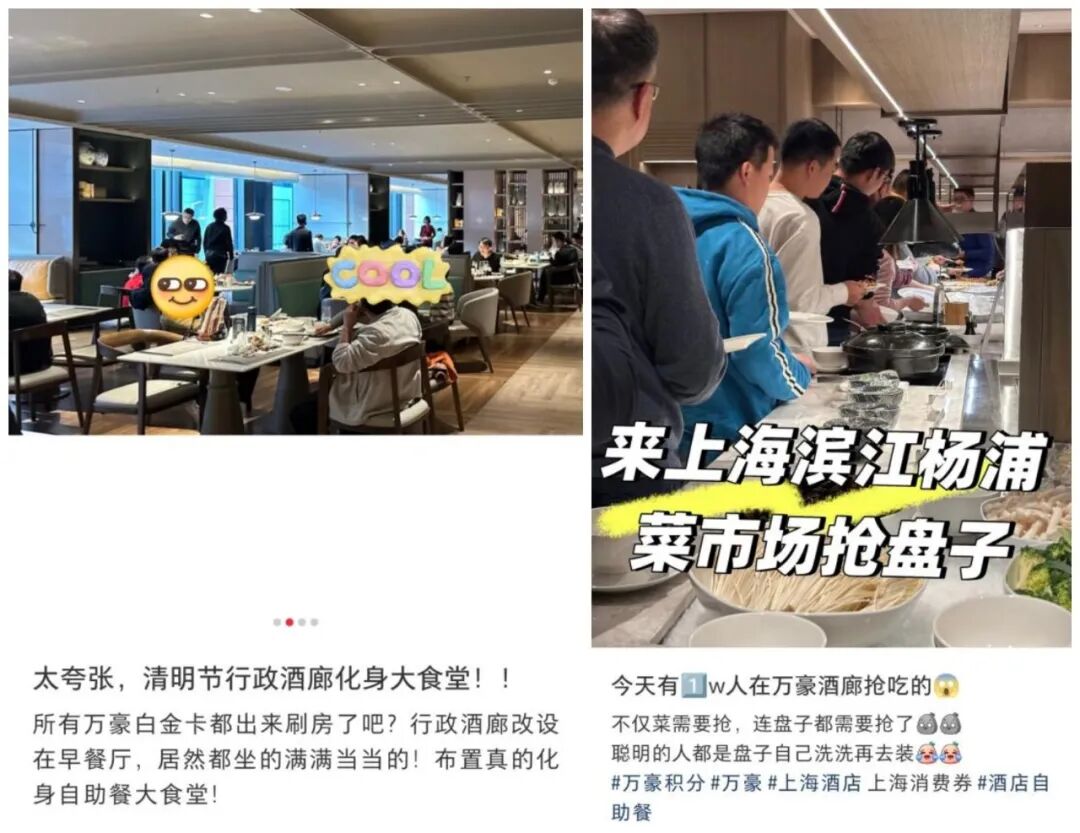
Source: Xiaohongshu
The Marriott Yangpu Riverside, which became famous for its viral incidents, even saw well-known scenes such as "guests eating at the front desk", "using cups to hold dishes", and "all pickles being snatched up".
When the lounge turns into a cheap canteen full of food grabbing, crowding, shared tables, empty plates and queuing, it does harm to the operation of hotel owners.
It should be made clear that so far, no international hotel group has released an official "permanent lounge closure list".
The decision to close the lounge is almost entirely made by the hotel owner.
An executive lounge is not as simple a product as "just putting an extra plate of food". Each additional guest brings a series of marginal costs including food, drinks, labor, cleaning and wear and tear.
Especially for Club Lounges that truly provide high-standard all-day catering and exclusive concierge services, these costs will not disappear automatically just because the guest is a high-tier card member.
When more and more hotels take executive lounges as a standard benefit for high-tier card members, they are essentially shifting part of the product cost, which was originally paid by high-spending guests, to the overall hotel room revenue and member operation cost.
Executive lounges that "lose money for reputation" are naturally the first to be targeted by hotel owners.
02 Why Close Lounges While Upgrading Others?
Lounges were being closed last year, so why is Marriott pushing for upgrades this year?
Let's first look at Marriott's upgrade plan: the new lounge will be uniformly named Marriott Bonvoy Lounge.
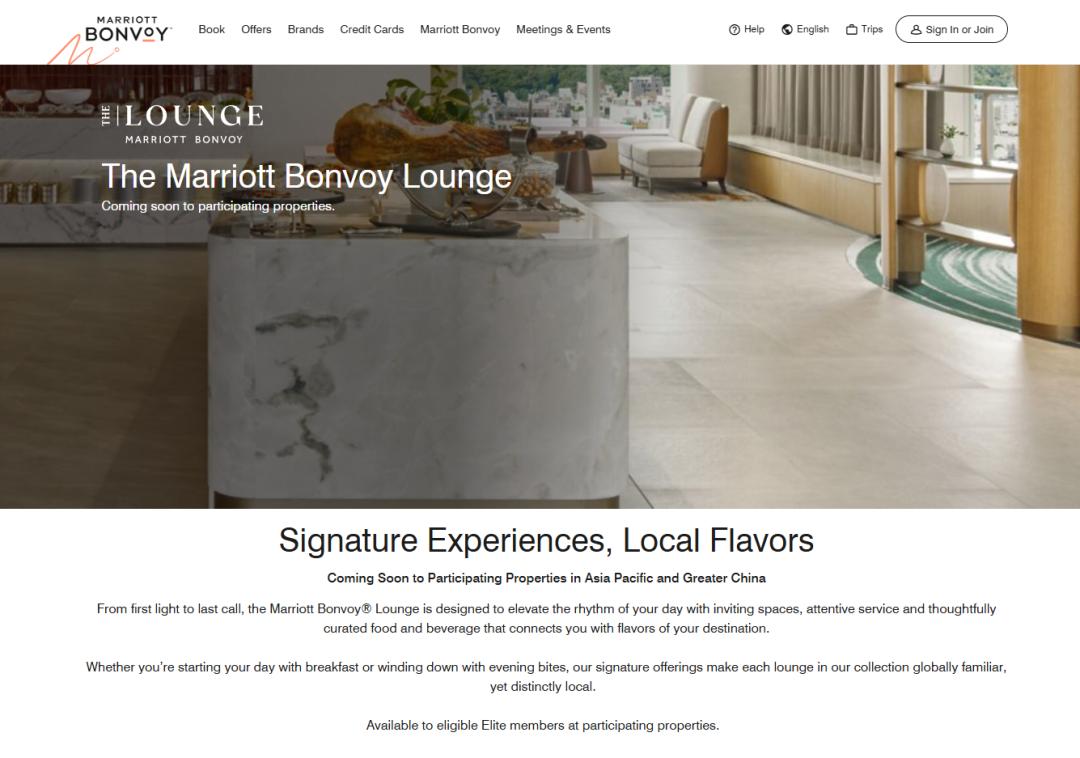
Source: Marriott official website
Around 100 eligible hotels in the Asia-Pacific region outside Greater China are expected to complete the conversion by February 2027, while about 220 hotels in Greater China plan to finish the upgrade by the end of the first quarter of 2027.
However, Marriott has not released the full list of hotels for this upgrade, nor has it clarified what upgrade standards the hotels need to meet.
It is worth noting that most of the lounges closed last year belonged to Courtyard, which is the mid-to-high end brand under Marriott.
Marriott revealed in its announcement that the 320 hotels that will iterate and upgrade their executive lounges are mostly high-end properties.
The official statement of the upgrade content includes upgrading catering services, strengthening exclusive services, focusing on local flavors, and arranging dedicated staff during peak hours.
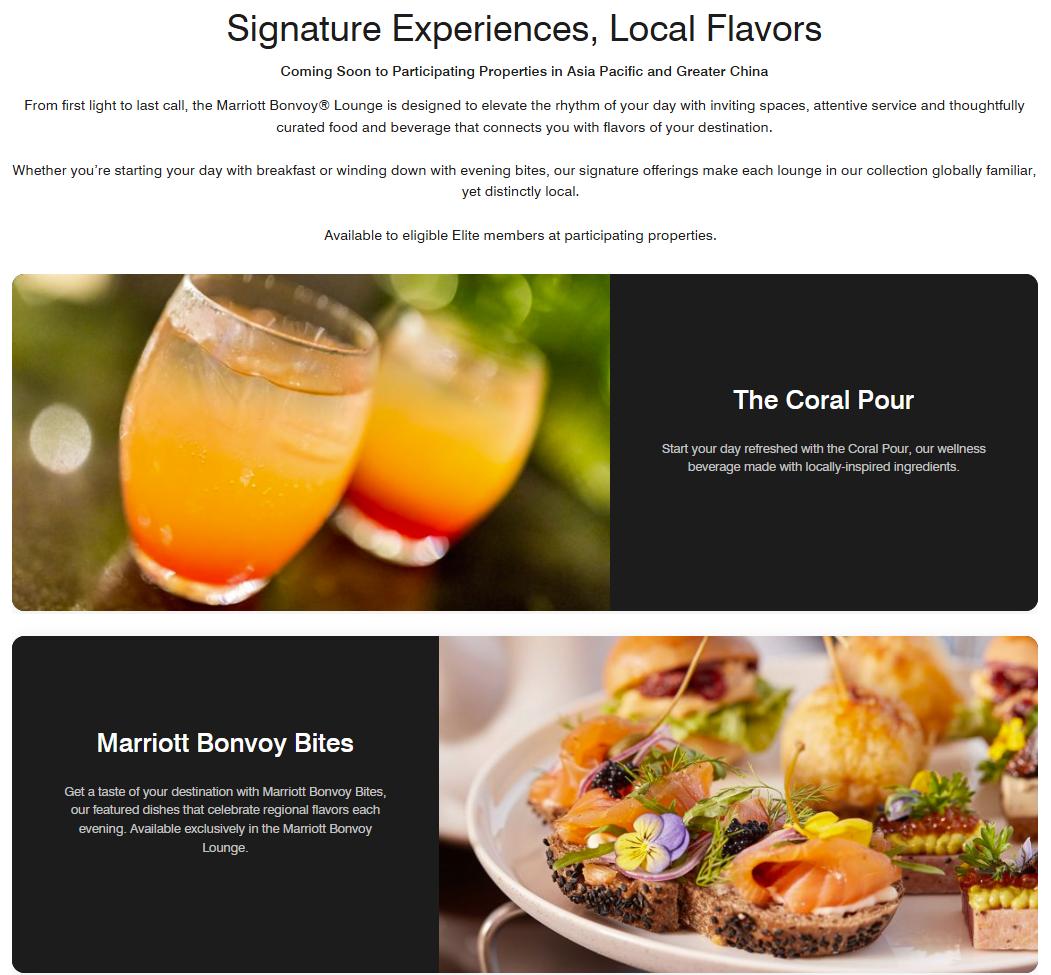
Source: Marriott official website
Nevertheless, there are several details worth considering.
The new lounge is called Marriott Bonvoy Lounge, focusing on local flavors.
The breakfast offering is named The Coral Pour, which provides local characteristic healthy drinks;
The dinner offering is called Bonvoy Bites, which originally refers to exquisite light food and wine pairings.
By changing from buffet to light food, Marriott seems to be trying to strike a balance between helping owners control costs and maintaining a decent experience.
In plain terms, it means transforming the previously criticized open self-service canteen into a more refined, experience-focused space, while helping owners control costs as much as possible.
This is a textbook example of the "wanting to have the best of both worlds" operation: costs are saved, and the owners' reputation is also maintained.
Marriott's mixed feelings about executive lounges are more like a precise tiering of member benefits.
Mid-to-high end select brands have relatively low average daily rates. Operating an executive lounge at a loss is not worth it, so it is cut off.
For high-end brands, the executive lounge will be turned into an exclusive benefit only for high-tier card members with real purchasing power, to maintain member loyalty.
In addition to improving the experience of high-tier card members, Marriott's lounge upgrade seems to also consider re-strengthening the competitiveness of its high-end hotels.
In recent years, local hotel brands such as All Seasons and Atour have risen rapidly. More and more guests choose mid-range chain hotels, while some long-operated international high-star hotels are facing increasing competitive pressure.
In addition, these local mid-range hotels also provide many value-added services, such as free laundry and free breakfast vouchers.
Many young guests feel that instead of spending 800 yuan to stay in an outdated high-star hotel, it is better to spend 500 yuan to enjoy the smart rooms and characteristic breakfast of Atour and All Seasons.
For many traditional full-service hotels under Marriott, the executive lounge is still an important differentiated supporting facility that distinguishes them from local mid-range select service hotels.
03 Who Will Pay for the Upgrade?
Careful observers may notice that Marriott has not mentioned a single word about the detailed access rules for members of the upgraded executive lounges.
Some people worry that the Platinum membership benefits will be reduced, while others hope the threshold will be raised to make the executive lounge less crowded.
However, what the owners care more about is who will pay for the upgrade.
In June this year, the American owners of about 1000 Marriott hotels jointly wrote a letter to the group headquarters, demanding a larger share of the co-branded credit card revenue and an increase in the compensation standard for reward redemptions.
A few weeks after the Wall Street Journal reported the incident, Marriott's point redemption threshold was raised significantly, and it is hard for the public not to connect the two events.
By the end of 2025, the membership scale of Marriott Bonvoy was close to 283 million, with 43 million new members added in 2025.
But in recent years, the structure of point sources has undergone fundamental changes. More than 60% of Marriott points no longer come from hotel stays, but from external cooperation scenarios such as co-branded credit card spending, retail, and car rental.
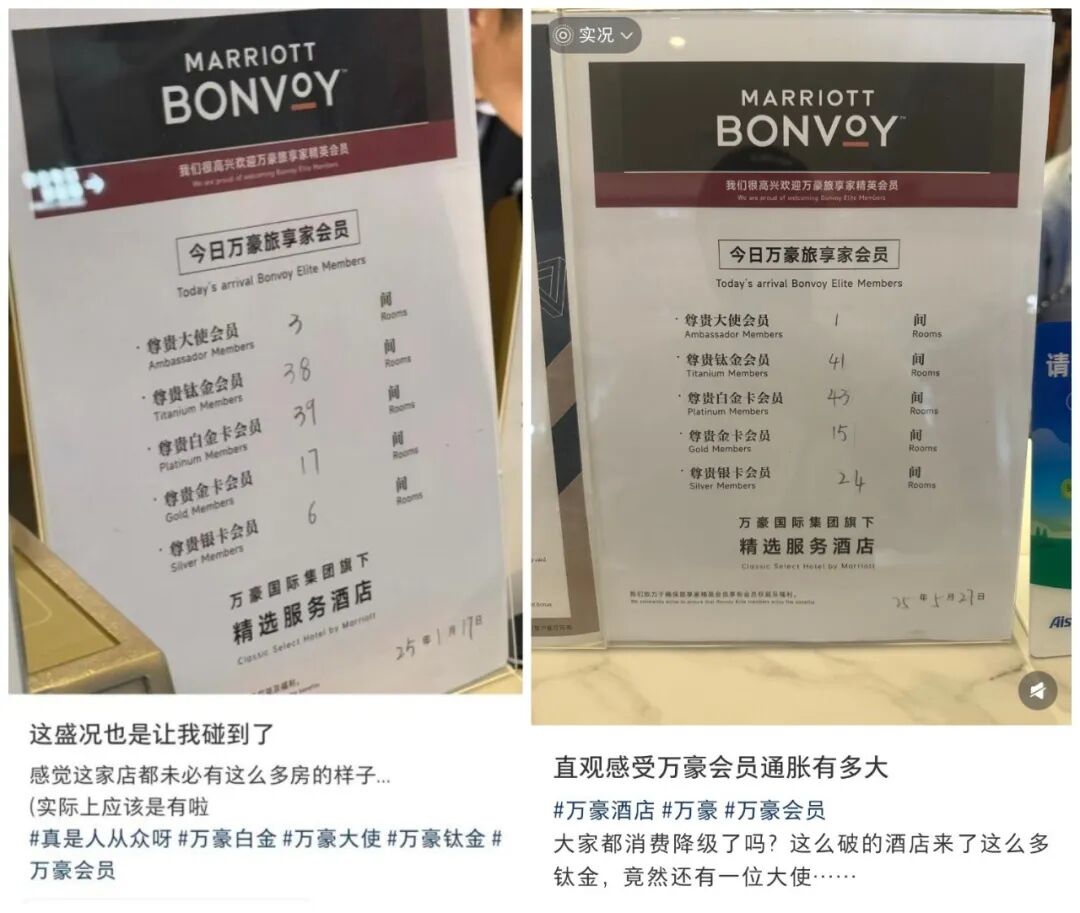
Source: Xiaohongshu
Users can continuously earn points through daily card spending, and these points will eventually be redeemed through offline hotel rooms.
But after the total amount of points surges out of nowhere, who is the cost passed on to?
Almost all the cost is borne by the hotel owners themselves.
The huge revenue brought by credit card cooperation belongs entirely to Marriott headquarters. Hotel owners cannot get a share of this part of the revenue, but they have to spend real money to maintain supporting facilities such as executive lounges.
In response to the owners' demand for cost reduction, Marriott gave a response quickly.
During the Q2 earnings call this year, Marriott announced the launch of a commission rebate program called "ITR Incentive" (Intent to Recommend). Eligible hotels under Marriott in North America can obtain a fee rebate of up to 50 basis points of the total room revenue, which will be counted from the second half of the year.
However, for this executive lounge upgrade, Marriott has not clearly stated in the current announcement who will bear the upgrade investment and how much the owners need to pay.
Whether the upgrade can be effective, whether the cost can be reasonably controlled, and what the membership access qualifications for the new upgraded lounges are, remain the core issues of most concern to the owners.
If after the lounge upgrade, consumers are still not impressed, but the hotel has to continue to bear the cost, the revenue problem that troubles the owners most will not be solved.
In the final analysis, when all the revenue from the monetization of the membership system goes to the brand, and the cost of point redemption is borne by the owners, the conflict of interest between the two sides will be amplified.
From the perspective of owners, with heavy asset investment and long payback period, once the return on investment of the owners is far below expectations for a long time, it will directly affect the foundation of Marriott's brand expansion.
This creates a dilemma: either compress the profit of the membership business; or raise the point redemption threshold and dilute the member benefits.
Caught between the owners and a huge number of members, Marriott seems to be in a dilemma.
What will Marriott do next?
In the short term, Marriott will most likely continue to use methods such as ITR rebates and executive lounge upgrades to appease the owners through "small concessions and partial optimization of supporting facilities".
However, the core competitiveness of a hotel brand does not lie entirely in the accumulation of hardware facilities such as executive lounges, but in the ability of services to create premium value and make guests willing to pay for it.
This article is from the WeChat official account "Hotel Finance", written by Dasheng, and authorized for release by 36Kr.