When the profit per vehicle is only 3,000 yuan, how long can the upstream component industry sustain itself?
In September 2026, neither dealers nor automakers witnessed the arrival of the traditional peak sales season.
According to data released by China Association of Automobile Manufacturers (CAAM) on October 12, total sales of China's domestic auto market reached 1.904 million units in September, down 26% year on year, of which domestic sales of traditional fuel vehicles hit 652,000 units, down 45.3% year on year. The retail sector also weakened synchronously. Data released by China Passenger Car Association (CPCA) in the same period showed that retail sales of passenger cars reached 1.618 million units in September, down 28% year on year, and retail sales of fuel vehicles dropped by 43%. In September, the comprehensive dealer inventory coefficient rose to 1.68, up 24.4% year on year.
The only growing segment was exports. Auto exports hit 1.053 million units in September, up 61.4% year on year, with a cumulative total of 8.205 million units from January to September, up 65.8% year on year. However, exports did not bring corresponding profits. According to data sorted out from the National Bureau of Statistics, the revenue of the auto manufacturing industry from January to August increased by 2.9% year on year, while costs rose by 4%. The total profit reached 253.4 billion yuan, down 16% year on year, with an operating revenue margin of 3.6%, while the average level of all industrial enterprises above designated size in the same period was 5.66%.
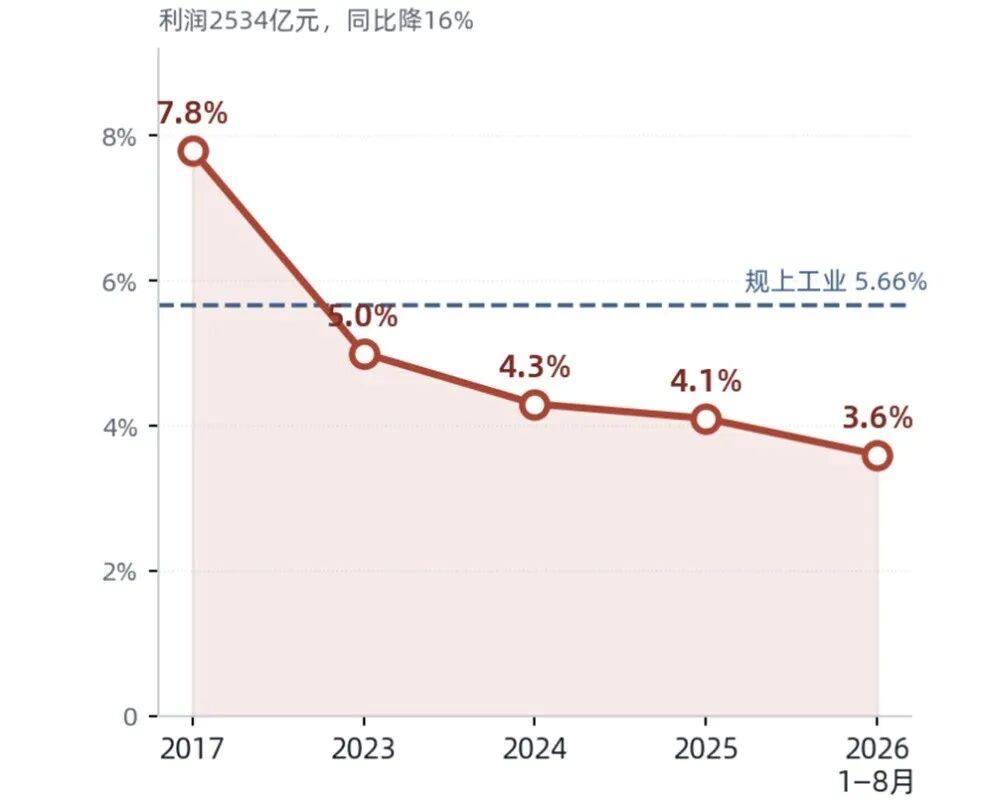
Chart | Profit margin trend of the automotive industry from 2017 to present
The profit margin at the vehicle manufacturing link is even thinner, with an average profit margin of 1.5% in the first half of the year, hitting a new low in nearly a decade. In the third quarter, the capacity utilization rate of the auto manufacturing industry stood at 66.2%, down 7.1 percentage points year on year, far below the healthy threshold of 75%.
According to the statement on the official WeChat account of Chen Shihua, Deputy Secretary-General of China Association of Automobile Manufacturers, for a car priced at 200,000 yuan, the automaker can only earn a profit of about 3,000 yuan.
The upstream sector has a far more difficult financial situation than vehicle manufacturing. According to statistics of 275 A-share listed auto parts companies from Eastmoney Choice, their total operating revenue in the first half of 2026 reached about 822.65 billion yuan, up 5.3% year on year, and the attributable net profit to shareholders was about 45.67 billion yuan, down 9.5% year on year, with net profit of 157 companies declining year on year. Data from CPCA shows that the price reduction range of new passenger cars in August reached 16.1%, and that of new energy vehicles reached 17.8%. The number of models with price cuts is decreasing, while the reduction per unit is expanding instead.
Demand is shrinking, production capacity is idle, and prices are still going down. For automakers, when selling one car only brings a profit of 3,000 yuan, hundreds and thousands of upstream parts enterprises will also face huge pressure — every link including price, delivery rhythm, settlement method and quality responsibility will be transmitted from the downstream to the upstream.
01
Rising costs and falling selling prices
Parts enterprises are caught in the middle
At the end of September, a piece of gossip spread widely in the industry. It pointed out that a certain automaker, holding a 500-million-yuan procurement order, was flatly rejected by a long-term cooperative supplier.
The rumor was described in great detail, claiming that after the deputy general manager of the parts enterprise carefully calculated the cost, he believed that although the order accounted for 12% of the enterprise's annual revenue, the profit was too thin and there was even risk of failing to break even, so it was "better not to take the order" and he refused it decisively. In short, the plot was described just like a satisfying online fantasy story.
Where there is news, there will be people who get to the bottom of it. After netizens dug for information at that time, they found that the information pointed to Ningbo-listed enterprise Cabey in Zhejiang Province.
However, this rumor was finally proved to be not completely consistent with the facts.
Reporters from CNR Finance once specially called Cabey for confirmation. Cabey told CCTV reporters that under the current environment, enterprise executives would not directly and toughly state that they would give up an order as high as 500 million yuan.
The statement of Cabey actually had hidden implications, because its final summary of the relevant rumor was that the relevant statement "was very likely to be taken out of context in the process of spreading". The rumor does not hold water, but the problem it points to may not be false. It's just that there is usually no decisive and unconstrained rejection as in the satisfying online story. After all, doing business needs to maintain decency and harmony. In fact, recent investigations by Auto Planet also found that there did exist cases where large orders were available but no one took them upstream of the vehicle manufacturing sector.
Checking the semi-annual report of Cabey on the securities trading platform can provide a perspective reflecting the current general environment from the revenue dimension —
In the first half of the year, Cabey's revenue from ordinary cables reached 1.883 billion yuan, up 23.13% year on year, with a gross profit margin of 8.60%, down 3.44 percentage points year on year. The company wrote in the risk warning that copper materials account for about 85% of the main business cost, and the processing fee is relatively fixed. In the same period, the cost growth rate of ordinary cables was 27.94%, 4.81 percentage points higher than the revenue growth rate. What can better illustrate the problem is the profit composition. The fair value change gain in the first half of the year was 70.5 million yuan, accounting for 55.06% of the total profit, which mainly came from the fair value change of equity investment. The income outside the main business supported most of the profit statement.
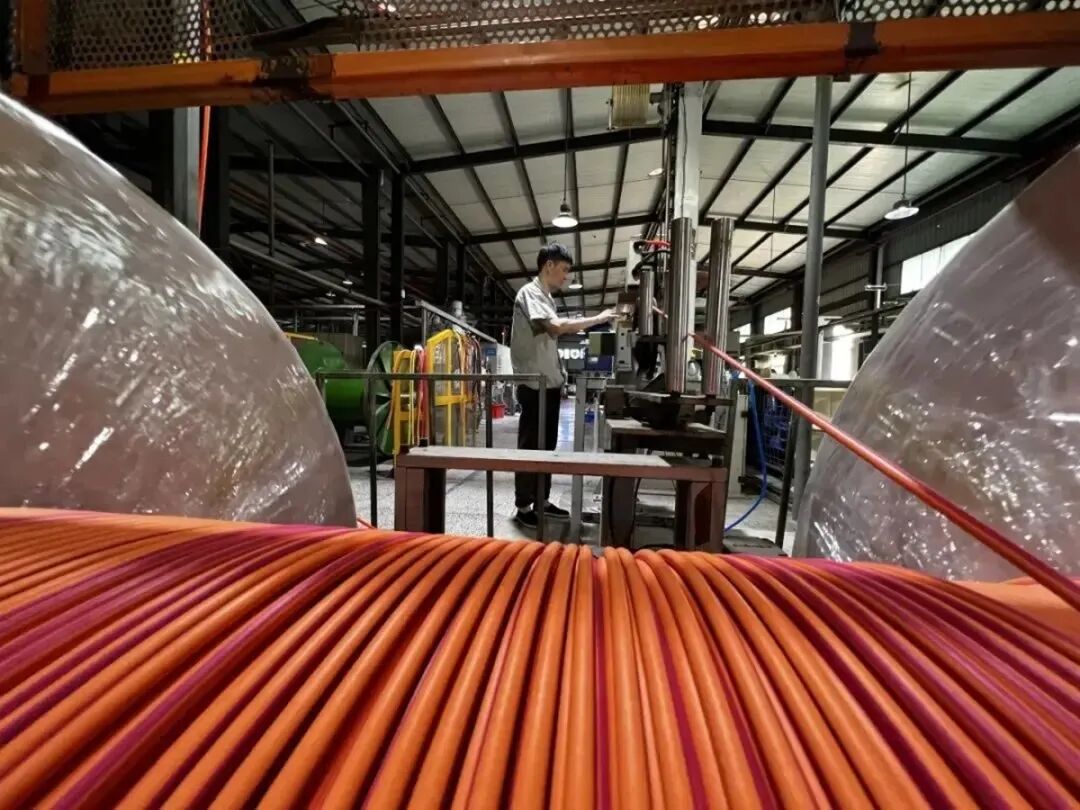
Chart | Auto wiring harness production is essentially a labor-intensive business with a consistently low profit margin
To put it bluntly, orders are being processed and scale is expanding, but profits are not earned from products. This also confirms the data released by CPCA in the middle of this year. At that time, Cui Dongshu, Secretary-General of CPCA, disclosed to the media that the net profit margin of small and medium-sized parts enterprises was generally suppressed below 2%.
For parts enterprises, 2026 is undoubtedly a tough year, because the pressure comes from both ends.
The cost side is rising. Copper price increased by about 30% year on year. Many parts enterprises wrote in their 2026 first quarterly reports that the rising prices of raw materials such as copper and natural rubber continue to compress profits, coupled with the annual price reduction required by automakers, leading to a general situation of revenue growth without profit growth.
The upstream sector tried to raise prices, and the three major connector giants successively adjusted their prices this year.
TE Connectivity raised prices across all product lines and all regions starting from January 5, 2026, with an increase range of 5% to 12%. In the middle of the year, Amphenol and Molex followed up. Amphenol raised prices across all product lines by 5~15%, and Molex raised prices for all categories by 5~30%. The reason why connector giants can raise prices is that they can barely sustain their operation. But in most cases, small and medium-sized parts enterprises are forced to follow the annual price reduction requirements of automakers.
The usual annual price reduction requirement for parts from upstream suppliers in the industry used to be 3~5%, but after more than three years of price war, it has gradually risen to more than 10%. Moreover, suppliers are often required to make concessions on the grounds of shortening the account period, forming a disguised price reduction of trading lower price for payment recovery.
The most radical requirement comes from Honda, which has been cornered by Chinese enterprises. Reuters reported in September that Honda plans to cut costs by a total of about 94 billion US dollars by 2030, setting a 30% cost reduction target for three categories of stamping and forging parts, electrical parts and parts related to software-defined vehicles. Previously, the conventional annual price reduction of its Japanese supply chain was only 2~3%. The report did not clarify the comparison benchmark of the 30% reduction, but no matter which benchmark it refers to, it is a terrifying proportion.
For local Japanese parts enterprises, what is even more terrifying is that Honda also requires tier 1 suppliers to expand the proportion of Chinese-made parts, bringing the cost standard of the Chinese market back to the original supply chain.
The result of such squeeze is written in the semi-annual reports. Among the 275 A-share listed auto parts enterprises, their total operating revenue in the first half of 2026 reached about 822.65 billion yuan, up 5.3% year on year, and the attributable net profit to shareholders was about 45.67 billion yuan, down 9.5% year on year. 178 enterprises recorded positive revenue growth, and 157 saw net profit decline year on year. The median revenue growth rate was 5.9%, and the median net profit growth rate was -10.1%. Only 7 enterprises recorded a net profit of more than 1 billion yuan, and about 70% of the companies had a semi-annual net profit of less than 100 million yuan.
Take a specific example. Jiangsu Xinquan Automotive Trim Co., Ltd., whose main business covers design and manufacturing of automotive interior and exterior trim parts and related molds, has a net profit margin curve as follows: 7.62% in 2023, 7.34% in 2024, 5.18% in 2025, and it dropped to 5.17% in the first half of 2026. Its operating revenue in the same period reached 8.015 billion yuan, up 7.45% year on year, and the attributable net profit to shareholders was 414 million yuan, down 1.9% year on year.
Revenue has been rising all the time, while profit margin has been declining. But the problem is not limited to the above points, there is one more point to add — the goods have been sold, but the payment is still on the way.
02
The old problem of account period
Has it been resolved after a year?
For suppliers, price only accounts for half of the cost, and the other half is time. The 60-day account period was the focus of public opinion in the last round, and also the first place where regulators took action. More than a year has passed, and the actual situation is more complicated than the promise.
On September 7, 2026, the General Office of the Ministry of Industry and Information Technology and the General Office of the State Administration for Market Regulation jointly issued the Notice on Promoting Automobile Enterprises to Standardize Payment of Supplier Accounts Payable and Optimize Account Period Management, with document No. 424. This is the first account period management document targeting the automotive industry at the national level.
The new regulation clearly sets the process nodes. For production materials, enterprises shall complete the acceptance according to the agreed quantity within 1 working day after the agreed delivery time, and complete the inspection and acceptance within 3 working days after receiving the materials. Failure to complete the acceptance within 3 working days will be regarded as qualified acceptance. For parts that really need to be verified on the vehicle, the off-line inspection of the vehicle shall be completed within 5 working days after receiving the parts. If the price is not yet determined, for continuous cooperation, no less than 90% of the payment shall be paid in advance with reference to the latest effective contract price. For non-continuous cooperation, more than 70% of the payment shall be paid in advance with reference to the industry average price or the development designated unit price, and the final payment shall be settled with excess refund and deficit replenishment. For small and medium-sized enterprises, it is encouraged to make payment within 30 days from the date of qualified acceptance, and the longest payment period shall not exceed 60 days. In addition, it is advocated that the validity period of each signed contract shall not be less than one year.
There are two core points formulated by the official to ensure the implementation of the Notice.
First, enterprises shall complete the semi-annual and annual situation reports before the end of January and the end of July each year, and submit them to the Ministry of Industry and Information Technology for the record. Second, the Ministry of Industry and Information Technology entrusts third-party institutions to conduct investigation and evaluation and publicly release the results, and carries out joint interviews with enterprises that have large accounts payable, deliberately extend the account period or receive many complaints. Those who violate laws and regulations will be seriously punished.
The relevant person in charge of the Ministry of Industry and Information Technology gave a self-evaluation that over the past year, with the joint efforts of industry enterprises, the average account period of key automotive enterprises has been effectively shortened, the proportion of cash on delivery has been greatly increased, and the overall account period situation has been significantly improved. But then came the second half of the sentence: due to the large number of links involved in account payment, and the great differences in the situations of various subsidiaries and branches of automotive enterprises, there are still many problems in the process of optimizing account period, and some suppliers do not have a strong sense of gain. In short — compared with mature multinational automotive enterprises, there is still room for improvement in the account period of key Chinese automotive enterprises.
Bai Xuejie, Vice Dean of the Institute of Economic and Social Development of Nankai University, gave a more specific statement. According to the investigation, the vast majority of vehicle manufacturers have achieved a 60-day account period for small and medium-sized enterprise suppliers, but the shortening of the account period for large and medium-sized suppliers still needs to be further promoted. In addition, some enterprises have different degrees of situations such as unclear acceptance conditions, long acceptance period, and using non-cash payment methods such as commercial acceptance bills. In March this year, Liu Changlai, a deputy to the National People's Congress, mentioned in his proposal that the actual account period of some enterprises still reaches 9 months.
Changes are indeed taking place. The net cash flow from operating activities of Pengling Co., Ltd. in the first half of 2026 turned from net outflow in the same period of the previous year to net inflow of 247 million yuan. The company wrote in its semi-annual report that the main reason was that the payment recovery method of its main customers was changed from commercial acceptance bills to bank acceptance bills, and about 250 million yuan of commercial bills originally recorded in accounts receivable had all matured in the reporting period, with only 50 million yuan left, plus the fact that the bill discount increased by about 100 million yuan year on year this year. One adjustment of settlement method turned the cash flow of an enterprise from negative to positive.
However, Pengling's experience also shows that whether the improvement is in place depends on the form in which the money arrives. The new regulation stipulates that the payment time is subject to the issuance time of cash or bank acceptance bills and other bills by automotive enterprises, while the payment period of commercial bills can be up to 6 months at most, which is not shortened by the new regulation. The 60-day requirement only regulates the invoicing time, not the time when the supplier gets the cash. The cost of discounting bills in advance also needs to be clearly stipulated in the contract who will bear it. This is exactly the reason why some suppliers do not have a strong sense of gain.
This shows that the account period problem can be solved, and it also shows that the solution is not yet universal. More importantly, the account period is only one link in the entire transmission chain. Pressing the payment period to 60 days cannot offset the profit loss caused by the annual price reduction rising from 3% to more than 10%, nor can it offset the cost increment brought by the 30% rise in copper prices.